

If you came here wondering whether Parameśvara really put an astronomy table into poetry, the short answer is yes. But he was not replacing calculation with metaphor. In Kerala in 1431, he used verse to make numerical corrections for Mars easier to remember and retrieve.
The most useful way to understand his achievement is to treat the poem as working knowledge. Identify the input, the output and the operation connecting them. Once you do that, the poetry no longer looks like ornament, and the astronomy no longer looks mysterious.
The verse solves a two-stage astronomical problem
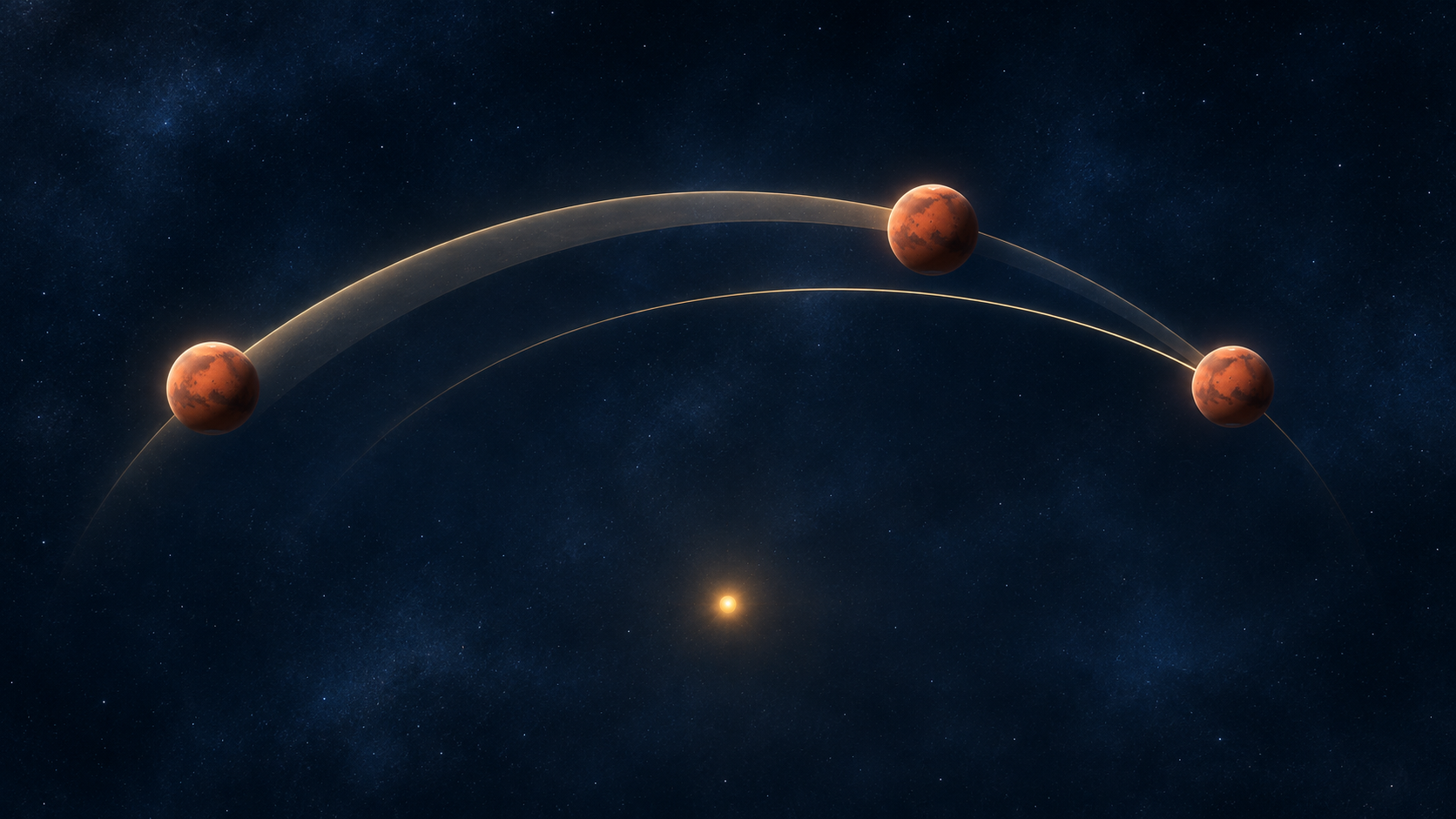
Begin with an evenly moving Mars. An astronomer first calculates where the planet would be if it progressed uniformly through its cycle. That gives a provisional position, not the final one, because Mars does not appear to move across the sky at a constant pace.
A second quantity corrects that provisional position. Indian astronomers called this correction the phala. Parameśvara’s table relates the planet’s progress through its cycle to the required phala:
- Input: how far Mars has progressed through the relevant cycle, expressed in degrees.
- Output: the phala, expressed in minutes of arc.
- Operation: apply that correction to the position obtained from the assumption of even motion.
This distinction prevents the most common conceptual error. The phala is not itself the position of Mars. It is a correction to a position already calculated. A table entry therefore belongs to the second stage of the computation.
You can express the workflow without imposing modern notation on the original verse: evenly computed position → select the appropriate phala → apply the correction → corrected position. The poem helps preserve the numerical middle step.
Two entries reveal what the numbers are doing

The surviving examples are enough to show both the units and the scale of the correction. When Mars is six degrees into the cycle, the phala is 68 minutes of arc. At the 90-degree point, it is 707 minutes of arc.
| Position in the cycle | Phala in arcminutes | Converted value | What to notice |
|---|---|---|---|
| 6° | 68′ | 1° 8′ | The correction already exceeds one degree. |
| 90° | 707′ | 11° 47′ | The correction is nearly twelve degrees. |
The conversion is straightforward but important. Sixty minutes of arc make one degree. For the first entry, 68′ becomes 1° 8′. For the second, 707 = 11 × 60 + 47, so 707′ becomes 11° 47′.
That second value shows why the correction cannot be dismissed as a minor rounding adjustment. At some parts of the cycle, the difference between uniform motion and the corrected result is substantial. The table carries an essential part of the planetary procedure.
Do not infer the missing entries from these two examples. They establish that the phala changes with position and show the magnitude it can reach. They do not establish a linear progression, the rule for intermediate values or whether a correction is added or subtracted at every point. Reconstructing a complete calculation requires the complete sequence and its accompanying procedure.
If you are explaining the table to students, make them label both sides of each entry. Write “90° input” and “707′ correction,” then perform the conversion. That small exercise prevents 707 from being misread as a planetary coordinate, a number of degrees or an unexplained sacred number.
Poetry is the memory system, not an escape from precision

A numerical grid and a memorized verse solve different practical problems. The grid makes values visible on a page. Verse gives the values an ordered, recitable form that a trained person can carry in memory. Parameśvara’s choice addressed a precise question: how do you retain a sequence of changing corrections for Mars?
Metre can also provide a limited check on transmission. If a syllable is omitted or added, the rhythm may no longer fit. That does not identify the correct number, and it cannot prevent every copying or recitation error. It can, however, warn a knowledgeable reader that something may be wrong.
The verse must still be taught with its computational conventions. A practitioner needs to know what the sequence describes, which unit each value uses, how the relevant entry is selected and how the correction is applied. Reciting the numbers without that procedure preserves data but not the whole method.
This is why two opposite readings both fail. Calling the poem mystical ignores its numerical function. Treating it as an awkward substitute for a printed spreadsheet ignores the conditions it was designed to meet. Its achievement is more specific: exact astronomical data was shaped for human memory without ceasing to be computational data.
You do not need to describe the verse as a modern database to appreciate it. Nor should you reduce it to an attractive curiosity from India’s past. It is a mnemonic interface between a planetary model and the astronomer performing the calculation.
A five-question test for reading poetic astronomy
When you encounter another scientific verse, resist the urge either to admire it vaguely or to translate it immediately into prose. Work through these questions first:
- What variable is being tracked? In this case, it is Mars’s progress through its cycle.
- What quantity has already been calculated? Here, it is the planet’s provisional position under the simplifying assumption of uniform motion.
- What is the table’s input? It is the location within the cycle, expressed in degrees.
- What is the table’s output? It is the phala, an angular correction expressed in minutes of arc.
- What operation remains? The correction must be applied according to the full astronomical procedure; isolated entries alone do not supply its sign or every selection rule.
Then rewrite at least one entry in explicit modern form: 6° → 68′ → 1° 8′. Do the same for 90° → 707′ → 11° 47′. If an explanation cannot preserve the distinction between the input angle and the correction angle, it has not yet explained the table.
This method also helps you evaluate large historical claims. The defensible achievement is already impressive: a Kerala astronomer in 1431 presented changing numerical corrections for Mars in a poetic form designed for recall. Claims about the complete planetary model, its accuracy or every computational rule require more than two entries. Respect for Bharatiya scientific history is strengthened by keeping that boundary clear.
Key takeaways
- Separate the evenly computed position of Mars from the phala that corrects it.
- Keep the units attached: the cycle position is given in degrees, while the cited phala values are given in arcminutes.
- Convert the corrections before judging their importance: 68′ is 1° 8′, and 707′ is 11° 47′.
- Treat the poetry as a mnemonic carrier of technical data, not as evidence that the astronomy was imprecise or merely symbolic.
- Do not invent missing rows, interpolation rules or signs from two examples; consult the complete procedure before attempting a historical calculation.
The next time you meet a mathematical verse, annotate four things in the margin: input, output, unit and operation. For Parameśvara’s Mars table, the chain is clear: position in the cycle → phala in arcminutes → correction of the evenly computed position. Once you can follow that chain, you are no longer merely admiring an old poem. You are beginning to read it as an astronomer’s tool.
References

Leave a Reply
You must be logged in to post a comment.