
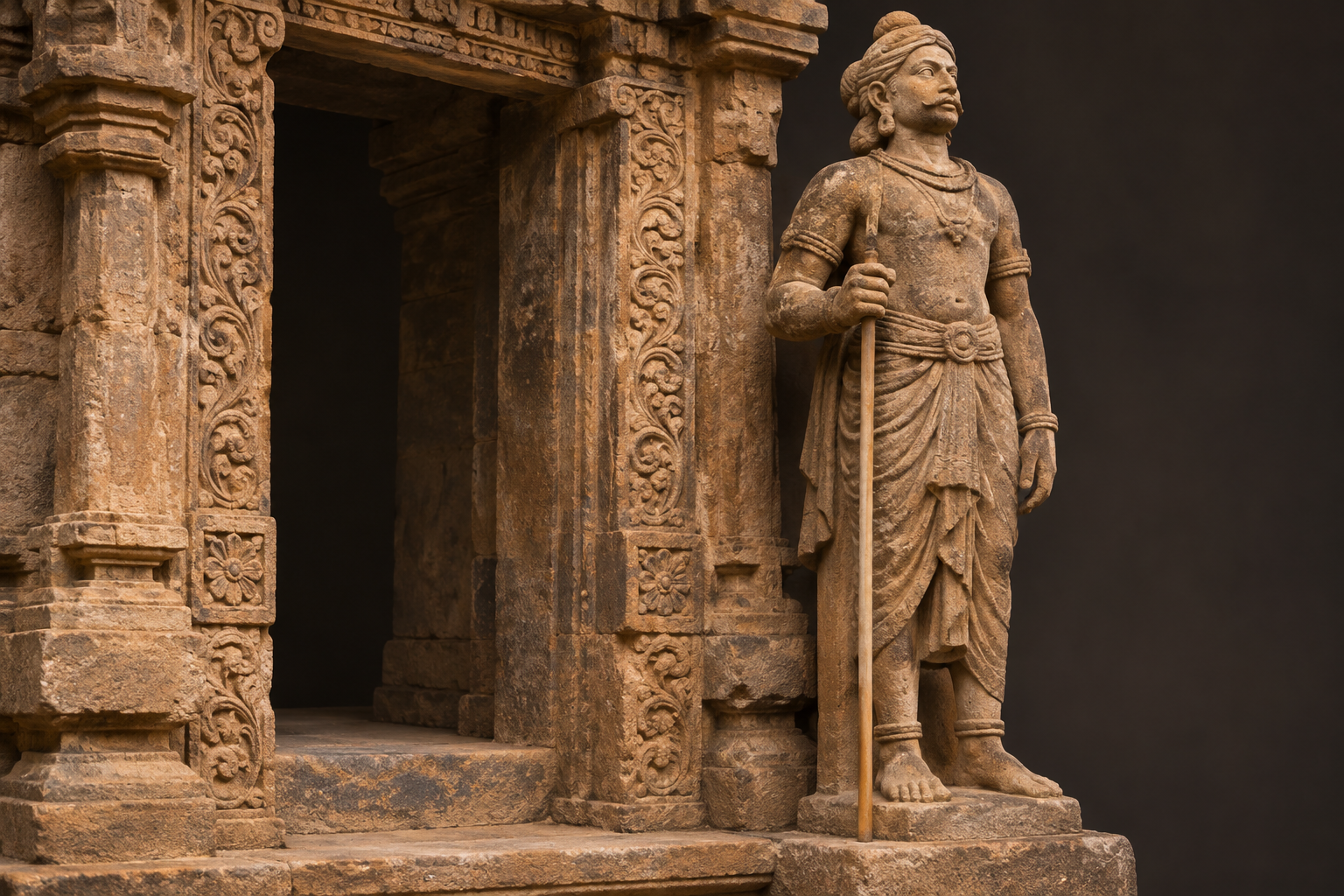
You are looking at a carved figure whose hand closes around a narrow shaft. It has no obvious blade, elaborate head, or dramatic gesture. Is it a walking staff, a damaged weapon, a badge of office, or something else? If you name it too quickly, you may misidentify the object. If you ignore it, you may miss the kind of authority the sculptor intended you to notice.
Where the surrounding iconography supports the identification, the object may be a vetra: a cane or rod. It is a modest but meaningful attribute, classified as a secondary implement associated with striking and control. That combination gives the vetra its distinctive force. It can express order backed by the capacity to act, along with the restraint that keeps power from becoming disorder.
Begin with the object, not the symbolism
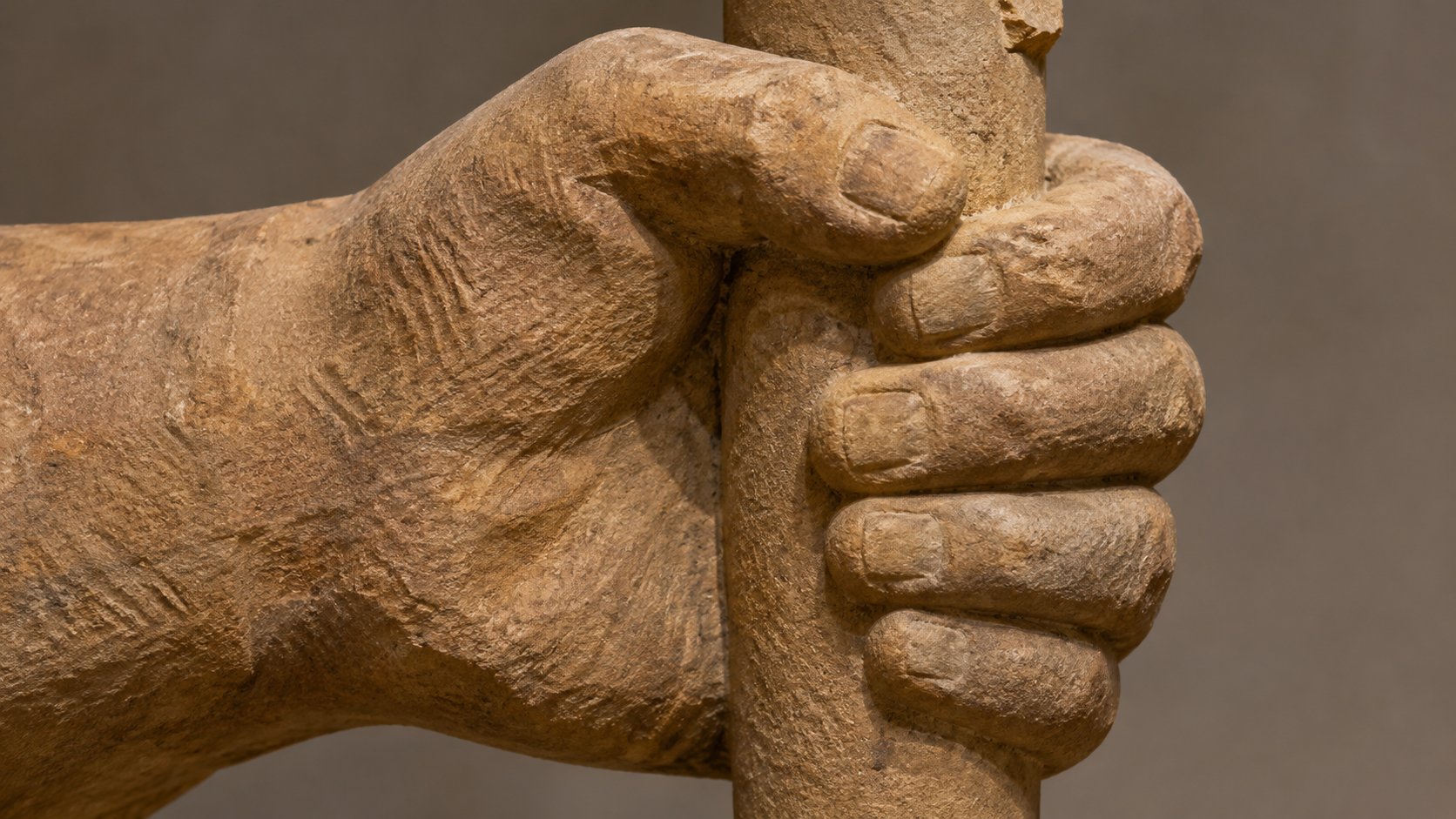
The safest way to read a possible vetra is to separate observation from identification. First record what the sculpture actually preserves. Only then ask what the object may be. This discipline matters because stone breaks, metal corrodes, painted details disappear, and a surviving shaft may once have carried a feature that is now lost.
When you examine the object in person or in a photograph, look for these details:
- Length: Note where the shaft begins and ends in relation to the figure. Do not assume that a broken end represents the original length.
- Shape: Is it straight, curved, tapered, or irregular? Does either end widen into a knob, point, blade, or decorative terminal?
- Thickness: Compare it with the figure’s fingers, arm, and other held objects. Apparent thickness can change with viewing angle.
- Grip: Record which hand holds it, where the hand meets the shaft, and whether the grip appears firm, relaxed, raised, or lowered.
- Position: Does the lower end rest on the base, cross the body, project outward, or remain suspended beside the figure?
- Condition: Look for fractures, repairs, heavy erosion, or missing sections before treating the present form as complete.
A good field note might read: The figure’s right hand holds a slim, straight shaft; the lower end is visible, but the upper end is damaged. That sentence is more useful than an immediate declaration that the object is a vetra. It preserves the evidence even if your eventual identification changes.
Establish the identification through context
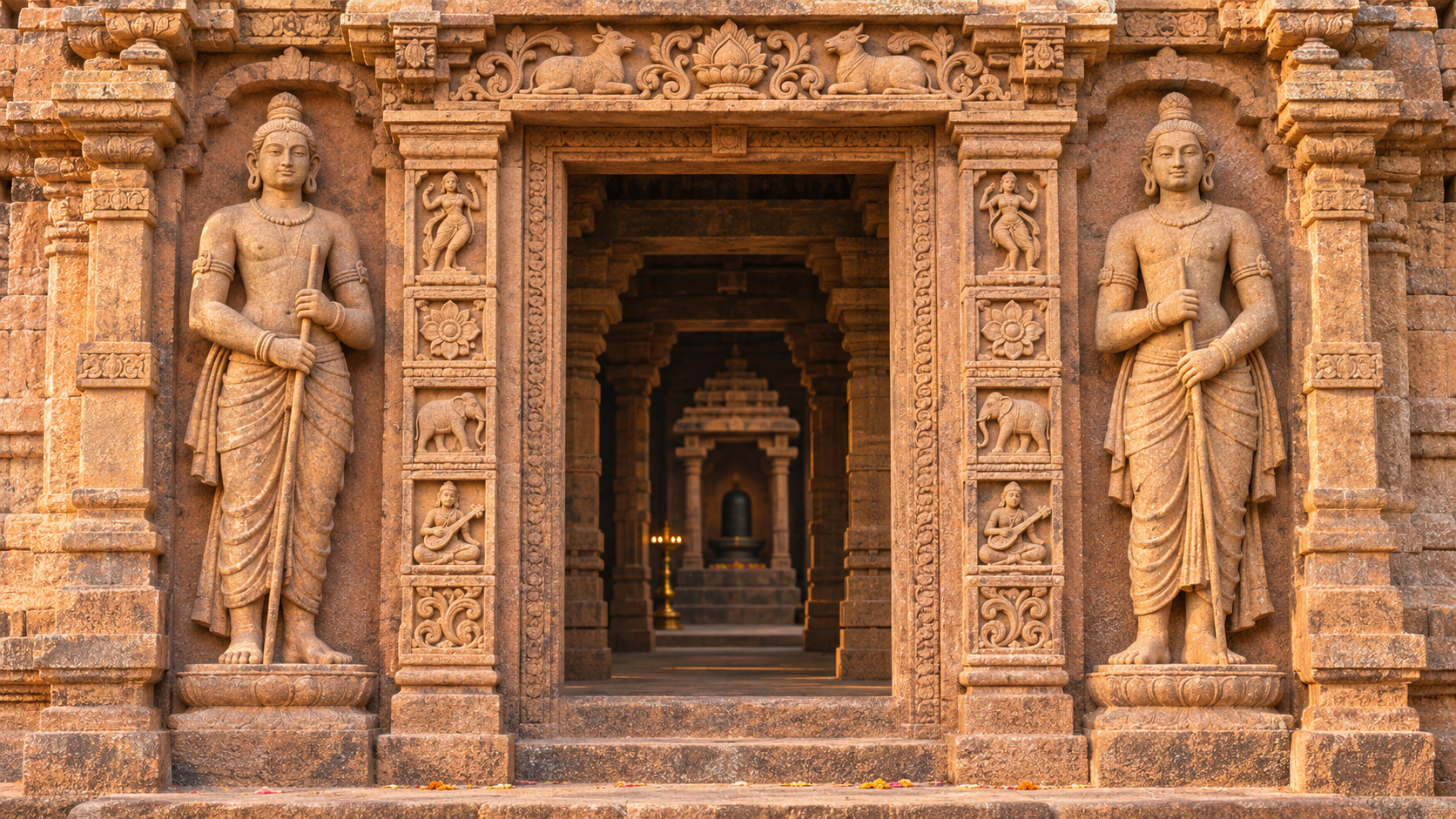
Not every rod-shaped object in Hindu sculpture is a vetra. A plain shaft might be a complete cane, part of a longer staff, the handle of another implement, or the surviving portion of a damaged attribute. Resemblance begins the inquiry; it does not settle it.
Use a four-stage identification process:
- Describe the visible form. Record the shaft, grip, orientation, terminals, and condition without assigning a name.
- Test alternative explanations. Ask what missing or eroded feature could change the identification. An absent upper section is especially important because it may once have distinguished a plain rod from a different implement.
- Read the whole figure. Examine posture, dress, scale, gesture, remaining attributes, and relationship to nearby figures. A secondary implement should be interpreted as part of an iconographic set, not in isolation.
- Check contextual documentation. Consult the monument’s label, catalogue, site record, or iconographic description where one is available. Compare repeated figures within the same sculptural programme before reaching for a visually similar object from an unrelated setting.
The identification becomes stronger when form, pose, context, and documentation point in the same direction. If only the shape supports it, call the object a possible vetra. That is not timid writing. It is accurate writing.
You should also resist naming the figure from the rod alone. The vetra is a secondary ayudha rather than one of the great, conspicuous weapons that immediately dominate the identity of a principal deva or devi. Its value often lies in qualifying a figure’s authority: it tells you something about how power is exercised, even when it cannot by itself tell you exactly who the bearer is.
Read the vetra as controlled authority
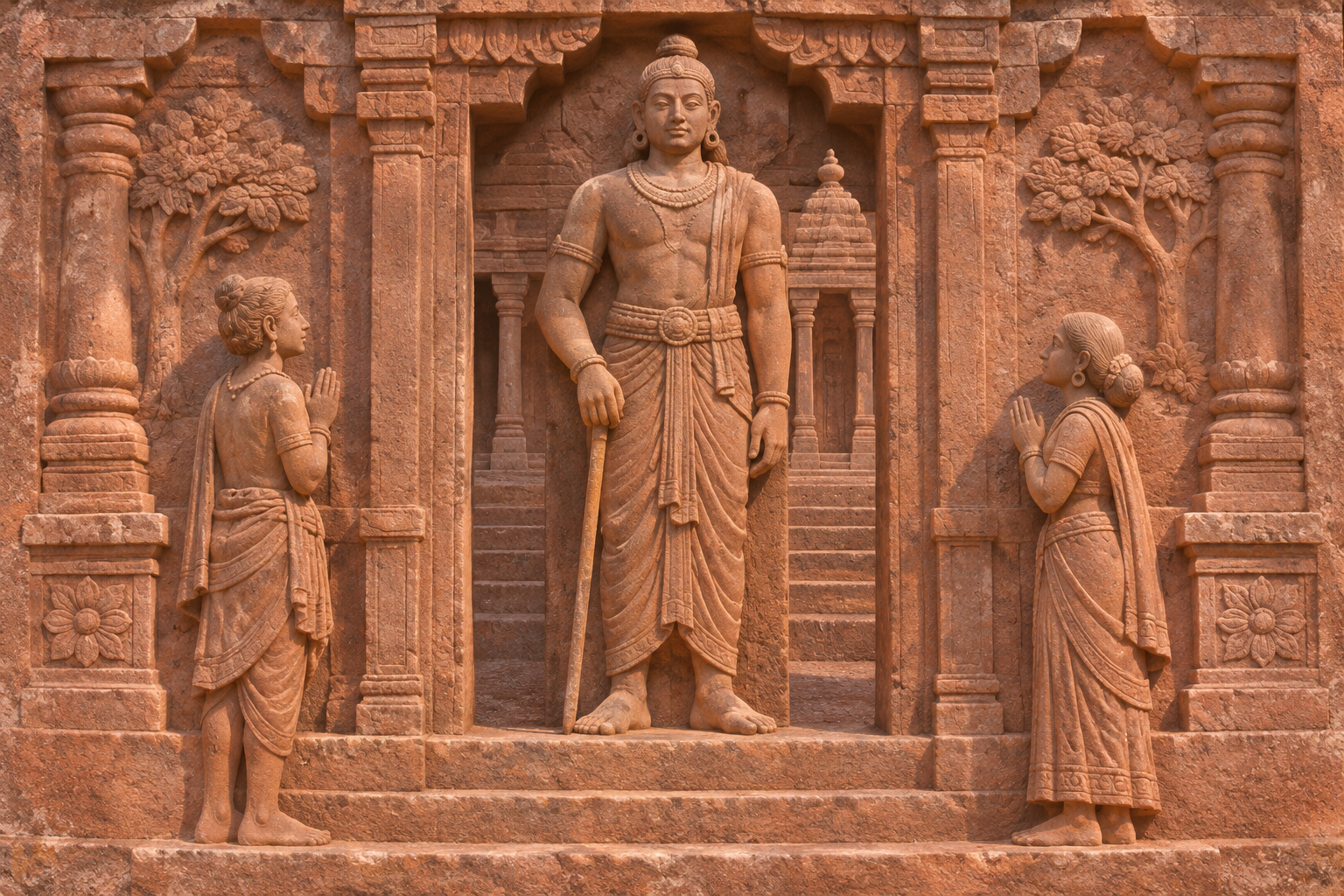
Order is more than stillness
A rod associated with control implies that order can be maintained, boundaries can be enforced, and disruption can be answered. The object therefore carries more than decorative weight. It makes authority visible in a compact form.
This does not mean that every figure holding a vetra is shown punishing someone. An implement can communicate capacity without depicting its use. A lowered or resting rod may still tell you that the bearer has a regulating function. A raised rod may make that capacity more immediate, but pose and scene must determine how far you can take the interpretation.
Restraint is power held within a limit
The vetra belongs to the language of striking and control, yet its symbolism is not exhausted by force. Restraint changes the meaning. The capacity to strike is present, but it is governed. Power remains available without becoming uncontrolled aggression.
That distinction makes the object especially valuable for a Dharmic reading of authority. Restraint is not helplessness, and order is not mere domination. Authority becomes legitimate in a moral sense only when it remains answerable to purpose, proportion, and discipline. The vetra can serve as a visual prompt for that reflection.
Keep reflection and identification on separate levels, however. You may use the vetra to think about disciplined power, but the object alone does not prove a formal doctrinal equation between vetra and dharma. Such a claim would require supporting textual, inscriptional, or programme-specific evidence.
When you encounter a likely vetra, ask three questions:
- What kind of order does the surrounding scene appear to establish or protect?
- Is the rod being used, displayed, carried at rest, or simply held as an attribute?
- Does the figure’s wider posture suggest active enforcement, watchful readiness, or composed authority?
These questions keep the interpretation close to the sculpture. They also prevent a generic statement such as the rod means power from replacing careful looking.
Describe a vetra without overstating the evidence
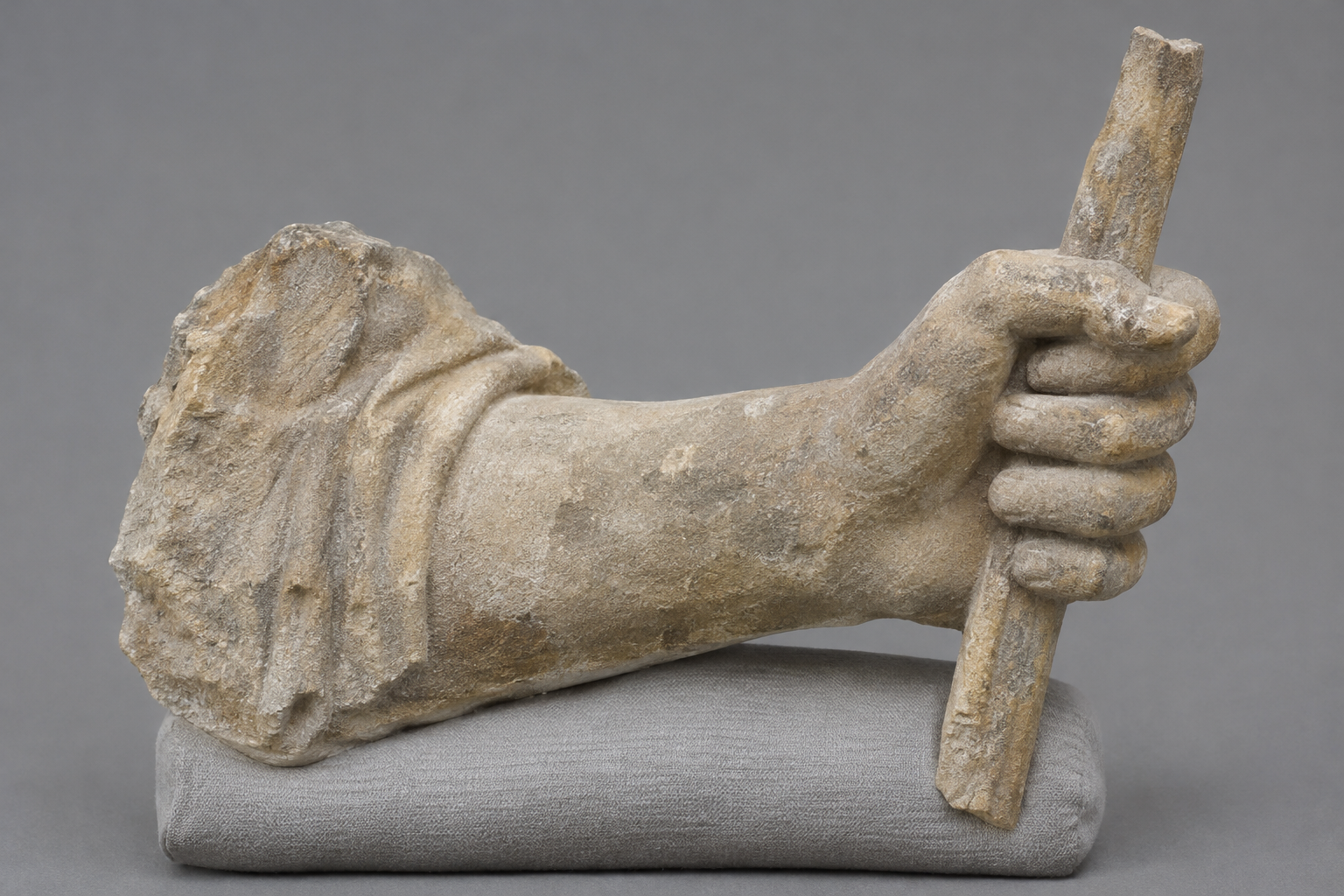
If you are preparing a museum caption, temple note, lecture slide, or social-media explanation, build the description in three layers. Each layer should make clear what you saw, what you identified, and what you inferred.
- Observation: State that the figure holds a slender rod or cane, including any relevant damage or missing terminal.
- Identification: Name it as a vetra only when the context supports that conclusion. Otherwise use possibly, probably, or may represent.
- Interpretation: Explain that the vetra is a secondary implement connected with striking and control and can therefore convey ordered authority and restraint.
A defensible caption for an incomplete sculpture could read: The figure holds a slender rod, possibly a vetra. In Hindu sculptural vocabulary, the vetra is a secondary implement associated with striking and control, allowing it to signify ordered authority and restraint. The identification remains provisional because the upper end of the object is damaged.
That wording avoids three common errors. It does not treat every straight shaft as a vetra. It does not use one secondary attribute to declare the figure’s identity. And it does not reduce an implement of restraint to a simple glorification of violence.
For devotional viewing, you can then move from identification to self-examination. Ask where strength in your own conduct needs firmer discipline, or where restraint has become an excuse for avoiding necessary action. That is a contemplative use of the image, not a claim that every sculptural programme assigns the same theological meaning to the rod.
Key takeaways
- A vetra is a cane or rod used as a secondary ayudha in Hindu sculptural art.
- Its association with striking and control allows it to express order, authority, and restraint.
- A slender shaft should first be recorded as a visible object; its identification as a vetra must come from form and context together.
- Damage at either end of the shaft can conceal the feature that would distinguish a vetra from another implement.
- The vetra can qualify the character of a figure’s authority, but it should not be used alone to identify that figure.
- Good interpretation distinguishes what the sculpture visibly preserves, what the object probably is, and what its symbolism may communicate.
Next time a quiet rod appears in a crowded sculpture, pause before passing over it or assigning it a name. Record the object, inspect the whole figure, and preserve uncertainty where the stone preserves uncertainty. When the evidence does support a vetra, you can read it as something more precise than a lesser weapon: a sign that effective power is power kept under discipline.
References

Leave a Reply
You must be logged in to post a comment.