
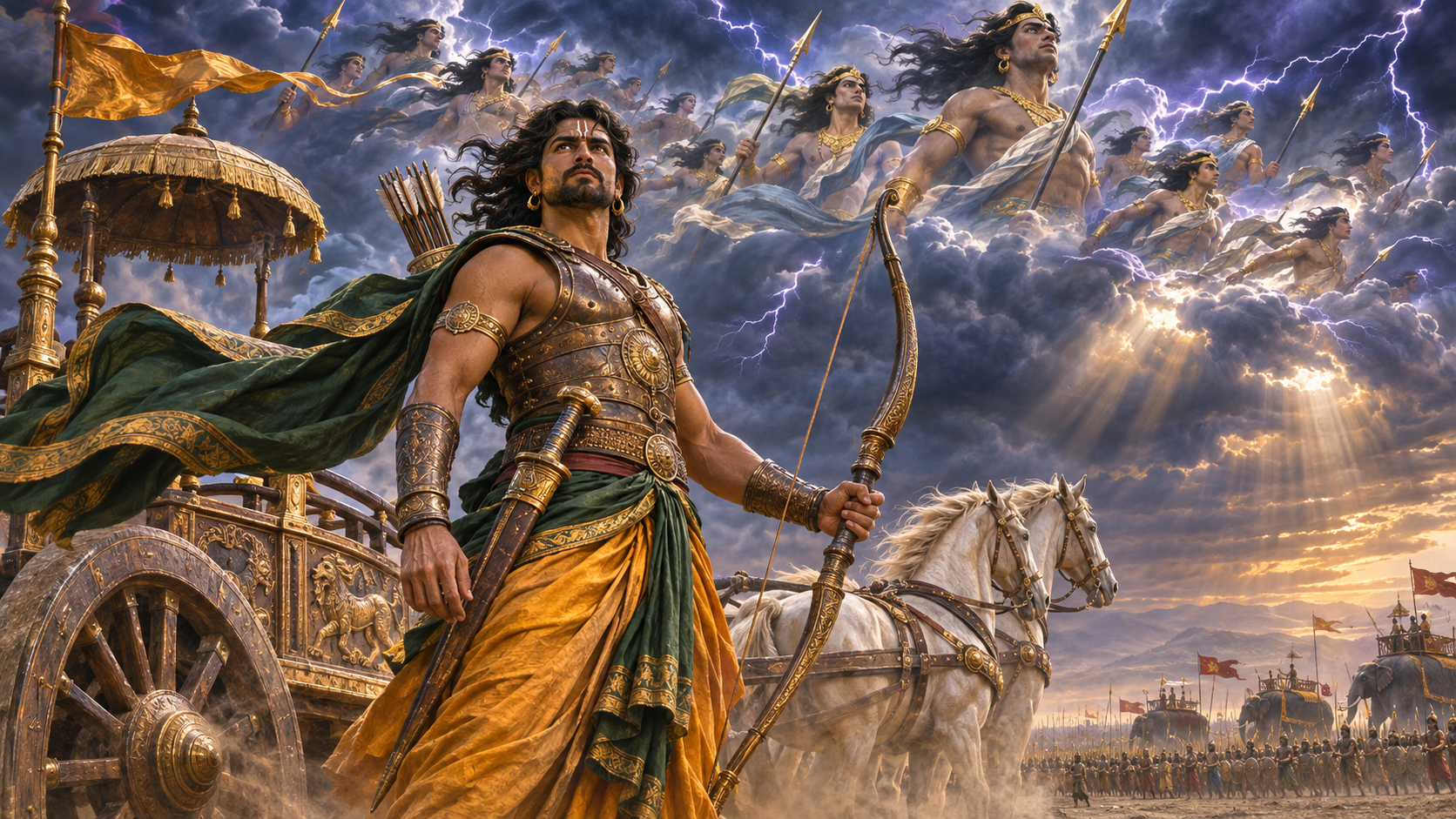
If you are trying to identify the deity behind Satyaki’s birth, his human genealogy can make the answer seem less direct than it is. The Mahabharata preserves two identities at once: Satyaki is a warrior of the Vrishni clan, and his divine origin lies in the Maruts.
Keeping those two levels together matters. It prevents you from turning an incarnation account into a biological genealogy, confusing the Maruts with another wind deity, or treating Satyaki as though his human identity were only a disguise.
The direct answer: Satyaki was born from the Maruts
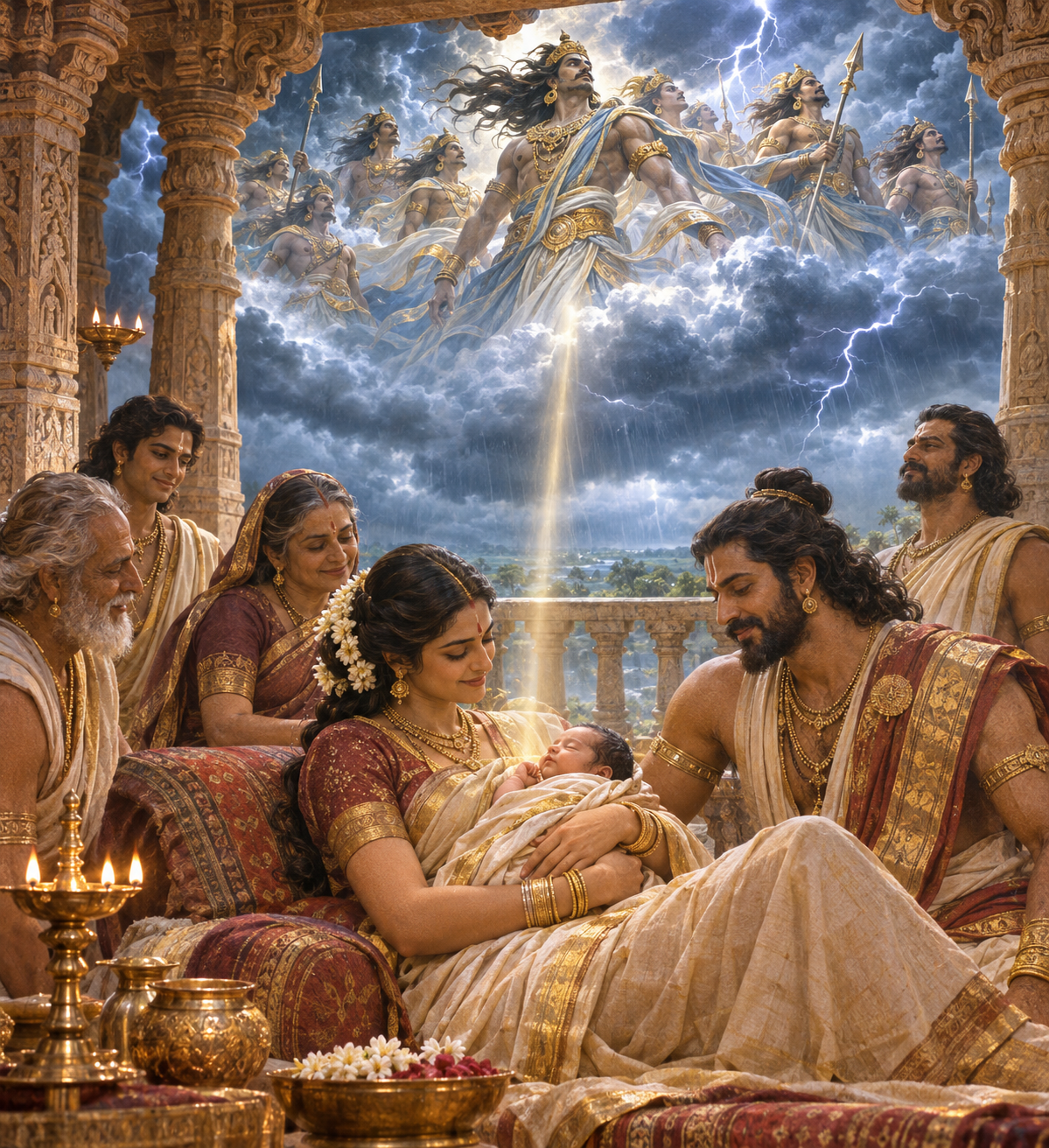
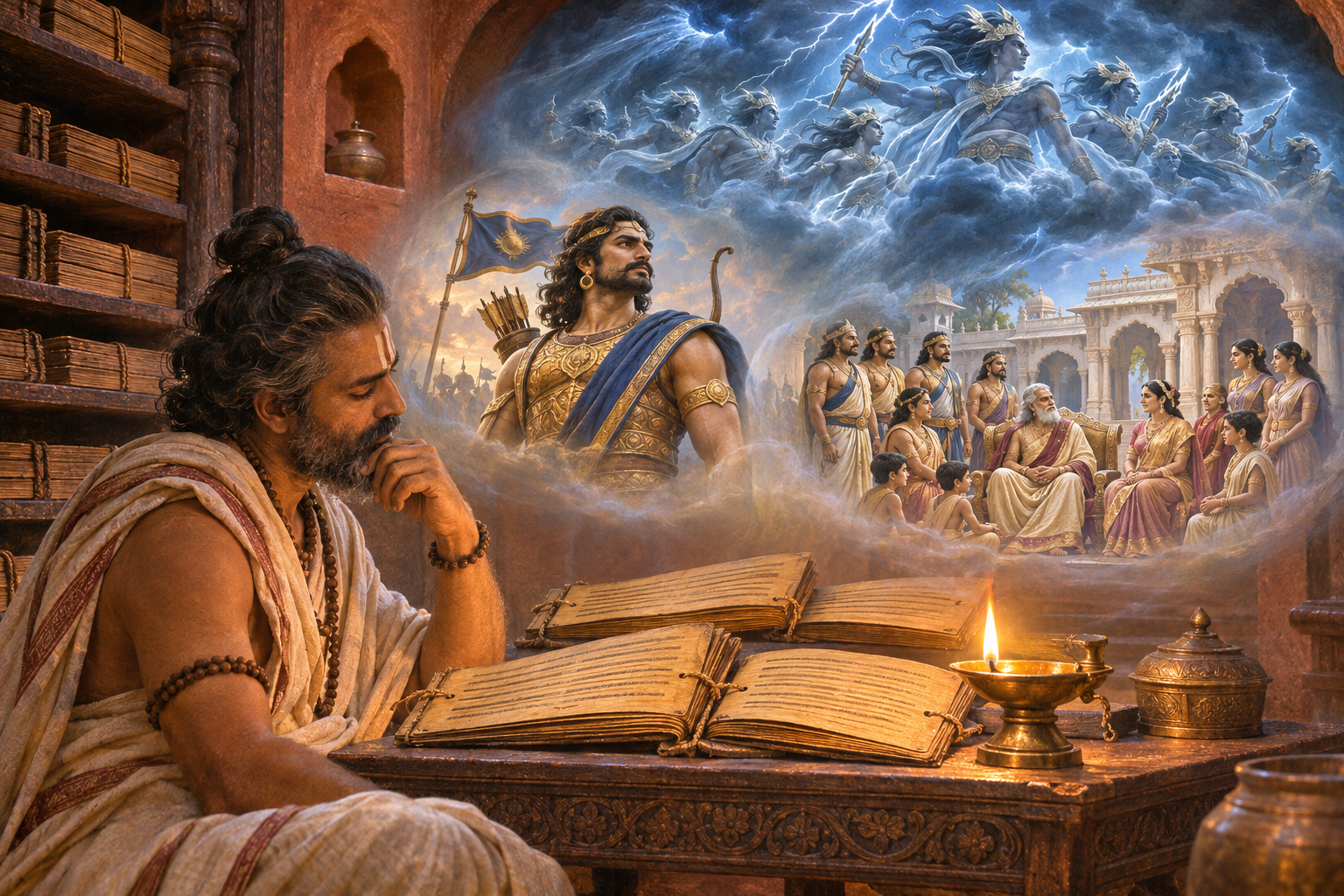
The Sambhava Parva of the Adi Parva, chapter 61, places Satyaki within a catalogue of divine beings who take earthly birth. His divine provenance is assigned to the Maruts, a group of deities associated with the powerful movement of wind and storm.
The precise identification is therefore collective and plural. Satyaki is linked to the Maruts, not presented there as the incarnation of one separately named wind god. If you need a short answer for study notes, teaching, or discussion, use this formulation: Satyaki of the Vrishni clan was born on earth from a portion of the Maruts.
The word “portion” carries much of the meaning. The incarnation catalogue describes divine power entering a human birth; it does not require you to erase Satyaki’s earthly family, clan, personality, or moral agency. Calling him an earthly manifestation connected with the Maruts is more accurate than calling him a Marut merely wearing a human disguise.
His Vrishni lineage and divine origin are not competing accounts
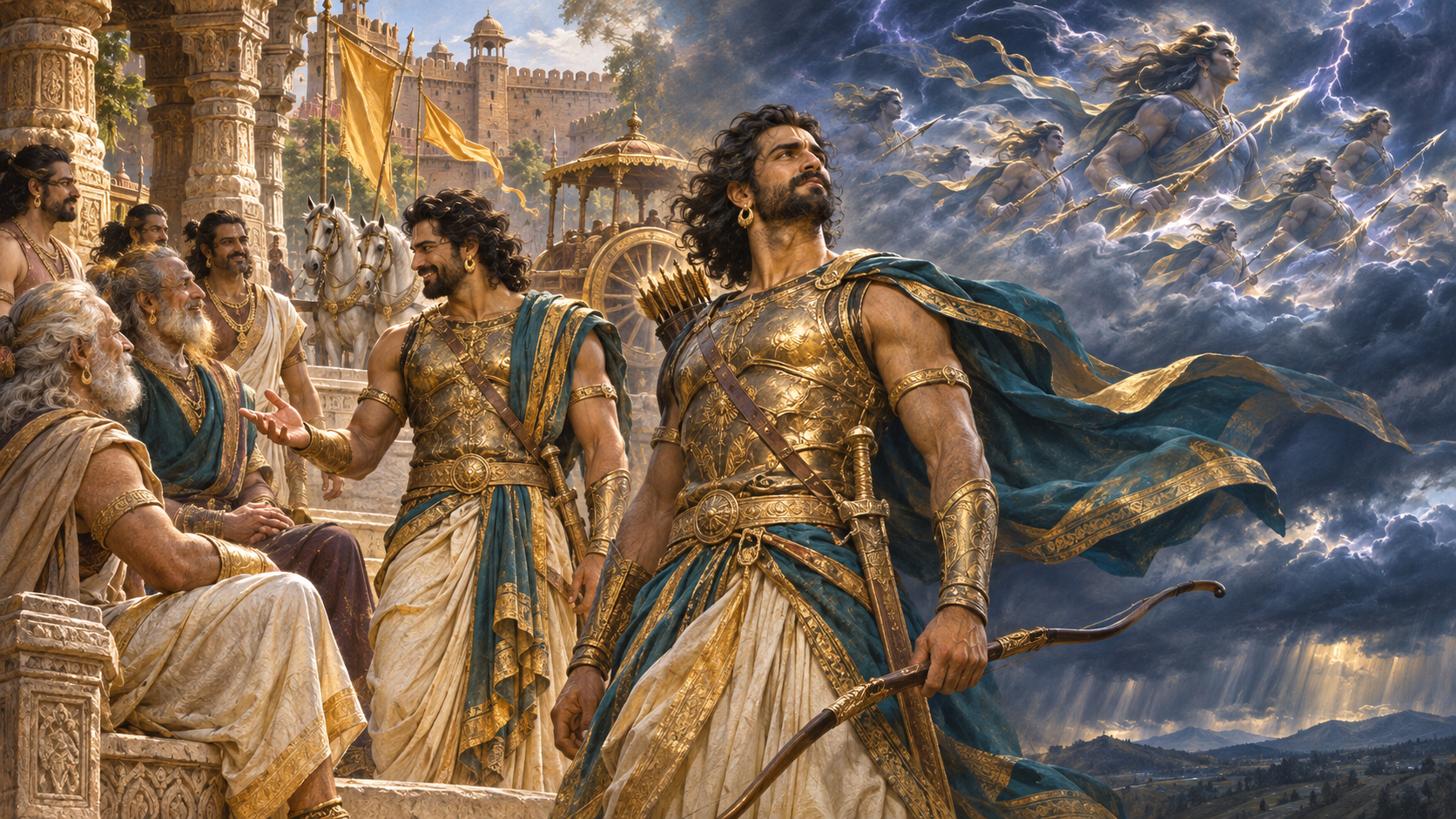
Readers sometimes approach epic genealogy as though every character must have only one valid origin. The Mahabharata works with layered identity. A person can belong fully to a human lineage while also embodying a portion of divine power.
- Human identity: Satyaki belongs to the Vrishni clan and acts within the relationships and duties of the human world.
- Divine provenance: His birth is associated with a portion of the Maruts.
- Narrative setting: His appearance belongs to the wider descent of divine beings into the earthly struggle over dharma.
You do not have to choose between the first two statements. The divine identification tells you what power stands behind the birth; the clan genealogy tells you where that birth occurs in human society. One answers a theological question, while the other answers a familial and political one.
This distinction is especially useful when reading the Mahabharata’s lists of incarnate beings. Those lists are not substitutes for the characters’ biographies. They provide an additional frame through which you can understand why particular powers have entered the conflict and how the earthly contest is connected to a larger dharmic order.
What the Marut connection adds to your reading of Satyaki
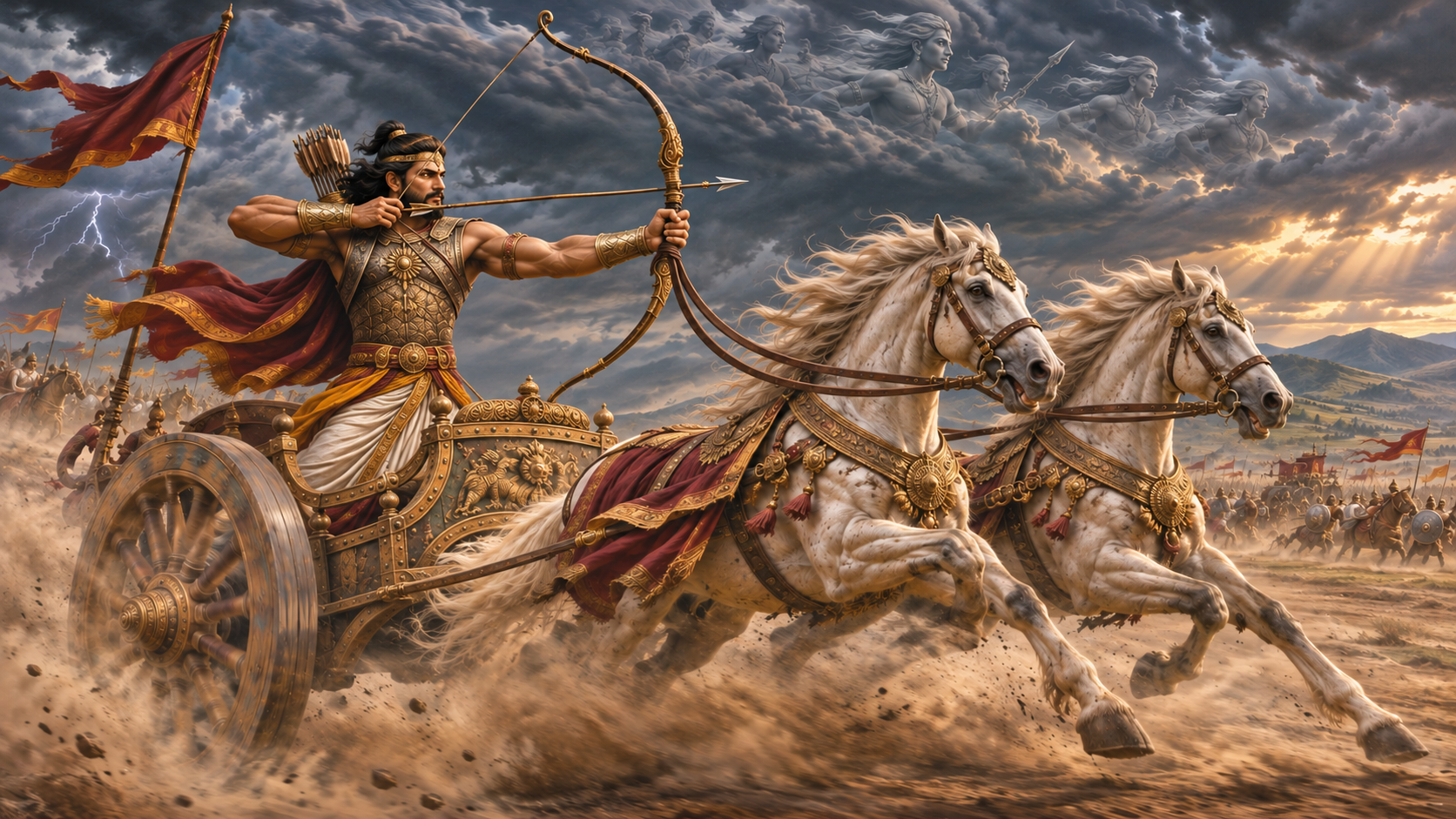
The Maruts are best understood as a company of divine powers rather than as one individual deity. Their association with wind and storm gives Satyaki’s origin a vocabulary of movement, force, martial energy, and collective power. That symbolism can sharpen your reading of the warrior, but it should remain an interpretation grounded in the explicit genealogical identification.
Three boundaries will keep that interpretation disciplined:
- Do not replace the plural with the singular. The identification is with the Maruts as a group. Naming one Marut without textual support makes the claim more specific than the account allows.
- Do not silently substitute Vayu. Vayu and the Maruts both belong to the religious language of wind, but they are not interchangeable names. The birth account identifies the Maruts.
- Do not treat symbolism as proof of every action. A storm-like reading may help you notice energy or martial force, but Satyaki’s choices still need to be judged within their immediate narrative setting.
The larger dharmic point is also easy to miss. Divine birth in the epic does not mean that human life ceases to matter. Divine powers enter earthly lineages precisely so that they can act amid human loyalties, obligations, risks, and decisions. Satyaki’s Marut origin gives his presence cosmic significance without making his human identity unreal.
A reliable way to read Mahabharata incarnation claims
You can apply the same method to Satyaki and to other figures in the epic:
- Locate the incarnation catalogue. For Satyaki, look in the Sambhava Parva of the Adi Parva. If your edition numbers chapters differently, search by the section name and by the surrounding list of divine births.
- Preserve the grammatical number. Record “Maruts” in the plural. Do not simplify a divine company into one deity.
- Preserve the idea of partial manifestation. “Born from a portion of the Maruts” is more careful than an unqualified claim that Satyaki simply “was the Maruts.”
- Keep the human genealogy beside the divine one. Write “Satyaki of the Vrishni clan, born from a portion of the Maruts.” That single line prevents most confusion.
- Separate identification from interpretation. The Marut origin is the textual identification. Ideas about storm-like energy, speed, or martial force are interpretive implications and should be presented as such.
This method is simple, but it protects you from a common error in epic reading: expanding a brief divine genealogy into claims the genealogy itself does not make.
Key questions about Satyaki’s divine birth
Which divine beings gave rise to Satyaki?
Satyaki’s divine origin is attributed to the Maruts. The identification concerns the Maruts collectively rather than one separately named member of the group.
Was Satyaki an incarnation of Vayu?
That is not the identification given in the incarnation account under discussion. It names the Maruts. Replacing them with Vayu because both are associated with wind removes an important textual distinction.
Was Satyaki human or divine?
Both descriptions operate at different levels. He is human in his Vrishni birth and social identity, while his divine provenance is traced to a portion of the Maruts. The epic does not require one level to cancel the other.
Where should you look for the identification?
Look in the Sambhava Parva of the Adi Parva, within the catalogue of divine beings taking earthly birth. The cited chapter numbering is chapter 61; section names are more reliable search markers when editions organize chapters differently.
When you next encounter Satyaki, keep one precise note beside his name: “Vrishni warrior; born from a portion of the Maruts.” It preserves the human and divine dimensions together and gives you a sound basis for interpreting the rest of his story.
References

Leave a Reply
You must be logged in to post a comment.