
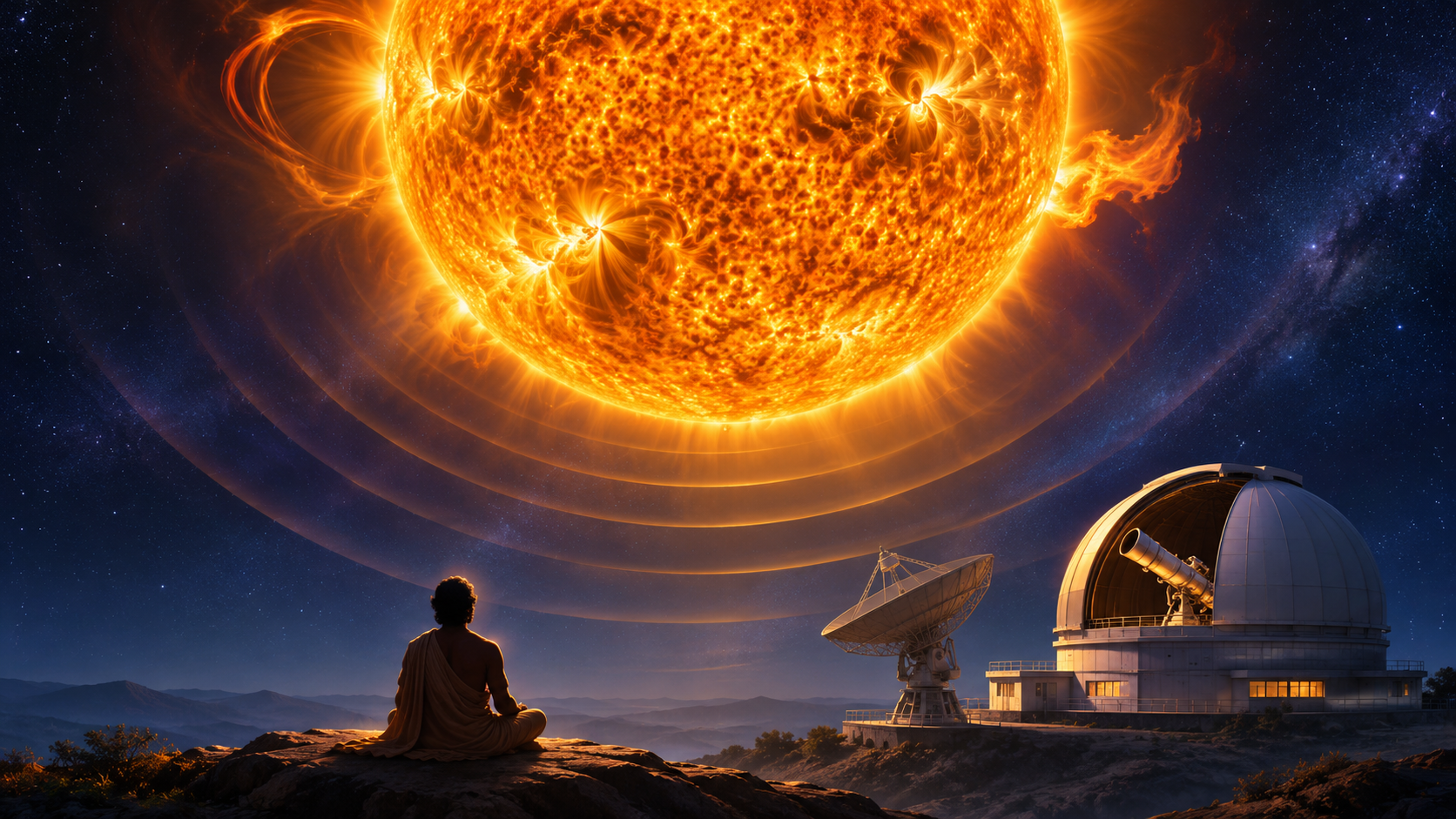
You may have seen a clip that seems to turn a Hindu intuition into a laboratory fact: the Sun is chanting Om. Claims about a sound coming from Surya Mandala have attracted both belief and accusations of fakery. The useful question is not whether reverence for Surya is reasonable. It is whether the audio proves the literal statement attached to it.
The short answer is no: a clip by itself does not prove that the Sun chants Om. Solar activity can be measured and represented as audible sound, and a listener may hear a resemblance to Om. That is different from recording a natural voice travelling from the Sun to a human ear. You can respect the sacred meaning without giving a processed file more evidentiary weight than it carries.
First separate the three claims being made
The word “sound” can hide several very different propositions. Before accepting or rejecting the claim, identify which one is actually on the table.
- A literal acoustic claim: The Sun naturally produces the recognisable syllable Om, and that sound reaches or can be recorded by us as sound.
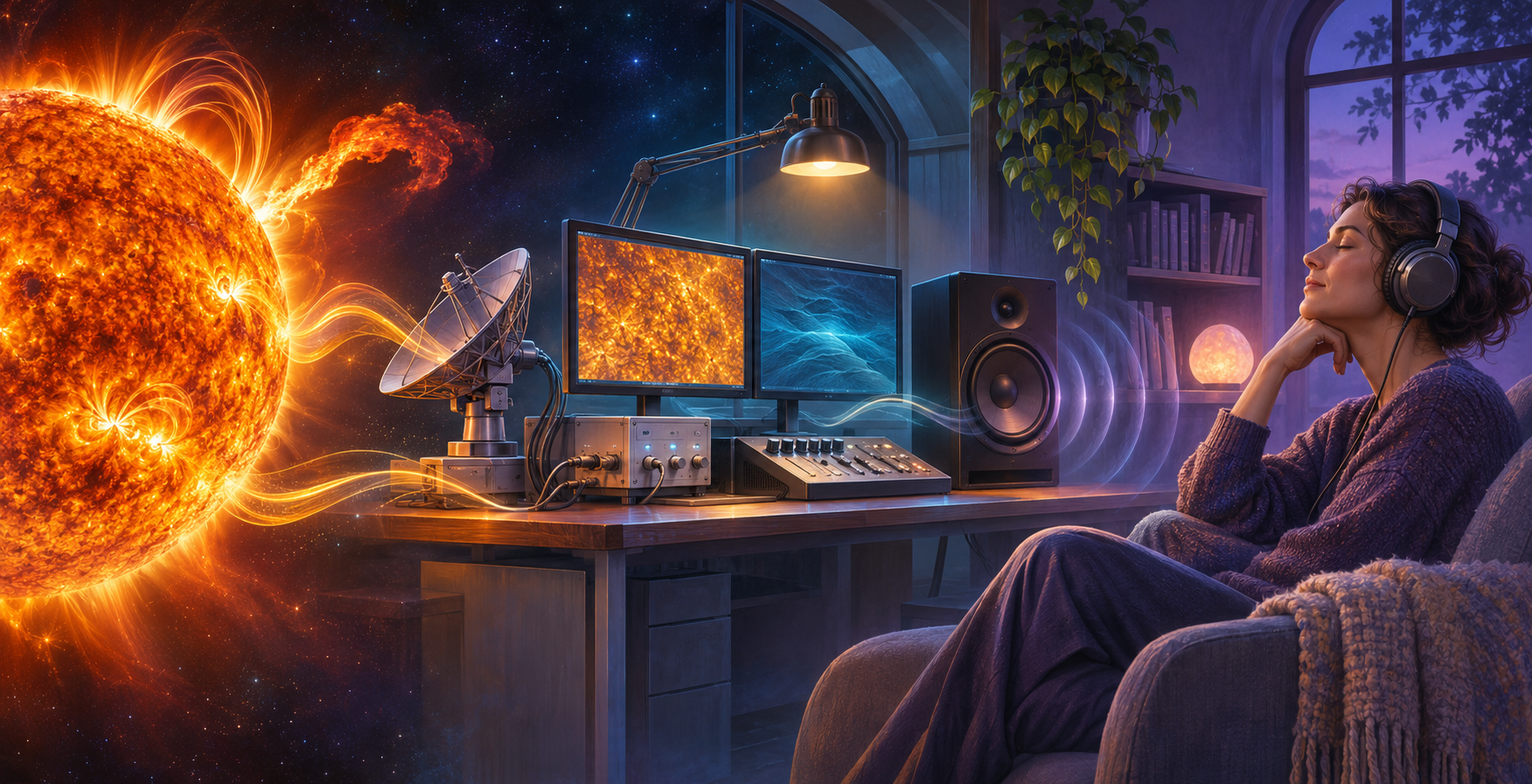
- A measurement-and-conversion claim: An instrument detects solar oscillations or another changing signal, after which those measurements are shifted, accelerated, slowed, or mapped into the range of human hearing.
- A spiritual or contemplative claim: Om expresses the sacred order underlying the cosmos, and the Sun can be contemplated as a manifestation of that order.
These claims are not interchangeable. The first needs a physical transmission and recording chain. The second needs a transparent explanation of the measurement and conversion. The third belongs to theology, philosophy, and sadhana; it is not proved or disproved by whether a waveform resembles a spoken syllable.
This distinction immediately improves the discussion. A real solar measurement can underlie a misleading caption. A devotional interpretation can be meaningful without being a laboratory conclusion. Conversely, calling every unfamiliar solar audio file “fake” may ignore the legitimate practice of converting scientific data into sound.
What solar “sound” can and cannot mean
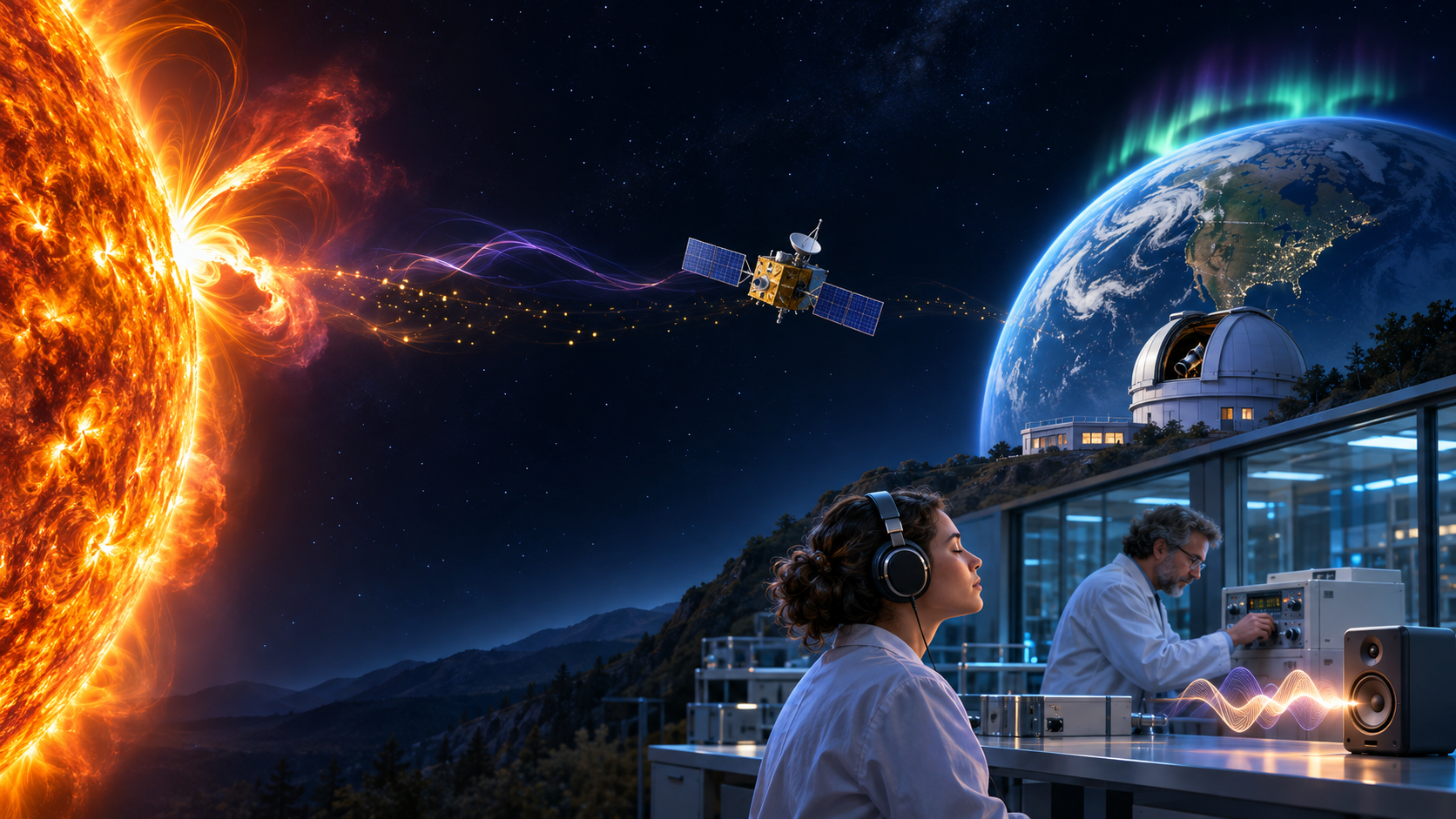
Ordinary sound is a mechanical disturbance moving through matter, such as air, water, or plasma. The Sun contains matter, so disturbances and oscillations can occur within it. The space between the Sun and Earth, however, is far too thin to carry ordinary sound in the way air carries a voice across a room. You are therefore not hearing the Sun directly through space when you play an online audio clip.
Scientists can still measure changing features of the Sun. Those measurements may then be converted into audible form. A conversion can preserve genuine patterns in the data while changing how those patterns are presented. Frequencies may be shifted, time may be compressed, or numerical values may be assigned to pitch and volume. This process is commonly called sonification.
Sonification is not deception when the transformation is disclosed. It can help people notice rhythm, repetition, or variation that would otherwise appear only as numbers or a visual graph. But it is also not necessarily a field recording of what a nearby human ear would hear. “Audio derived from solar measurements” and “the natural voice of the Sun” are two different descriptions.
Resemblance adds another layer of uncertainty. Human perception is very good at finding familiar words, faces, and rhythms in ambiguous material. Once a caption tells you to listen for Om, you are more likely to organise a sustained or pulsing tone around that expectation. That does not make your experience dishonest. It means resemblance alone cannot establish the origin or meaning of the sound.
Use a simple decision rule: if the audio has been produced by translating measurements, call it a sonification or an audio rendering. If listeners find that it resembles Om, describe that as an interpretation. Do not merge the two statements into “science proved that the Sun chants Om.”
Use this five-question check before sharing a clip
You do not need specialist equipment to evaluate the basic credibility of a viral claim. You need a traceable chain from measurement to caption.
- Where is the original file? Look for the first identifiable upload, not a repost with music, subtitles, or a devotional image added. If every trail ends at another social-media account, the provenance remains unknown.
- What was actually measured? A credible description should identify whether the starting material was an oscillation, an electromagnetic signal, a sequence of images, or some other dataset. The vague phrase “scientists recorded the Sun” does not answer this question.
- How was it made audible? Check whether the frequency was shifted, playback speed was changed, time was compressed, or data values were assigned to musical properties. These choices do not automatically invalidate the result, but they determine what the audio means.
- Does the resemblance survive different processing choices? If one carefully selected rendering sounds like Om while other reasonable renderings do not, the resemblance depends partly on presentation. Treat it as evocative, not conclusive.
- What does the caption claim? “This audio was generated from solar measurements” may be technically defensible. “The Sun literally chants the Hindu mantra Om” adds intention, language, and religious meaning that the audio alone cannot demonstrate.
If the measurement and conversion chain is clear, share the clip as an audio rendering of solar data. If the chain is missing, describe it as an unverified clip attributed to the Sun. That wording is accurate without prematurely calling the file fraudulent. It also stops an uncertain media claim from borrowing authority it has not earned.
Dharma does not need a viral audio file

Hindu practice treats Om as a sacred syllable, while Surya is revered as a visible divine presence and a giver of light and life. Those commitments belong to a much larger spiritual framework. Their truth and value do not rise or fall with the authenticity of one recording.
A metaphysical claim about sacred order is not the same kind of claim as a statement about an acoustic waveform. Confusing the two weakens both. Science loses precision when processed measurements are presented as divine speech. Dharma is reduced when its profound language about consciousness, reality, and cosmic order is treated as though it needs validation from a trending audio file.
This matters especially when you teach, speak at a satsang, or share material in a family group. Use wording that fits what you actually know:
- When the provenance is documented: Say that the clip is a processed audio rendering of solar measurements and that some listeners find it reminiscent of Om.
- When the provenance is absent: Say that it is a circulating clip attributed to the Sun and that its method of production has not been verified.
- When your purpose is devotional: Say that the sound can serve as a meditation on Om and Surya. Make clear that this is a spiritual use, not a scientific proof.
This is not a retreat from a pro-Dharma position. It is intellectual discipline. A weak viral claim is easy to debunk, and its failure can then be misrepresented as a failure of Dharma itself. Keeping the scientific and spiritual claims in their proper domains protects the dignity of both inquiry and faith.
Key takeaways
- A viral audio clip cannot, by itself, prove that the Sun literally chants Om.
- Real solar measurements can be converted into audible sound, but a sonification is not necessarily a direct acoustic recording.
- Hearing Om in an ambiguous tone is an interpretation unless the measurement and processing chain independently establishes more.
- Before sharing, identify the original file, the measured phenomenon, the conversion method, and the exact claim being made.
- You can use verified solar audio for contemplation without presenting spiritual meaning as a laboratory finding.
The next time the clip reaches you, do not choose between reflexive belief and reflexive mockery. Ask what was measured, how it became audible, and what the caption adds. Then share it with a label precise enough to honour both Surya and satya.
References

Leave a Reply
You must be logged in to post a comment.