
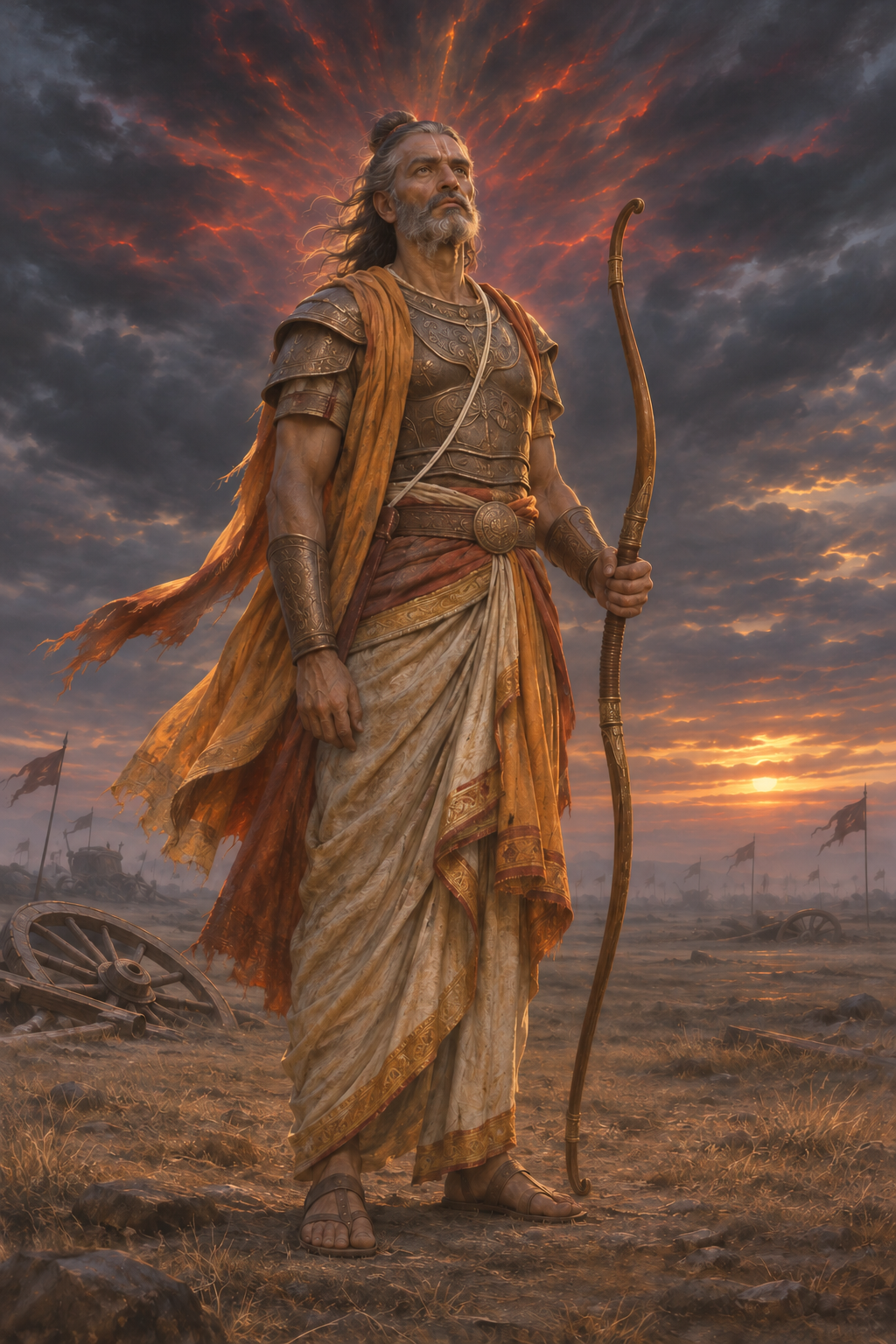
If you have heard Kripacharya called an incarnation of Rudra, you may be wondering how literally to take it. Does the Mahabharata present him as Rudra himself, or does the connection describe something more limited?
The precise answer is that Kripacharya bears a Rudra amsha: a portion, share, or concentrated expression of Rudra’s fierce power. “Rudra incarnation” is acceptable shorthand, but “Rudra amsha” is the better phrase when you want to understand his character, his participation in the night attack, and his survival beyond the war without making the claim larger than it is.
The textual claim is an amsha, not complete identity
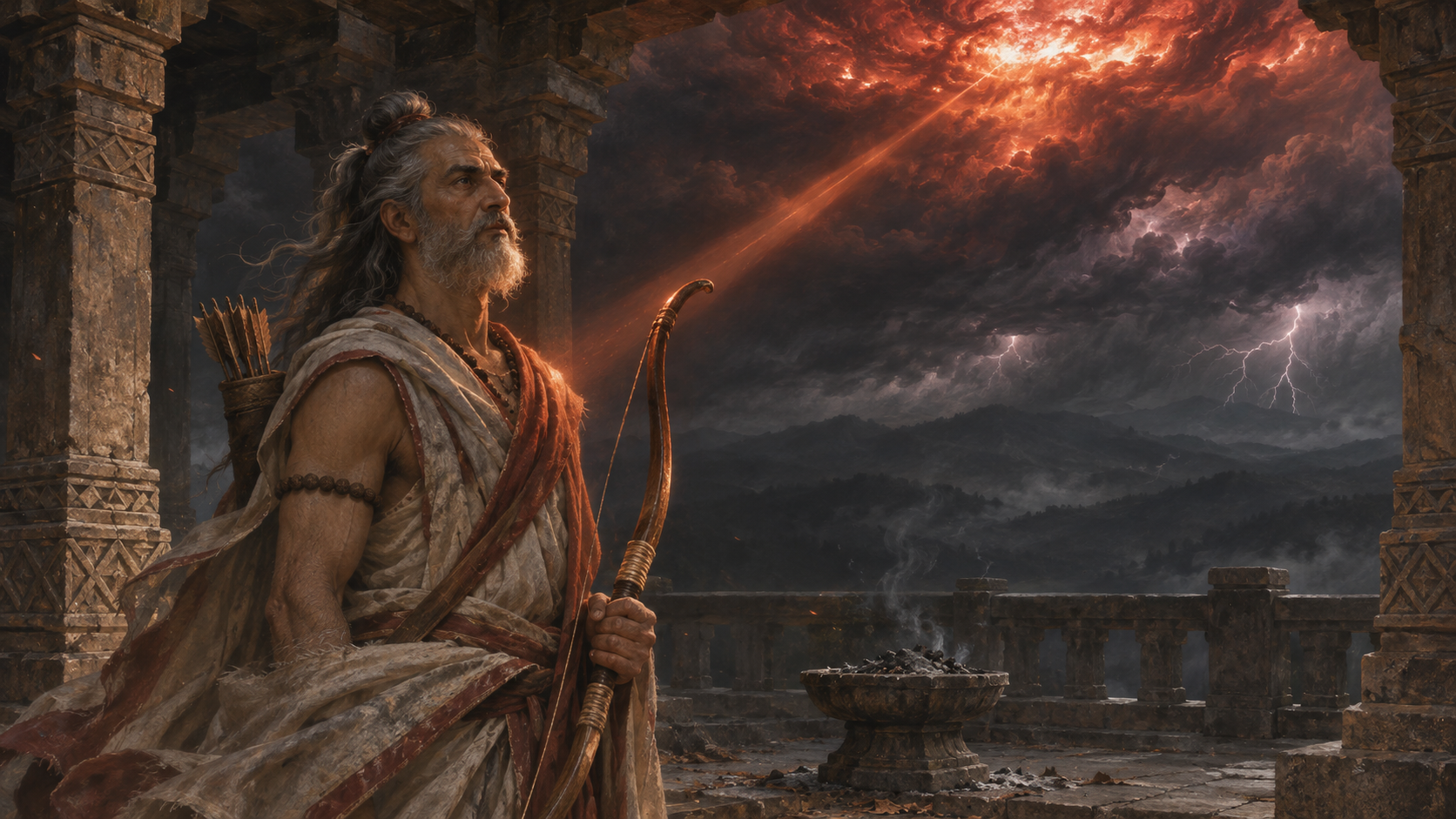
Sambhava Parva of the Adi Parva, chapter 61 places the births of numerous kings, warriors, rulers, and courtiers within a cosmic genealogy. Many are born with portions of devas, asuras, rakshasas, gandharvas, and other beings. Kripa’s Rudra connection belongs to this framework of partial manifestation.
That distinction matters. In common theological usage, an amsha is not an arithmetic fraction of a deity, and it is not a statement that every aspect of the human person is identical with that deity. It identifies a divine quality or power that becomes especially significant in a particular life.
You should therefore avoid the stronger formulation, “Kripacharya was Rudra in every respect.” It erases the difference between a complete identity claim and an amsha claim. A more accurate sentence is: “Kripacharya was born with a Rudra amsha, expressed through his fierce martial energy and unusual endurance.”
You may also encounter wording that associates Kripa with “Rudra” or “the Rudras.” Unless a particular edition or commentary supplies a more exact identification, do not manufacture one. The stable point is the Rudra-linked portion, not a speculative equation between Kripa and the totality of Rudra.
What the Rudra connection helps you notice in Kripa
An amsha functions as an interpretive key. It tells you which quality to watch as a character moves through the epic. In Kripa’s case, the key is fierce energy: the capacity to act as a warrior, remain formidable amid destruction, and continue after the world around him has been shattered.
This does not reduce Kripa to rage. Fierceness can be disciplined or undisciplined, protective or destructive, governed by dharma or carried beyond its proper boundary. The Rudra amsha makes that force visible; it does not settle the moral value of every act produced through it.
When you read an episode involving Kripa, look for three related features. Notice the intensity he brings to a crisis, the restraint or lack of restraint surrounding that intensity, and what remains after the immediate act is over. This is more useful than searching for a one-to-one allegory in which each of Kripa’s deeds must correspond to a deed of Rudra.
The distinction also protects the complexity of the Mahabharata. A cosmic origin can explain why a person is fitted for a role without turning that person into a puppet. Divine inheritance supplies power and disposition; the human story still exposes choices, loyalties, consequences, and failures of judgment.
The night attack tests the meaning of divine inheritance
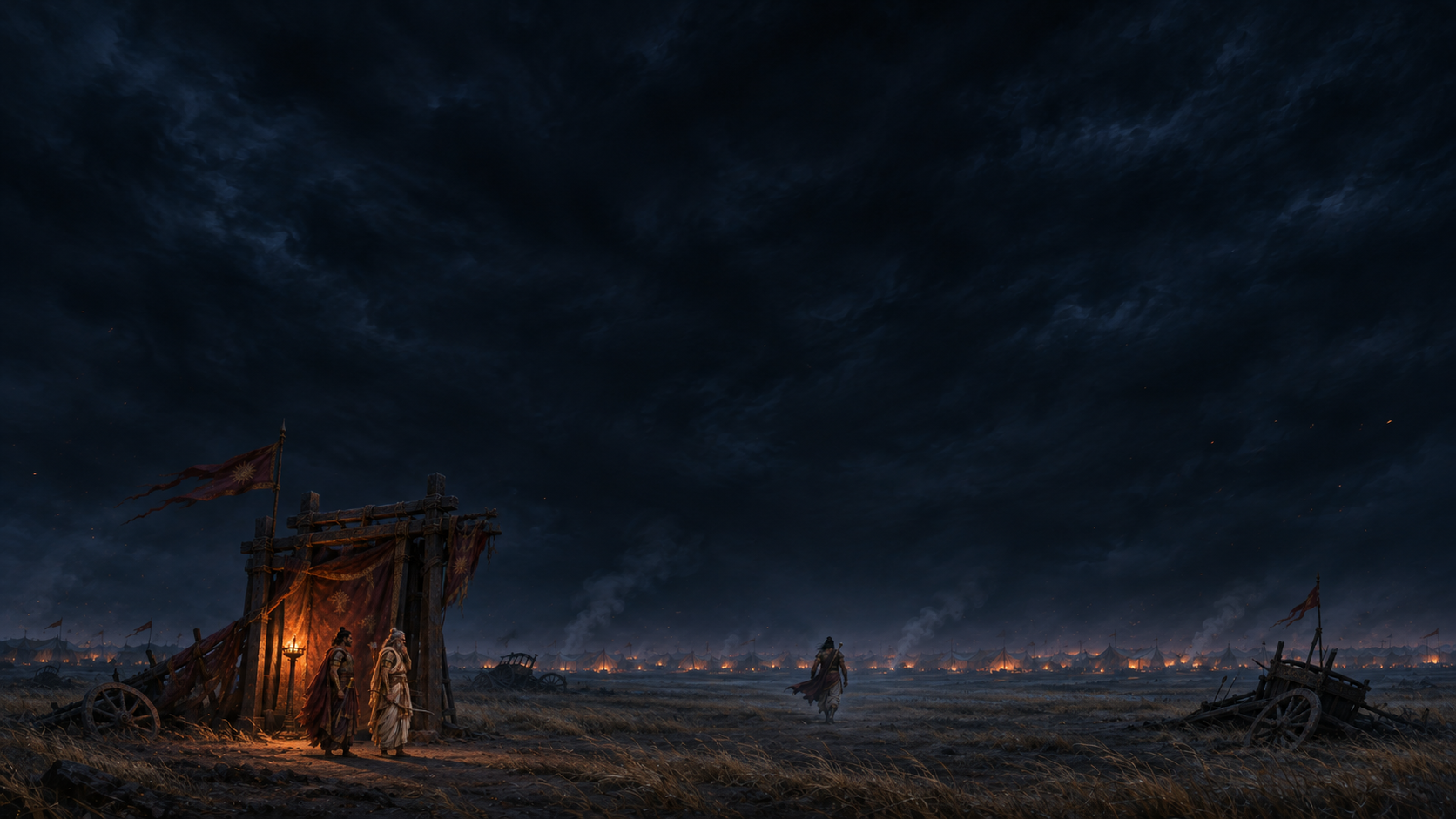
The Rudra connection becomes morally difficult when you consider Kripa’s participation in the night attack. It is tempting to treat his divine portion as a ready-made explanation: he joined because Rudra’s fierce energy compelled him. That reading is too simple.
An amsha can make a character dramatically suited to an action without making the action righteous. Explanation is not absolution. If you use divine origin to cancel moral agency, every troubling act becomes immune to ethical examination, and the epic’s difficult questions disappear precisely where they matter most.
A sound reading keeps three questions separate:
- What did Kripa choose? Begin with the human act rather than the cosmic label.
- What does the Rudra amsha illuminate? It may explain the intensity, severity, or destructive capacity expressed through the act.
- How should the act be judged? Test it against dharma and consequence instead of assuming that divine ancestry makes it praiseworthy.
The order is important. First identify the action. Then use the amsha to understand the energy within it. Only after that should you form a moral judgment. Starting with “he was Rudra-born, therefore the act was justified” confuses spiritual symbolism with ethical permission.
This gives you a more demanding interpretation of the night attack. Kripa’s Rudra nature does not remove the darkness of the episode. It helps explain why fierce power remains available when ordinary restraints have broken down. The episode can then be read as a warning about what happens when tremendous capacity is separated from sufficient restraint.
Surviving the war is part of the Rudra pattern
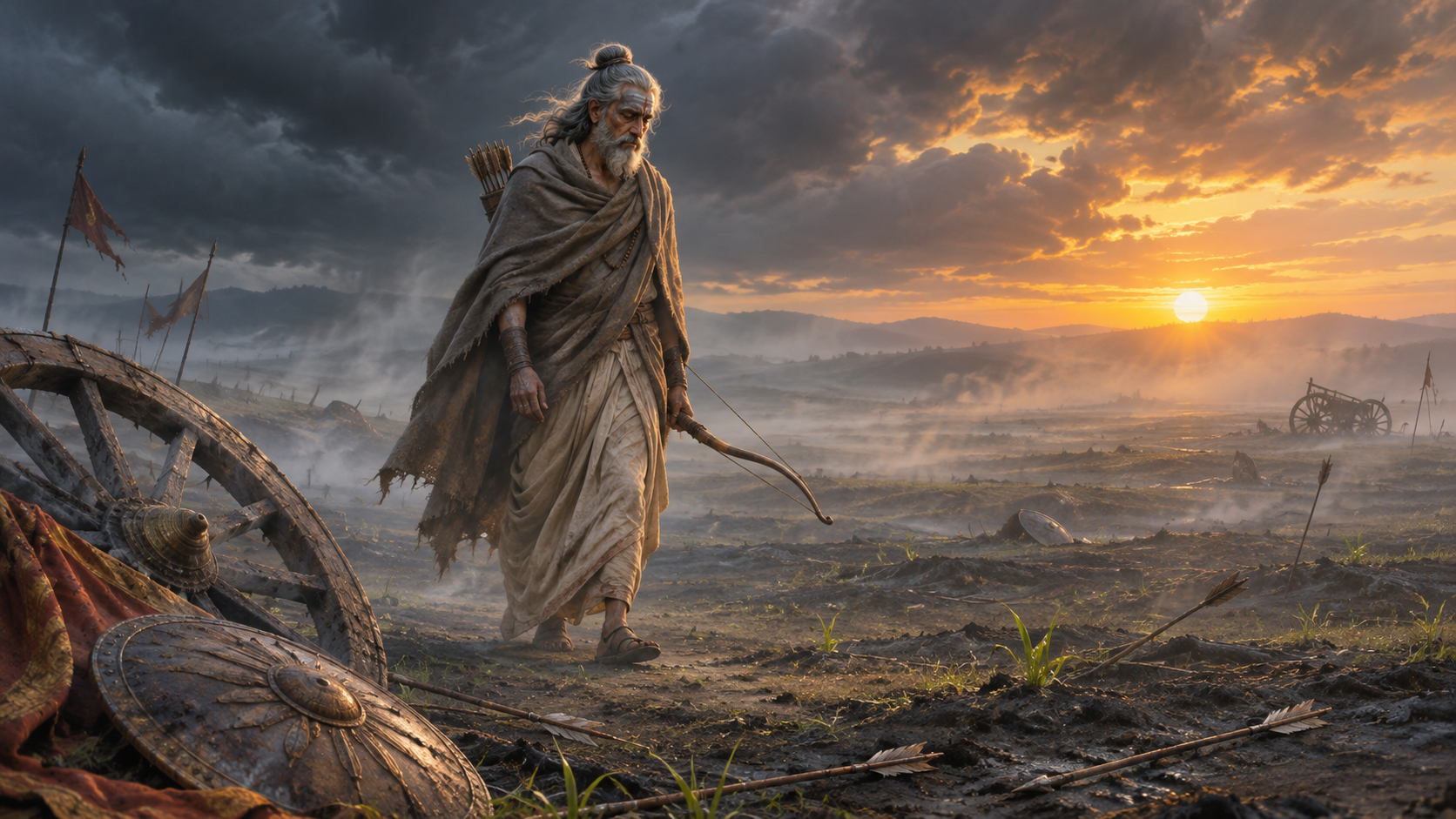
Kripa’s significance does not end with battlefield ferocity. He lives beyond the war, and that endurance adds another dimension to his Rudra amsha. Fierce power is not only the force that passes through destruction; it can also be the force that remains when destruction has passed.
Do not read survival as an automatic certificate of righteousness. In an epic, survival can mean preservation, but it can also mean continued responsibility, memory, or unresolved consequence. A person who remains must inhabit the world created by the actions that came before.
This is why Kripa should not be read only at the moment of combat. Compare the fierce warrior within the catastrophe with the figure who exists beyond it. Ask what his continued presence preserves and what it obliges him to remember. The Rudra association then becomes a pattern of endurance through dissolution, not a decorative label attached to his birth.
That comparison also corrects a common mistake in reading epic characters: treating their divine origin as more important than their narrative destination. Birth tells you what force enters the story. Survival shows you what the story does with that force after its most violent expression.
Key takeaways for reading the claim responsibly
- Kripacharya is best described as bearing a Rudra amsha, not as being completely identical with Rudra.
- Amsha means a partial manifestation or concentrated share of divine power, not a physical or numerical fraction.
- The Rudra connection directs your attention to fierce martial energy, severity, and endurance.
- Kripa’s divine inheritance can illuminate his participation in the night attack, but it does not by itself justify that participation.
- His survival beyond the war is not necessarily a reward; it can be read as continuity, responsibility, and the burden of remaining.
- The most balanced method is to judge the human action first and then use the divine amsha to understand its deeper pattern.
You do not have to choose between taking the Rudra connection seriously and taking Kripa’s moral agency seriously. The Mahabharata’s character becomes clearer when you preserve both. The amsha explains the kind of power moving through him; dharma determines how that power should be assessed.
The next time you read a Kripa episode, write down two observations: the human choice he makes and the Rudra quality the scene reveals. Keep those lines separate until both are clear. That small discipline will let you honour the epic’s sacred cosmology without flattening its ethical complexity.
References

Leave a Reply
You must be logged in to post a comment.