
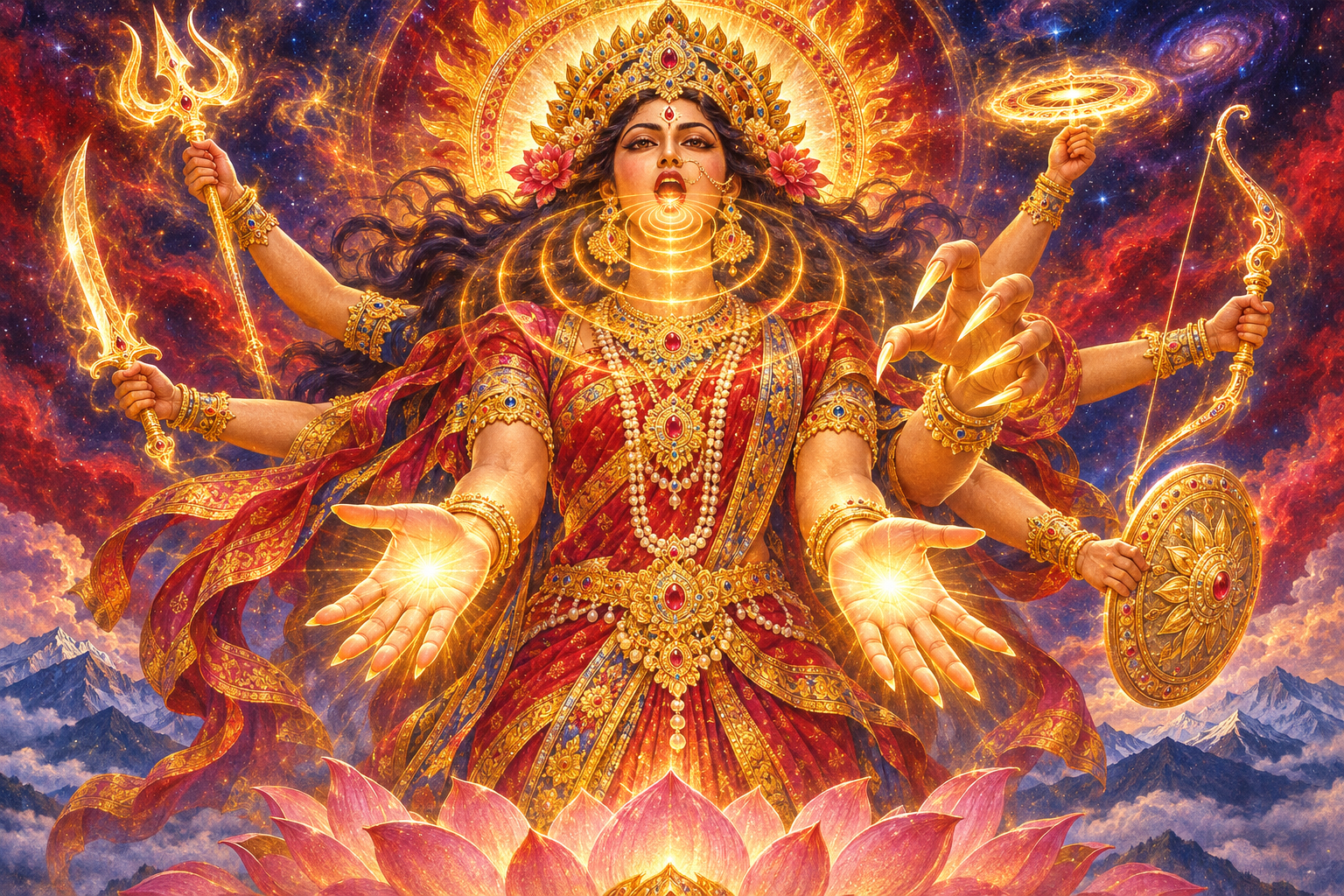
You look at an image of Shakti and see weapons in several hands. The natural question is which weapon came first and who placed it in her grasp. But that question can quietly reverse the theology: it makes the instrument seem older than the power using it.
To understand primordial Shakti, begin before the forged object. Her first powers are presented as voice and body: the hunkar that fills the universe, followed by fingernails used like blades. The familiar manufactured weapons come later as human forms for recognising a force that never depended on them.
First decide what kind of origin you are asking about
The origins of Shakti’s weapons can be approached in two different ways. One is historical: when did a particular object enter sculpture, painting, ritual practice, or the iconography of a particular form of the Goddess? Answering that question requires dated images, texts, inscriptions, and attention to regional traditions.
The other approach is theological. It asks what comes first in the order of divine power. Does Shakti become formidable because she receives a weapon, or can any object become formidable because Shakti holds it?
The primordial account answers the second question. It is a hierarchy of power, not a dated catalogue of art. Shakti is understood as Time itself. A being identified with the force that consumes every embodied thing cannot ultimately depend upon an implement fashioned within time.
Keep that distinction in view when you encounter a confident claim about the first weapon of the Goddess. A theological sequence cannot by itself tell you when a sword, spear, or other attribute first appeared in material culture. Conversely, the age of a surviving image cannot determine the limits of Shakti. Historical evidence and theological meaning answer different questions.
The first weapon is voice, not an object

Primordial Shakti’s first weapon is hunkar: a scream or forceful vocal utterance that spreads through the universe. The crucial detail is that nothing has to be built, sharpened, carried, or supplied. The act proceeds immediately from her being.
This changes how you should read the word weapon. In ordinary use, a weapon is an external tool that increases the reach of its bearer. Here, the earliest weapon is closer to self-manifestation. Voice crosses the distance between hidden power and the world that must encounter it. Shakti does not borrow force from an object; her expression itself becomes force.
The hunkar also prevents a common visual mistake. Because an image gives you visible objects to inspect, your attention can settle on what is easiest to name: the blade, shaft, handle, or point. Sound cannot be frozen in the same way. Yet the sequence places the invisible act before the visible implement. What is hardest to depict is presented as more primordial than what is easiest to carve.
When you next view an image of the Mother, do not begin by counting objects. First ask what cannot be held in a hand: voice, presence, will, time, and the power by which an action becomes effective. The held attributes make more sense after that question, not before it.
Fingernails make the same point in bodily form
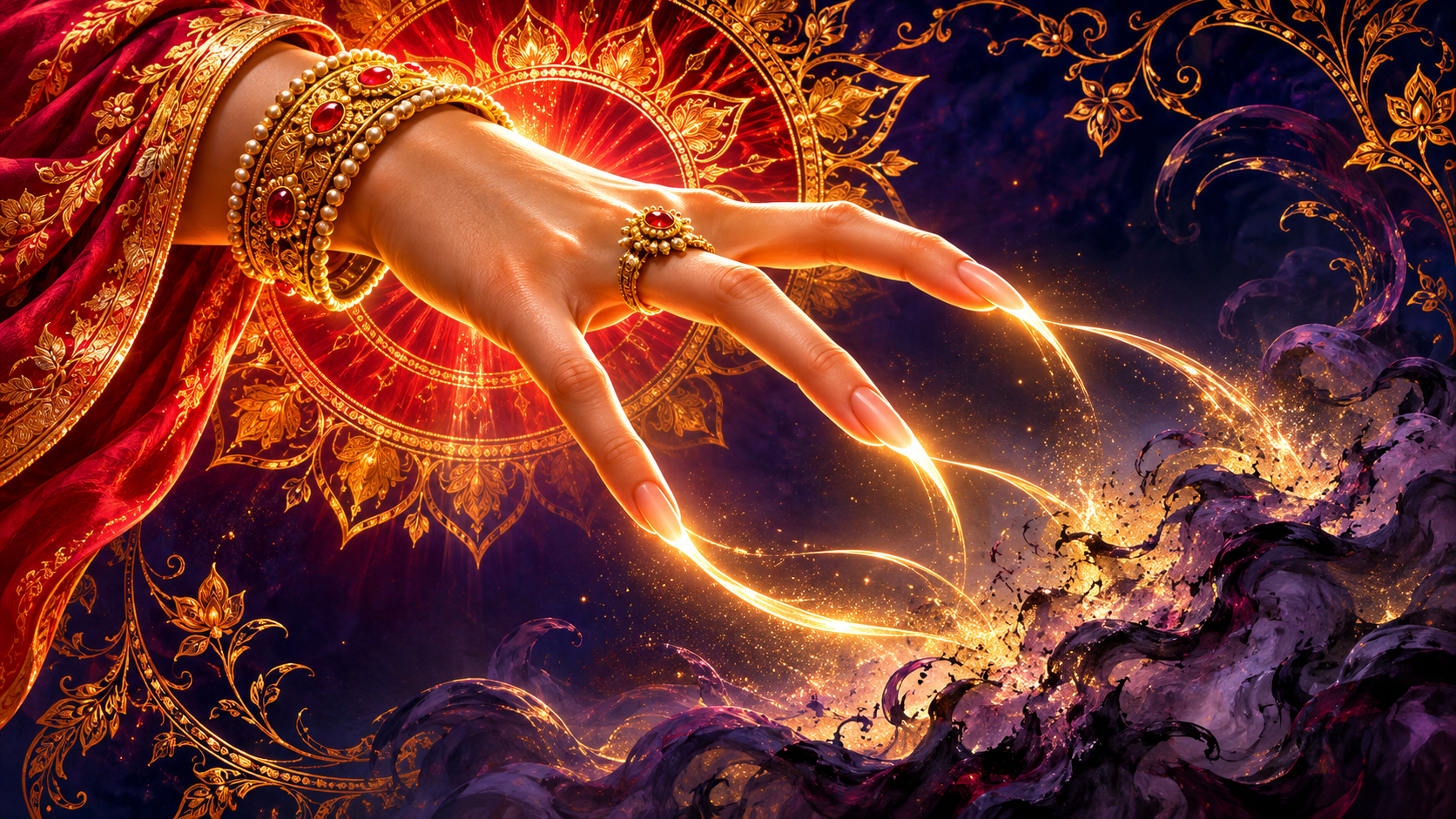
After hunkar come Shakti’s fingernails. They require no artisan and no separate material. They belong to the body, yet they can perform the work later associated with a cutting instrument.
The order of events matters. Shakti first subdues her enemies and only then uses her nails like blades to cut them apart. Victory is therefore not credited to a superior piece of equipment. The opponents have already been overcome before the cutting begins. The nails reveal the completeness of her power; they do not create it.
That gives you a precise test for interpreting divine weapons. Ask whether your reading makes Shakti dependent on the object. If removing the object would leave the Goddess powerless, the interpretation has confused the sign with its source. The primordial sequence points in the opposite direction: even what appears ordinary in the body can become sufficient when it expresses Shakti.
This is not an argument that the body is merely another weapon. It is a lesson about immediacy. Hunkar is inherent expression; fingernails are inherent instruments. Both stand closer to the Goddess than a manufactured implement. The movement is from being, to expression, to bodily action, and only later to the crafted objects familiar in sacred images.
Human-made weapons do not diminish the divine image
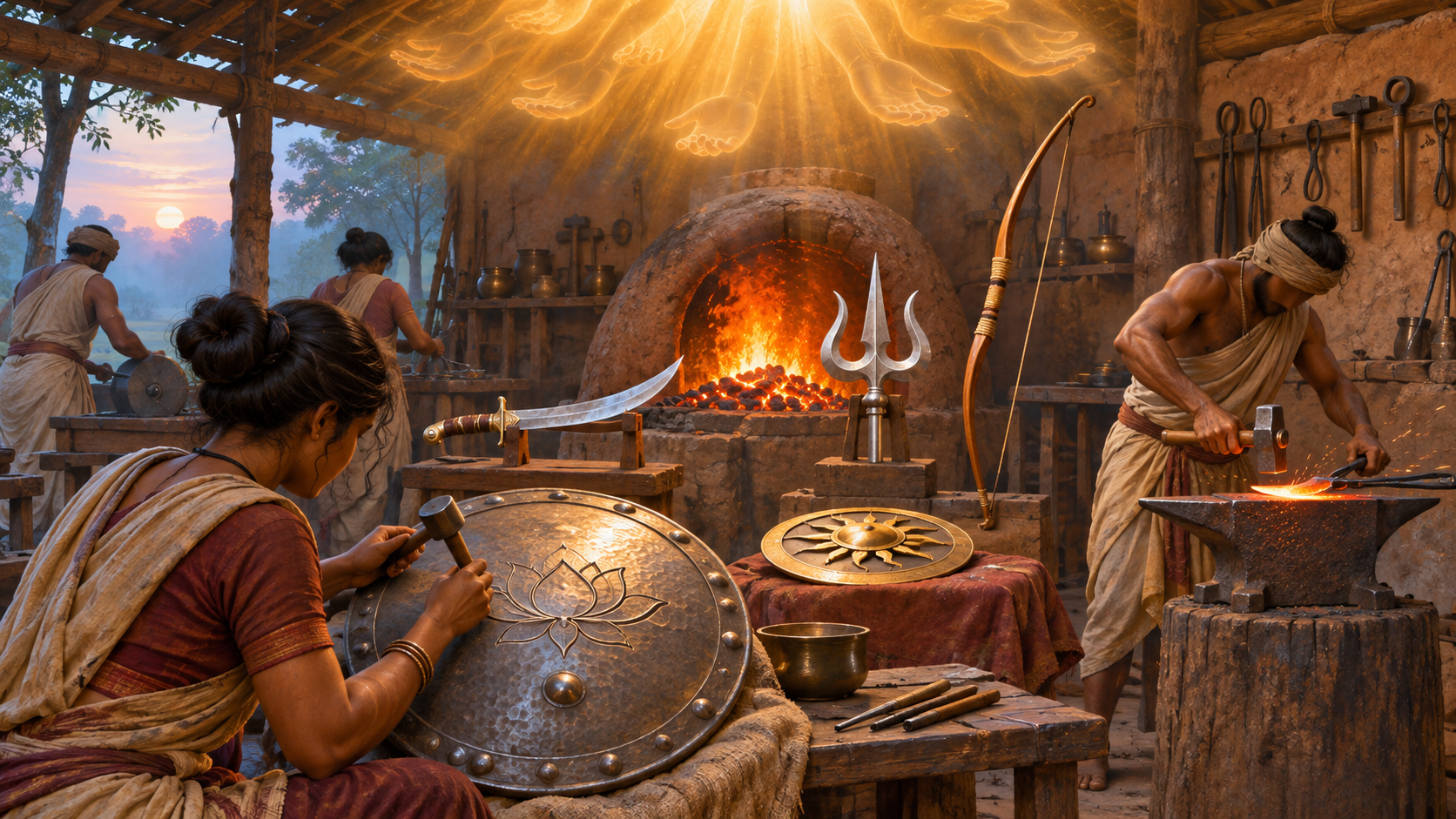
Saying that the later weapons are human creations need not be read as an attack on murti, temple art, or devotional imagination. A symbol does not become worthless because human hands can fashion it. Human beings require visible forms through which distinctions can be remembered, contemplated, and transmitted.
A crafted weapon gives shape to a particular kind of action. A worshipper can notice whether an attribute cuts, reaches, restrains, protects, or confronts. Those observations can guide contemplation, but they should not be turned into a rigid universal dictionary. The precise meaning of an object may depend on the form of the Goddess, the tradition venerating her, and the larger arrangement of the image.
The soundest relationship between Shakti and her attributes runs in one direction: her power gives the object its divine significance. The object does not confer divinity upon her. A manufactured weapon can therefore be sacred without being primordial. It can disclose an aspect of power without being the origin of that power.
This also guards against a crude story of progress. The movement from scream and nails to crafted arms should not be treated as though the Goddess began with primitive equipment and later acquired better technology. Hunkar is not an inferior substitute for metal. It comes first precisely because unmediated Shakti needs no technological extension.
A practical way to read any image of Shakti
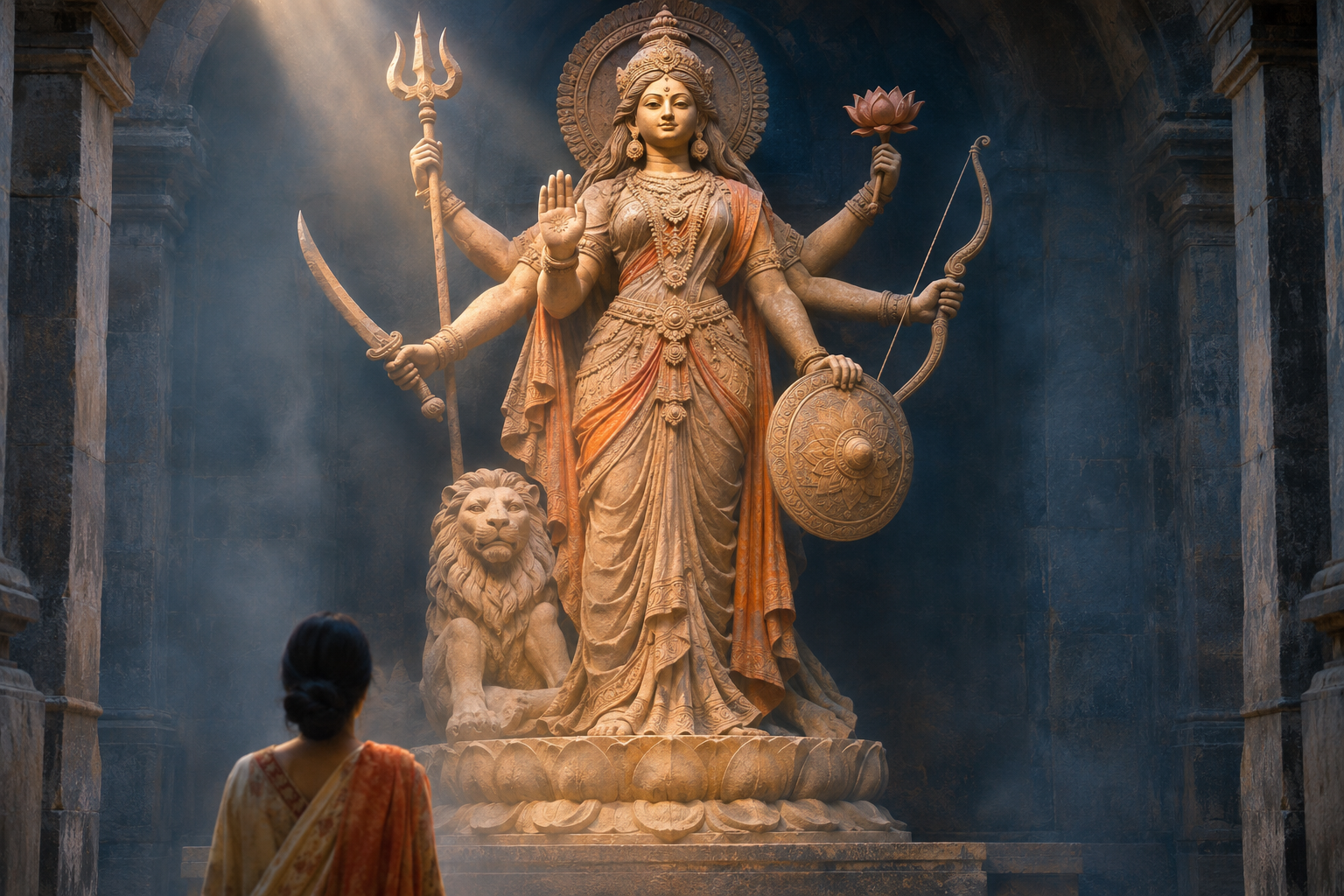
You do not need to ignore the weapons in order to see beyond them. Use the image in layers, moving from the specific form before you to the primordial principle behind it.
- Name the particular form. Do not merge every image of the Goddess into one generic catalogue. Begin with the name used by the shrine, household, artist, or tradition.
- Observe before assigning meanings. Note what is held, what the hands are doing, and which features belong to the body. Description should come before interpretation.
- Separate inherent power from external equipment. Place voice, presence, bodily action, and manufactured objects in different categories. This immediately shows whether your reading depends too heavily on the hardware.
- Ask what action the attribute makes visible. Focus on the relationship between bearer, object, and action rather than attaching a single isolated keyword to the object.
- Apply the dependence test. If your interpretation implies that Shakti needed the implement in order to become powerful, return to hunkar and the fingernails. The primordial order says that the capacity precedes the tool.
- Keep theology and chronology separate. Use historical evidence for claims about when an image appeared. Use the primordial sequence to understand why divine power cannot be reduced to the age or material of an image.
Key takeaways
- Primordial Shakti’s first weapon is hunkar, a scream that spreads through the universe.
- Her fingernails come next and act as blades after her enemies have already been subdued.
- The sequence places inherent expression and bodily power before manufactured instruments.
- Later weapons remain meaningful, but they reveal aspects of Shakti rather than supplying her power.
- Theological priority is not the same as the historical date when an object entered sacred art.
The next time you stand before Shakti, let your attention move in the same order: from the visible implement to the action it signifies, from the action to the power that makes it effective, and from that power to the Mother who needs no forged weapon at all. Her hunkar comes first, her fingernails follow, and human-made weapons arrive only after her sufficiency is clear.
References

Leave a Reply
You must be logged in to post a comment.