

If your work matters to you, easing your grip can feel like lowering your standards. Yet when every task becomes a test of your worth, even spiritual practice turns into another performance measure. You work harder, enjoy less and remain haunted by the possibility that none of it is enough.
You do not have to choose between exacting work and an unburdened life. A Dharmic approach puts each concern in its proper place: dharma identifies your responsibility, purpose supplies direction, excellence governs the quality of action, and lila — divine play — frees you from treating a finite result as the final verdict on your life.
Let dharma, purpose, excellence and lila do different work

The word purpose is often asked to answer several different questions. What should you do now? What kind of future should you build? Why does your life matter? What will make other people respect you? Packing all of these into one grand mission makes purpose too heavy to use.
A clearer framework separates four questions:
- Dharma: What does this role, relationship or situation rightly ask of you?
- Purpose: What worthy direction are your choices serving?
- Excellence: What standard of care does this particular action deserve?
- Lila: Can you participate wholeheartedly without pretending that you control the whole movement of life?
Suppose an urgent family responsibility interrupts a project tied to your long-term ambitions. Purpose may still point toward the project, but dharma may require your attention at home. Excellence means giving proper care to whichever responsibility is actually yours in that moment. Lila helps you release the fantasy that a disrupted plan has ruined the entire story.
This distinction also protects you from spiritual evasions. Purpose cannot justify neglecting a present duty. Divine play cannot excuse carelessness. Excellence cannot demand limitless time. Repeated practice, or abhyasa, gives your effort continuity, but repetition must remain answerable to dharma rather than becoming compulsion.
Before your next important decision, answer each of the four questions in one plain sentence. If you cannot identify the duty, do not hide the uncertainty beneath an inspiring mission statement. If you cannot name the standard, you are not ready to judge the work. If you cannot distinguish your action from the outcome, you are preparing to carry more than belongs to you.
Make excellence an offering, not an identity test
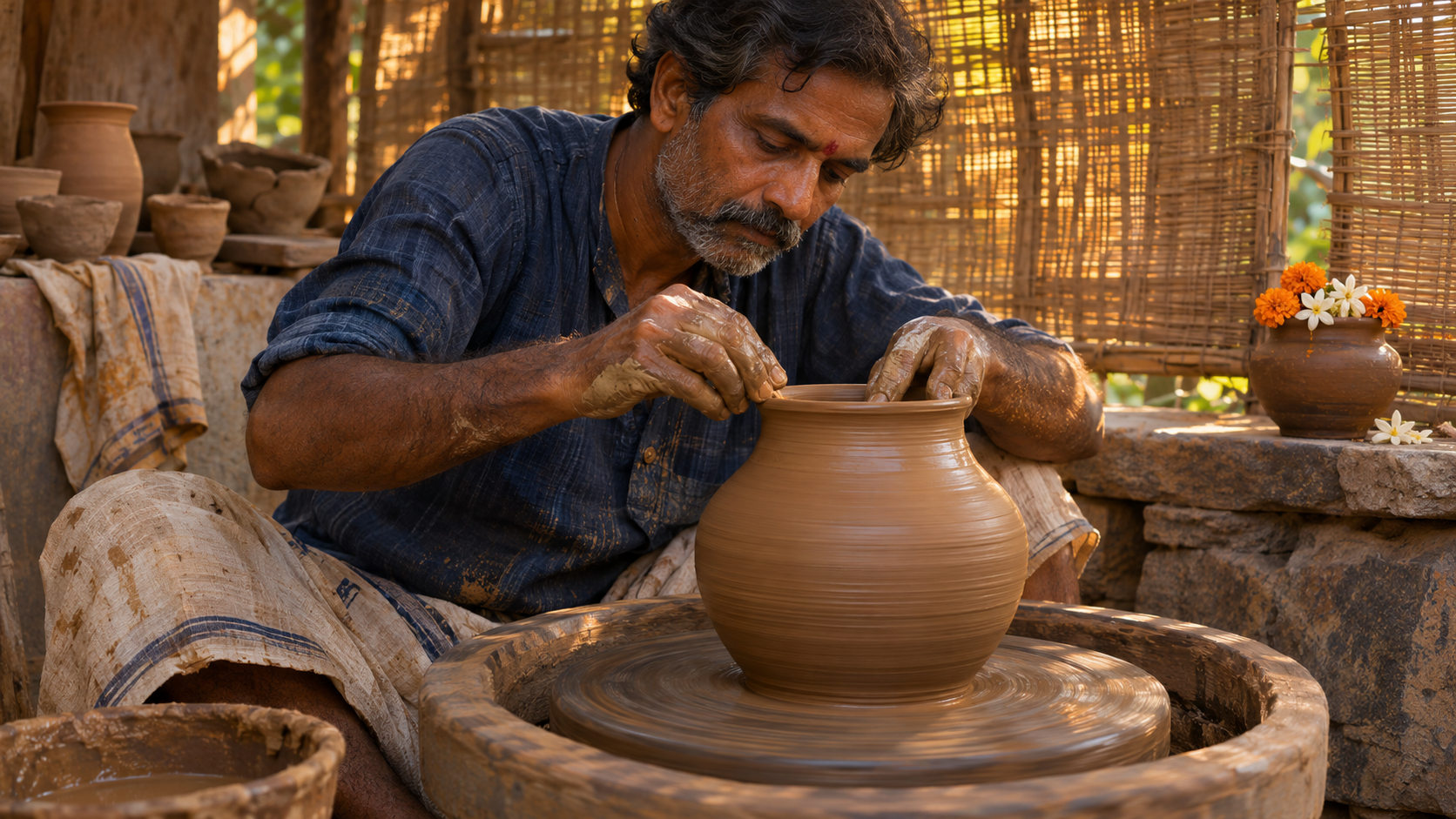
A temple-sculptor scene brings the inner standard of craft into focus: an artisan is making a sacred image while a similar one lies nearby, even though only one is needed. The scene matters because the standard is not created by applause. The maker still has to answer to the work.
That is different from perfectionism. Excellence asks, What does this work deserve? Perfectionism asks, How can I prevent this work from exposing me to criticism? The first directs attention toward the task and those it serves. The second keeps pulling attention back toward the self.
You can usually distinguish them by setting a completion test before anxiety begins to move the boundary:
- Name the person, community, practice or function the work is meant to serve.
- Identify the defects that would genuinely prevent it from serving that purpose.
- State what promise, duty or craft requirement must be fulfilled before the work is complete.
- Ask which other responsibility will lose attention if you continue refining this one.
An invisible defect may still matter. A hidden weakness can compromise function, safety or integrity even when no observer will notice it. In sacred and cultural work, beauty and reverence may also be part of the function rather than optional decoration. The question is not simply whether someone will see the correction. The question is whether the correction serves the work.
Use two tests when you are tempted to keep polishing. If your name were removed, would the correction still benefit the recipient or honour the task? And what legitimate duty are you postponing by continuing? A yes to the first may justify further care. A serious answer to the second may tell you to stop.
An inner standard without a stopping point becomes self-punishment. A stopping point without an inner standard becomes carelessness. Excellence requires both: honest workmanship and proportion.
Use purpose as a compass, not a courtroom

Relentless purpose-seeking can leave a person exhausted, disconnected and out of rhythm with life. This happens when purpose stops guiding choices and starts prosecuting every unproductive moment.
Under that pressure, rest must prove that it will improve later output. Friendship becomes networking. Worship becomes a technique for concentration. A walk, a meal or an hour with family seems wasteful unless it advances a measurable goal. Life is no longer lived; it is continuously submitted for evaluation.
A compass is useful because it indicates direction. It does not condemn you for pausing, taking shelter or attending to the person beside you. Purpose should work the same way. It should help you choose among competing possibilities without demanding that every experience become a rung on a ladder.
Build purpose in practical layers rather than waiting for one permanent mission:
- Choose an orientation. Name the quality of service you want your life to express, such as truthfulness, stewardship, learning, protection or devotion. Keep it broad enough to survive a change in job or status.
- Name the present commitment. Identify the responsibility that deserves priority in your current circumstances. This is more useful than an impressive ambition with no claim on your daily conduct.
- Select the next faithful action. Convert the commitment into something observable: finish the promised work, make the necessary call, prepare the meal, keep the appointment or begin the practice.
- Protect non-instrumental space. Leave room for worship, conversation, beauty, quiet and recreation without forcing them to justify themselves as productivity tools.
Your orientation may remain steady while your commitments change. Your next action may be small without being insignificant. When life becomes uncertain, the nearest genuine duty is enough to begin. You do not need to discover a singular destiny before you can live honourably.
This is where a Dharmic sense of purpose differs from personal branding. It does not ask you to invent a heroic identity and then bend every circumstance around it. It asks you to notice the responsibilities already present, place them within a worthy direction and act without making yourself the centre of the universe.
Practise divine play without becoming careless

Divine play is easily mistaken for the claim that nothing matters. That reading empties lila of its discipline. Play can involve form, skill, attention, response and consequence. What it loosens is not care but possessiveness — the belief that you must dominate the result for the action to have value.
Serious care prepares, checks, repairs, apologises and follows through. Grimness treats tension as proof of importance, ties self-worth to success and refuses to stop after the duty is complete. You can abandon grimness without abandoning care.
Use this sequence when you begin work that matters:
- Name the duty. State what is actually yours to do, not everything you wish you could control.
- Define honest completion. Decide which promises, functional needs and standards must be met.
- Identify the offering. Remember the person, community, sacred commitment or larger good the action serves.
- Enter the action fully. Give attention to the next movement instead of mentally rehearsing praise, blame, victory or failure.
- Watch for expanding attachment. If fear or vanity keeps adding requirements, compare them with the completion standard you set at the beginning.
- Inspect without flattery. Correct shortcomings that affect the work. Do not rename avoidable negligence as detachment.
- Close the action. Once the duty is fulfilled, receive the result, learn what it teaches and stop extracting an identity from it.
If the outcome disappoints you, lila does not require pretending that it was good. Repair what can be repaired. Admit what was poorly done. Change the method where necessary. Then refuse the extra punishment of turning one result into a declaration about your entire being.
If the outcome succeeds, receive appreciation without converting it into evidence of special status. Gratitude is compatible with excellence; self-inflation is not required. The same release applies after failure and success because neither result belongs to you alone.
This is close to the practical spirit of karma-yoga: full attention to action without claiming absolute possession of its fruits. You still plan, practise and make judgments. You simply stop asking the result to establish your right to exist.
Divine play will not always feel cheerful. Some duties are solemn, tiring or painful. The lightness of lila lies deeper than mood. It is the freedom to meet a demanding moment without forcing that moment to validate the whole of your life.
Key takeaways
- Let dharma determine what is rightly yours to do, purpose indicate direction, excellence set the standard and lila release the result.
- Define honest completion before you begin, so fear and vanity cannot keep moving the boundary.
- Judge a correction by whether it serves the work, not by whether other people will notice it.
- Keep some parts of life free from optimisation; worship, relationship, beauty and rest do not need to become instruments of ambition.
- Wholehearted effort and surrender are not opposites. You can care deeply without treating an outcome as a verdict on your worth.
Choose the next task that genuinely belongs to you. Before touching it, name whom it serves, what honest completion means and which part of the outcome you cannot command. Then work carefully, finish cleanly and leave room for life to answer back. That is where excellence begins to feel less like a burden and more like participation.
References
- Hindu Pad — A story of Excellence from Hare Krishna Movement
- Hindu Blog — Seeing Life Seriously With A Purpose Is Destroying The Natural Rhythm – Hinduism

Leave a Reply
You must be logged in to post a comment.