
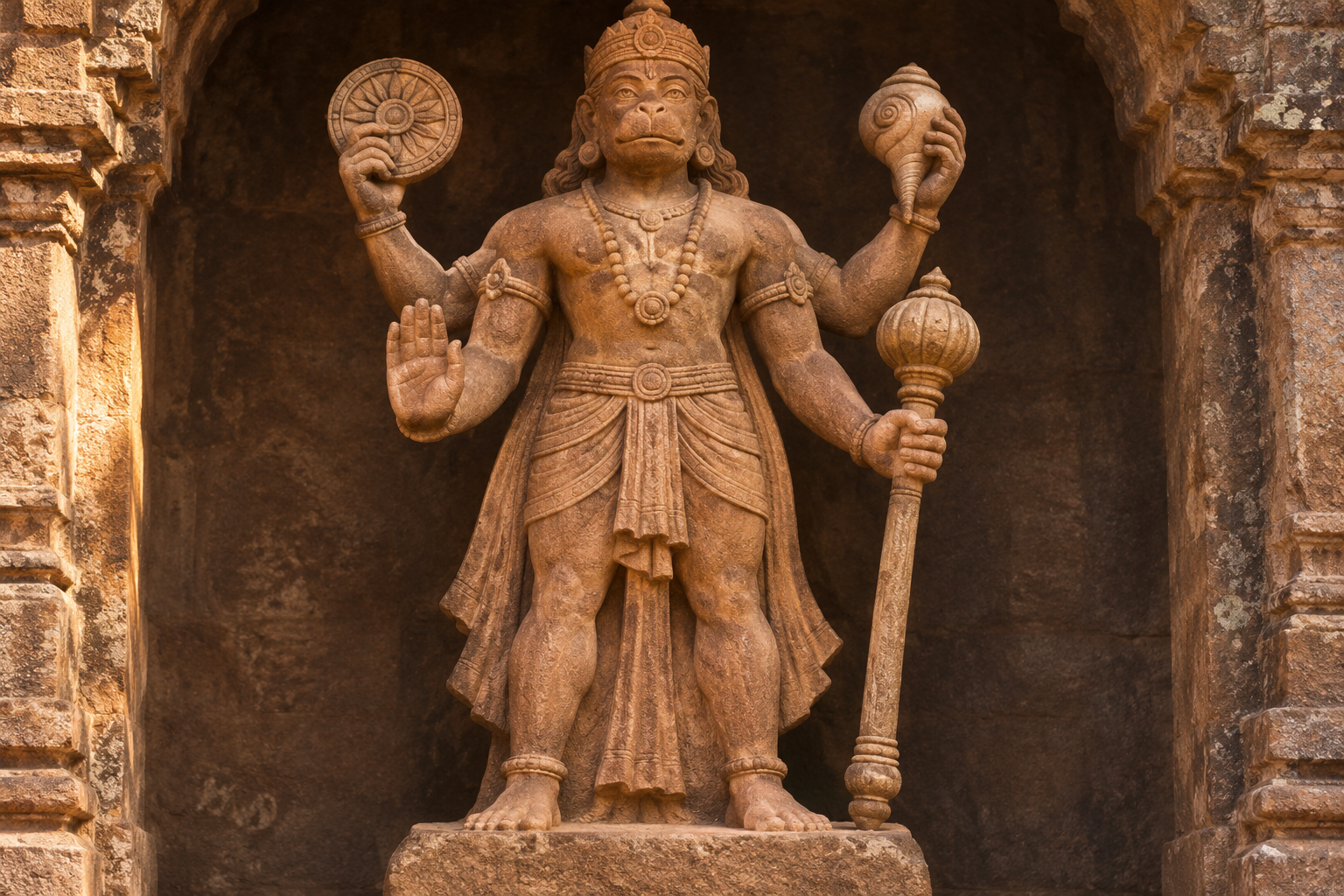
If you have found an unfamiliar Hanuman murti in a temple niche, sculpture gallery or photograph, the extra arms can make it easy to jump to the wrong label. Begin with the visible cluster: a Hanuman figure with four arms and the shankha, chakra and gada points to the rare Chaturbhuja Hanuman form.
The name identifies the form, but it does not finish the reading. You still need to distinguish what the image visibly establishes from what its symbols may mean. That discipline prevents two common errors: overlooking the form’s Vaishnava vocabulary and making a larger theological claim than the murti can support.
Start with a visual inventory, not a theological guess
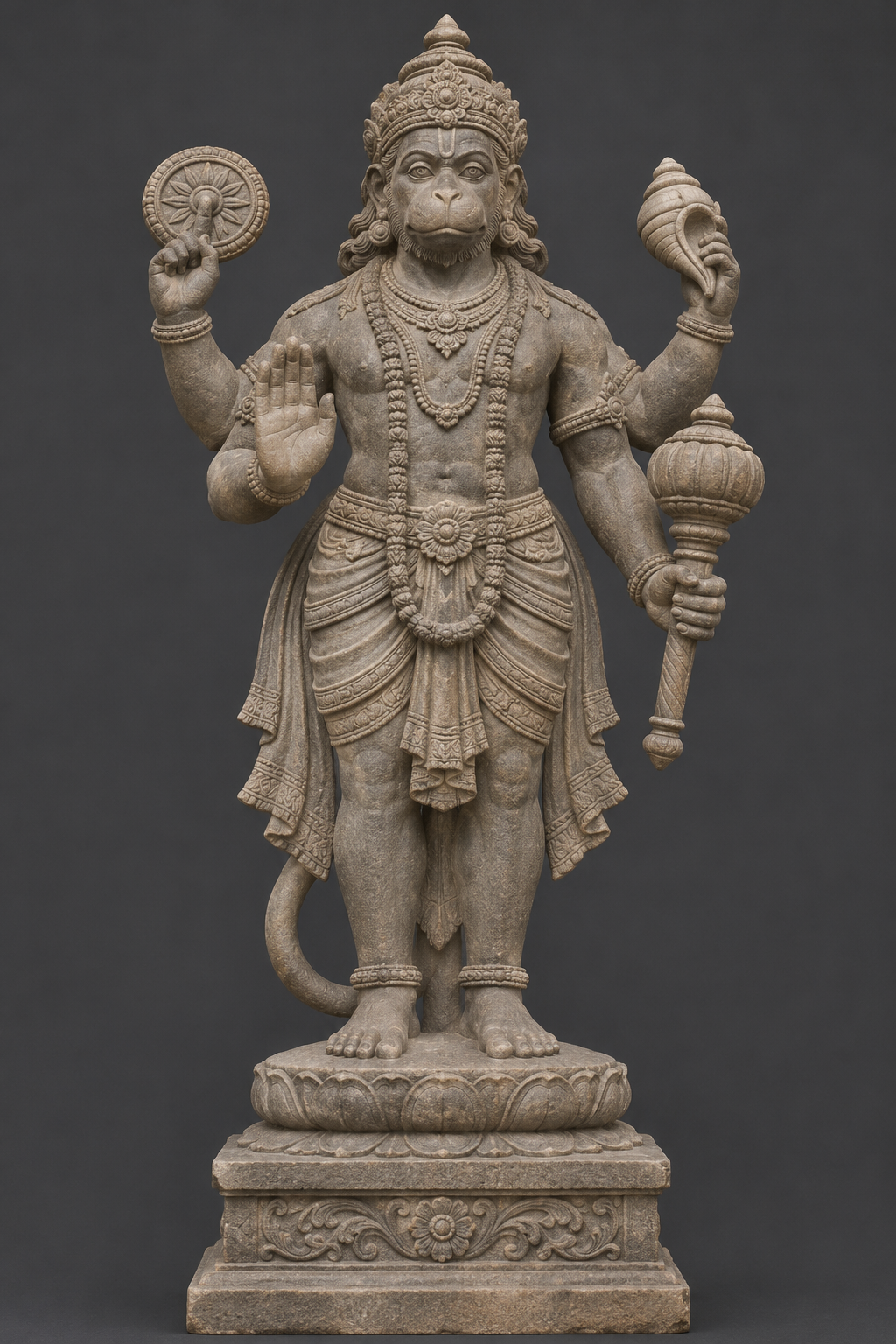
Chaturbhuja means four-armed. Count the arms before interpreting the objects in them. A tail, a damaged projection, an ornamental element or an object held across the body can confuse the silhouette, especially in a frontal photograph.
- Count the arms that emerge from the shoulders. Record four only when you can follow four actual limbs.
- Identify each object separately. The shankha is a conch, the chakra is a discus and the gada is a mace.
- Confirm that the figure is Hanuman. Look for characteristic features such as the simian face and tail, then consider the temple’s name for the murti, any inscription and the surrounding sacred context.
- Mark anything obscured, broken or cropped as unclear. Do not convert an expectation into an observation.
This sequence matters because four arms are not unique to Hanuman, while the gada by itself is already familiar in Hanuman imagery. The stronger identification comes from the combination of the Hanuman form, four arms and the coordinated attributes. If one of those elements is uncertain, keep the identification provisional until you can inspect a clearer view or reliable local description.
Read the shankha, chakra and gada as a coordinated set
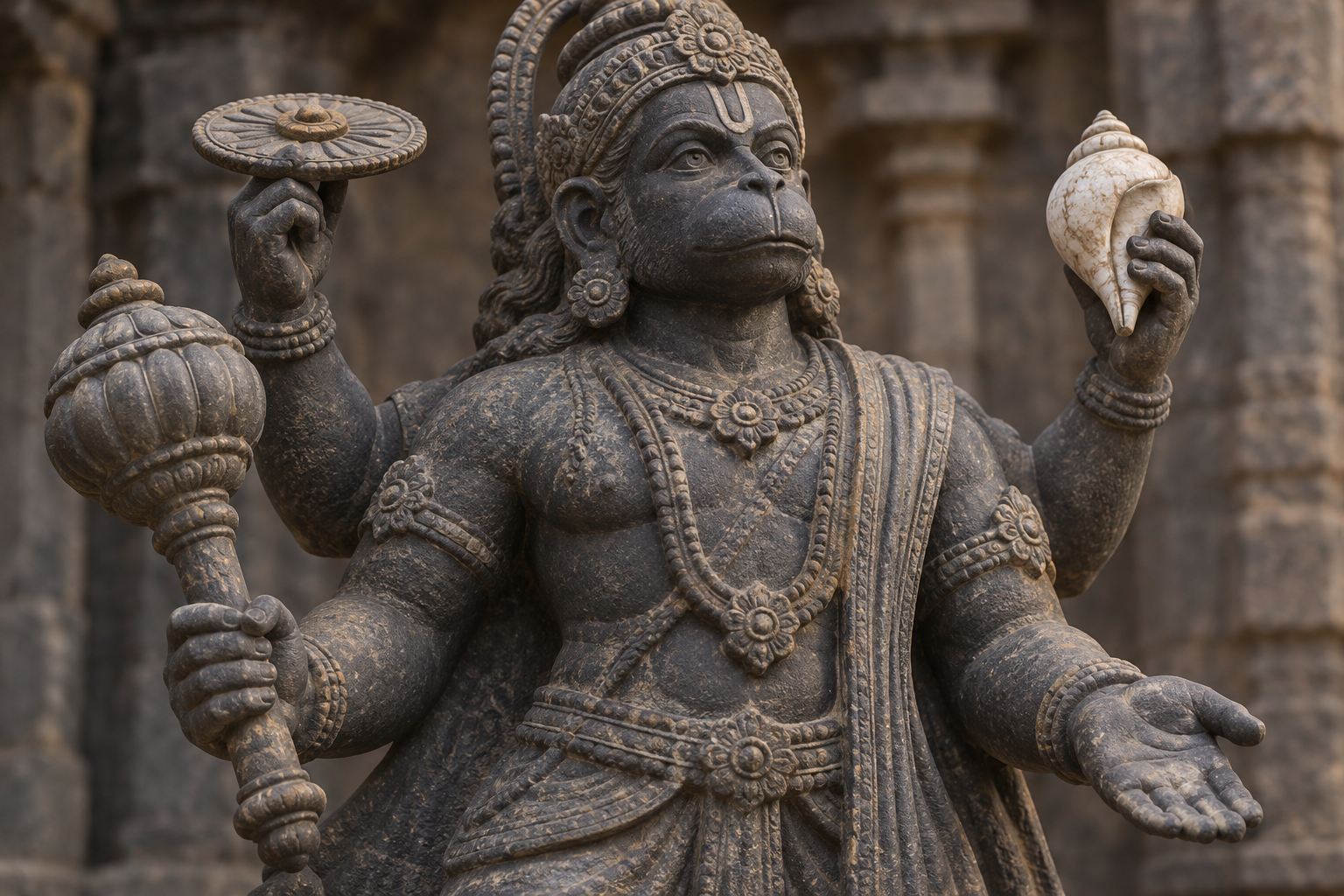
The three emblems should not be treated as decorative inventory. Read them together and ask how each changes the character of the figure.
| Attribute | What you are seeing | A careful interpretive question |
|---|---|---|
| Shankha | Conch | Does the form present Hanuman as one who announces and upholds dharma, not only one who acts in battle? |
| Chakra | Discus | Is protective power being shown as ordered and divinely authorized rather than as raw force? |
| Gada | Mace | How is Hanuman’s strength placed in the service of a sacred purpose? |
The shankha and chakra carry a strong association with Vishnu and place this Hanuman image within a recognizably Vaishnava visual vocabulary. The gada maintains continuity with Hanuman’s familiar strength. Together, the emblems connect power, protection and devotion without reducing the murti to any one of those themes.
Do not turn that vocabulary into a rigid symbol dictionary. An emblem can communicate several related ideas at once, and its emphasis may depend on the temple tradition in which the murti is worshipped. The soundest interpretation starts with the ensemble and then asks how local worshippers understand it.
Why the four arms change the way you encounter Hanuman
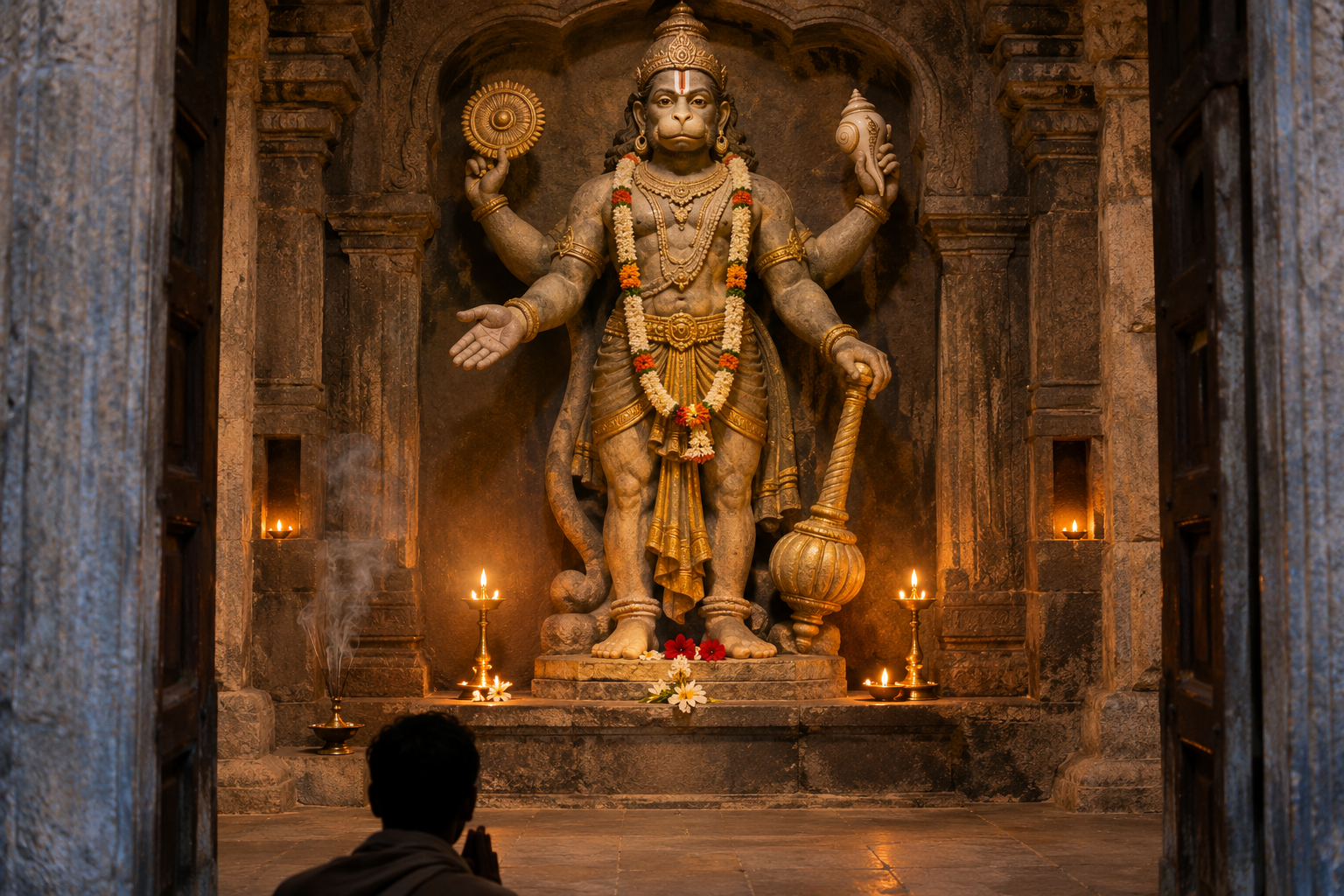
Common two-armed depictions often direct your attention toward humble service or heroic strength. A posture can foreground one action or one devotional mood. Four arms allow several attributes to appear simultaneously, so the image presents a more expansive divine presence.
That expansion does not cancel Hanuman’s devotion. It shows that devoted service and divine power need not be opposites. Strength is not displayed as self-importance; it remains aligned with dharma. Protection is not detached from humility; it becomes an expression of sacred responsibility.
It is therefore misleading to treat the additional arms as a simple ranking, as though four-armed Hanuman must be a “better” or universally “higher” Hanuman than every two-armed form. Iconography changes emphasis. A two-armed image may lead you to notice what Hanuman is doing, while the Chaturbhuja image asks you to consider the powers gathered within his service.
Avoid five common identification mistakes
- Do not confuse arms with faces. Chaturbhuja describes four arms; Panchamukhi describes five faces. The terms identify different features and are not interchangeable.
- Do not call every four-armed figure Hanuman. Confirm the bodily features and sacred context before assigning the name.
- Do not use the gada as the sole clue. Count the arms and look for the shankha and chakra as part of the coordinated set.
- Do not claim that Vishnu-associated emblems, by themselves, prove a complete identity between Hanuman and Vishnu. Shared attributes can express relationship, authority and theological affiliation without settling every doctrinal question.
- Do not invent the fourth hand’s attribute. If three objects are visible but the remaining hand is hidden, damaged, empty or unclear, write “unclear” in your notes and inspect another view.
The last point is especially important when you are working from a photograph. A neat reconstruction may feel satisfying, but iconographic study depends on separating what the image shows from what you expected to find. If the fourth hand is not visible, its position or object remains an open question for that particular murti.
Key takeaways
- Identify Chaturbhuja Hanuman through a cluster of evidence: Hanuman’s bodily form, four arms, and the shankha, chakra and gada.
- Read the shankha and chakra as Vaishnava visual language, while the gada preserves the familiar emphasis on strength and active service.
- Understand the extra arms as an expansion of the image’s theological range, not as a rejection of Hanuman’s humility or devotion.
- Keep observation and interpretation separate. Write down what is visible before explaining what it means.
- Use the temple’s name, inscription and living tradition to refine the reading, especially when an attribute is damaged or obscured.
On your next temple visit, make a five-line record before reaching a conclusion: number of arms, presence of shankha, presence of chakra, presence of gada and condition of the remaining hand. Then ask how the temple names and worships the form. That small discipline will give you a more faithful reading than a sweeping claim built from one familiar symbol.
References

Leave a Reply
You must be logged in to post a comment.