
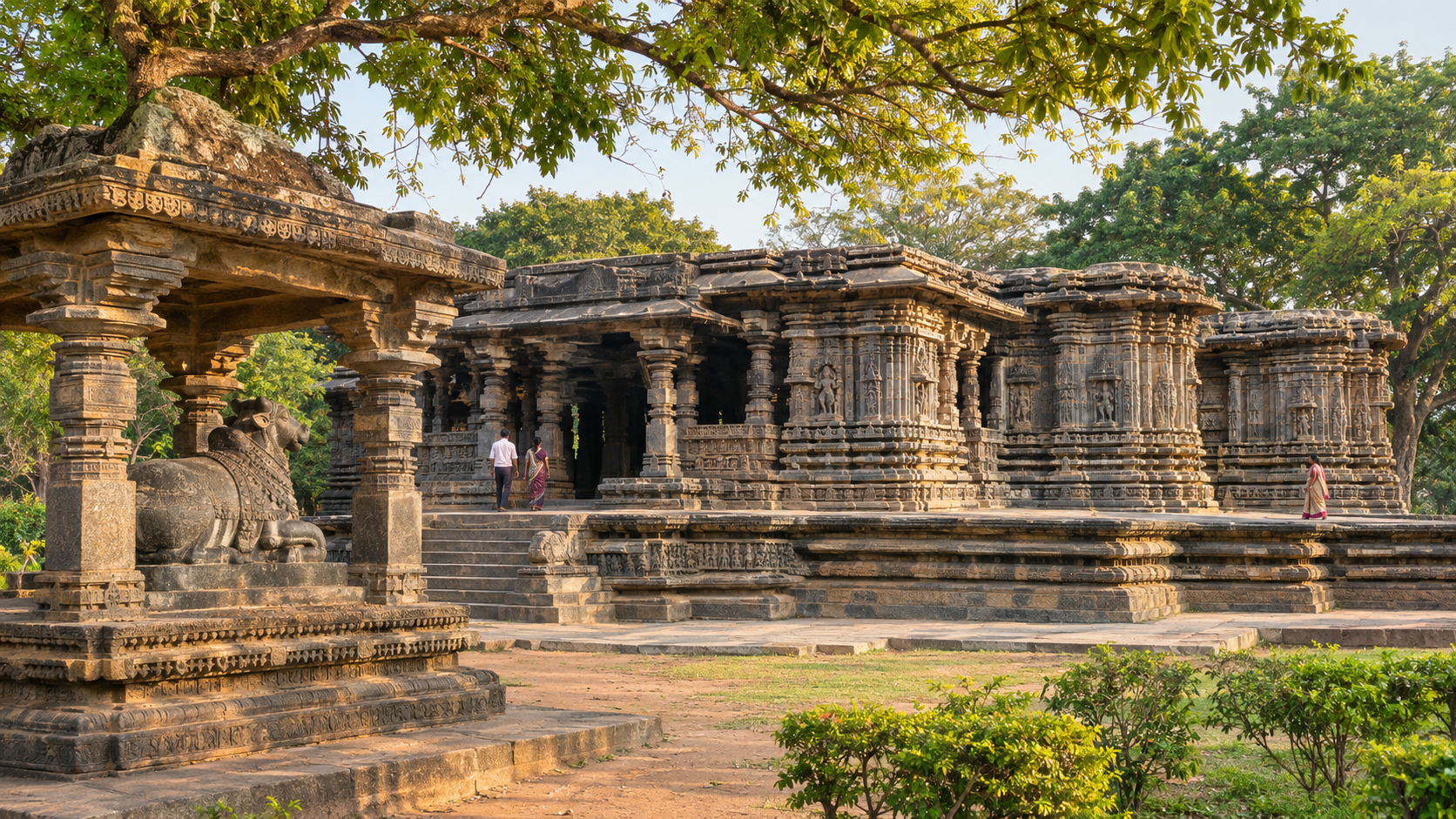
If you are deciding whether to visit the Thousand Pillar Temple, begin with one correction to the usual tourist instinct: do not arrive expecting that the main task is to count pillars. The name is memorable, but the temple becomes far more intelligible when you approach it through its sacred identity, its three-shrine plan, and its Kakatiya setting.
This gives you a practical way to prepare. Use the right names when planning the journey, learn what trikutalaya means before entering, and observe how a temple can carry worship, architecture, and regional memory at the same time.
Use both names to find the right temple
The popular name Thousand Pillar Temple generally refers to the historic Rudreswara, also spelled Rudreshwara, Swamy Temple at Hanamkonda. Hanamkonda forms part of the present-day Warangal urban area in Telangana. That distinction matters when you search maps, arrange transport, or ask locally for directions: a broad search for attractions in Warangal may not be as precise as the paired names.
Use this naming sequence when planning:
- Search for “Thousand Pillar Temple Hanamkonda” to identify the familiar destination.
- Check that the listing also identifies it as Rudreswara or Rudreshwara Swamy Temple.
- Confirm current access, worship, photography, and footwear rules through a current local or official channel. These practical conditions can change and are not established by the temple’s historical description.
- Save the complete location rather than relying only on “Warangal,” which refers to the wider urban area.
The two spellings of Rudreswara are variants of the same temple name, not evidence of two different monuments. Keeping both in your search terms will help you recognize relevant signs and listings without confusion.
Read the trikutalaya before looking for a thousand pillars
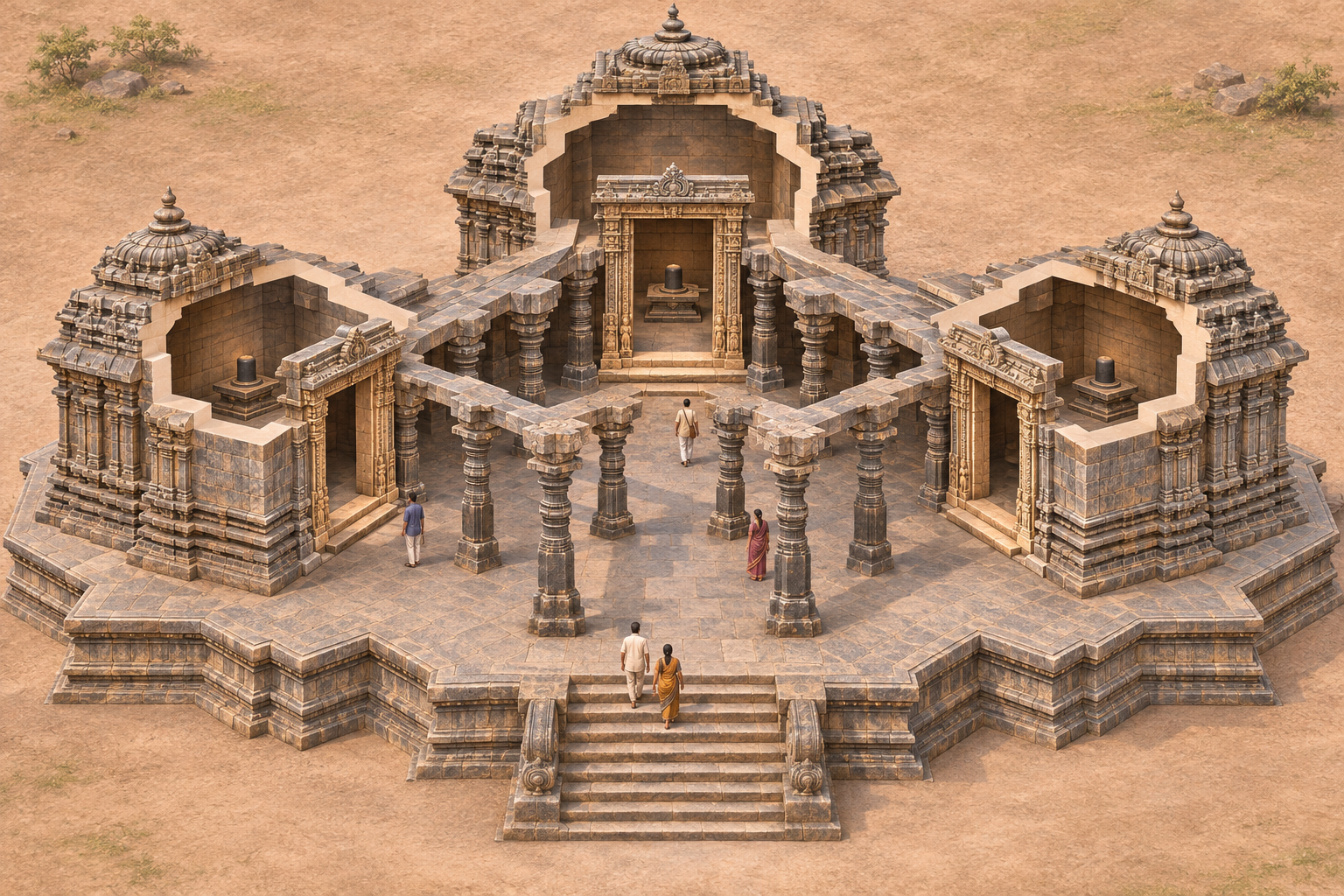
The most useful architectural term to know is trikutalaya: a temple organized around three shrines. This tells you more about how to observe the complex than the numerical nickname does. The three-part arrangement asks you to notice relationships among sacred spaces rather than treating the building as one undifferentiated hall.
Before moving close to individual details, pause where you can understand the overall arrangement. Try to identify the three shrine directions and the space that connects them. Then change your position and see how the plan reveals itself from another angle. A temple plan is experienced through movement; one frontal photograph rarely explains it.
Use four questions to guide your attention:
- Where are the three shrine entrances in relation to one another?
- Which spaces appear to be shared, and which lead toward a particular shrine?
- How do your sightlines change as you move through the structure?
- What does local signage identify about each sanctum?
Do not assign a deity to each shrine from memory or from an unverified caption. The available description establishes the three-shrine form but does not supply a complete identification of all three sanctums. Read the temple’s own signs or ask an authorized person at the site. That small discipline protects you from turning an uncertain detail into a confident but inaccurate claim.
Let the Kakatiya setting change what you notice
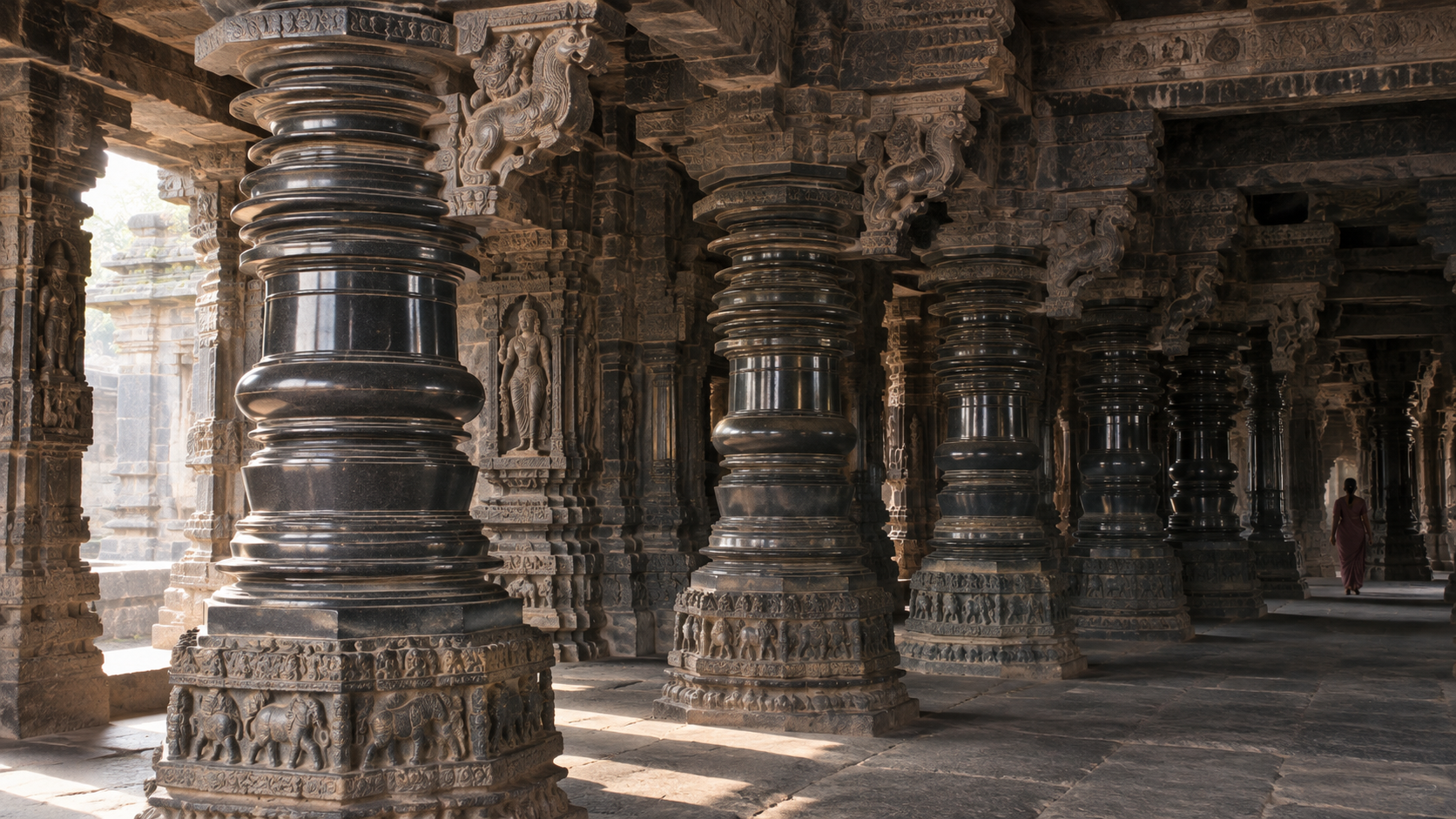
Rudreshwara Swamy Temple is recognized as one of the important Kakatiya-period monuments at Hanamkonda. You do not need a catalogue of dynastic dates to make that fact useful. It tells you to see the temple as part of Telangana’s historical landscape, not as an isolated decorative object.
For a Dharmic visitor, this distinction is important. A temple is not merely a container for attractive stonework. Its plan orders sacred attention; its name preserves a devotional identity; and its continued recognition keeps regional history attached to a real place. Architecture and worship may be discussed separately in a textbook, but a temple brings them into the same field of experience.
When an interpretive board, guide, or museum display provides additional information, separate three kinds of claims in your notes:
- What you can directly observe: the three-shrine organization, spatial relationships, entrances, and visible architectural details.
- What the site identifies: names, functions, historical attributions, and any marked conservation information.
- What remains interpretation: symbolic readings or historical conclusions that need supporting evidence.
This method is especially helpful if you plan to write, teach, or post about the temple later. It keeps a personal impression from quietly becoming a historical assertion. If part of the building is labelled as repaired or reconstructed, record that distinction as well; do not describe every visible element as though it necessarily survives unchanged from the Kakatiya period.
Visit as a worshipper or guest, not only as a photographer
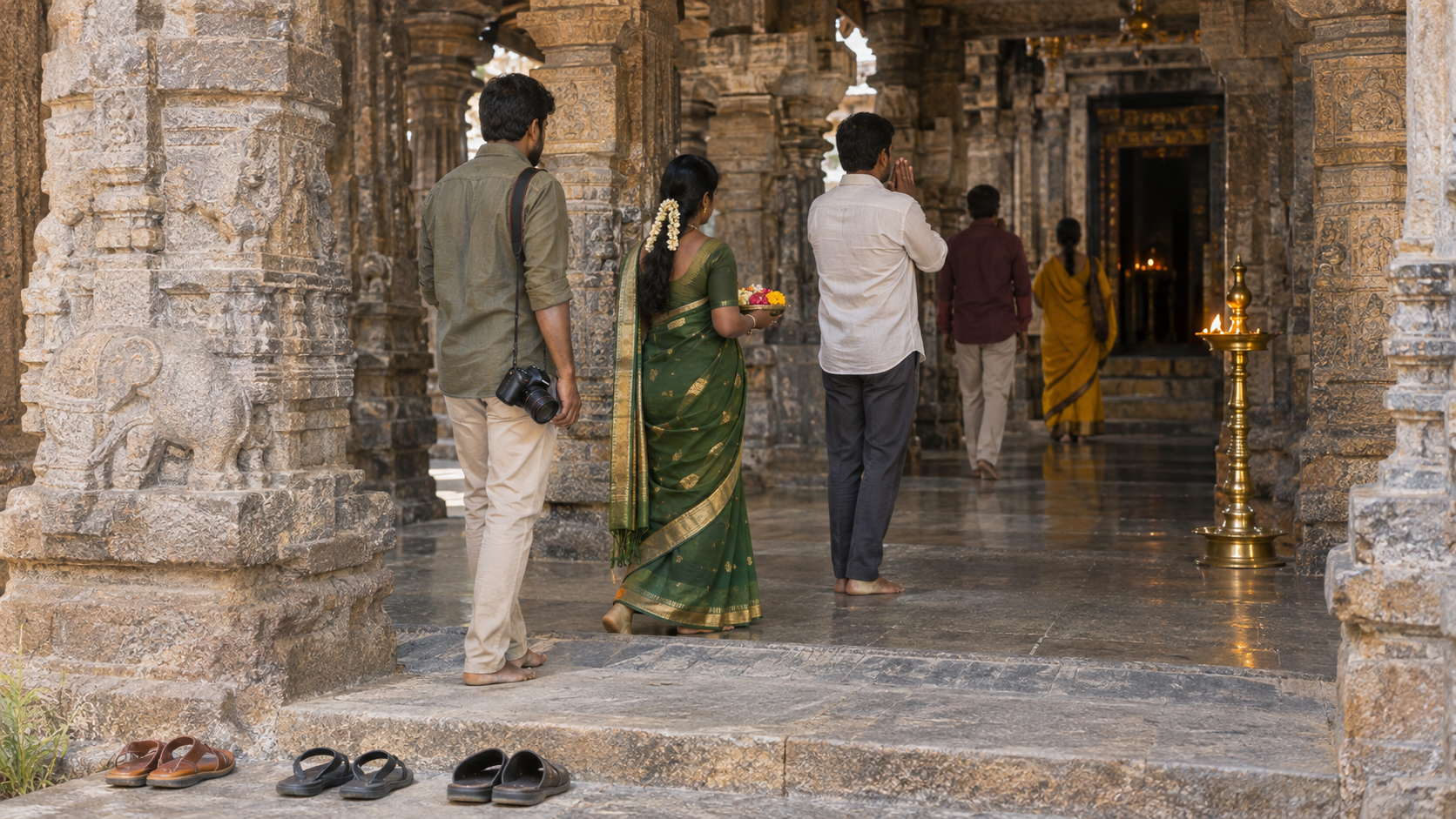
The safest posture is to treat Rudreshwara Swamy Temple as a sacred place first and a heritage destination second. Even when your main interest is history or architecture, your visit takes place in a space defined by a deity and a temple identity.
- Follow current instructions at the entrance. Remove footwear where directed and observe any restrictions around particular areas.
- Ask before photographing. Permission for exterior architecture does not automatically establish permission inside a shrine or for photographing worshippers.
- Keep circulation clear. Do not block entrances, movement, or worship while composing a photograph or recording a video.
- Observe without touching. Avoid leaning bags or equipment against architectural elements, and do not touch carvings merely to point them out.
- Write down exact labels. Record the spelling used on site, especially for Rudreswara or Rudreshwara and for the individual shrines.
- Allow time for the plan to become visible. Walk slowly enough to understand the three-shrine relationship instead of collecting disconnected close-ups.
If a local explanation conflicts with something you previously read, note the difference instead of resolving it on the spot through guesswork. Ask what inscription, tradition, or institutional record supports the explanation. A precise question is more respectful, and more productive, than arriving determined to confirm a caption.
Key takeaways for your visit
- The Thousand Pillar Temple is the historic Rudreswara or Rudreshwara Swamy Temple at Hanamkonda in Telangana’s Warangal urban area.
- Use both the popular and sacred names when checking directions and current visitor information.
- Trikutalaya means that the temple is organized around three shrines; study that relationship before focusing on isolated details.
- Its Kakatiya-period identity makes the temple part of Telangana’s regional and Dharmic history, not merely a photogenic monument.
- Verify the identities of individual sanctums from reliable on-site information rather than guessing.
- Follow current temple instructions for access, footwear, photography, and conduct.
Carry one good question into Hanamkonda: how does the three-shrine plan direct your attention? That question will slow you down in the right way. You will leave with more than a set of images—you will have begun to understand how sacred form, Kakatiya memory, and the living name of Rudreshwara meet in one place.
References

Leave a Reply
You must be logged in to post a comment.