
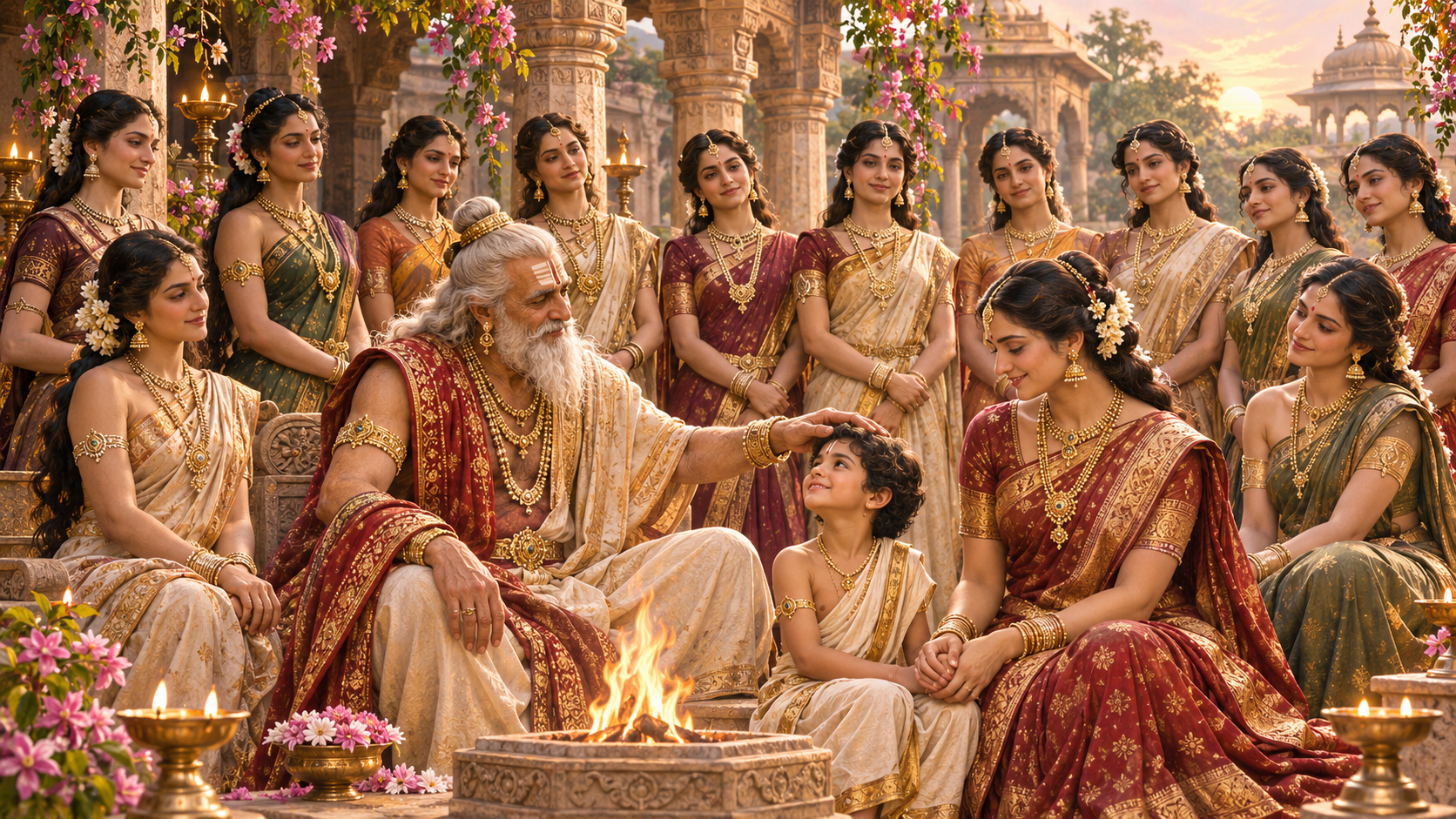
Perhaps you arrived here after encountering the startling claim that Prajapati Daksha had no sons and therefore made his daughters his sons. Read literally, that sounds like either a contradiction or a modern equality slogan projected onto an ancient text. Neither reading gets you very far.
The useful question is what familial work the category putrika allowed a daughter to perform. In the Mahabharata, Daksha’s fifty daughters provide the route through which a line without male children can continue. Understanding that distinction will help you read this passage—and other Dharmic genealogies—without erasing either their flexibility or their limits.
The problem the putrika category was built to solve
A genealogy does more than record who gave birth to whom. It identifies continuity: whose line a descendant extends, where that descendant belongs in the family structure, and how an apparent break in descent is resolved.
That creates a specific problem when a man has daughters but no sons. If descent can move only from father to son, his branch appears to end. The putrika arrangement answers that problem by appointing a daughter to carry the line forward. Her son can then be regarded as continuing his maternal grandfather’s line. The daughter is therefore not merely adjacent to the genealogy; she becomes its recognized channel of continuity.
This is why an ordinary use of the word “daughter” and the technical category of putrika shouldn’t be treated as interchangeable. Putrika signals an assigned genealogical function. In this case, the appointment is prompted by the absence of sons. That condition matters because it tells you why the category is being invoked.
You should also keep the scope precise. The passage establishes a solution to a lineage problem. It does not, by itself, settle every question about marriage, property, ritual authority, or the status of every daughter in every period of Bharatiya history.
Why Daksha’s fifty daughters matter in a genealogy
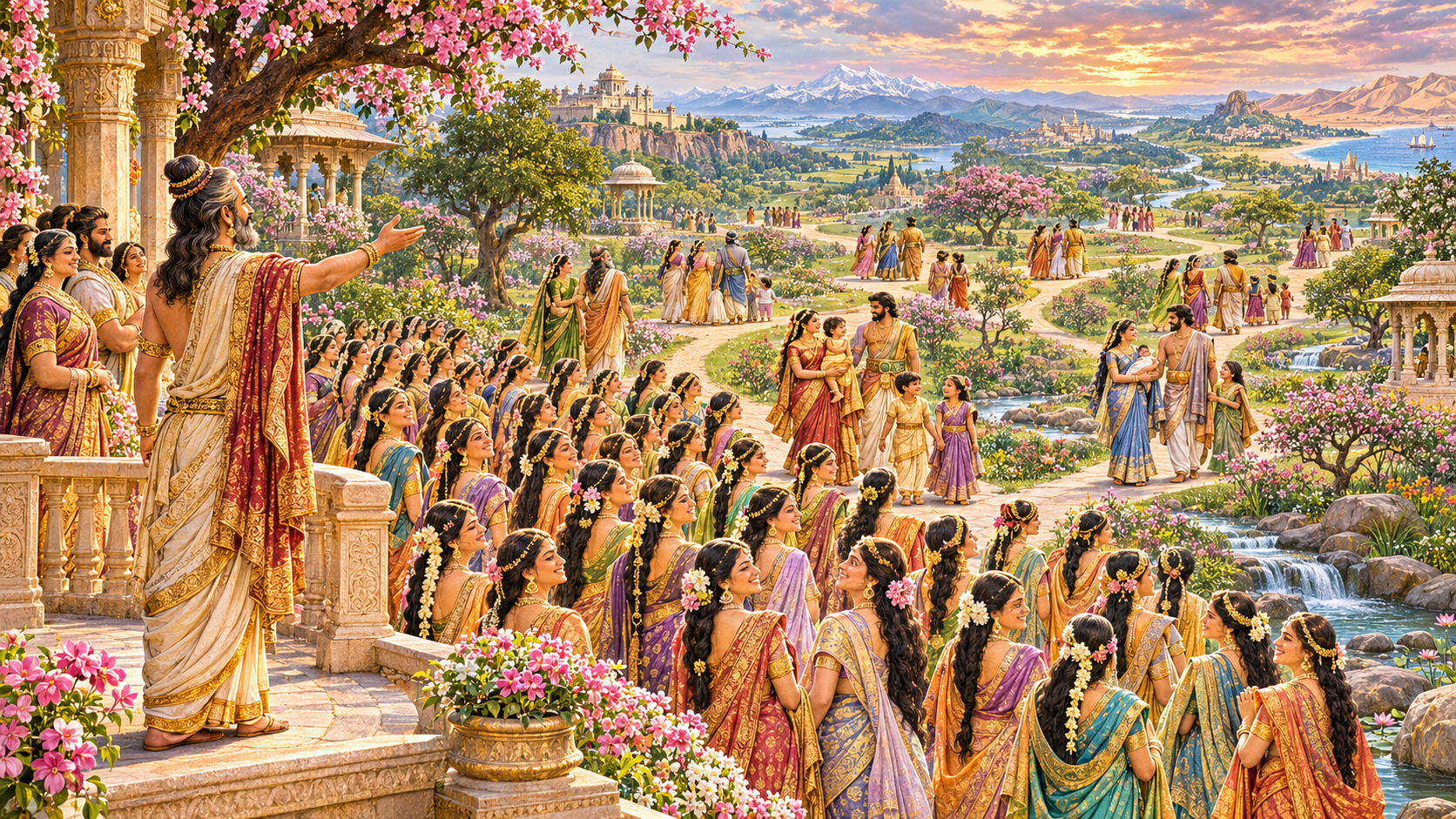
In the Adi Parva’s Sambhava Parva, Chapter 60, the Mahabharata sets out the origins of rishis, Prajapatis, and other beings. Within that genealogical setting, Daksha is presented as having no sons and appointing his fifty daughters as putrikas.
The setting tells you how to read the episode. This is not an isolated domestic anecdote placed inside the epic for sentiment. It is part of an account explaining how lines of descent proceed. “Daksha had no sons” would ordinarily announce a genealogical dead end. The appointment of his daughters prevents that dead end.
The presence of fifty daughters also makes them impossible to dismiss as decorative names surrounding male actors. Within this account, they are the mechanism through which Daksha’s continuity becomes possible. The genealogy remains strongly concerned with lineage, yet it does not require that lineage to travel through an unbroken sequence of father-to-son births.
That supports a narrower and more defensible conclusion than the slogans usually attached to the passage. It is inaccurate to say that women are absent from the genealogical structure. It is equally unwarranted to use this one episode as proof of complete social equality in every sphere. What the episode clearly demonstrates is that a daughter could be deliberately recognized as the bearer of her father’s line when he had no son.
The scale of Daksha’s case tells us that the idea is structurally important within this genealogy. It does not tell us how frequently ordinary households used the arrangement. Mythic genealogy and everyday social prevalence are different questions, and the passage answers only the first.
“Daughter as son” describes a function, not a change of sex
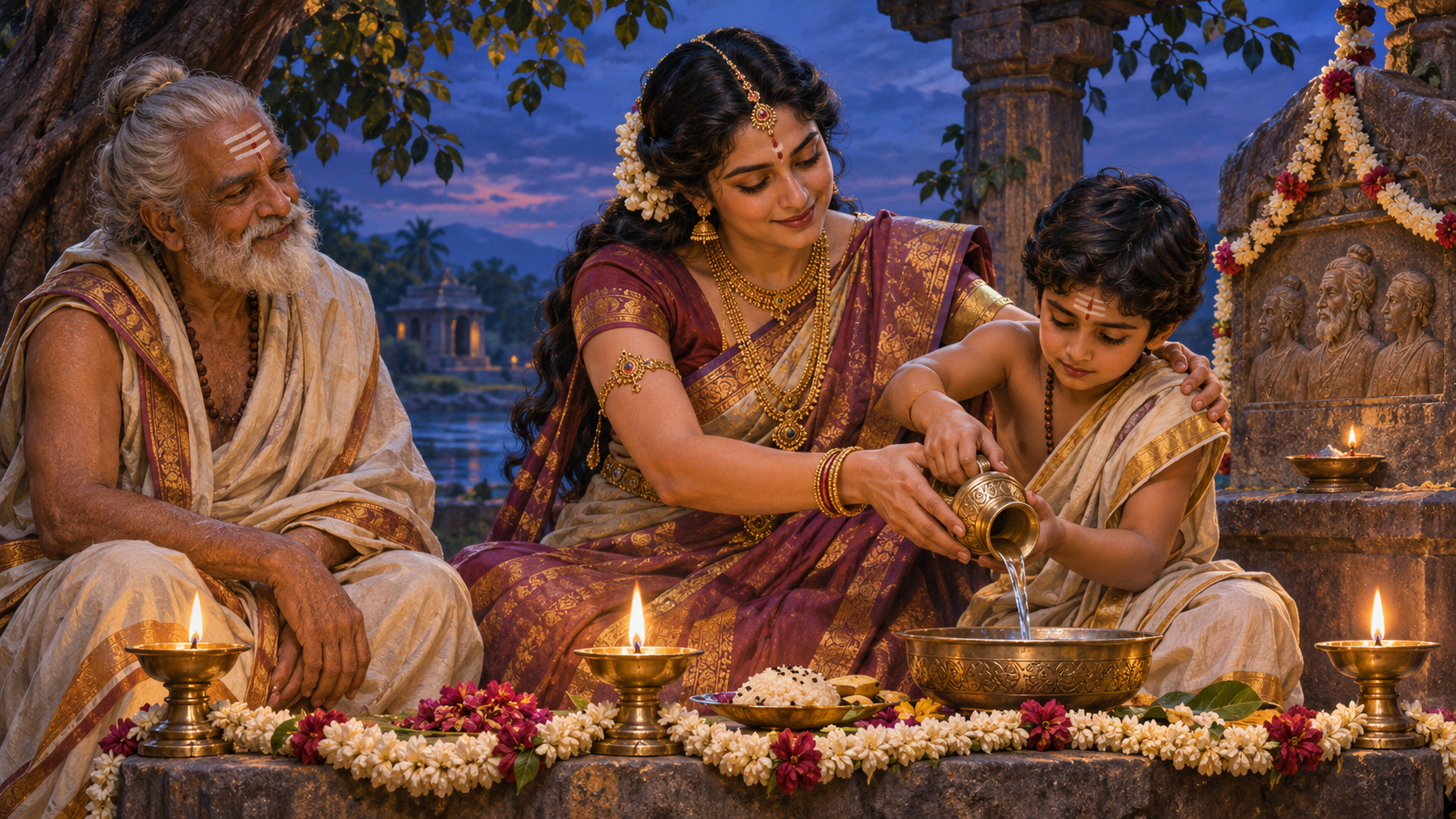
The shorthand “daughter as son” can help if you understand it functionally. It misleads if you take it to mean that the daughter ceases to be a woman or is simply relabelled as male.
- Her identity remains that of a daughter. The distinct term putrika preserves that relationship rather than replacing it with an ordinary word for son.
- Her genealogical capacity changes. She is appointed to perform the lineage-bearing role expected in this situation.
- Her offspring connects two generations. Her son can continue the line of the maternal grandfather whose lack of sons created the problem.
The sequence can be kept simple: Daksha → putrika → her son → continuation of Daksha’s line. The middle position belongs to the daughter. Remove her, and the claimed continuity cannot be explained.
This distinction prevents two opposite mistakes. The first is to exaggerate the passage into “daughters and sons were identical in every respect.” The episode establishes functional equivalence for lineage; it does not establish identity in every social category. The second mistake is to say that a daughter mattered only after being converted conceptually into a man. Putrika is meaningful precisely because it recognizes a daughter who carries a function otherwise associated with a son.
A careful English rendering should therefore retain the Sanskrit term or translate it as “appointed daughter,” followed by an explanation of the lineage function. Translating putrika simply as “son” removes the very feature that makes the institution significant.
A reliable way to read putrika passages
If you are studying, teaching, or discussing this episode, use the following sequence. It keeps your interpretation close to what the passage can actually support.
- Locate the passage before making the claim. Here the relevant setting is the Mahabharata’s Adi Parva, Sambhava Parva, Chapter 60. Naming the location lets others see that the episode belongs to a genealogy.
- State the triggering condition. Daksha has no sons. Without that detail, putrika can sound like a general synonym for daughter rather than a response to a particular lineage problem.
- Translate the role, not just the label. Use “appointed daughter who carries her father’s line” when your reader may not know the technical term.
- Map the descent explicitly. Ask who gives birth to the descendant, whose line that descendant continues, and why those two answers aren’t necessarily the same.
- Stop where the evidence stops. Use the episode to establish the recognized passage of lineage through daughters. Don’t silently expand it into a universal claim about inheritance, political power, gender equality, or common household practice.
This method also improves the language of public discussion. “The Mahabharata says daughters are sons” invites a dispute over a misleading literal statement. “The Mahabharata depicts Daksha appointing his daughters to continue his line because he has no sons” identifies the condition, the act, and the result.
More broadly, the episode warns against forcing every Dharmic kinship category into a rigid modern binary. A society can prefer patrilineal continuity while also recognizing a formal route through a daughter. Those two features may sit in tension, but the text allows them to coexist.
Key takeaways
- Putrika is best understood as an appointed daughter with a defined lineage-bearing function.
- Daksha’s lack of sons is the condition that explains the appointment of his fifty daughters.
- The daughters do not literally become male; they perform the genealogical role needed to continue their father’s line.
- The episode shows that descent in the Mahabharata isn’t confined to an uninterrupted father-to-son chain.
- The passage supports neither the exclusion of women from genealogy nor sweeping claims of equality in every social sphere.
- A precise explanation should name the textual location, the triggering condition, and the limited scope of the claim.
When you next encounter an unfamiliar kinship term in an Itihasa or Dharmic genealogy, ask three questions before translating it: whose line is at stake, what condition activates the category, and what exact function does the person perform? Applied to putrika, those questions reveal Daksha’s daughters not as exceptions to be explained away, but as the indispensable carriers of the genealogy itself.
References
- Mahabharata, Adi Parva, Sambhava Parva, Chapter 60.
- Hindu Blog — Daksha’s Daughters as Sons: The Putrika Tradition in the Mahabharata.

Leave a Reply
You must be logged in to post a comment.