
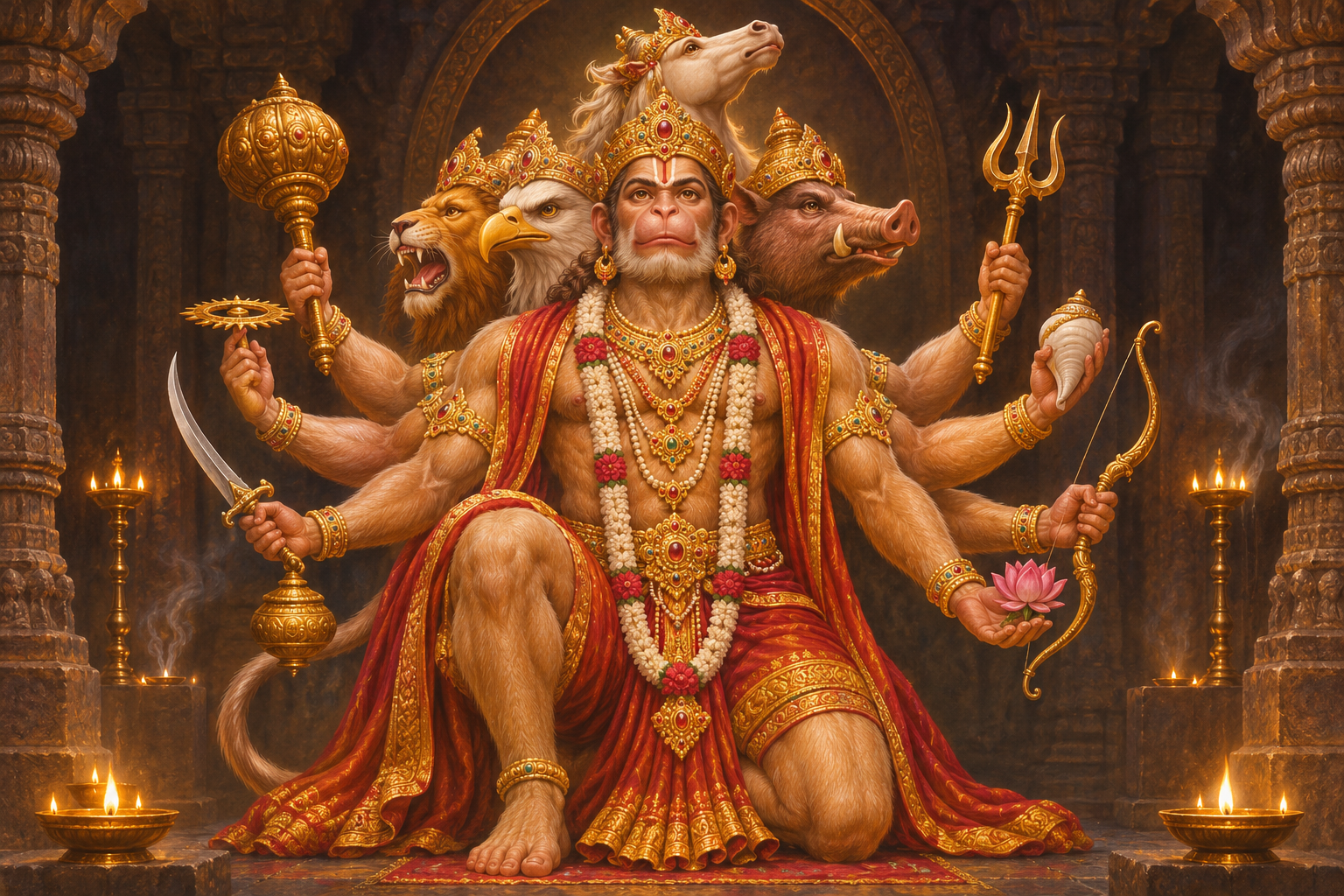
You are standing before a Panchamukhi Hanuman murti, but the five faces, many arms and unfamiliar arrangement make it difficult to know where to look. Is it simply a more powerful-looking Hanuman, or does every face change the meaning of the form?
Begin with one principle: this is a unified form, not a crowded assembly of unrelated deities. Once you identify the faces and understand their relationship, the murti becomes a practical map of devotion, discernment, courage, protection and disciplined action.
See one Hanuman before counting five faces
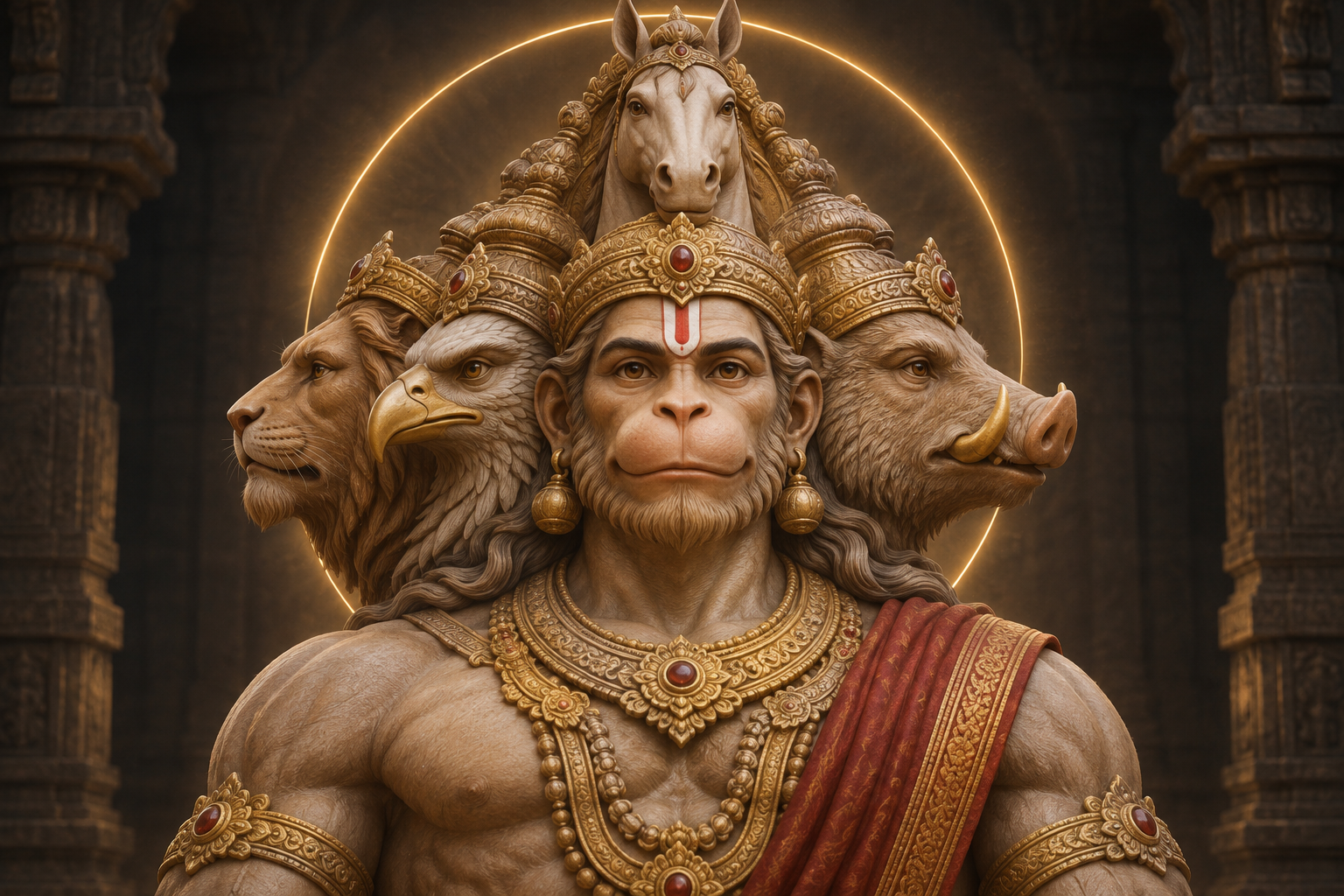
Panchamukhi means “five-faced.” In the widely recognized arrangement, Hanuman’s own vanara face looks east, while the other faces are Narasimha, Garuda, Varaha and Hayagriva. The composition brings several sacred powers into the identity and service of Hanuman rather than presenting five separate objects of worship.
That unity matters. If you treat the faces as five disconnected figures, you miss the theological force of the image. Hanuman is the exemplar of strength governed by bhakti: immense capacity placed wholly at the service of dharma. The additional faces expand that disciplined capacity. Ferocity, speed, restoration and knowledge are gathered around unwavering devotion.
The five-faced form belongs to scriptural and devotional tradition; it is not merely an ornamental multiplication of heads. Its visual complexity is therefore functional. It teaches you to recognize that a dharmic response may require more than raw force. One situation calls for courage, another for sharp discrimination, another for swift intervention and another for patient restoration.
The five faces and what each one contributes
The following is the common iconographic scheme. Individual sculptures, paintings and temple traditions may arrange or emphasize the faces differently, so use the table as a reading key rather than as a reason to dismiss every variation as incorrect.
| Face | Common direction | How to recognize it | Devotional meaning |
|---|---|---|---|
| Hanuman | East | Vanara face, usually central or forward-facing | Bhakti, courage, self-mastery and action in the service of dharma |
| Narasimha | South | Lion face | Fierce protection and the removal of forces that cannot be met by passivity |
| Garuda | West | Beaked, bird-like face | Swiftness, vigilance and freedom from constricting or poisonous influences |
| Varaha | North | Boar face | Rescue, stability and the restoration of order when it has been submerged or displaced |
| Hayagriva | Upward | Horse face, often placed above the others | Knowledge, clarity, sacred learning and disciplined intelligence |
Hanuman remains the interpretive centre. His face tells you how the powers represented by the other four are to be used. Narasimha’s fierceness is not anger for its own sake. Garuda’s speed is not restlessness. Varaha’s strength is not domination. Hayagriva’s knowledge is not intellectual vanity. Each capacity is placed under the rule of devotion and dharma.
This gives you a useful way to contemplate the murti. When you look at Narasimha, ask what must be confronted rather than accommodated. With Garuda, ask where hesitation has become an excuse. With Varaha, notice what has fallen into disorder and needs to be lifted patiently. With Hayagriva, ask what you need to understand before acting. Return to Hanuman and ask whether your intended action is genuinely an offering to dharma or merely an assertion of ego.
How to read a Panchamukhi Hanuman murti accurately
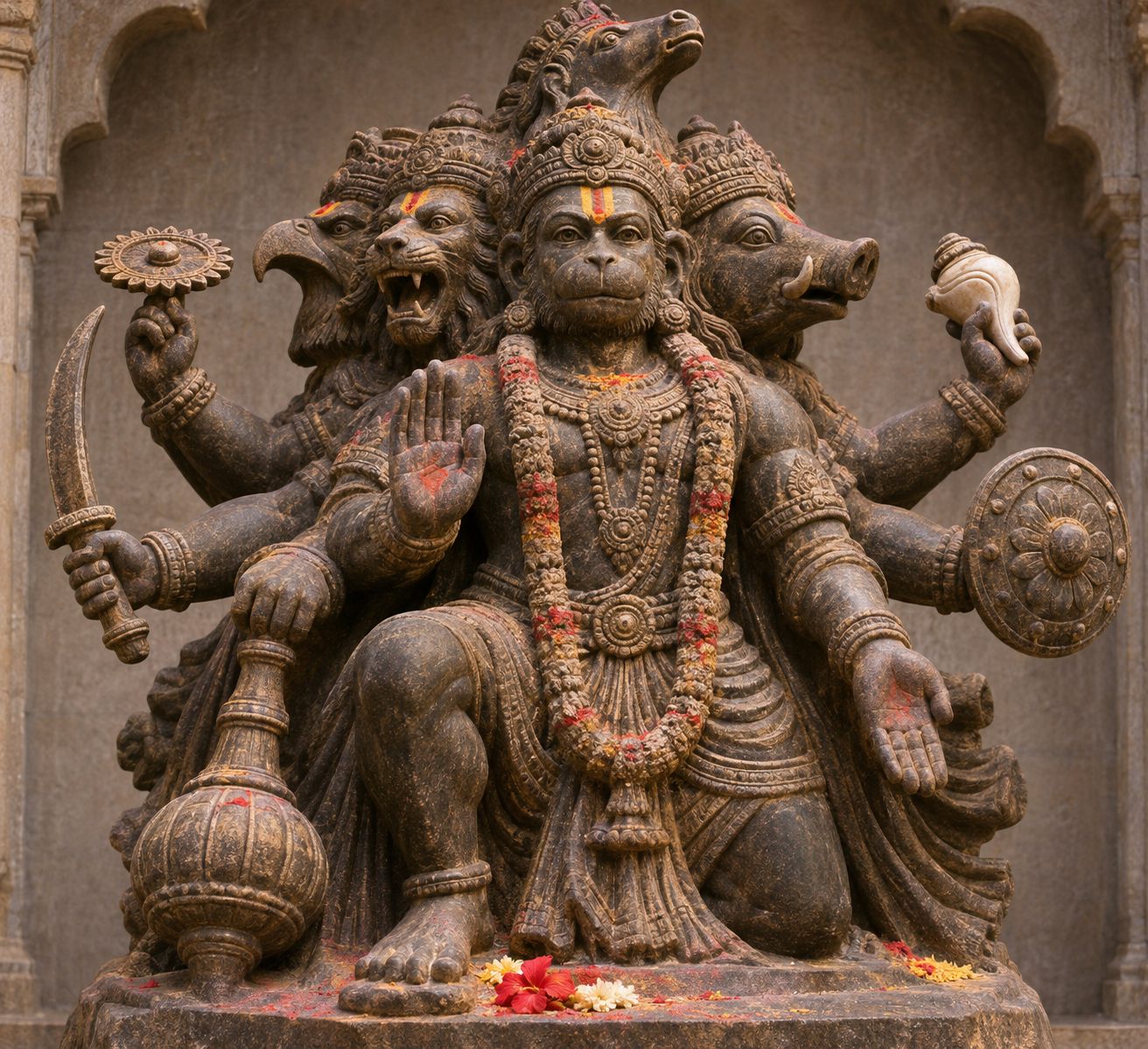
Popular prints often spread all five faces in a fan-like arrangement so that the devotee can see them at once. A three-dimensional murti may distribute them around the central head more literally. The upward face may also be compressed, tilted or placed above the crown because the sculptor must make a theological idea visible within the limits of stone, metal or a printed page.
Use a simple sequence when identifying the form:
- Find Hanuman’s face first. It is usually the central or forward-facing vanara head. This establishes the identity of the whole murti.
- Identify the animal forms. Look for the lion of Narasimha, the beak of Garuda, the snout of Varaha and the horse-like head of Hayagriva.
- Locate the upward face. Hayagriva may appear above the horizontal group rather than beside it. In a crowded image, this is the face most easily overlooked.
- Read directions from the murti’s standpoint. Sacred directions belong to the deity’s orientation, not automatically to your left and right as you face the image.
- Examine the hands last. Multiple arms, weapons and sacred emblems reinforce protection and many-sided capability, but their selection and placement can vary. Do not reject a murti merely because one object differs from another depiction.
The faces are more reliable identifiers than the inventory of objects. A sculptor may alter an emblem to suit a regional convention, available space or temple lineage while preserving the essential five-faced identity. Conversely, a generic multi-headed figure should not be labelled Panchamukhi Hanuman unless the characteristic faces can actually be recognized.
Condition also matters when you are examining an old carving. A damaged snout, worn beak or missing upper portion can make identification uncertain. In that situation, look at the entire composition: the central vanara identity, the surviving animal heads, the number and placement of faces, and any accompanying Hanuman attributes. One damaged feature should not carry the whole conclusion.
The symbolism is a discipline, not a promise of spectacle
Panchamukhi Hanuman is commonly approached as a protective form, but protection should not be reduced to the expectation that difficulties will disappear without effort. The iconography points toward complete preparedness. You protect what is dharmic by learning clearly, watching carefully, acting promptly, confronting what is destructive and restoring what has been damaged.
The five faces can therefore serve as a test before an important decision:
- Hanuman: Is your motive grounded in service, loyalty and self-control?
- Narasimha: Are you refusing to name a genuine wrong because confrontation feels uncomfortable?
- Garuda: Does the situation require timely action rather than another round of delay?
- Varaha: What must be recovered, repaired or placed back on stable ground?
- Hayagriva: What fact, teaching or distinction must you understand before you proceed?
This is also why the form should not be read as an invitation to aggression. Power without the central discipline of Hanuman would contradict the image’s own structure. The lion face does not authorize uncontrolled rage, and the many weapons do not turn every disagreement into a battle. The murti joins strength to viveka, the ability to distinguish a necessary response from an impulsive one.
Nor should the five faces be flattened into a mechanical formula in which each head guarantees a particular worldly result. Sacred iconography works first by shaping the devotee’s attention. It shows what a complete dharmic posture looks like: devoted at the centre, formidable when required, alert to danger, capable of restoration and guided by knowledge.
How to approach the form in daily worship
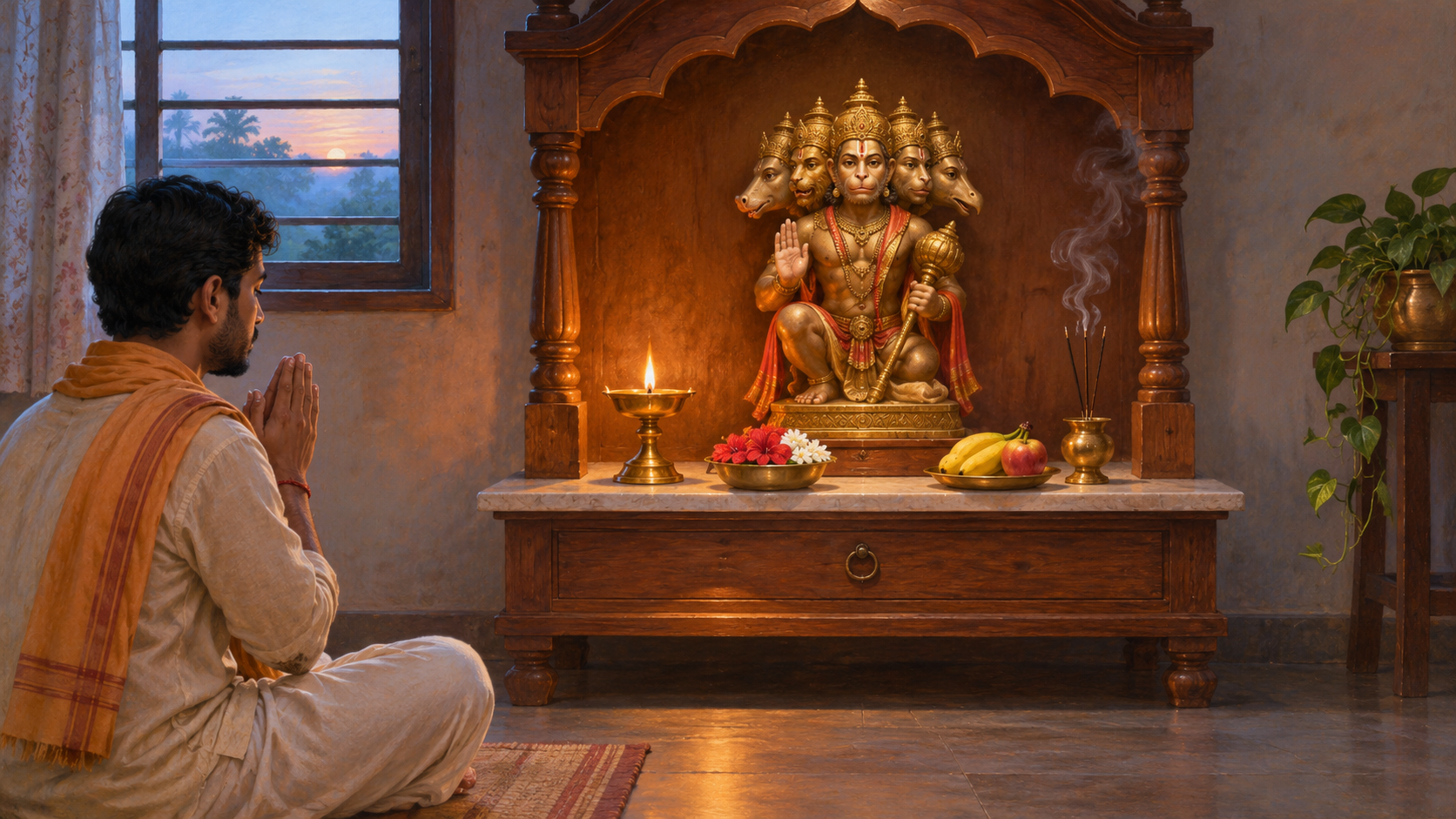
You do not need to begin with an elaborate ritual. If Panchamukhi Hanuman is new to you, start by learning to see the murti correctly. Sit before the image, identify each face and spend a few moments with the quality it represents. Then return your attention to Hanuman at the centre. This prevents the practice from becoming a hurried request for protection without any corresponding change in conduct.
A simple devotional sequence can be kept clear and purposeful:
- Begin with a respectful salutation to Hanuman.
- Name the five faces mentally, using their visible forms to steady your attention.
- Bring one real situation to mind rather than making a vague request for every problem to vanish.
- Ask which capacity the situation requires: devotion, firm protection, speed, restoration or knowledge.
- Choose one dharmic action you can take after the prayer.
If your family, temple or sampradaya follows a particular Panchamukhi Hanuman mantra or ritual procedure, follow that living tradition. Specialized mantra practice should be learned in its proper form rather than assembled from fragments found in devotional graphics. Simple prayer, however, can remain simple: reverence, attention and a sincere commitment to act rightly are already a meaningful beginning.
Key takeaways
- Panchamukhi Hanuman is one integrated sacred form, not five unrelated deities placed together.
- The common arrangement combines Hanuman with Narasimha, Garuda, Varaha and Hayagriva.
- The faces represent complementary capacities: devotion, fierce protection, swift vigilance, restoration and knowledge.
- Directions should be read from the murti’s orientation, while the arrangement of faces and objects may vary across depictions.
- The best way to use the symbolism is to connect prayer with one specific dharmic action.
The next time you encounter Panchamukhi Hanuman, pause before asking what the form can do for you. Identify the five faces, find Hanuman at the centre and decide which quality your present duty demands. Then carry that quality out of the shrine and into the action waiting for you.
References

Leave a Reply
You must be logged in to post a comment.