
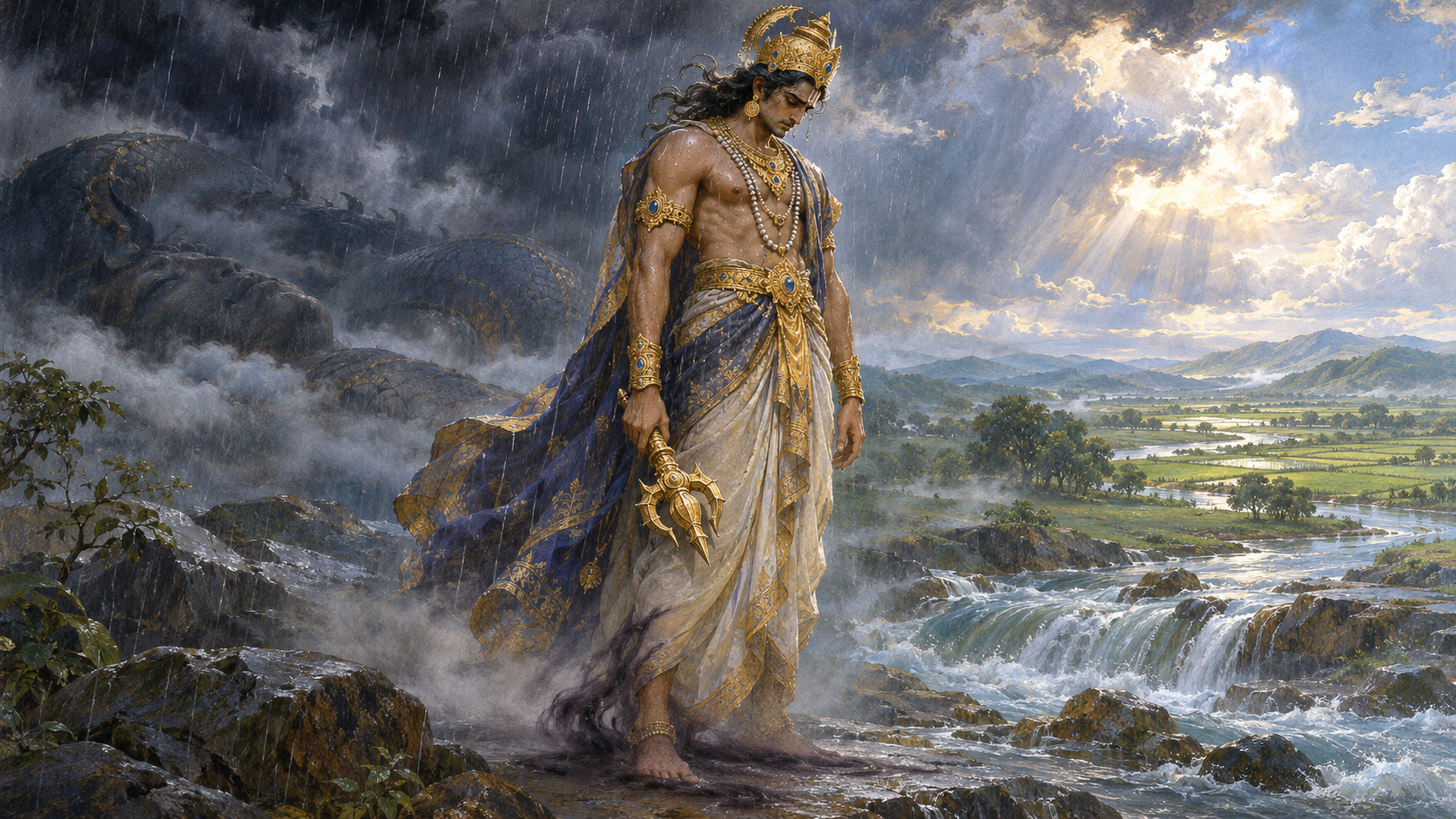
If you have wondered why Indra should bear guilt after killing Vritra, the apparent contradiction is the point. How can the protector of cosmic order defeat an adversary and still become impure?
The answer lies in a distinction that Dharmic moral reasoning refuses to erase: authority to act is not immunity from the consequences of acting. Vritra-vadha can be a victory for Indra while still leaving Indra responsible for what the victory involved.
Indra’s guilt is more than a troubled conscience

Modern readers often hear the word “guilt” and imagine an emotion: regret, shame, fear, or remorse. The moral vocabulary attached to Vritra-vadha is more exacting. Indra is marked by brahmahatya and impurity after the killing. His problem is not merely that he might feel bad; the deed has produced a consequence that he must bear.
This distinction matters because the surviving lesson does not depend on reconstructing Indra’s private state of mind. You do not have to invent a psychological portrait for the episode to make sense. Guilt here can first be understood as moral liability: something remains attached to the agent after the act is complete.
That is a stronger claim than “Indra regretted what happened.” Feelings can fade, be suppressed, or be explained away. Impurity cannot be dismissed so easily. It means that success has not closed the moral account.
Why Indra’s rank cannot make the killing pure
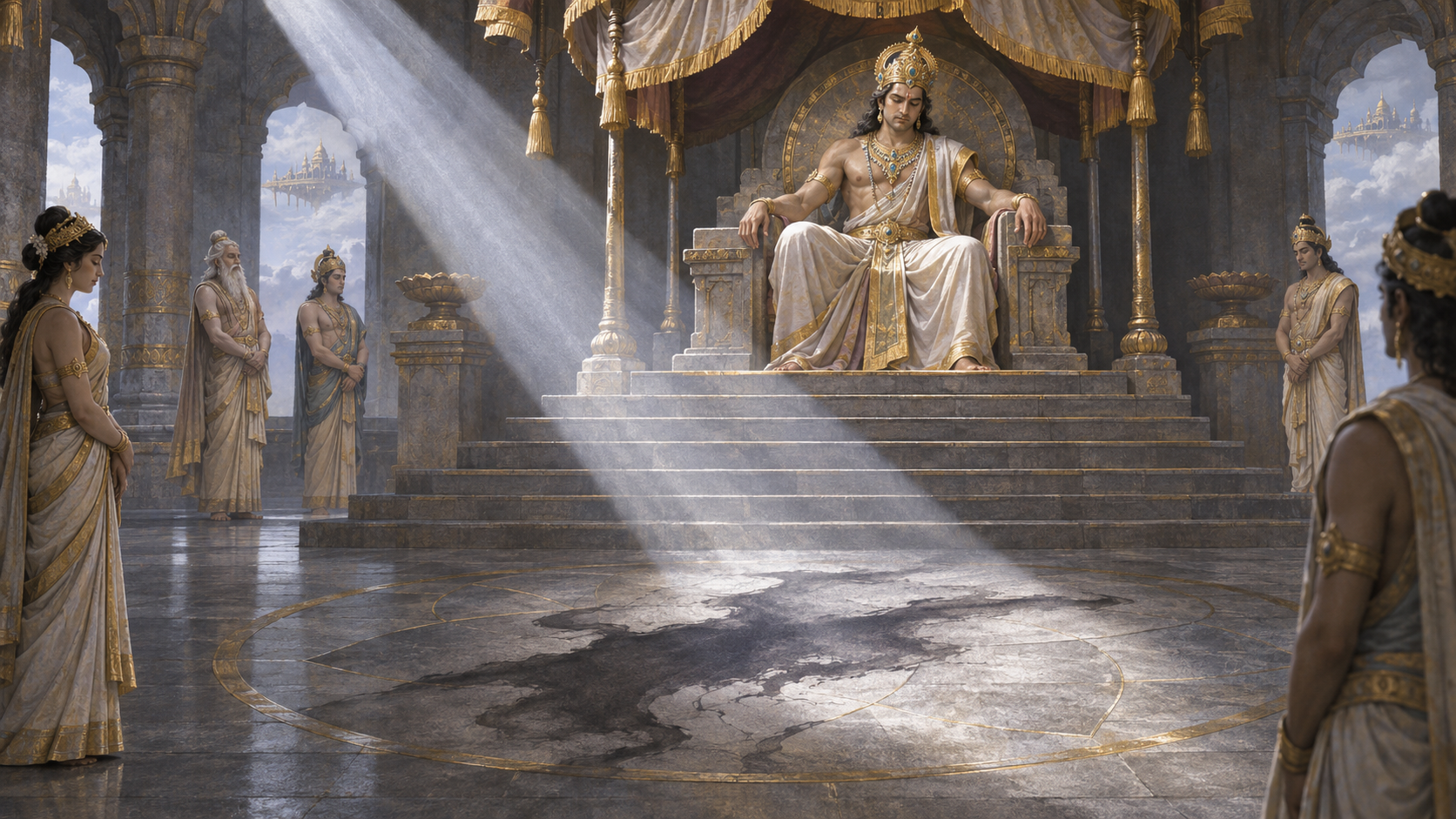
Indra is not an accidental or powerless figure. He is the king of the Devas, ruler of Svarga, bearer of the Vajra, and a protector of cosmic order. Those attributes make the aftermath of Vritra-vadha sharper, not easier to dismiss.
The Vajra answers whether Indra has the power to strike. His kingship establishes his office. His protective function explains why conflict may fall to him. None of these, by itself, proves that every deed performed through that office leaves its agent pure.
Keep four questions separate when you read the episode: Who has the authority to act? What duty is being served? What result is achieved? What moral consequence remains? Confusion begins when a satisfactory answer to any one of them is treated as an answer to all four.
This is why the episode reaches beyond a simple contest between a Deva and an adversary. If rank automatically created purity, the king of the Devas could never become impure. If victory automatically erased liability, there would be no brahmahatya to confront. Indra’s exposure to consequence shows that dharma is not merely whatever the strongest or highest-ranking figure has done.
Two easy readings empty the episode of its meaning
The first mistake is to sanitize Indra: he is a Deva, therefore the killing must be pure in every respect. That reading protects a devotional image at the cost of the moral teaching. Once Indra is made incapable of liability, Vritra-vadha becomes only a tale about superior force.
A mature pro-Dharmic reading does not require moral sterilization. A tradition displays confidence, not weakness, when even a celestial king remains answerable to an order greater than his throne. Indra’s stature makes the warning universal: if consequence can reach him, human power certainly provides no exemption.
The second mistake runs in the opposite direction. It treats impurity as proof that Indra’s entire role was false or that nothing of value could have been protected. That also collapses the tension. An act can serve an important function without becoming morally weightless. A grave consequence does not necessarily tell you that every aspect of the act, its purpose, and its result must receive one undifferentiated judgement.
The more demanding reading holds both truths in view. Indra can act as protector, and Indra can remain accountable for the cost of his act. Dharma does not have to turn him into either a spotless victor or a one-dimensional villain.
Use Vritra-vadha as a test of your own use of power

You are not Indra, and an ordinary dispute is not a cosmic battle. The pattern is still useful whenever authority is exercised: in a family, a workplace, a temple committee, a community organisation, or public office.
Before defending a hard decision solely by your position, ask what duty you actually had rather than merely what power you possessed. Then ask what harm remained even if your objective was legitimate. Notice whether you are using a successful result to avoid examining the means. Finally, identify what responsibility continues after the decision instead of assuming that victory has ended the matter.
A revealing warning sign is a defence that ends with “I was in charge” or “we won.” Those statements may establish control and outcome, but they do not settle purity, proportionality, or responsibility. Indra’s kingship and victory do not prevent the question of brahmahatya from arising; your title and success cannot complete your moral reasoning either.
This lesson should restrain the use of myth as a blanket justification for force. The episode does not hand every powerful person an Indra-like mandate. It does the reverse: it denies even Indra a consequence-free mandate. The practical question after decisive action is not only “Did it work?” but also “What do I still owe because I did it?”
Key takeaways
- Indra’s kingship, Vajra, and protective office establish his power and function; they do not grant automatic purity.
- Brahmahatya should first be read as a condition of moral liability and impurity, not reduced to an unsupported claim about Indra’s emotions.
- Authority, duty, outcome, and moral consequence are related questions, but they are not interchangeable.
- A careful reading neither sanitizes Indra nor reduces him to a villain. It preserves the tension between necessary office and continuing accountability.
- The episode gives you a practical test for leadership: after asking whether an action succeeded, ask what consequence remains and what responsibility follows.
When someone asks why Indra was guilty after killing Vritra, begin there. Dharma’s claim does not end when the thunderbolt strikes or when the victor is declared. The moral work begins by refusing to let power, office, or success have the last word.
References

Leave a Reply
You must be logged in to post a comment.