

You may have encountered the “ten wives of Dharma” in the Mahabharata and wondered what to do with the passage. Is it only a divine genealogy to memorize, or does the list tell you something useful about living by dharma?
The names themselves provide the key. Kirti, Lakshmi, Dhriti, Medha, Pushti, Shraddha, Kriya, Buddhi, Lajja and Mati are also qualities of character and life. Read carefully, they show that dharma is not sustained by good intentions alone. It needs discernment, action, endurance, nourishment, restraint and a worthy relationship with prosperity and reputation.
Read the genealogy as an ethical map

In the Chapter 60 numbering of the Sambhava Parva within the Adi Parva, Daksha and his wife have fifty daughters, ten of whom are given in marriage to Dharma. The same account places Daksha’s birth from Brahma’s right toe and his wife’s birth from Brahma’s left toe. These details locate the list inside a sacred genealogy of creation, not an ordinary account of ten human marriages.
That distinction matters. Dharma is personified in the narrative, while dharma is also the principle of right order, responsibility and conduct. The marriage image can therefore be read ethically: these ten qualities stand beside Dharma as partners through which dharma becomes effective in life. This is an interpretive use of the genealogy, not a claim that the passage stops to present a formal philosophical system.
Nor should “wife” be turned into a synonym for a secondary or disposable quality. The practical point is relationship. Remove one of these partners and the expression of dharma becomes distorted. Prosperity without discernment can reward greed. Action without reflection becomes restless activity. Reputation without modesty becomes vanity. Conviction without intelligence can harden into credulity.
When you use the list for self-examination, do not ask which name is the most important. Ask which quality is absent from the decision in front of you. That question turns a remote genealogy into a precise diagnostic tool.
The ten names and the question each asks you
No single English word captures the full range of a Sanskrit name. The working meanings below are deliberately practical. They help you examine conduct without pretending that each term has only one possible translation.
| Name | Working meaning | Question for your conduct |
|---|---|---|
| Kirti | Good repute or worthy renown | Would a truthful account of this action strengthen or damage your good name? |
| Lakshmi | Prosperity, abundance and auspicious flourishing | Are your resources being acquired and used in a way compatible with dharma? |
| Dhriti | Steadfastness, fortitude and constancy | Will you continue this duty after enthusiasm and praise disappear? |
| Medha | Intelligent comprehension and retained understanding | Have you understood the matter deeply enough to explain its moral consequence? |
| Pushti | Nourishment, growth and thriving | Does your choice sustain the people, relationships and institutions entrusted to you? |
| Shraddha | Committed trust, reverence and earnest conviction | What worthy commitment gives your practice continuity? |
| Kriya | Action, practice and disciplined performance | What concrete act will embody the value you claim to hold? |
| Buddhi | Discernment and discriminating intelligence | Can you distinguish the merely attractive option from the right one? |
| Lajja | Moral modesty, reserve and reluctance to do wrong | What proper boundary should stop you even when nobody else would know? |
| Mati | Considered intention, judgement and mental orientation | What motive is directing your choice before the outward act begins? |
Several common misreadings disappear once you apply the questions. Kirti is not fame for its own sake. A person can be widely known and still possess no worthy reputation. Lakshmi is not permission to pursue wealth by any means; prosperity belongs beside Dharma, not above it. Kriya is not busyness. It is the movement from professed value to embodied practice.
Lajja also needs care. It should not be confused with humiliation imposed on someone by a family, community or authority. For this ethical exercise, use the name narrowly: the inward reserve that keeps you from doing what you recognize as degrading, dishonest or improper. Healthy moral restraint limits misconduct; humiliation merely injures a person.
Buddhi and Mati may look especially close in English. A useful practical distinction is to let Buddhi examine and discriminate among choices, while Mati names the intention or settled orientation that directs you toward one of them. Buddhi asks, “What is right here?” Mati asks, “What is actually moving me?” You need both because a person can identify the better course while remaining driven by resentment, fear or vanity.
Dharma becomes distorted when one quality stands alone
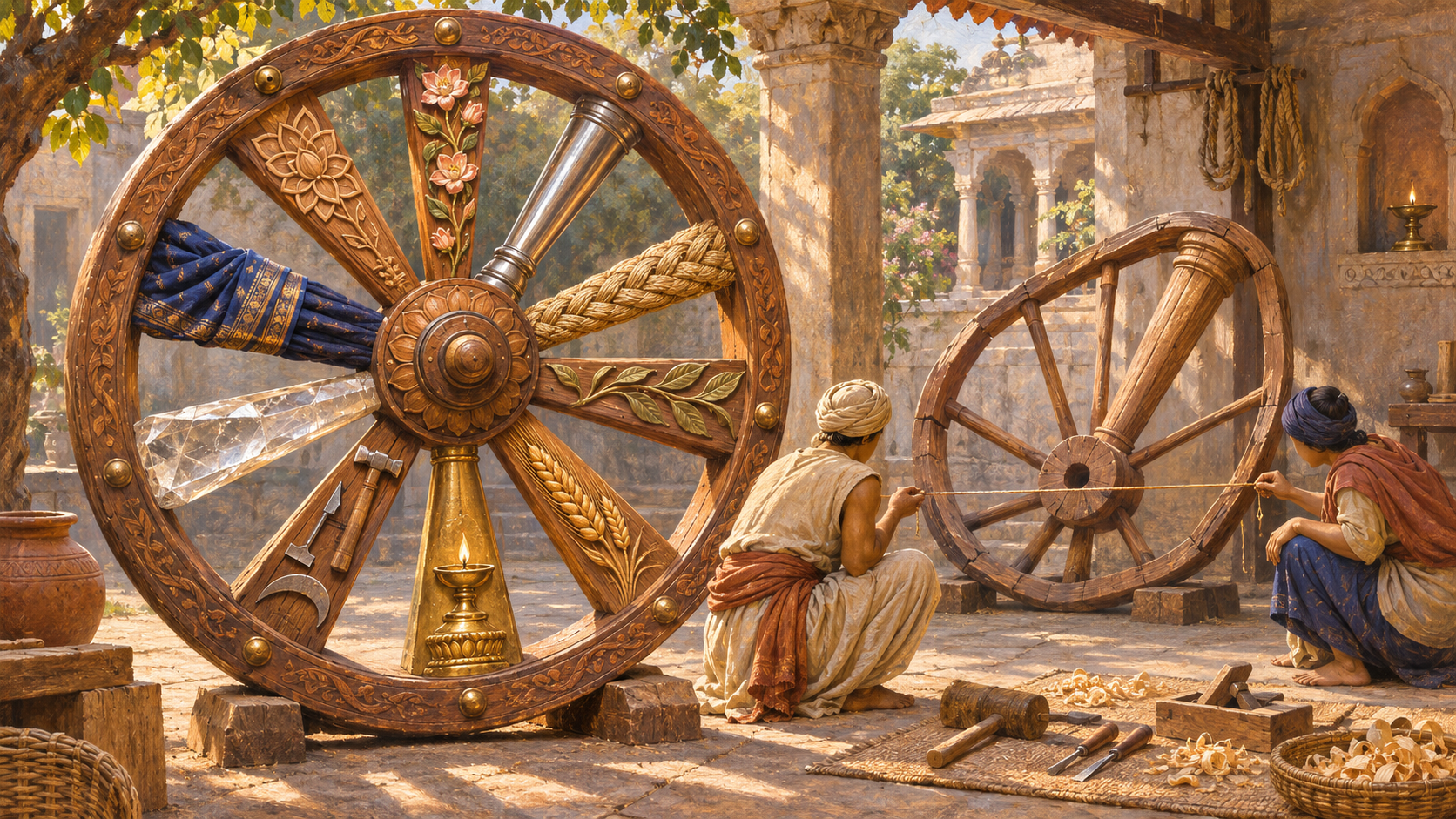
Prosperity and reputation need moral governance
Kirti and Lakshmi are outwardly visible. Other people can see your standing, possessions, influence and success. That visibility makes both easy to mistake for proof of righteousness. They are not proof. Their ethical value depends on how they were gained, how they are used and what they encourage you to become.
If you face a decision involving money or status, place Buddhi, Lajja and Mati beside them. Use Buddhi to distinguish legitimate benefit from an attractive rationalization. Use Lajja to identify the line you should not cross. Use Mati to expose the motive beneath your public justification. Then ask Kirti a harder question than “Will people admire me?”: would truthful disclosure leave you deserving of trust?
Knowledge has to become disciplined action
Medha, Buddhi and Mati concern understanding, discrimination and intention. They prevent action from becoming blind. But they can also remain comfortably internal. A person may understand a teaching, identify the right choice and form a noble intention without doing anything that changes life.
Kriya closes that gap. If you say that seva matters, Kriya asks where and how you serve. If you say that truth matters, Kriya asks which misleading statement you will correct. If you say that study matters, Kriya asks what disciplined practice follows from what you have learned. The test is not how elevated the idea sounds. It is whether the idea acquires a form in conduct.
Commitment must be durable and life-sustaining
Shraddha gives a practice earnest commitment. Dhriti keeps it steady when the first impulse weakens. Pushti asks whether the result genuinely nourishes life. Together they correct two opposite failures: devotion that never becomes consistent, and grim persistence that damages everything it was supposed to protect.
Before calling mere stubbornness Dhriti, return to Buddhi. Is the duty still sound, or are you protecting pride? Before calling comfort Pushti, return to Kriya. Does your idea of nourishment support responsible action, or does it excuse avoidance? The ten names work best as mutual checks. Each virtue is clarified and disciplined by the others.
Use the ten wives for a ten-day dharma audit

You do not need an elaborate ritual to work with this genealogy. Choose one real area of life: family responsibility, livelihood, community service, study, use of money, speech or a decision you have postponed. Keep that same area before you as you examine one name on each of ten successive days.
- Kirti: Write the fully truthful version of your present conduct as if it were visible to the people whose trust you value. Notice where you feel tempted to omit a fact.
- Lakshmi: List the resources involved, including money, time, authority, opportunity and goodwill. Identify one resource being acquired or used in a questionable way.
- Dhriti: Name the duty that remains after excitement fades. Remove one avoidable obstacle that has made you inconsistent.
- Medha: Restate the relevant teaching or principle in your own words. If you cannot explain its consequence for this situation, return to study before claiming certainty.
- Pushti: Identify who or what should be nourished by the decision. Look beyond immediate comfort to the health of the household, community, practice or institution involved.
- Shraddha: Name the commitment you are prepared to honor without demanding constant reward or recognition. Also name what evidence would require you to reconsider your interpretation.
- Kriya: Convert the commitment into one observable act. Give it a place in your actual routine rather than leaving it as an aspiration.
- Buddhi: Put the strongest competing duties side by side. State why one deserves priority here instead of hiding the conflict behind a slogan.
- Lajja: Mark the boundary you must not cross, even if crossing it would be profitable, popular or easy to conceal. If you have already crossed it, identify the correction owed.
- Mati: Write the motive you would like to have and the motive your behavior presently reveals. Adjust the action wherever those two answers diverge.
At the end of the cycle, do not try to repair all ten dimensions at once. Circle the two questions that exposed the clearest weakness. Choose one corrective action that can be repeated, and keep returning to it until conduct changes. The purpose is not to collect ten admirable words. It is to let one neglected quality reshape a real decision.
You can also use the list before a collective decision. A family, temple committee or community organization can ask who is responsible for examining prosperity, long-term endurance, practical execution, nourishment, ethical boundaries and public trust. This prevents a meeting from treating financial gain or good intentions as the whole of dharma.
Key takeaways
- The ten wives are Kirti, Lakshmi, Dhriti, Medha, Pushti, Shraddha, Kriya, Buddhi, Lajja and Mati.
- The genealogy can be used as an ethical map without reducing the sacred narrative to a mere allegory.
- No quality should be isolated: prosperity needs discernment, conviction needs intelligence, knowledge needs action and endurance needs nourishment.
- Kirti means more than visibility, Lakshmi more than accumulated wealth, Kriya more than busyness and Lajja more than imposed shame.
- For a decision you face now, ask which of the ten qualities is missing and make that absence the focus of your next corrective action.
The most faithful way to remember these names is to put them to work. Take the decision already in front of you and begin with Kirti: write the account you could defend without concealment. Then let the remaining nine questions test whether your proposed course deserves to be called dharmic.
References

Leave a Reply
You must be logged in to post a comment.