
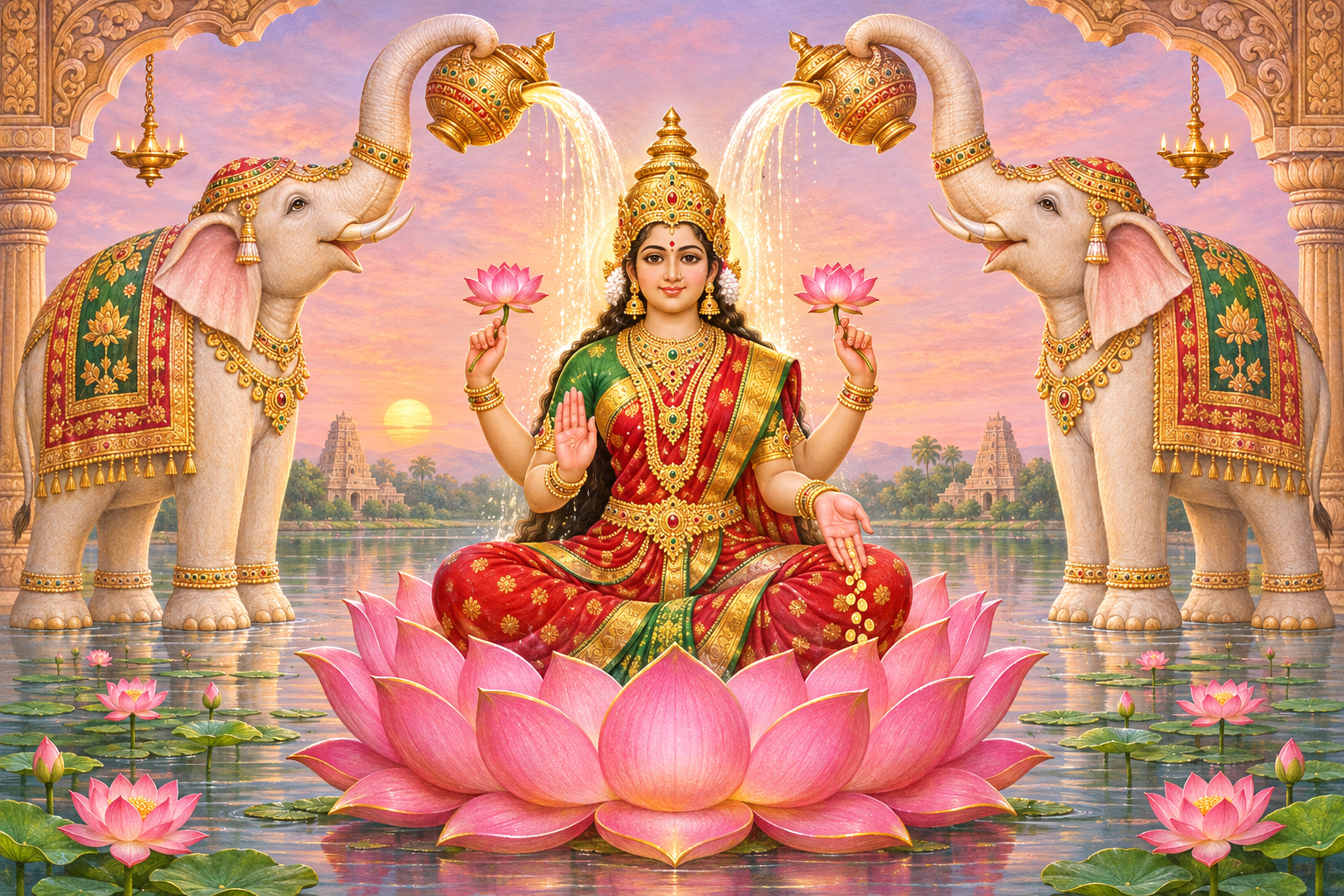
You may recognise Lakshmi and still wonder what makes a particular murti, relief, or painting Gaja Lakshmi. Which details establish the identity, and what can you responsibly understand from them without turning every ornament into a secret code?
Start with the relationships in the image. The central goddess, the two flanking elephants, their vessels, and the amrita flowing toward her form one visual statement. Read that statement before interpreting any isolated feature.
Identify Gaja Lakshmi by the complete composition
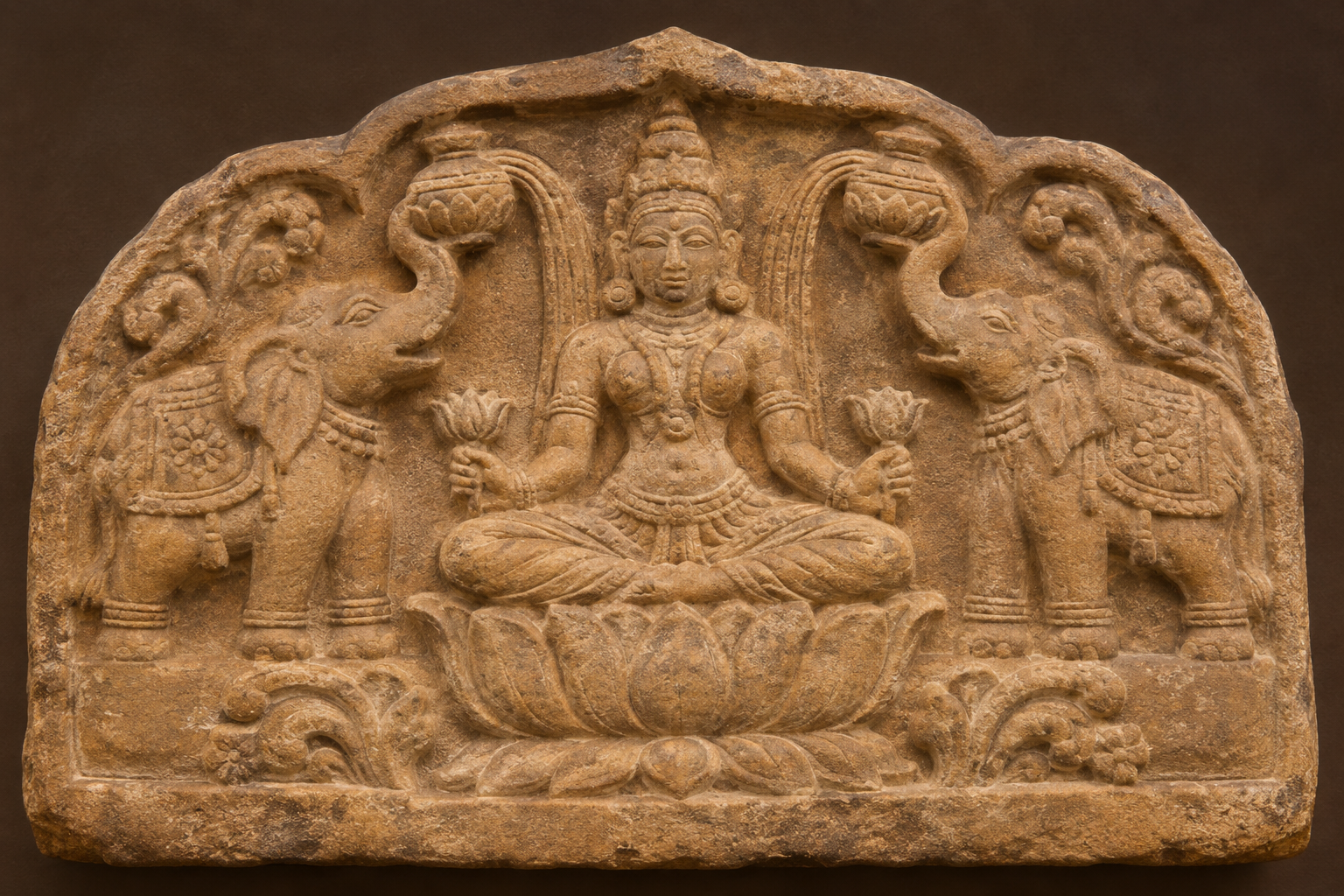
Among the Ashtalakshmi, the eight manifestations associated with prosperity, Gaja Lakshmi is distinguished by two elephants flanking Lakshmi and showering her from vessels containing amrita. The Sanskrit word gaja means elephant, but the name refers to more than the presence of an elephant somewhere in the artwork.
Look first for a central figure of Lakshmi. Then look to both sides. The elephants should frame her, while the nectar-bearing vessels and the direction of the outpouring connect them to her. These are not three unrelated motifs placed together for decoration. The elephants are participating in an act centred on Devi.
This relational test is more reliable than beginning with ornamental details. Artistic treatments can differ in complexity, scale, and style. If you start by counting minor features, you can miss the visual grammar that actually makes the form recognisable.
Key takeaways
- Read Lakshmi, the paired elephants, the vessels, and the flowing amrita as one composition.
- A lone elephant motif does not by itself establish the Gaja Lakshmi form.
- The elephants are attendants engaged in an offering, not independent emblems competing with the goddess.
- The flow of divine nectar gives prosperity a meaning larger than possession or financial gain.
- Do not assign a fixed doctrine to every decorative variation unless a specific lineage or temple tradition supplies that interpretation.
Why the elephants serve rather than dominate
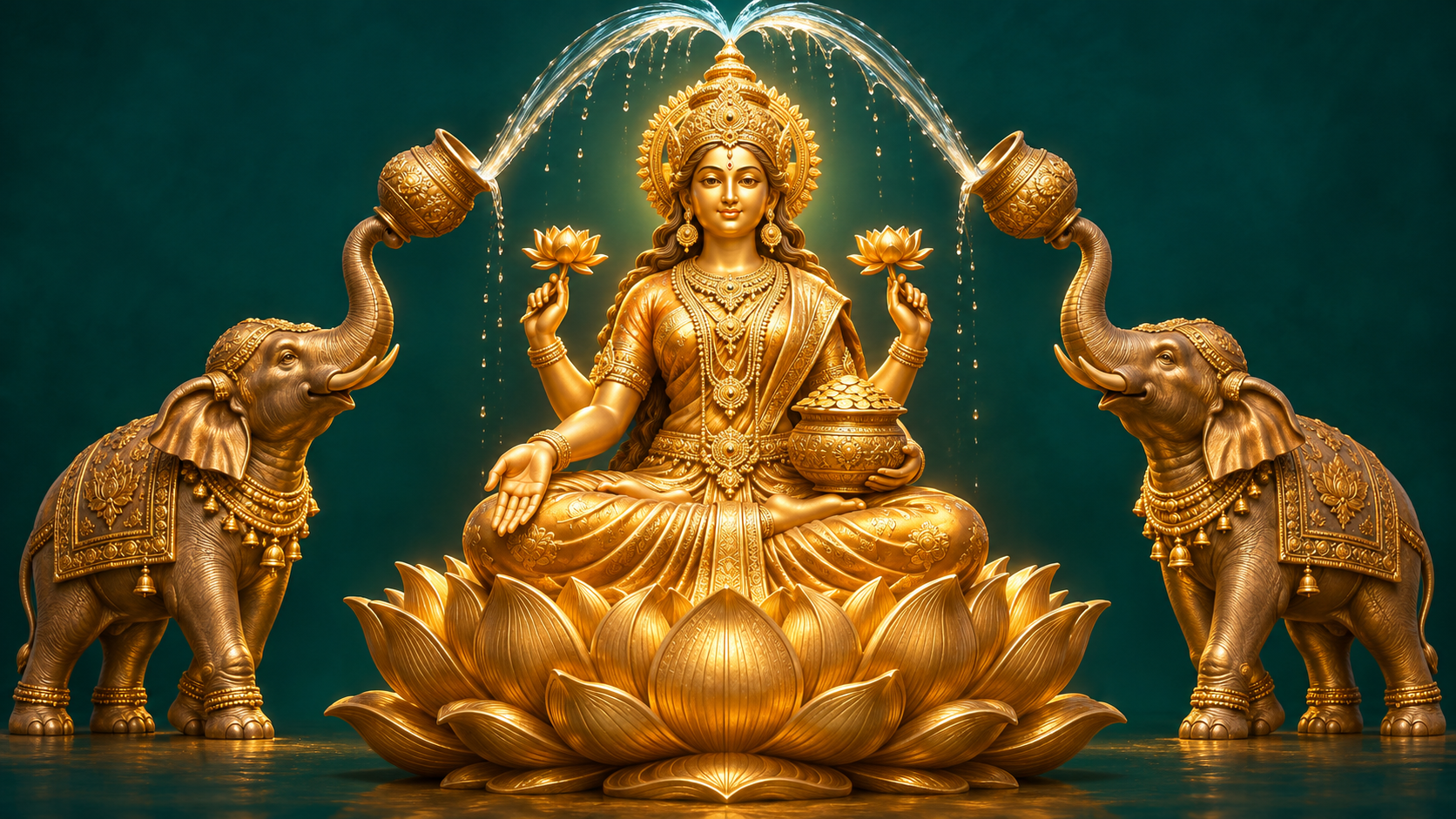
Elephants bring obvious visual weight to the composition. Their size and strength could have made them the dominant figures. Yet they remain at the sides, and their activity is directed toward Lakshmi. Power is present, but it has recognised a sacred centre.
That placement matters. Gaja Lakshmi does not reject strength, dignity, or material capacity. She shows those forces placed in the service of abundance and grace. The elephants do not seize, trample, or carry wealth away. They pour an offering upon Devi.
The pair also creates visual balance. One elephant would pull the eye toward a single edge; two flanking elephants hold the goddess at the centre and give the scene order. Symmetry makes their strength appear governed rather than erratic.
Do not automatically turn the two sides into a doctrinal equation. It is tempting to declare that one elephant represents material prosperity and the other spiritual prosperity, or to attach some other neat pair of concepts. Symmetry alone does not prove such a code. Use a more disciplined interpretation: the pair balances the composition and jointly attends Lakshmi. Go further only when a particular temple, lineage, or teacher provides a basis for doing so.
This gives you a practical contemplative question. When you possess strength, influence, knowledge, or resources, what stands at the centre of their use? The elephants suggest that greatness becomes auspicious when it serves what is sacred rather than demanding to be worshipped itself.
Amrita changes what prosperity means
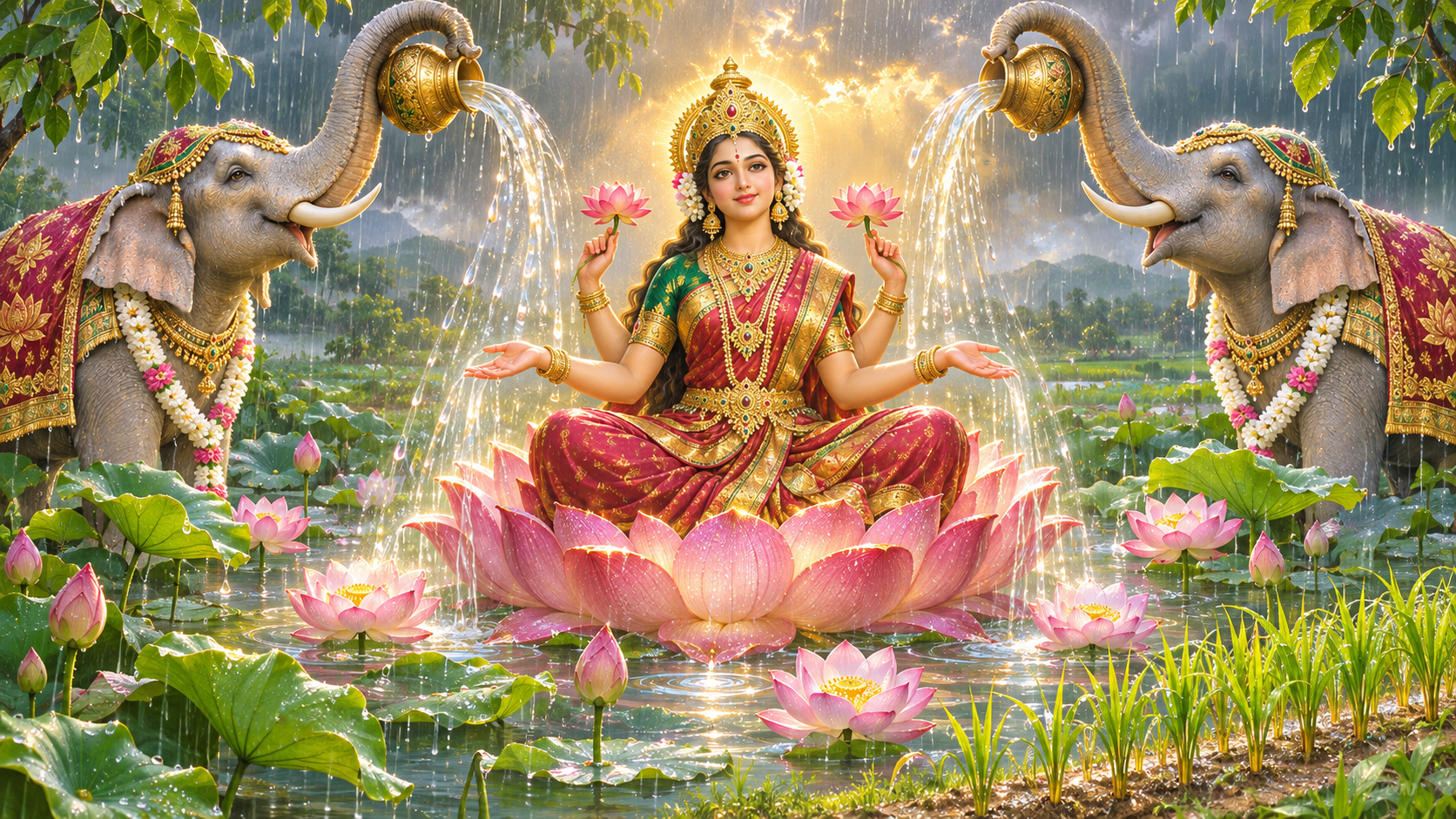
The vessels contain amrita, the divine nectar commonly associated with deathlessness. This is more specific than a generic shower of riches. The elephants hold something precious, release it, and direct its flow toward Lakshmi.
That action turns the image from an inventory of symbols into an event. A vessel can store. Pouring makes what was stored move. The scene therefore lends itself to an understanding of abundance as renewal and circulation, not merely accumulation.
Grace is equally important. Lakshmi is not being depicted as a machine that produces possessions on demand. She is the divine centre of the scene, and the nectar descends upon her in an act of honour. Prosperity here is inseparable from a right relationship with the sacred.
This corrects a common modern reduction. If Gaja Lakshmi becomes only a charm for getting more money, most of the composition has been discarded. The elephants’ service, the vessels’ capacity, the nectar’s flow, and Lakshmi’s centrality together point toward a fuller prosperity: abundance governed by grace and capable of sustaining life.
Keep three levels of interpretation separate
- Begin with what is visible. Lakshmi occupies the centre; two elephants flank her; vessels contain amrita; the outpouring is directed toward the goddess.
- Use the name to establish identity. Gaja identifies the elephants as defining participants in this form of Lakshmi, while Ashtalakshmi places the form within a group of eight manifestations associated with prosperity.
- Treat further meaning as contemplation, not automatic doctrine. Power serving grace, balance around a sacred centre, and abundance in circulation are readings grounded in the composition. They need not be presented as the only possible teachings recognised by every tradition.
This distinction protects both clarity and reverence. You can say confidently what the image depicts, explain what its arrangement invites you to notice, and still leave room for local and lineage-specific understanding.
How to inspect or choose a Gaja Lakshmi image
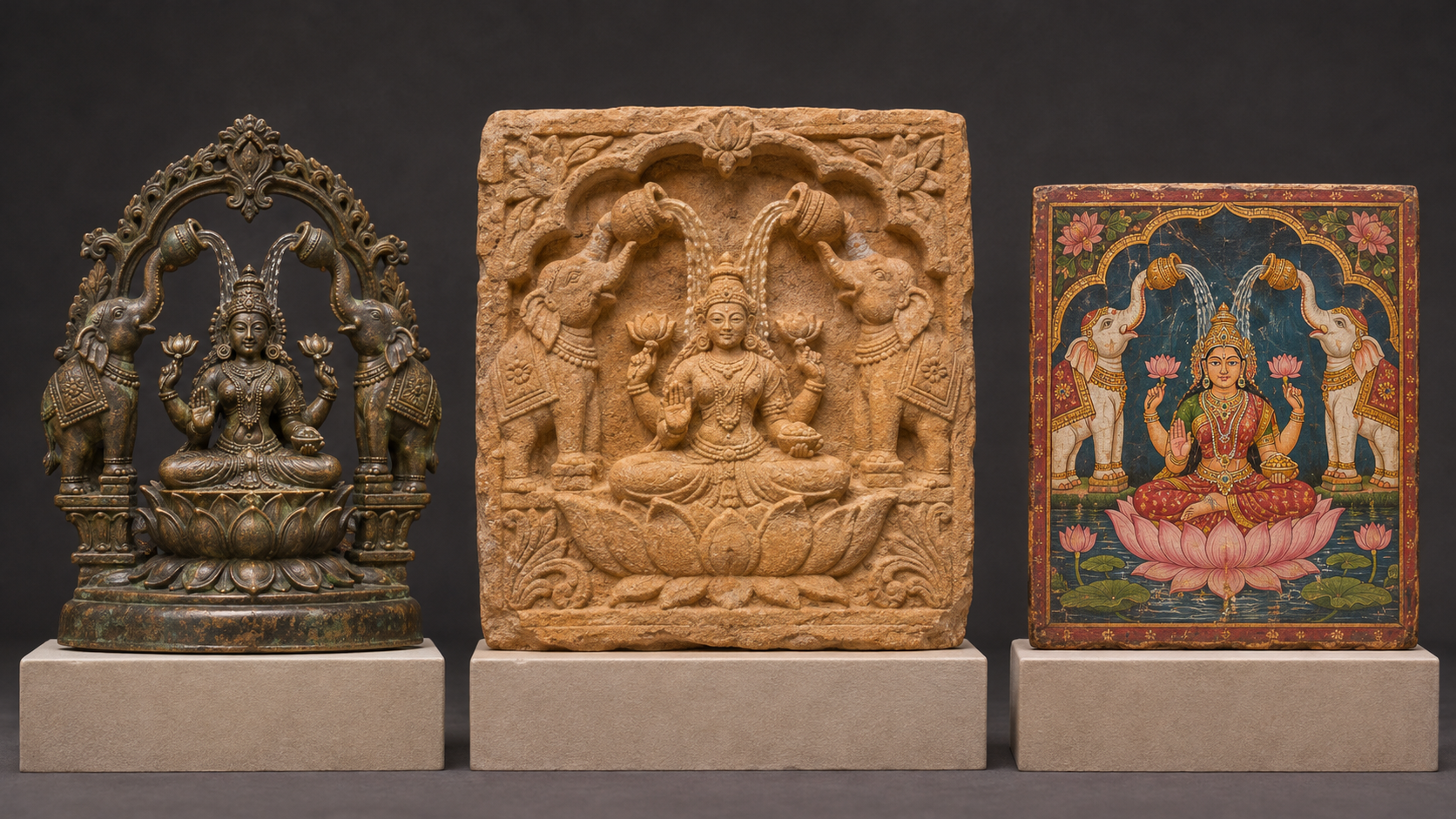
If you are studying a temple panel, evaluating an online image, or choosing sacred art for your home, use a repeatable inspection rather than trusting the title alone.
- Find the centre. Confirm that Lakshmi, rather than an elephant or an unrelated decorative figure, is the focus of the composition.
- Check both flanks. Look for the paired elephants on opposite sides. An elephant elsewhere in a crowded scene is not enough to establish the form.
- Follow the action. Identify the vessels and determine whether their contents are being directed toward Lakshmi. This relationship is more informative than the mere presence of containers.
- Test legibility at the intended distance. In a small murti or a weathered relief, the elephants may be visible while the vessels and pouring action disappear. If clear identification matters to you, choose an image whose defining action remains readable where it will actually be viewed.
- Separate material value from iconographic clarity. Cost, size, surface decoration, and craftsmanship may affect your choice, but none of them substitutes for the defining composition.
- Ask about the local tradition. If the image is intended for worship, consult a trusted priest, acharya, temple authority, or family tradition about ritual suitability. Iconography can identify the form; it does not by itself determine every rule concerning placement, mantra, offerings, or consecration.
A highly stylised work may evoke Gaja Lakshmi while simplifying the defining action. That does not make it worthless, but it changes what you can claim. Call it a clear representation when the relationships remain visible; call it an allusion or adaptation when only fragments of the composition survive.
When documenting a temple image, photograph the entire panel before taking close details. Record the temple or site, the image’s location within it, and any inscription or official identification. A tightly cropped photograph may preserve an elephant while removing the central relationship that tells you what the elephant is doing there.
Let the image shape conduct, not just interpretation
During darshana or private contemplation, follow the movement already present in the image. You do not need to invent an elaborate symbolic code.
- Rest your attention on Lakshmi at the centre. This keeps prosperity connected to Devi rather than reducing her to the objects a devotee hopes to receive.
- Bring the elephants into view. Notice that their visible strength is expressed through attendance and offering.
- Trace the flow from vessel to goddess. Consider the difference between resources kept closed and resources directed toward a worthy purpose.
- Name one corresponding act. Use some strength, time, knowledge, or material capacity in service of your family, community, temple, or another dharmic responsibility. Keep the act definite enough to perform.
You can also sit with three questions: Am I treating prosperity as a possession or as grace? Does my strength serve anything beyond my own status? Does what comes to me stop with me, or does it nourish a larger circle?
These are contemplative prompts arising from the arrangement of the image, not claims that every sampradaya prescribes the same meditation. Ritual instructions should come from the tradition you actually follow.
The next time you encounter Gaja Lakshmi, pause before labelling the elephants as mere signs of wealth. Verify the pair, the vessels, and the directed flow of amrita. Then let the composition place power at the service of grace. If the image changes how you use one resource already in your hands, its symbolism has begun to become practice.
References

Leave a Reply
You must be logged in to post a comment.