

You have found Mitra Saptami and Nimba Saptami on the same calendar date, but the names seem to call for different practices. You do not need to assemble every custom into one improvised ritual. Begin with your family’s tradition, keep Surya Bhagavan central where appropriate, and include neem worship when it belongs to your regional or inherited observance.
In 2026, the date to prepare for is 16 December. The practical work is deciding which observance you are keeping, what level of puja you can perform faithfully, and which details you need to confirm with a local temple or family elder.
One lunar date carries two devotional emphases
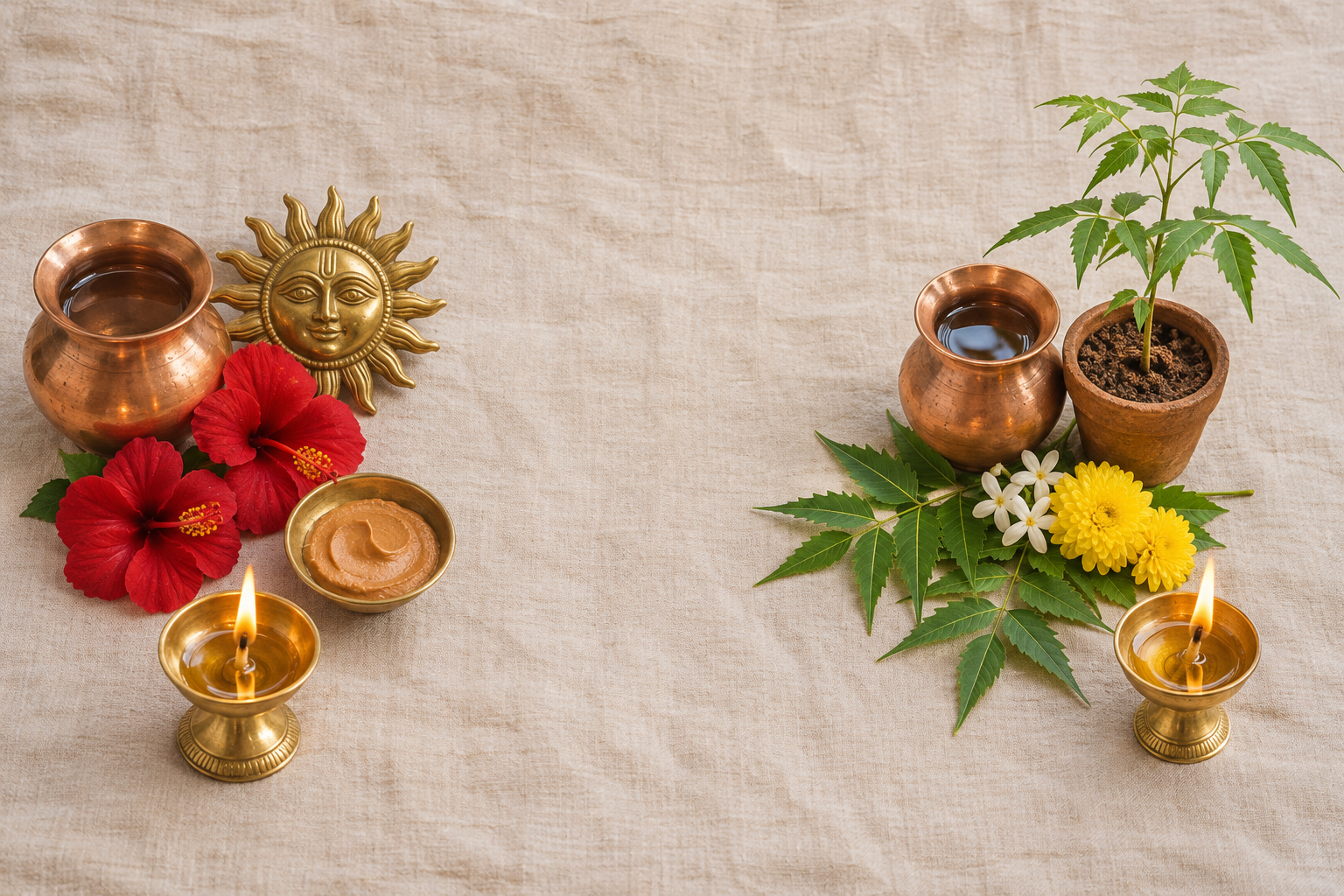
Both Mitra Saptami and Nimba Saptami fall on Shukla Paksha Saptami, the seventh lunar tithi of the bright fortnight, in Margashirsha. Both are dated 16 December in 2026.
The shared tithi does not make the two names meaningless. Mitra Saptami is a vrata devoted to Surya Bhagavan. Its stated ritual form includes Shodashopachara Puja and a special naivedya. Nimba Saptami places particular attention on the neem tree, Azadirachta indica, while also retaining an association with Surya. Neem worship on this day is found mainly in North Indian states.
Think of these as overlapping observances with distinct emphases, not as rival dates. A calendar may display both names because different communities recognize the same tithi through different practices.
A tithi is not identical to a midnight-to-midnight civil date. If you live outside Bharat, if your local calendar differs, or if you need the exact puja period, consult a panchanga calculated for your location. The published date gives you the day to reserve; the local panchanga gives you the timing to follow.
Choose the observance before gathering puja materials
Your first decision is not which items to buy. It is which tradition you are actually following. Use this order of priority:
- Follow an established family practice if one exists. Ask what the household calls the vrata, whether neem worship is included, and whether a particular naivedya is customary.
- Follow the paddhati of your temple or sampradaya when you are observing under its guidance. A complete Shodashopachara sequence should come from that tradition, not from a mixture of unrelated online checklists.
- Give regional practice its proper place. If your North Indian family observes Nimba Saptami, neem worship is not a decorative addition; it is part of the day’s identity.
- If you have no inherited procedure, keep the observance modest and Surya-centered. A sincere, clearly limited home puja is better than presenting an invented combination as an authoritative rite.
This approach also prevents a common mistake: assuming that every name printed beside a tithi requires a separate full festival. The calendar tells you which observances coincide. Your lineage, family, and locality tell you which form is yours.
A practical way to observe at home

The following plan helps you prepare without pretending that one generic sequence can replace a traditional paddhati.
- Confirm the local tithi. Check a reliable panchanga for your city before making time-sensitive plans. If your family priest or temple gives a specific period, use that instruction.
- Name the observance you intend to keep. Decide whether this is Mitra Saptami, Nimba Saptami, or the form your family uses when both names appear. Make that intention clear before the puja rather than changing procedures halfway through.
- Clarify the vrata rule. Mitra Saptami is a vrata, but the word vrata does not by itself establish one universal fasting rule. Find out whether your tradition calls for dietary restraint, a particular meal pattern, or simply disciplined worship. Do not impose a strict fast on yourself or another person from the name alone.
- Prepare only the offerings you can identify responsibly. A special naivedya is associated with Mitra Saptami, but no single recipe should be declared universal without a family or temple instruction. If no inherited dish is known, use a fresh offering already accepted in your household tradition and describe it simply as your offering.
- Choose between the formal and simple puja forms. Shodashopachara is a sixteenfold mode of honoring the deity through prescribed services. Perform it when you know the sequence or have qualified guidance. Otherwise, keep a clean puja place, invoke Surya Bhagavan according to your customary prayers, make the ordinary offerings your household knows, present the naivedya, and conclude with namaskara. Do not label a shortened personal sequence as a complete Shodashopachara Puja.
- Add neem worship only in a fitting form. Where Nimba Saptami belongs to your practice, worship a living neem tree respectfully and follow the offerings recognized by your family or community. Avoid breaking branches merely to create a ritual object. If no neem tree is accessible and you have received no substitution rule, retain the Surya observance and ask for guidance rather than treating an unrelated plant as equivalent.
- Close the observance deliberately. Complete the prayer, offer gratitude, and handle the naivedya as your household custom directs. Record any unanswered questions while they are fresh so that you can resolve them before the next observance.
If you are undertaking the vrata as a formal vow rather than as a simple devotional observance, consult your family priest or temple before the day. The important distinction is between adapting honestly to your circumstances and claiming ritual completeness that you have not been taught.
Four practical questions before Margashirsha Saptami

What if my family says Nimba Saptami but the calendar says Mitra Saptami?
There is no necessary conflict. Both names can occur on Margashirsha Shukla Saptami. Follow the name and procedure preserved by your family while recognizing that the calendar may also list a Surya-centered observance for the same tithi.
Must everyone perform all sixteen upacharas?
Shodashopachara is the formal puja associated with Mitra Saptami, but performing it correctly requires knowledge of the prescribed sequence. If you have not learned that paddhati, undertake a modest Surya puja and seek guidance before assuming a formal vow. Simplicity should be stated honestly, not disguised as completeness.
Does vrata automatically require a strict or waterless fast?
No universal strict-fast rule follows merely from the word vrata. Use the rule taught in your family or sampradaya. Do not copy an extreme fasting schedule without authoritative guidance, especially when age, pregnancy, medication, illness, or another medical need makes fasting unsafe.
Does honoring neem mean that I should consume neem?
No. Nimba Saptami honors the neem tree, but ritual reverence does not by itself provide an instruction to ingest neem or use it as treatment. Do not turn a worship practice into a medicinal regimen without appropriate professional advice.
Before 16 December 2026, settle three things: the local tithi timing, the tradition you will follow, and whether you need help with the formal puja. Once those are clear, you can observe Margashirsha Saptami without either flattening its regional diversity or burdening the day with unsupported rules.
References

Leave a Reply
You must be logged in to post a comment.