

You may have found Margashirsha Saptami under two names and wondered whether your calendar has duplicated the observance. In 2026, it has not: Mitra Saptami and Nimba Saptami both fall on 16 December.
The two names preserve different emphases on the same Margashirsha Shukla Saptami. Mitra Saptami centres worship of Surya Bhagavan. Nimba Saptami honours the neem tree and is also dedicated to Surya. You can therefore prepare for the day coherently without pretending that every family or region follows one identical ritual.
One tithi, two observances, and a shared centre
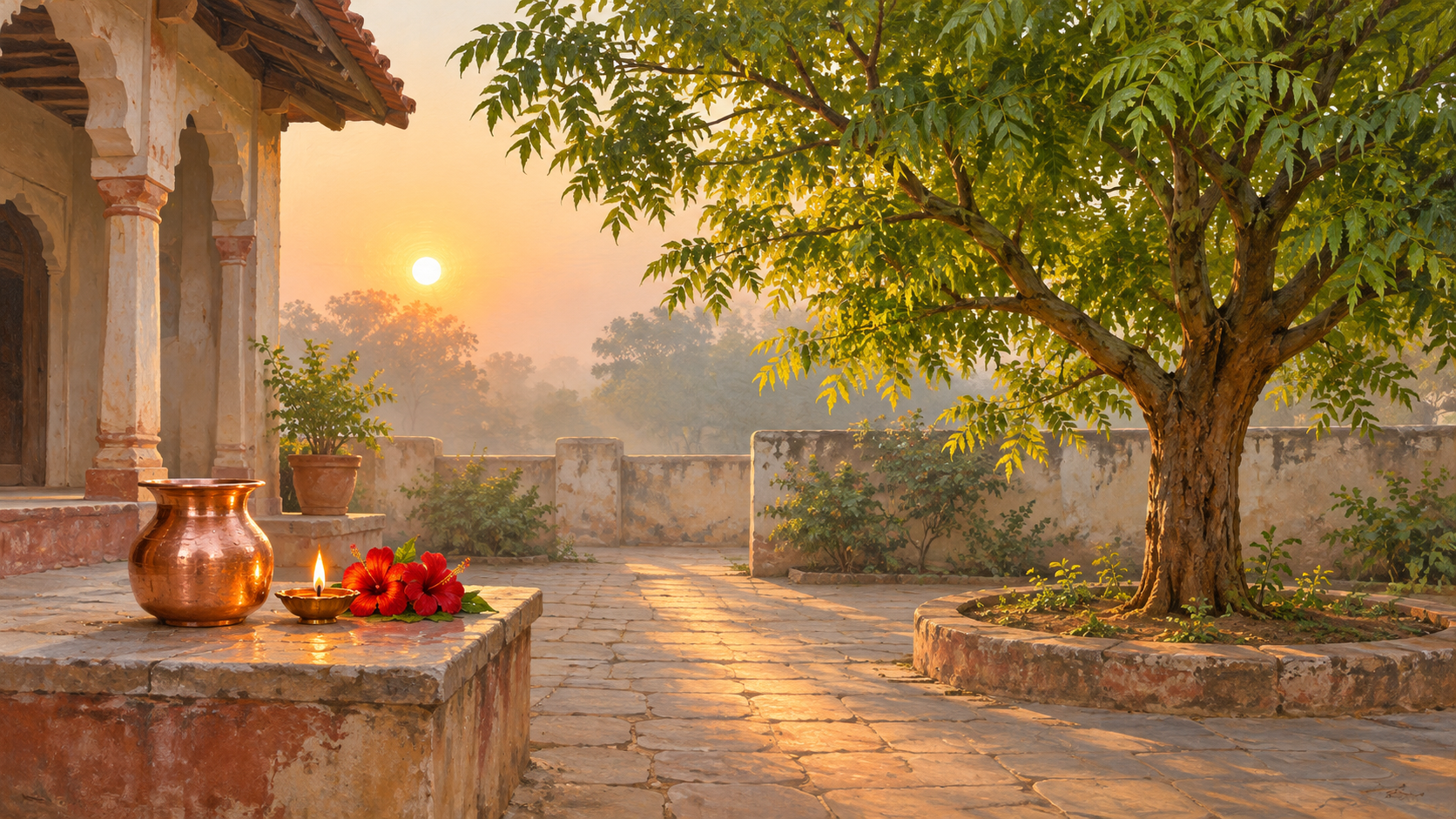
Shukla Paksha is the waxing half of a lunar month, and Saptami is its seventh tithi. The relevant tithi here occurs in Margashirsha. For the 2026 observance, the civil-calendar date is 16 December.
A tithi is not simply a midnight-to-midnight date. If the precise worship period matters in your tradition, consult a panchang calculated for your location or ask the temple where you normally seek calendar guidance. This is especially important if you live outside Bharat, because a date-only listing does not supply local start and end times.
Mitra Saptami is a vrat dedicated to Surya Bhagavan. Its stated form includes Shodashopachara Puja and a special naivedyam. Nimba Saptami is dedicated to the neem tree, is observed mainly in North Indian states, and retains Surya worship within its observance.
This gives you a clear organising principle. If your household observes both names, keep Surya as the common devotional centre while giving neem its own respectful attention. If your family follows only one form, there is no need to manufacture a combined ceremony and present it as inherited custom.
Key takeaways for 16 December 2026
- Mitra Saptami and Nimba Saptami fall on the same Margashirsha Shukla Saptami in 2026; they are not two consecutive festival dates.
- Surya Bhagavan is the shared devotional focus. Neem is the distinguishing focus of Nimba Saptami.
- Mitra Saptami calls for Shodashopachara Puja and a special naivedyam, but the available observance details do not establish one universal menu or one universally fixed household sequence.
- Use your local panchang for tithi timing and your family, sampradaya, or temple tradition for ritual details, fasting discipline, and naivedyam.
- Honouring neem does not require damaging the tree or turning a religious observance into an unsupervised medicinal practice.
A practical plan for the Surya observance

The most reliable preparation separates what is clearly established from what must come from your own tradition. Do not fill gaps with a confident-looking ritual list copied from an unrelated Surya festival.
- Confirm the local tithi. Mark 16 December 2026, then check the Margashirsha Shukla Saptami timing for your city. If your temple publishes a calendar, use the same calendar the community will follow.
- Identify your inherited form. Ask whether your household knows the day as Mitra Saptami, Nimba Saptami, or both. A regional difference is not a contradiction that needs to be corrected.
- Prepare for the scale of puja you can perform properly. If Shodashopachara is familiar in your home, assemble the materials used in that established sequence. If it is unfamiliar, obtain guidance from a knowledgeable priest or elder rather than guessing at sixteen items.
- Worship Surya Bhagavan in the customary order. Keep the focus on attentive upachara, prayer, and offering instead of adding practices merely because they appear in another Surya observance.
- Prepare the naivedyam your tradition recognises. A special offering belongs to Mitra Saptami, but no single dish is established by the available details. Follow family or temple instruction; do not advertise a regional recipe as mandatory for everyone.
- Add neem reverence if you observe Nimba Saptami. Treat it as a distinct part of the day, not as a decorative prop attached to the Surya puja.
- Record the guidance you followed. A brief note with the panchang used, the family custom, and the naivedyam will make next year’s preparation more faithful and less improvised.
Shodashopachara literally indicates a sixteenfold mode of ritual hospitality or service. The name tells you the intended fullness of the puja, but it does not justify assuming that every lineage arranges or expresses the upacharas identically. Use the procedure your tradition recognises.
The word vrat also should not be treated as automatic proof of one particular food rule. Whether your observance involves a full fast, a limited diet, another discipline, or primarily the puja depends on the practice you have actually received. If you have no inherited rule, ask before imposing a severe fast on yourself or someone else.
How to honour neem without inventing a ritual
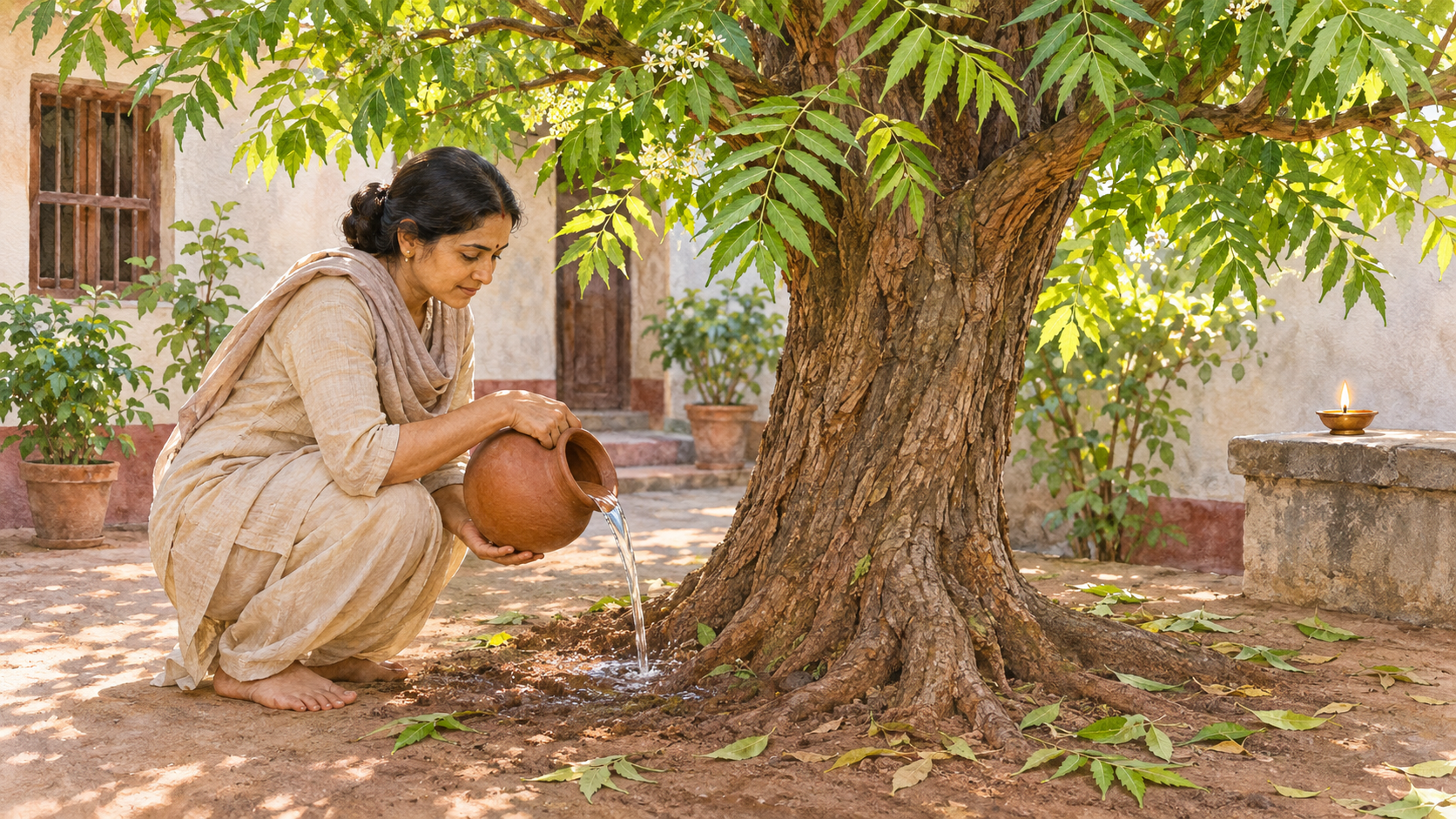
Nimba Saptami concerns the neem tree, botanically identified as Azadirachta indica. That specificity matters. If you are uncertain whether a nearby tree is neem, have it identified by someone knowledgeable rather than assuming that any similar-looking plant will do.
Where your family or community has a recognised Nimba Saptami procedure, follow it. Where it does not, begin with restraint: approach the living tree reverently, keep its surroundings clean, and avoid stripping leaves, cutting bark, or breaking branches merely to make the observance feel more elaborate. The dedication is to the tree itself; needless damage works against the reverence you are trying to express.
If no neem tree is accessible, do not substitute an unidentified plant and call the result traditional. You can still perform the Surya-centred observance and ask a North Indian temple or a family familiar with Nimba Saptami how they handle the absence of a living neem tree. The regional concentration of this practice means that many Hindus outside those communities will not have inherited a detailed neem ritual.
Planting a neem tree may be a meaningful voluntary act where the species suits the climate and local ecology, but it should not be presented as a required replacement ritual without support from your tradition. A living tree also creates a continuing responsibility for location, water, space, and care.
Most importantly, tree worship is not medical instruction. Nimba Saptami does not by itself tell you to consume neem leaves, oils, powders, or extracts. Do not turn a devotional occasion into an unsupervised remedy, especially for a child, during pregnancy, or alongside medicines. Worship and treatment are different decisions.
Preserve the meaning by resisting false uniformity
The easiest mistake is to flatten the day into one supposedly pan-Hindu checklist. The second is to separate the names so sharply that their common dedication to Surya disappears. A more faithful approach holds the distinction and the overlap together.
For Mitra Saptami, give proper attention to Surya Puja, Shodashopachara, and naivedyam. For Nimba Saptami, recognise the neem tree as the particular focus while retaining Surya within the observance. Where your family combines them, do so transparently as your household or regional practice. Where it does not, respect that boundary.
You can also adopt a personal reflection without mislabelling it as a scriptural command. Turning toward Surya and a living neem tree can train attention toward light, life, dependence, and gratitude. The discipline lies in treating them as worthy of reverence rather than as resources to be used carelessly. That reflection complements the ritual; it does not replace the ritual instructions of your sampradaya.
By the evening before 16 December, settle four things: your local tithi timing, the form your household will observe, the materials needed for Surya Puja, and the guidance for naivedyam and neem reverence. With those decisions made in advance, Margashirsha Saptami can remain a day of worship rather than a morning of hurried improvisation.
References

Leave a Reply
You must be logged in to post a comment.