
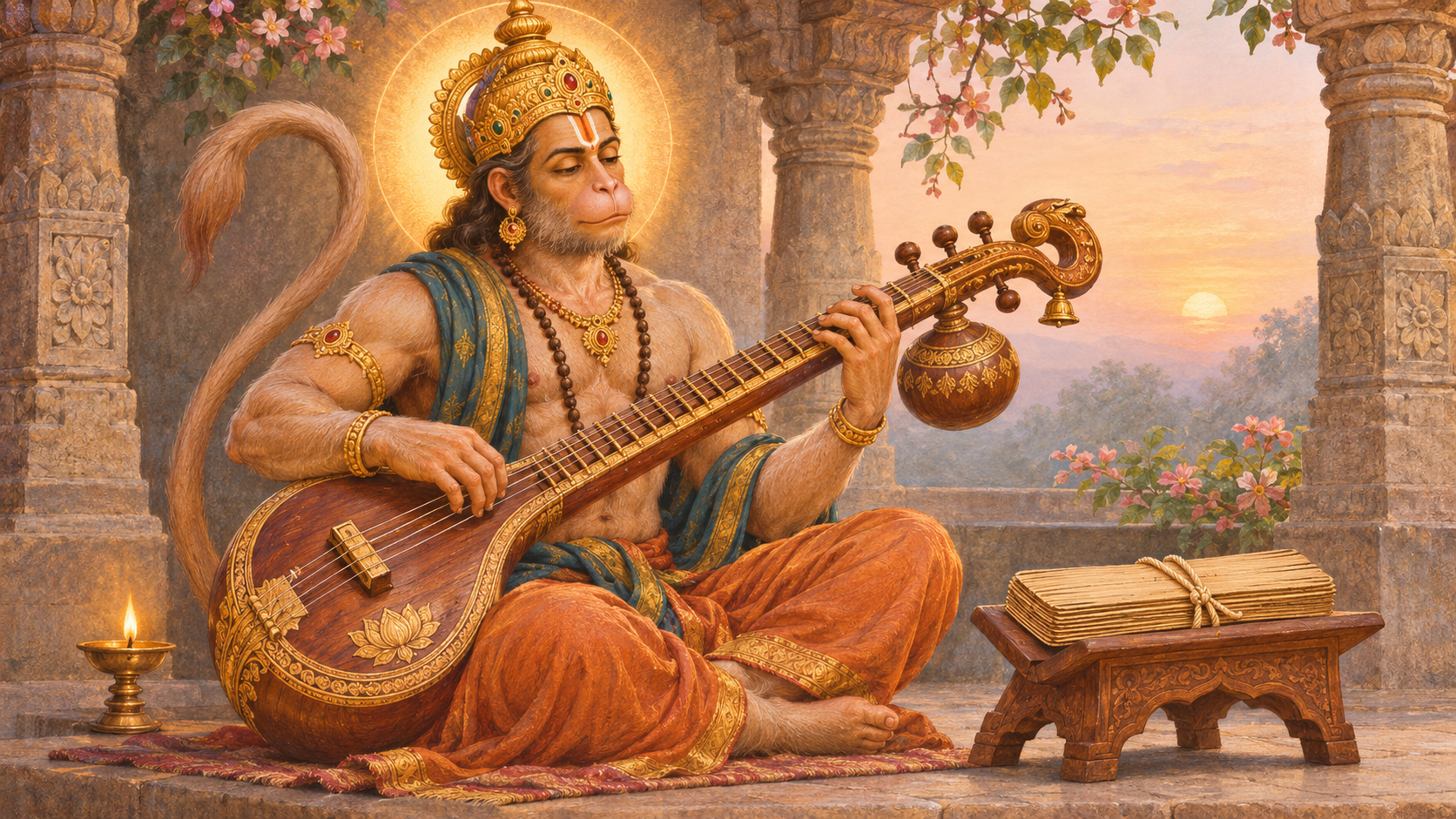
You may know Hanuman through images of strength, fearless action and service to Bhagavan Rama. Then you encounter him with a veena and palm leaf, and the familiar visual language seems to change. Is this still Hanuman, and what are these unexpected objects asking you to notice?
This is Veenadhara Hanuman. The form does not replace the warrior or the devoted servant. It brings forward another dimension of the same sacred personality: disciplined artistry, learning and the capacity to teach. Once you read the two principal attributes together, the image becomes much easier to understand.
Recognize the form through the complete set of attributes
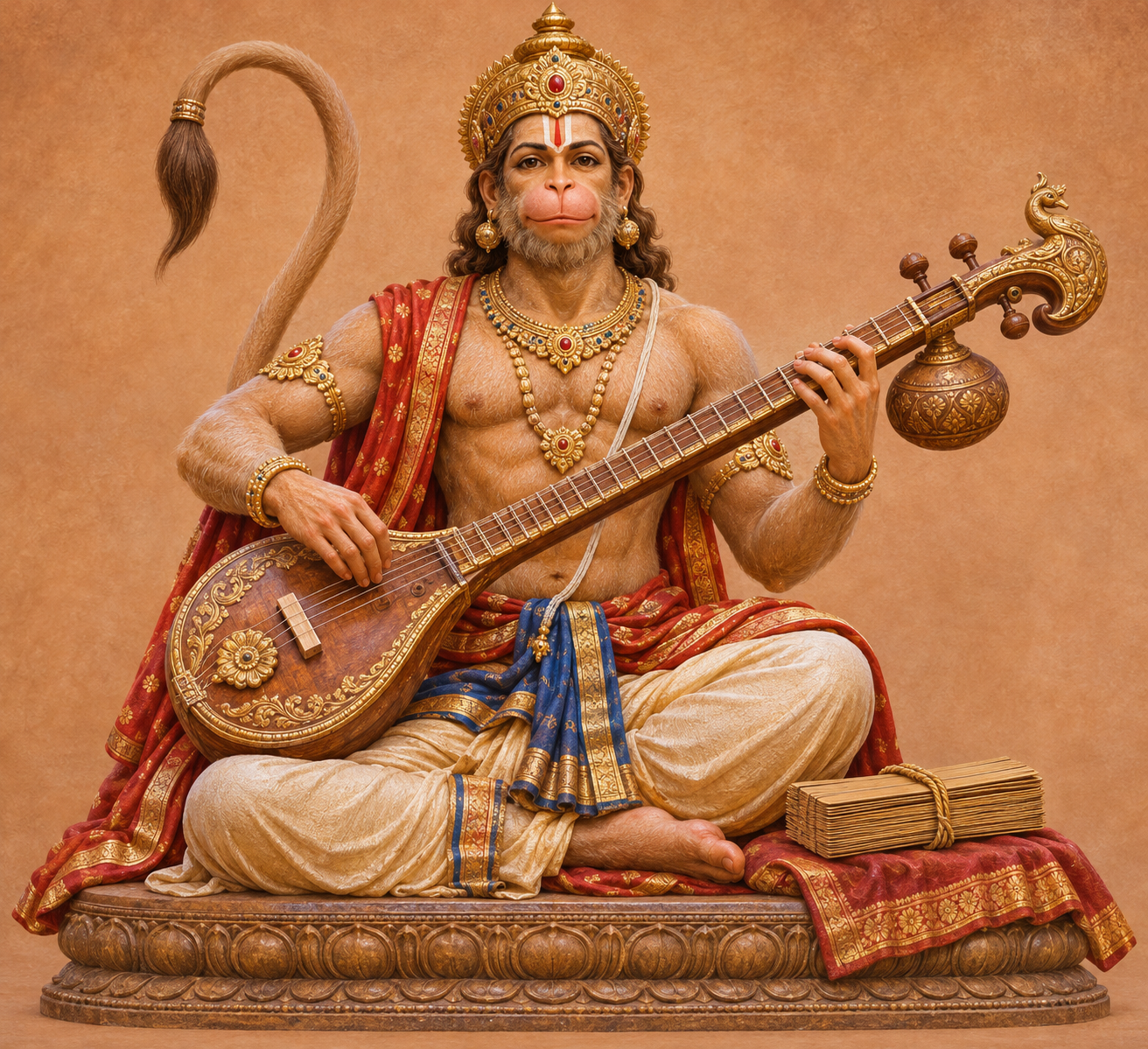
Begin with the figure, not the instrument. A veena by itself does not identify Hanuman, because an attribute can appear in more than one sacred context. First establish that the central figure is Hanuman from the image’s label, setting, provenance or other recognizable features. Then examine what this particular form places in his hands.
The decisive combination is Hanuman, the veena and the palm leaf. That combination moves the image into a gentler, scholarly and artistic register in which Hanuman appears as a teacher and musician. The objects are not incidental decoration. They tell you which qualities the artist or worshipping tradition wants to make present.
Use a simple three-step method whenever you examine such an image:
- Identify the sacred figure independently of the objects being carried.
- Name only what you can actually see: a veena, a palm leaf, a gesture or another clear attribute.
- Interpret the relationship among those elements before assigning a detailed story to any one of them.
This method prevents a common mistake: recognizing an unusual object and immediately inventing a specific episode to explain it. Veenadhara Hanuman can be meaningfully read without claiming a date, regional school, named composition or textual passage that the image itself does not establish.
The veena presents power governed by attention
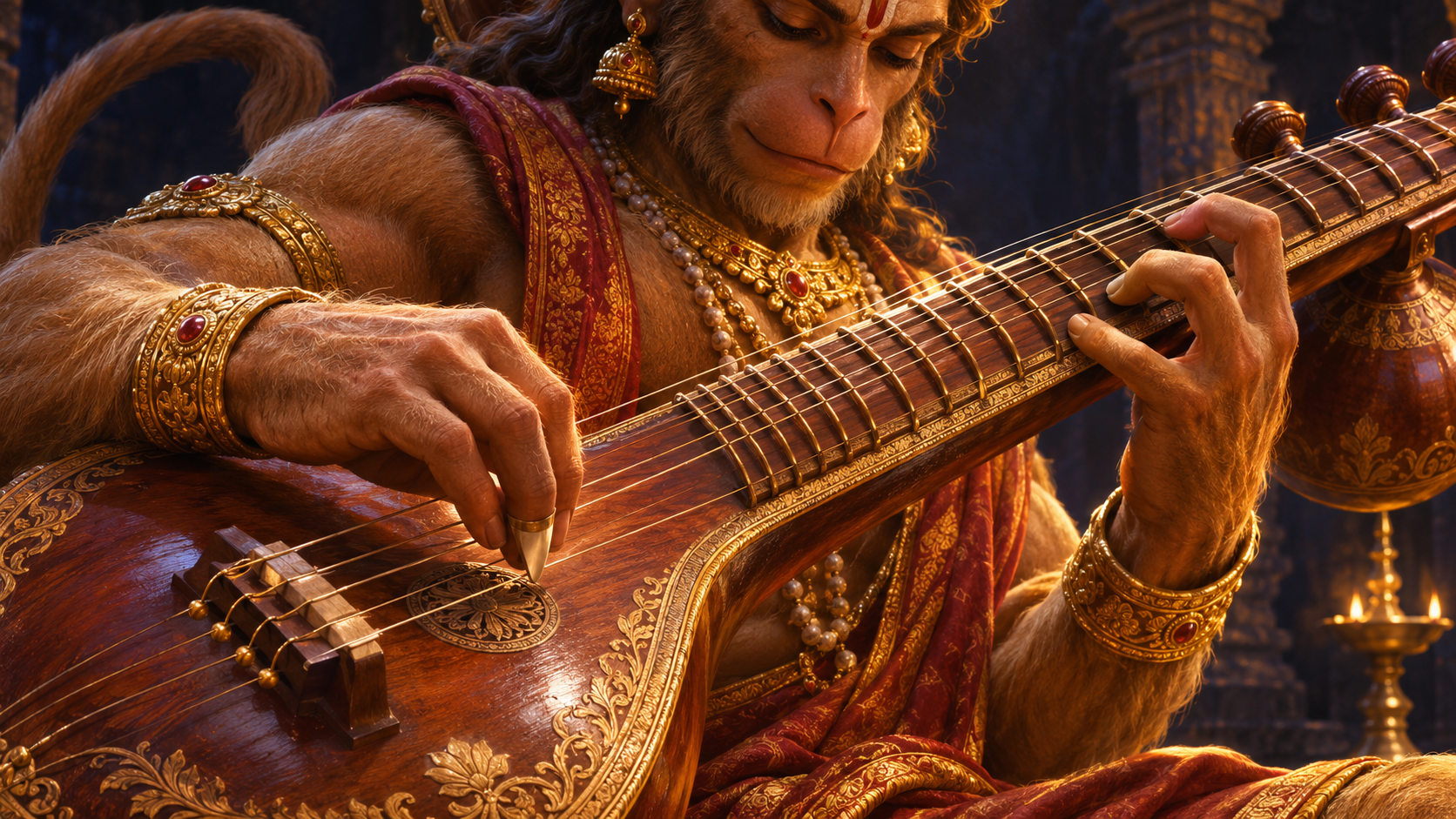
In the more familiar visual forms, Hanuman’s energy is directed toward action: confronting danger, carrying out Rama’s work or standing in devoted service. The veena redirects your attention from outward force to cultivated expression. Music requires strength, but strength alone cannot produce music. The player must also bring concentration, timing, restraint and repeated practice.
That distinction matters. The instrument does not make Hanuman passive or detach him from seva. It shows energy becoming ordered. The same steadfastness that sustains difficult action can sustain attentive listening, memorization and artistic discipline. Veenadhara Hanuman therefore gives you a way to see music not merely as entertainment but as a field in which devotion and self-mastery can operate together.
Do not read the veena as a rejection of Hanuman’s heroic nature. Hindu iconography often concentrates on one aspect without erasing the others. A peaceful form does not deny courage; it shows what courage looks like when it is not required to fight. Here, power is quiet enough to become precise.
If you are a musician, student or teacher, this gives the image a practical point of contact. Before practice or study, look at the instrument and ask a direct question: is your energy merely intense, or has it become attentive? That question stays faithful to what the veena visibly contributes without turning the image into a promise of effortless talent or success.
The palm leaf marks knowledge that must be carried forward
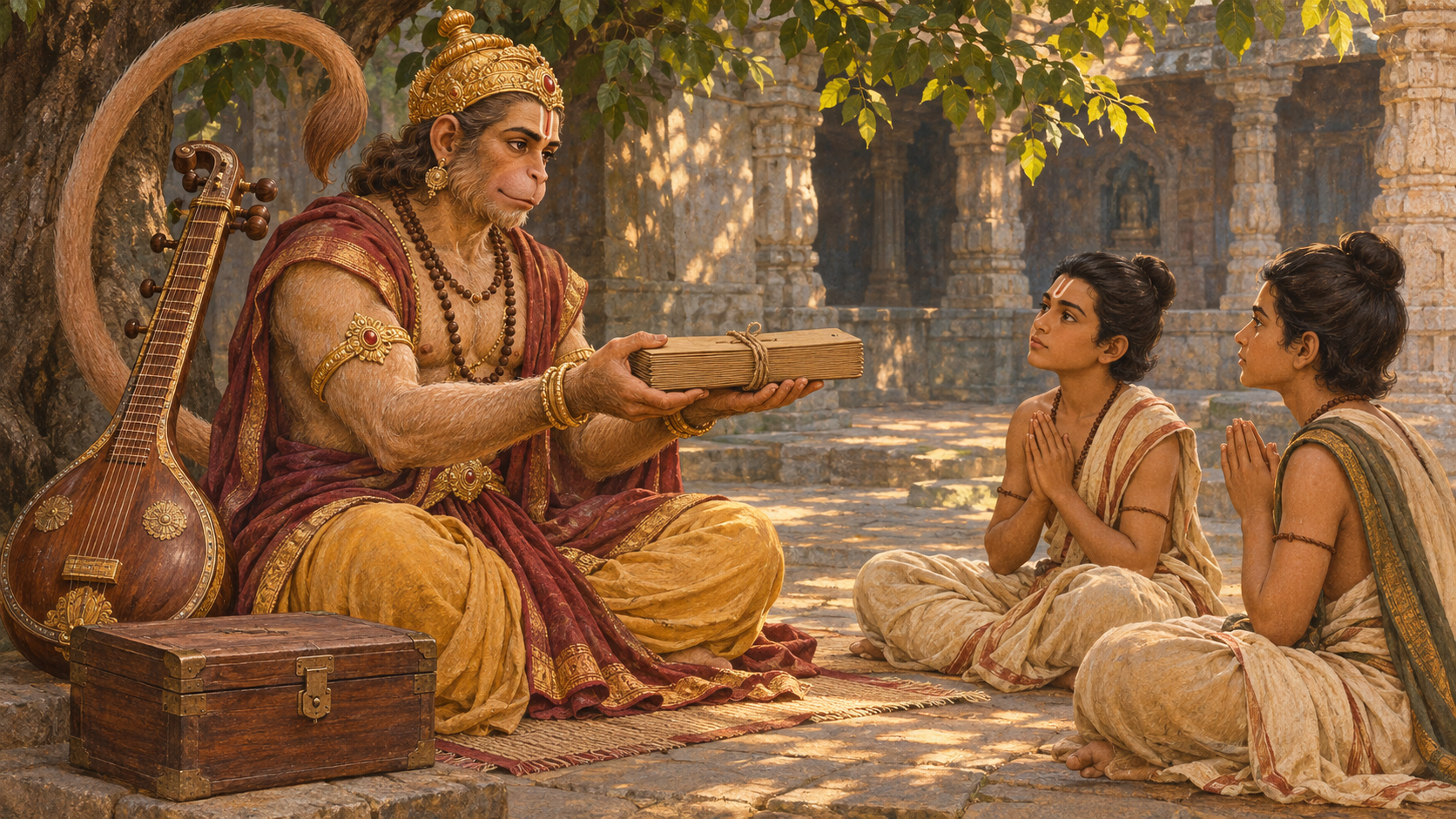
The palm leaf introduces a second kind of discipline. Whereas music unfolds through performance and is received through listening, a written leaf points toward knowledge that can be studied, remembered, preserved and transmitted. It shifts the viewer’s understanding of Hanuman from one who knows what to do to one who can also sustain and communicate knowledge.
There is an important limit to this reading. A palm leaf does not automatically identify a particular scripture, hymn, language or verse. Unless an inscription, accompanying label or established local tradition supplies that information, naming a specific text would go beyond the visible evidence.
Keep three levels of interpretation separate:
- What you can observe: Hanuman is associated with a palm leaf.
- What the attribute reasonably conveys: learning, study, preservation and teaching.
- What requires additional evidence: the exact work, passage, language or scholarly lineage represented.
This distinction is especially useful in a temple, museum or photograph without a caption. It lets you appreciate the iconography while remaining honest about what you do not know. If a precise identification matters, ask the temple’s custodians, consult the object’s catalogue entry or look for an inscription rather than filling the gap with a convenient story.
Read the veena and palm leaf as a single teaching
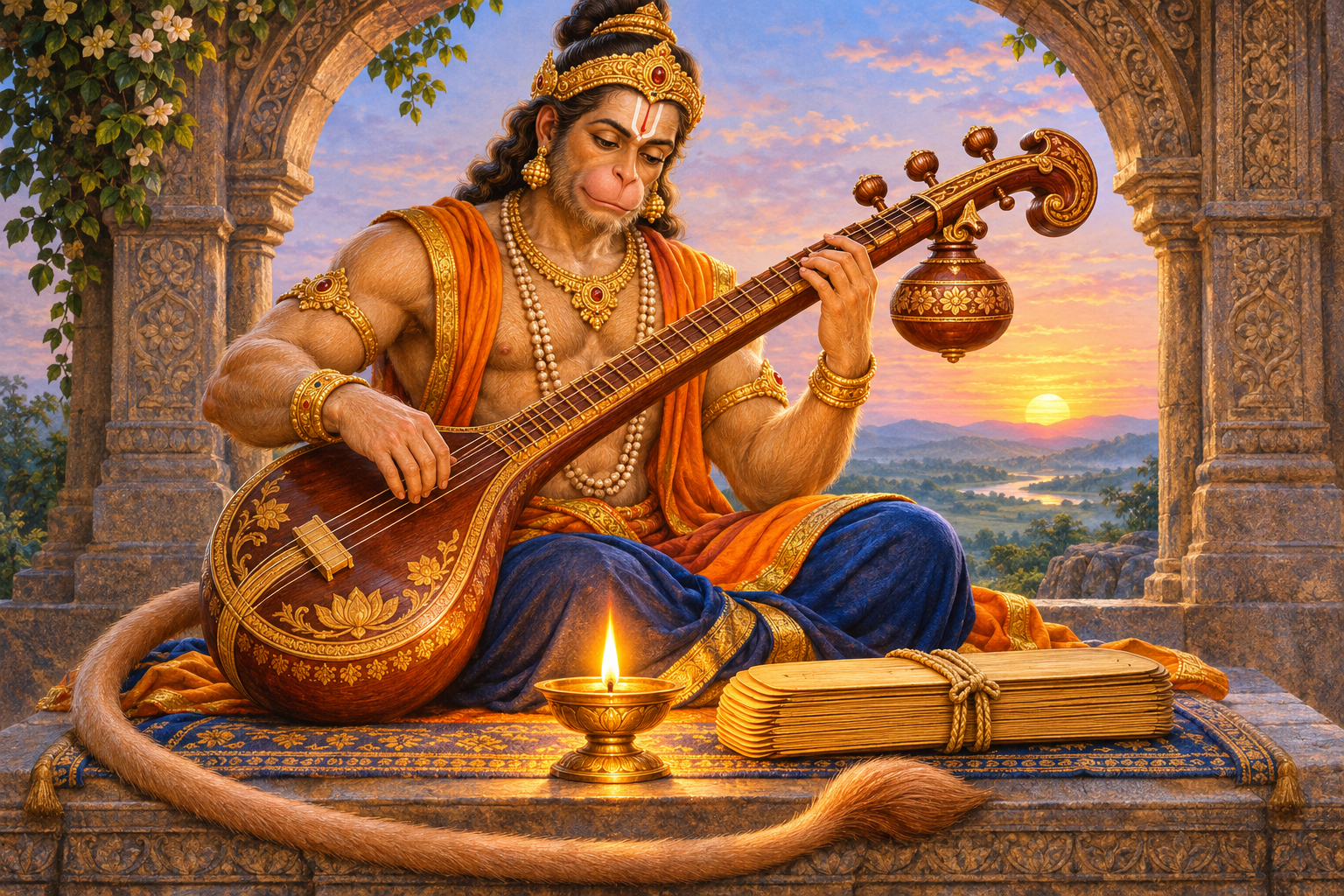
The deepest meaning emerges from the pairing. The veena suggests knowledge brought to life through sound and disciplined performance. The palm leaf suggests knowledge retained for study and transmission. One is enacted; the other is preserved. Placed together, they resist the false choice between creative expression and serious learning.
This pairing also broadens the meaning of devotion. Bhakti need not be confined to an emotional state, and scholarship need not become dry accumulation. The musician must learn; the student must give knowledge a living voice. Veenadhara Hanuman holds these functions together in one figure, so neither art nor learning stands apart from service.
You can use the image devotionally without inventing a special ritual. Let the visible attributes shape a modest practice. Read a short passage with full attention. Recite or sing what you already know carefully rather than mechanically. If you teach, prepare so that what you pass on remains accurate and alive. The aim is not to imitate the sculpture literally, but to embody the relationship it presents: learn deeply, express faithfully and place both capacities in service of dharma.
The form can also correct an incomplete picture of Hanuman. If you see him only as physical force, the palm leaf asks you to notice intelligence and learning. If you see devotion only as obedience, the veena asks you to notice creativity and refinement. If you treat scholarship and art as self-display, Hanuman’s identity as Rama’s devoted servant returns both to seva.
Key takeaways
- Identify Hanuman first; do not use the veena alone to identify the figure.
- Read the veena as disciplined artistic expression, not as a denial of Hanuman’s heroic strength.
- Read the palm leaf as a sign of learning, preservation and teaching, but do not assign it a specific text without evidence.
- Interpret the two attributes together: knowledge must be preserved, practiced and given living expression.
- Let the form guide concrete habits of attentive study, careful recitation, responsible teaching and service.
The next time you encounter Veenadhara Hanuman, pause before searching for an elaborate legend. Confirm the figure, name the attributes and watch how they work together. The veena and palm leaf already offer a demanding instruction: cultivate what you know, refine how you express it and dedicate both to something greater than yourself.
References

Leave a Reply
You must be logged in to post a comment.