
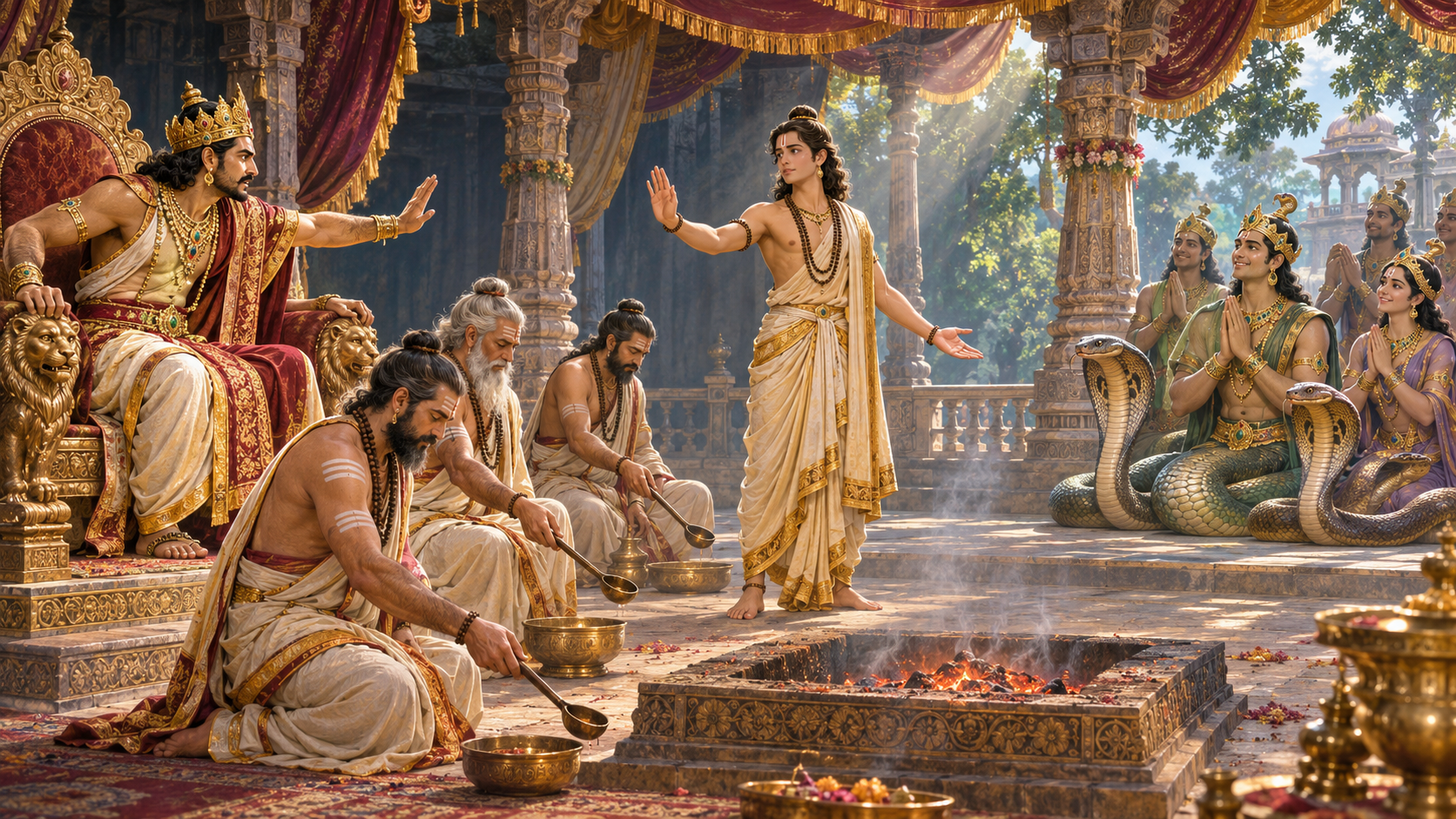
If you are trying to understand “Sage Astika’s boon to the Nagas,” begin by separating two requests that are often compressed into one. Astika first asked a king to spare the Nagas. He then asked the rescued Nagas to protect people who would remember his intervention.
That distinction reveals the episode’s deeper movement. Mercy does not end when one side is saved. It becomes an obligation to show restraint in return. Astika turns a cycle of injury and vengeance into a covenant between the powerful, the vulnerable, and those who keep the memory alive.
The two boons in Astika’s story
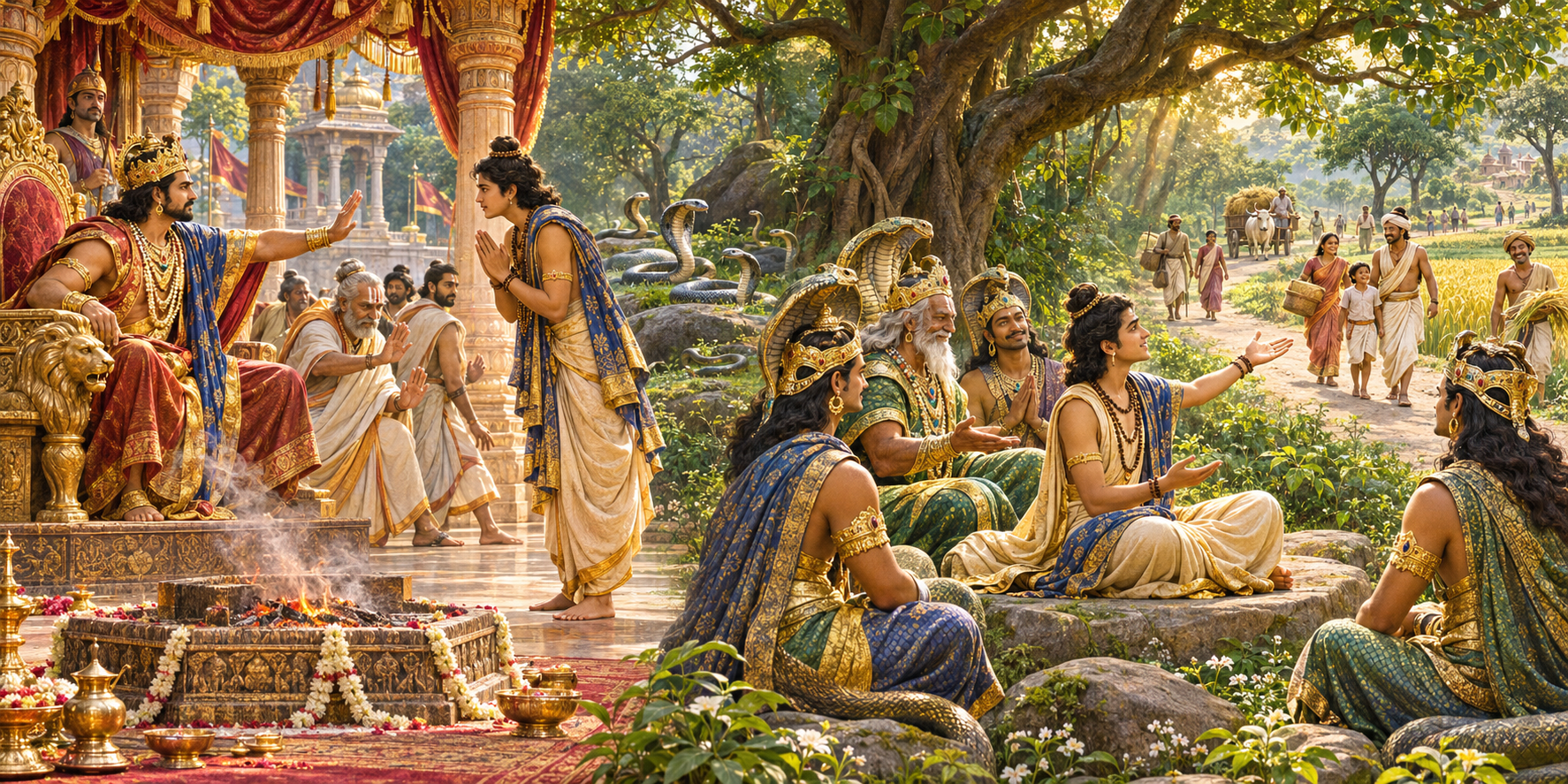
The crisis begins with grief sharpened into collective revenge. King Janamejaya undertakes the sarpasatra, a sacrifice intended to destroy the serpents, because his father, King Parikshit, died from Takshaka’s bite. As Nagas are drawn into the destructive sacrifice, Astika intervenes and obtains its cessation.
This is the first boon: Janamejaya grants Astika’s request to stop the sarpasatra. The direct beneficiaries are the Nagas who would otherwise perish. When people speak of Astika’s “boon to the Nagas,” this act of deliverance is usually what they mean.
But another boon follows. The grateful Nagas allow Astika to ask something of them. He does not request wealth, prestige, or an advantage reserved for himself. He asks that people who faithfully remember or recite the account of his deed should have no fear of serpents. The traditional formulation connects this remembrance with morning or evening recitation.
| Moment | Who grants the boon | What Astika asks | Who benefits |
|---|---|---|---|
| During the sarpasatra | King Janamejaya | Stop the destruction of the serpents | The endangered Nagas |
| After the Nagas are spared | The Nagas | Protect those who remember or recite Astika’s saving deed | Future generations who preserve the memory |
The distinction matters because Astika is not merely a rescuer. He is also a mediator. He asks the human king to restrain his vengeance, and he asks the Nagas to restrain their power. Dharma is restored through reciprocal limits rather than through the unconditional victory of one side.
Why Astika’s second request is genuinely selfless
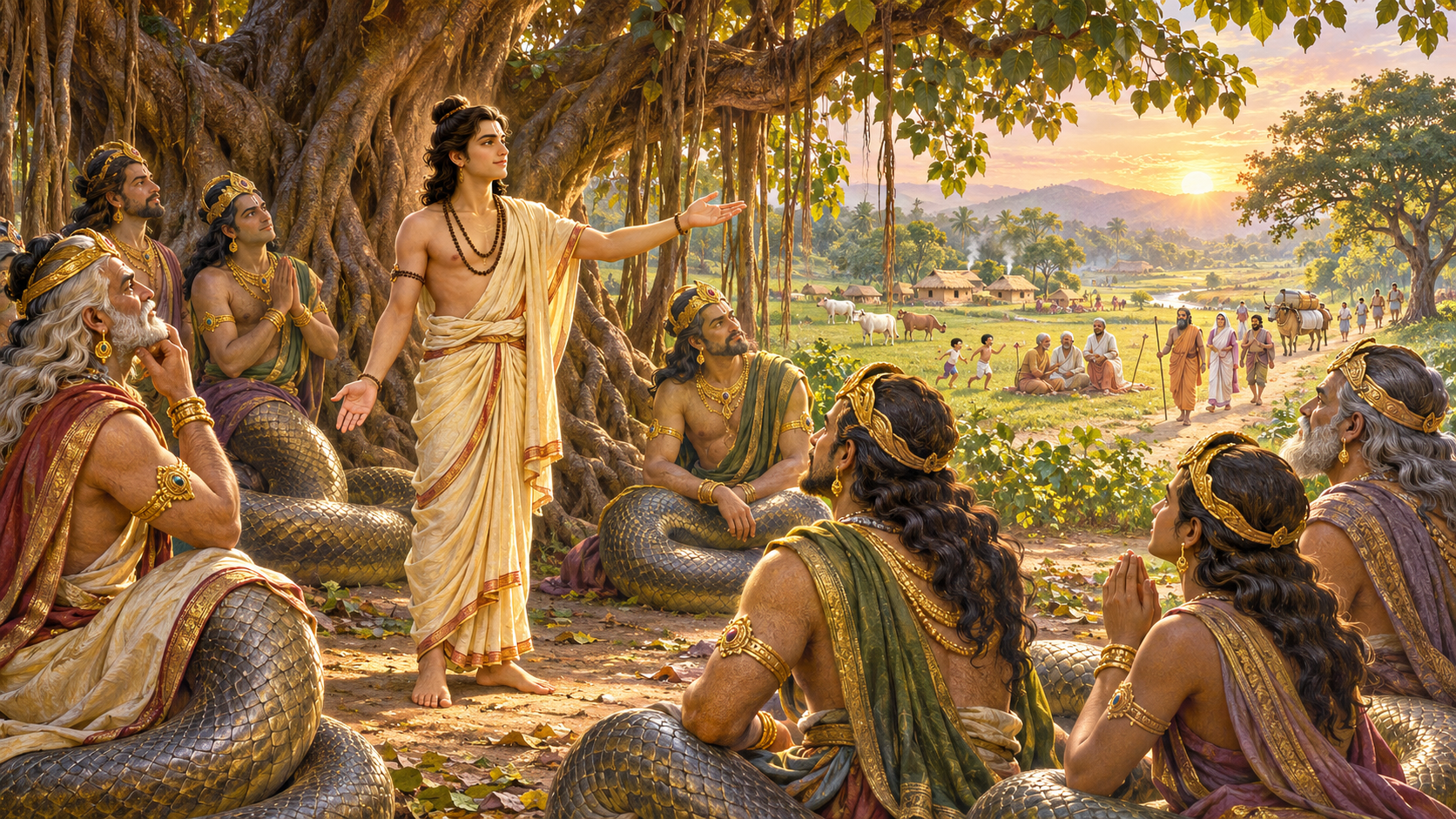
A boon reveals what its recipient values. Astika uses an open offer for the welfare of people he will never meet. He does not convert the moral credit earned by his intervention into a private reward. He converts it into continuing protection.
The request is selfless in three precise ways. Its benefit extends beyond Astika. It reaches beyond the people present at the sacrifice. It also asks the Nagas to answer their own rescue by preserving life rather than taking it. Gratitude becomes an ethical responsibility.
This makes the episode more demanding than a simple tale in which good defeats evil. Takshaka’s act and Janamejaya’s grief are not erased. The problem is that retaliation against one serpent has expanded into the destruction of an entire class of beings. Astika identifies the point at which punishment has ceased to be proportionate and has become indiscriminate.
You can apply that distinction whenever anger begins to enlarge its target. Use what we might call the Astika test:
- Name the original injury accurately. Do not minimize it, but do not add unrelated grievances to it.
- Identify the responsible agent. Ask whether your response is reaching people who did not commit the wrong.
- Set a stopping point before acting. A response without a limit can become another form of injustice.
- Leave room for a credible mediator. If no voice is permitted to interrupt retaliation, vengeance has already displaced discernment.
This is not a formula for ignoring wrongdoing. It is a way to notice when the desire for justice has changed into a desire for total punishment. Astika neither denies the injury nor accepts extermination as its answer.
Remembrance is part of the protection

Why should protection be connected to remembering a story? Because sacred remembrance is not merely the storage of information. To remember Astika is to recall a complete moral sequence: a death produces grief, grief becomes collective vengeance, a wise intervention stops the destruction, and those who receive mercy promise restraint.
The recitation therefore carries more than a request for personal safety. It keeps alive the moment when hostility could have continued but did not. The person invoking Astika’s name places himself or herself inside that memory of restraint.
You do not have to choose between a devotional reading and an ethical one. A devotee may receive the Nagas’ promise as sacred protection. At the same time, the remembrance can train the devotee not to answer fear with indiscriminate harm. The prayer asks protection from serpents; the narrative asks human beings to examine what they do when fear and anger take control.
That balance is important when the episode is invoked in relation to actual snakes. Recitation can be a meaningful religious observance, but it is not permission to approach, provoke, capture, or handle a snake. Nor should it be used to delay urgent medical care after a suspected bite. Devotional trust and practical responsibility do not compete with each other.
A responsible observance can therefore join three actions: remember Astika’s intervention, refuse needless cruelty toward living beings, and follow sound physical precautions. That combination preserves both the sacred promise and the episode’s ethic of protecting life.
Questions that clarify the episode
Did Astika ask Janamejaya or the Nagas for a boon?
He asked both, at different moments and for different purposes. Janamejaya granted the request that ended the sarpasatra and spared the Nagas. The Nagas then granted Astika’s request to protect those who would remember or recite his deed. Confusing these two exchanges hides the reciprocity at the heart of the story.
Was the boon meant only for Astika?
No. Astika directs the benefit toward future rememberers of the episode. That is why the request is described as selfless: the opportunity for a personal reward becomes a continuing safeguard for others.
Does stopping the sacrifice mean the original wrong did not matter?
No. Parikshit’s death remains the injury that sets the crisis in motion. Astika’s intervention establishes a different point: one wrong does not make the destruction of an entire community dharmic. Ending indiscriminate retaliation is not the same as denying responsibility.
Carry Astika’s choice into your own practice
If you recite or retell this episode, do not stop at the promise of protection. Pause at the two moments when power accepts a limit. Janamejaya stops even though he has the means to continue. The Nagas, once saved, accept an obligation toward those who preserve Astika’s memory.
You can make that structure part of a simple reflective practice:
- Recall the injury without enlarging its target.
- Remember the lives that restraint can spare.
- Ask what mercy received now requires you to give.
The next time anger tells you that an entire group must answer for one person’s deed, remember where Astika stood: between a real grievance and an irreversible excess. Then choose the intervention that preserves justice without allowing vengeance to consume the innocent.
References

Leave a Reply
You must be logged in to post a comment.