
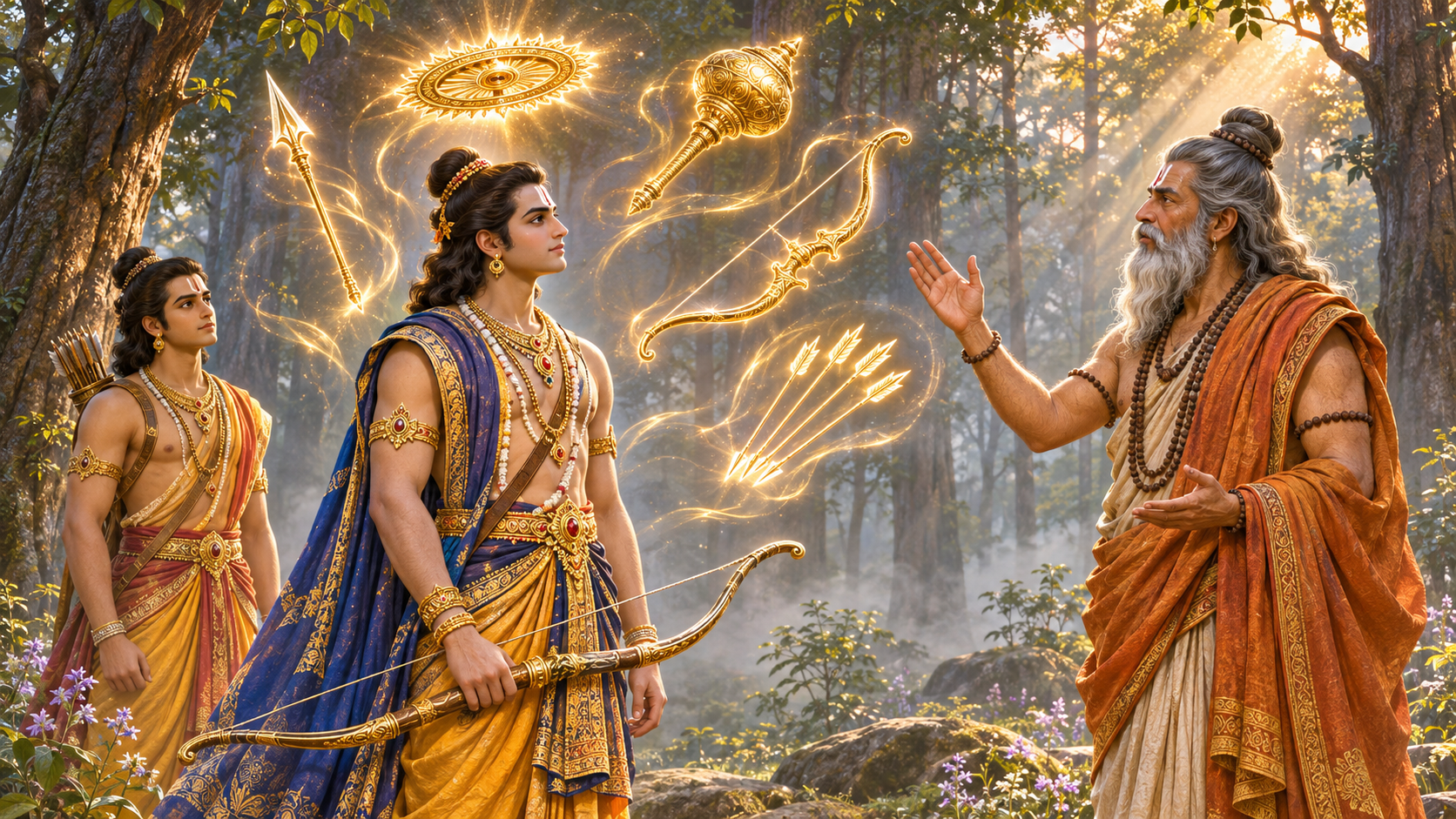
You may have reached Krishashva’s name while trying to understand Rama’s divine weapons and found the relationship unclear. Did Krishashva wield the weapons, create them, or personally hand them to Rama?
The clean answer is that Krishashva belongs to the sacred lineage of the weapons, while Vishwamitra is the teacher who prepares Rama and entrusts those powers to him. Keeping lineage, transmission and use separate makes the Bala Kanda episode much easier to understand.
Krishashva gives the weapons a lineage, not merely a label
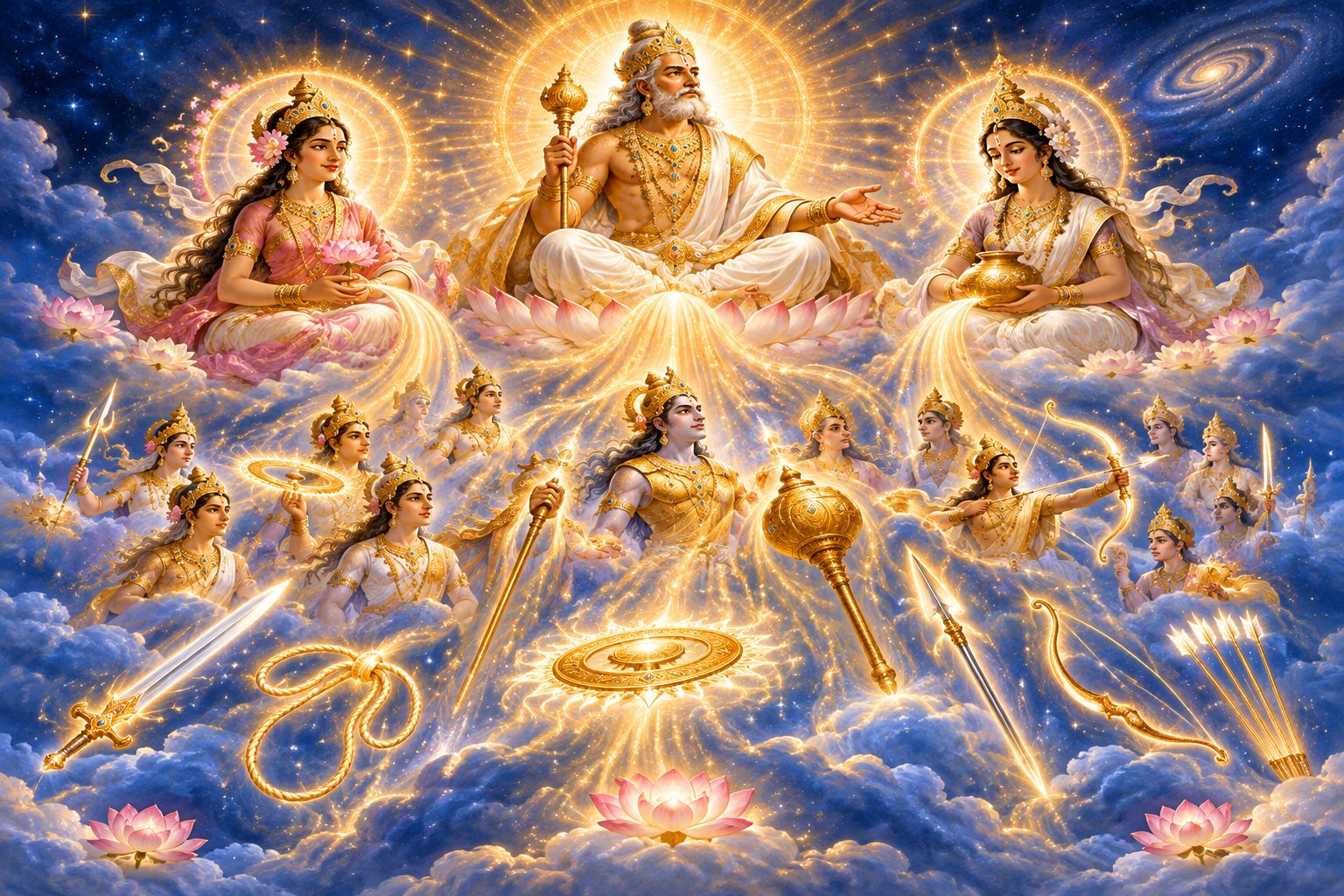
Krishashva is presented as a Prajapati associated with the divine weapons. That description matters. A Prajapati belongs to the order of generation and creation, so the connection places these powers within a sacred genealogy rather than treating them as anonymous pieces of military equipment.
This is also why you should not picture Krishashva as an armourer forging an arsenal for Ayodhya. His place in the account explains the weapons’ sacred provenance. Vishwamitra’s place explains their transmission to Rama. Rama’s place explains how a qualified kshatriya receives and uses them in the service of dharma.
- Krishashva: the Prajapati connected with the weapons’ lineage.
- Vishwamitra: the sage whose authority, knowledge and instruction mediate their transmission.
- Rama: the disciplined recipient who must command the powers without becoming ruled by them.
Calling them Rama’s divine weapons therefore does not mean that Rama invented them or possessed them as ordinary property. It means that they came under his command after instruction. In the epic world, stewardship is a better model than ownership.
Dasharatha’s fear explains why Rama must be prepared
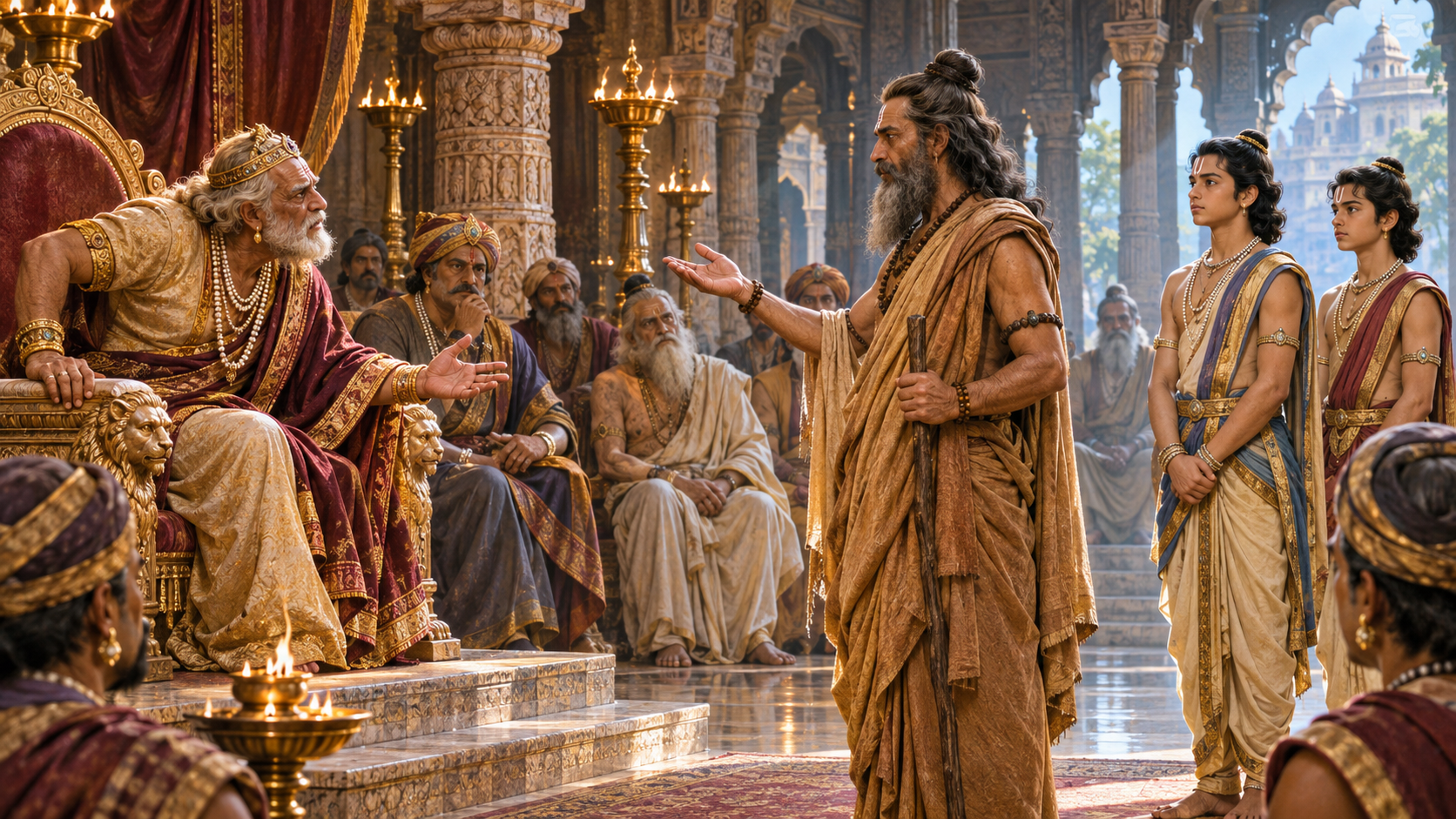
The weapons make sense only when you read what comes before them. In Bala Kanda chapter 20, Vishwamitra arrives at Dasharatha’s court and asks that Rama and Lakshmana protect his yajna from rakshasas. Dasharatha hesitates because Rama is young and has not faced a real battle. Vasishtha then enters at the moment when a father’s fear and a sage’s request appear irreconcilable.
Dasharatha’s anxiety is not a disposable obstacle inserted to delay the adventure. It establishes the central question: what makes Rama ready to bear extraordinary force? Royal birth alone is not the answer. The sequence places him under a guru, sends him to defend a defined sacred duty and subjects strength to instruction before associating him with a divine arsenal.
When you read the episode, follow that sequence rather than jumping directly to a list of weapons:
- A yajna must be protected.
- Dasharatha sees Rama’s youth and inexperience as reasons to refuse.
- Vasishtha’s intervention places the request within the authority of dharma and the guru tradition.
- Rama leaves royal security and accepts disciplined service under Vishwamitra.
- Divine power comes within a relationship of training, responsibility and restraint.
This order changes the lesson. Rama does not receive power and then search for a worthy purpose. The purpose is already present, and the power is entrusted in relation to it.
A divine astra is more than a superior physical weapon
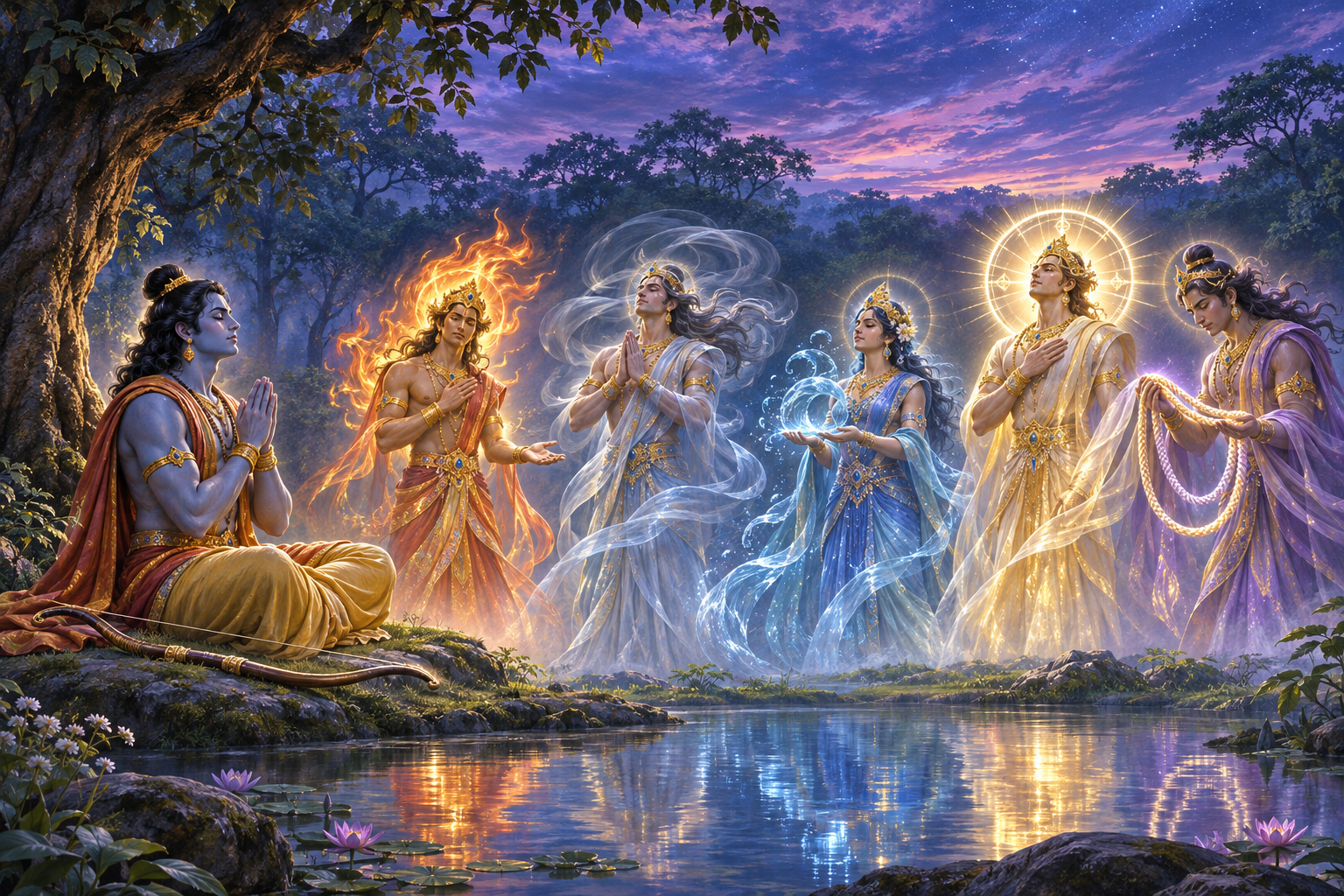
Modern readers often imagine the divine weapons as increasingly destructive projectiles. That picture captures only their battlefield effect. In epic usage, an astra generally denotes a power deployed through sacred knowledge or invocation, while shastra more often denotes a weapon physically held and used. English translations may call both of them weapons, which can hide the distinction.
An astra consequently involves more than possession of an object. The wielder must know how to invoke it, direct it and bring its operation to an end. Ability to release force without the ability to govern or withdraw it would be incomplete mastery.
The association with Krishashva reinforces this larger view. The powers have identity, lineage and a place within cosmic order. They are not morally self-directing, however. Their place in dharma depends on the qualifications, intention and discipline of the person who commands them.
This gives you a reliable test for interpreting any divine weapon episode: do not ask only what the weapon can destroy. Ask who is authorised to use it, who taught that person, what duty justifies its use and what limits remain after it has been invoked. Those questions reveal the ethical architecture that a catalogue of weapon names cannot.
The yajna defines the moral boundary of Rama’s power
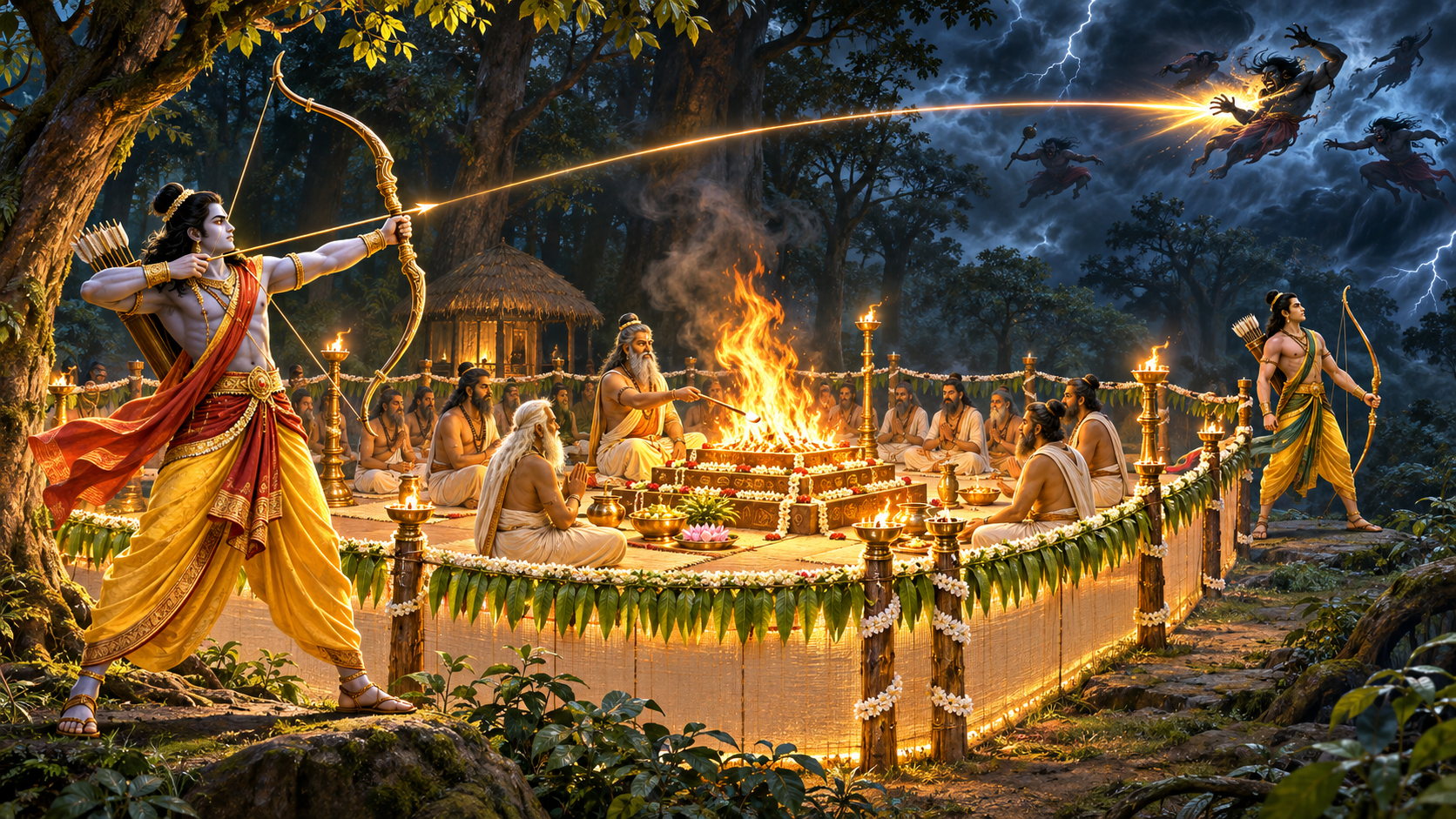
Vishwamitra does not take Rama away merely to display the prince’s strength. The stated mission is to protect a yajna from disruption. The task is bounded: defend a sacred act so that it can be completed. Rama’s martial capacity is therefore placed at the service of something beyond conquest, anger or personal reputation.
That setting helps explain why the account joins a sage, a prince and divine weapons. Vishwamitra possesses spiritual authority and specialised knowledge. Rama bears the kshatriya responsibility to defend order. The yajna supplies the dharmic purpose. None of the three elements should be detached from the others.
Read this carefully and the episode stops being a fantasy of unlimited force. It becomes an examination of controlled force. Rama’s greatness lies not simply in having access to powers unavailable to ordinary warriors, but in becoming the kind of person to whom such powers can be entrusted.
The distinction remains practical outside the battlefield. Knowledge, office, wealth, technology and political authority all magnify a person’s reach. The dharmic question is never merely whether you can use a power. It is whether its use serves a legitimate duty, remains proportionate to that duty and stays under disciplined control.
How to read the episode without losing its structure
If you are studying this passage for a class, satsang or personal reading, use five questions. They prevent three common confusions: treating genealogy as a transfer scene, treating initiation as ownership and treating destructive capacity as the measure of spiritual worth.
- Identify each role. Mark Krishashva as the figure associated with the weapons’ lineage, Vishwamitra as teacher and transmitter, and Rama as recipient and wielder.
- Mark the narrative order. Begin with the request to protect the yajna and Dasharatha’s hesitation. Do not begin with the arsenal.
- Separate origin, transmission and deployment. These answer different questions even when a retelling places them close together.
- Look for the governing duty. Ask what Rama has been sent to defend and why force is needed for that limited purpose.
- Measure mastery by control. Notice whether the warrior possesses the knowledge and discipline to govern a power, not merely the capacity to release it.
If your translation varies in spelling or compresses a genealogy, keep the roles in view before comparing individual names. A variant spelling is less likely to mislead you than a collapsed distinction between where a power comes from, who teaches it and who is permitted to use it.
Key takeaways
- Krishashva is the Prajapati connected with the sacred lineage of Rama’s divine weapons; he is not the battlefield teacher in the episode.
- Vishwamitra is the crucial mediator who takes Rama from protected prince to instructed defender of a yajna.
- Dasharatha’s concern about Rama’s youth establishes why qualification and guidance must precede extraordinary power.
- An astra should be read as an invoked and governed power, not simply as a more destructive physical weapon.
- The weapons belong within dharma because their use is tied to duty, instruction, restraint and control.
On your next reading of the Bala Kanda, write three labels beside the episode: lineage, transmission and use. Place Krishashva, Vishwamitra and Rama under the appropriate headings. That small exercise will show you why the deepest subject here is not the size of Rama’s arsenal, but the discipline that makes divine power safe in his hands.
References

Leave a Reply
You must be logged in to post a comment.