
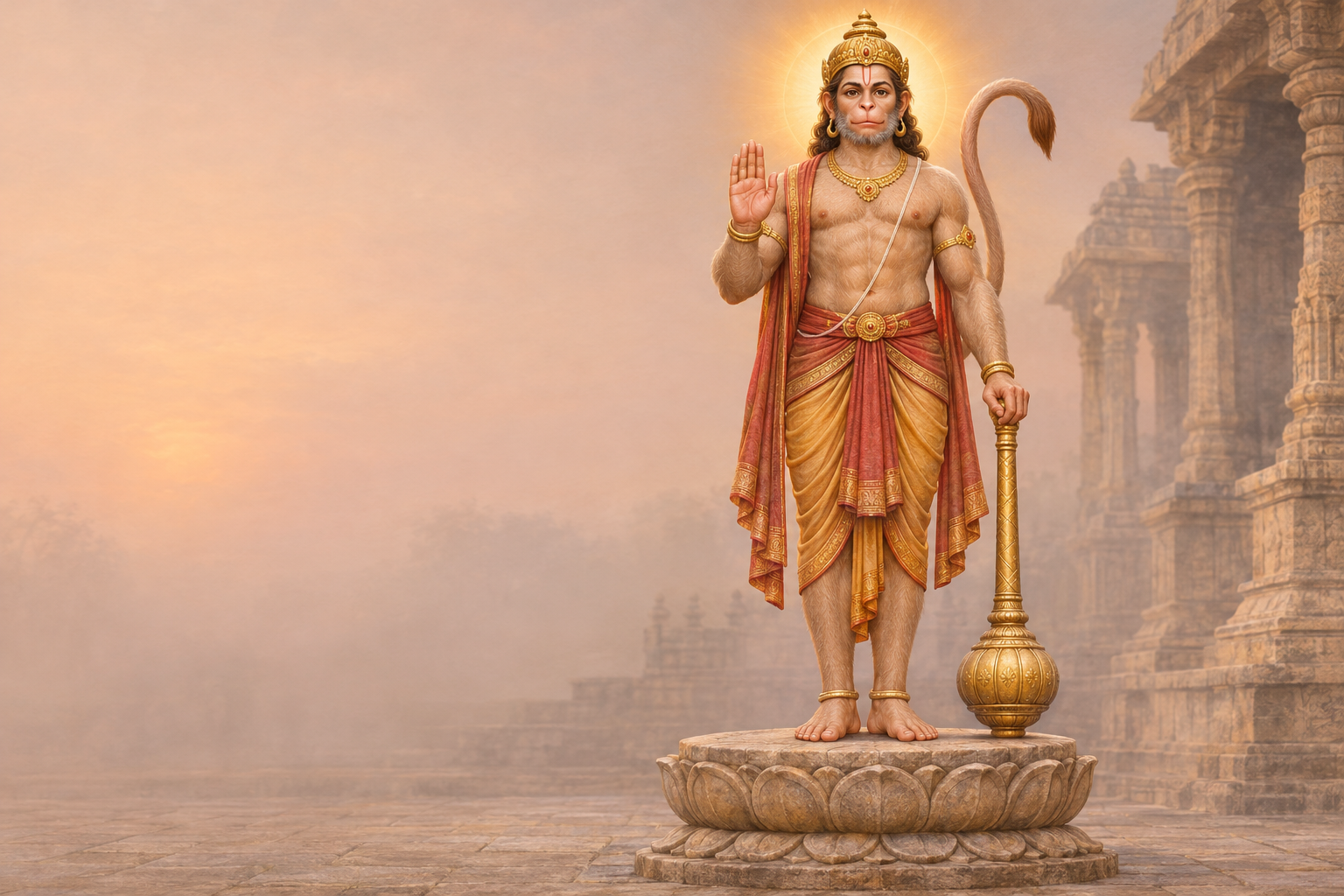
You may encounter a Hanuman murti that is neither flying with a mountain nor bowing before Rama. He stands composed, with an open palm raised toward you. If you are trying to identify this form, choose it for your home, or understand what it asks of a devotee, begin with the hand. Then read the whole figure.
Abhaya Hanuman presents courage as steadiness rather than spectacle. The image does not deny danger or difficulty. It shows strength that is present, disciplined, and ready to serve without being ruled by fear.
Identify Abhaya Hanuman from the whole composition
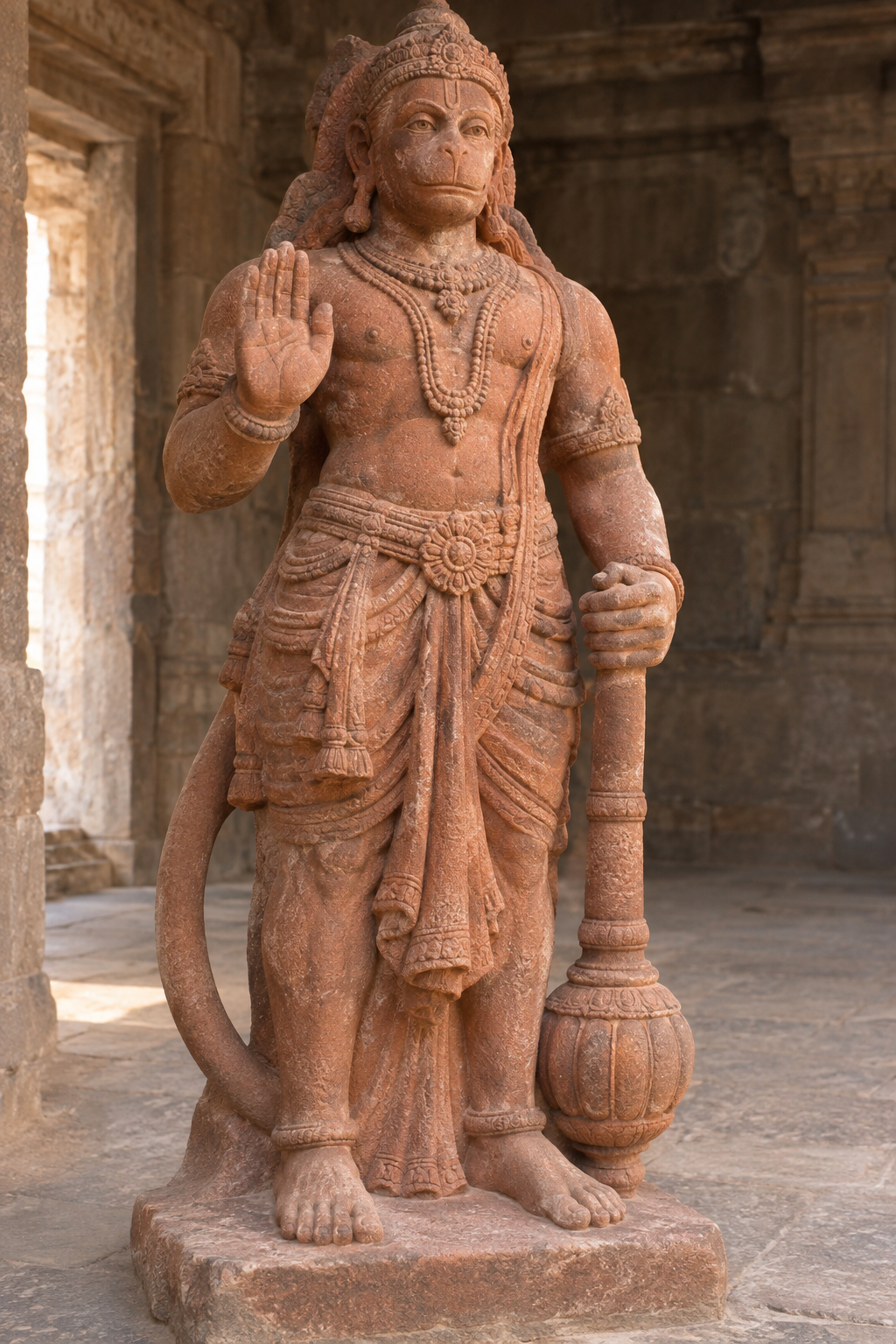
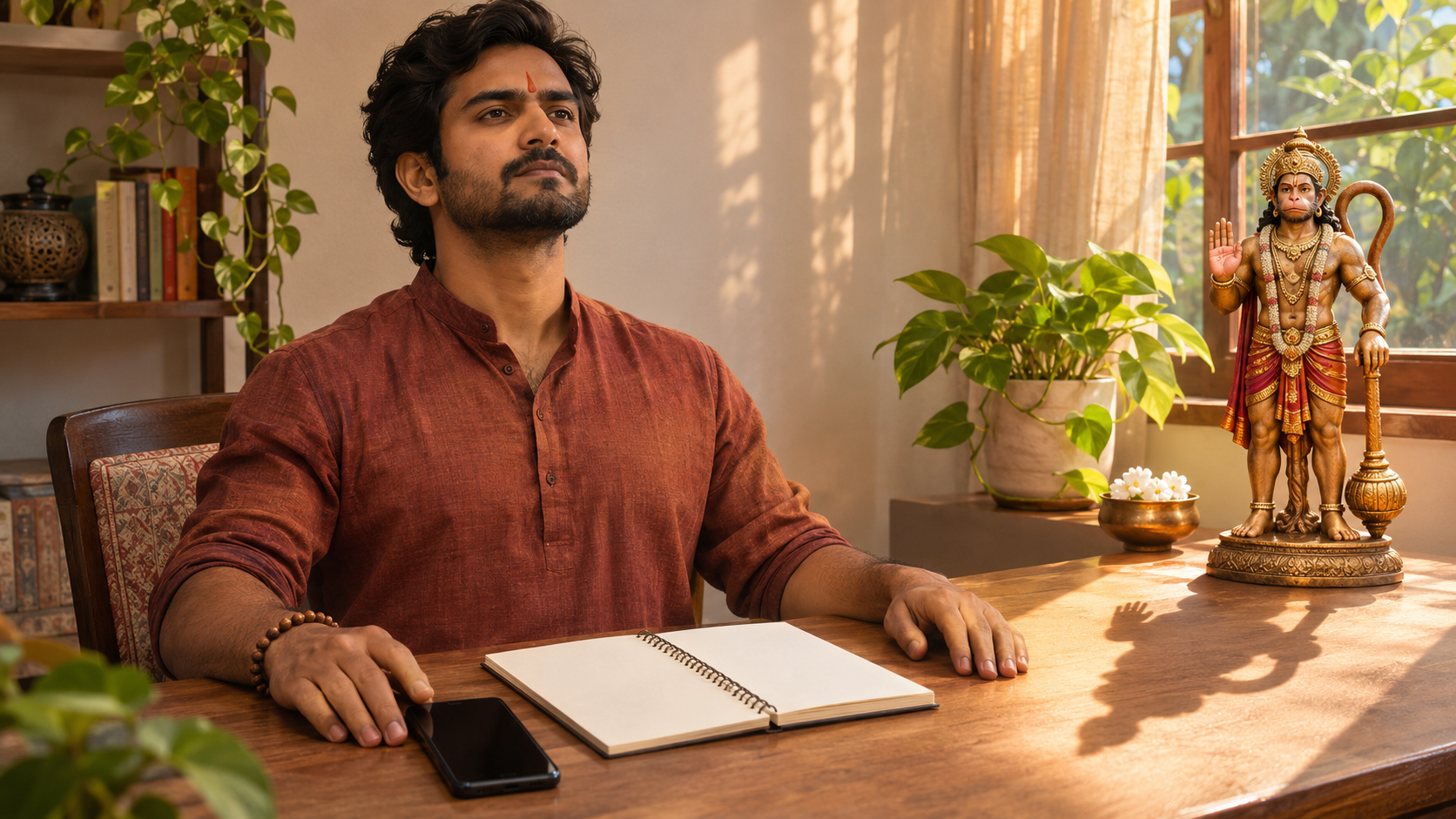
Abhaya means freedom from fear. In visual language, abhaya mudra is an open, raised palm directed toward the viewer. It communicates reassurance, protection, and the confidence to stand firm. In this form, the gesture is joined to a serene and upright presentation of Hanuman.
Do not identify the murti from one hand alone. Use four passes:
- Confirm that the figure is Hanuman. Look for his recognisable simian countenance and, where the sculpture makes it visible, his tail. Damage, age, clothing, or the viewing angle may obscure one of these features.
- Find the primary gesture. In the Abhaya form, an open palm faces outward. This differs immediately from two palms joined in namaskara.
- Read the stance. The figure is upright and composed rather than shown rushing through the air. Balance and stillness are part of the meaning, not empty space between more dramatic actions.
- Notice the emotional register. A calm face and stable posture make the raised palm feel protective rather than confrontational.
The combination is decisive: Hanuman’s identity, the outward-facing palm, the standing posture, and the calm relationship with the devotee. Regional sculptural traditions can vary proportions, ornaments, and secondary attributes. A difference from the first online image you saw is not automatically an iconographic error.
Stillness changes what the image places before you
Hanuman’s familiar forms do not compete with one another. Each selects a different aspect of the same sacred personality and brings it to the foreground.
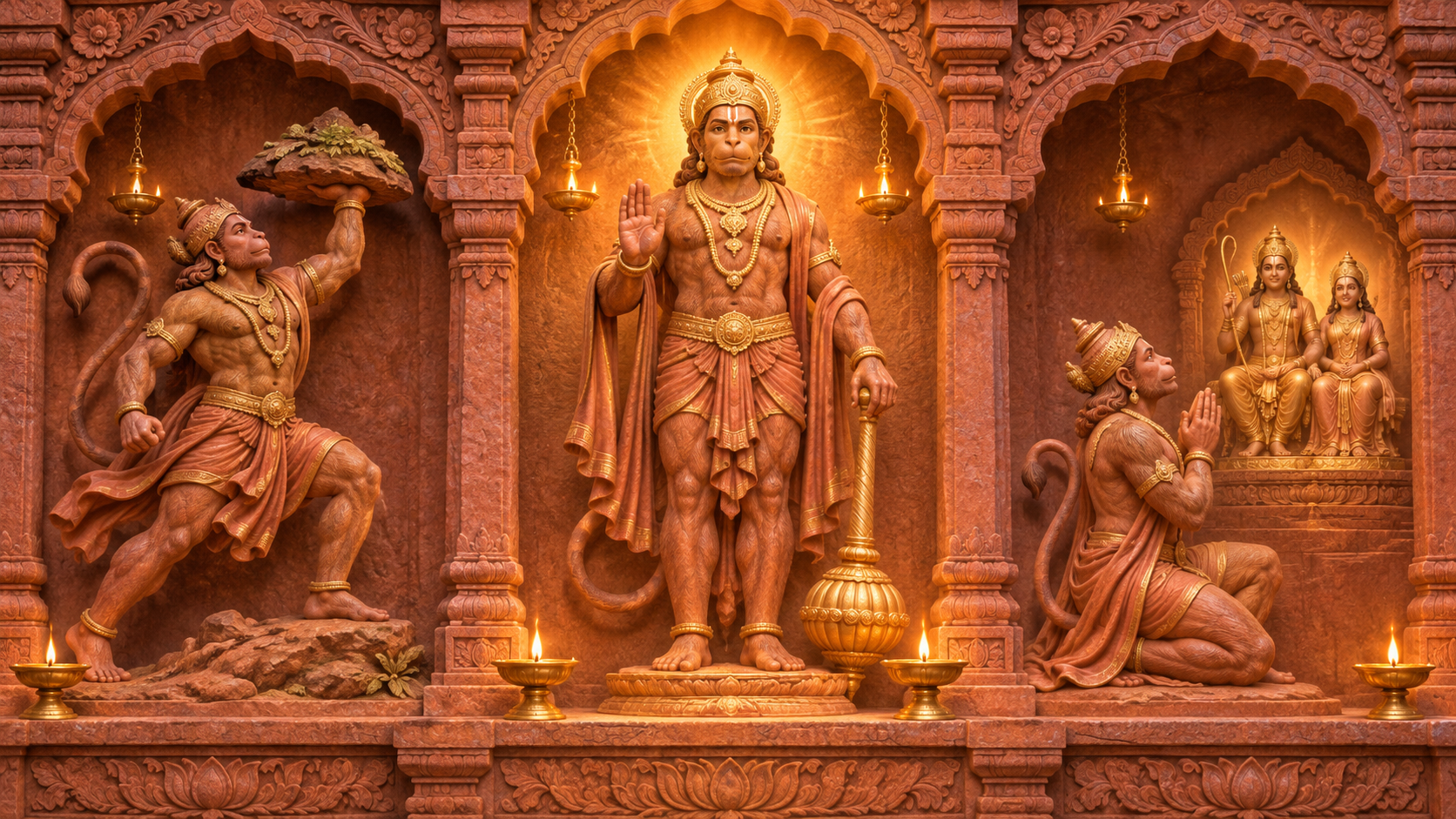
Hanuman in flight carrying the Sanjivani mountain makes urgent service visible. The namaskara form before Bhagavan Rama centres surrendered devotion. Abhaya Hanuman turns toward the devotee and centres composed protection. The mountain, folded hands, and open palm are therefore not interchangeable decorations. They determine the encounter the image creates.
Stillness here is not passivity. An upright body can communicate that strength is available without needing to display aggression. The open hand is empty because its immediate work is assurance. The figure does not appear overwhelmed by the fear brought before it.
This also prevents a common misreading. Abhaya is not a promise that hardship will disappear, and fearlessness is not carelessness. Hanuman’s raised palm can instead be read as a call to stop giving fear the final word. Sensible caution may remain. Your duty may still be difficult. What changes is whether fear receives a veto over the next dharmic action.
Turn the gesture into a practical devotional discipline
You do not have to invent an elaborate ritual to engage this iconography. A simple three-part contemplation can connect the visible gesture with conduct. Treat this as a way of attending to the murti, not as a substitute for the puja, mantra, or initiation practices of your own sampradaya.
- Receive the assurance. Look first at the open palm and name the fear plainly. Do not exaggerate it, suppress it, or pretend that devotion has already erased it.
- Recover the duty. Ask what service, responsibility, or truthful action is being delayed by that fear. Hanuman’s courage is inseparable from devotion and service; it is not self-assertion for its own sake.
- Take one visible step. Make the necessary call, begin the neglected responsibility, offer the apology, protect the person who depends on you, or complete the work already entrusted to you. Choose the step your situation actually requires rather than waiting to feel invulnerable.
This practice keeps the symbolism from becoming decorative. The palm offers reassurance; the standing body models steadiness; your action completes the encounter. If nothing changes after you leave the shrine or image, you have noticed the icon but not yet allowed it to instruct you.
Choose, commission, or describe the form with care
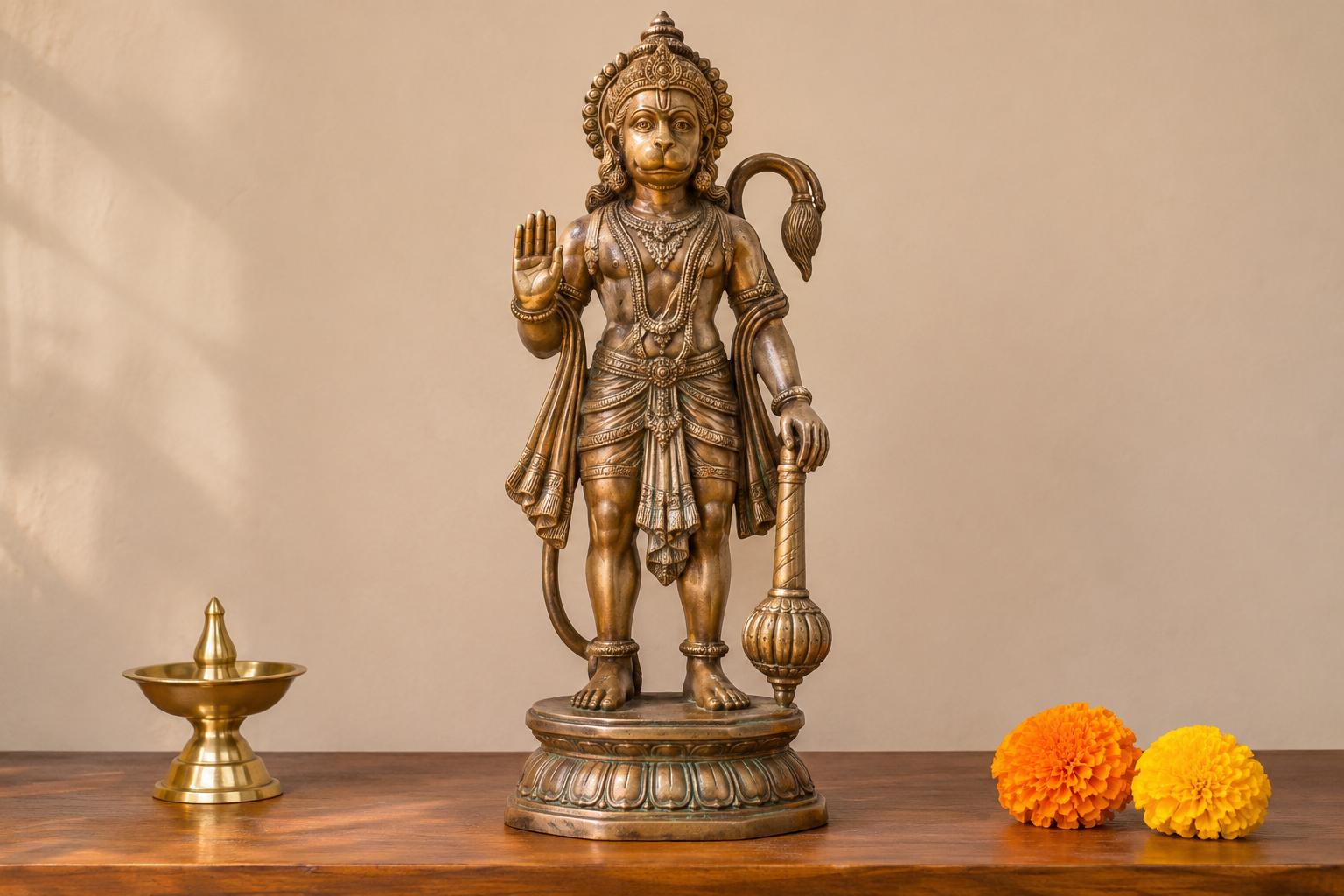
If you are buying a print, commissioning an artist, preparing a caption, or selecting a murti, decide first whether you want this particular emphasis. Abhaya Hanuman is especially intelligible where the desired focus is reassuring presence: courage held in reserve, protection without menace, and readiness to serve.
- Check the viewing distance. The open palm should remain legible at the size and distance from which the image will normally be seen. If the gesture disappears, much of the form’s distinct meaning disappears with it.
- Ask for the posture, not merely the name. Specify a standing, composed Hanuman with an outward-facing open palm in abhaya mudra. This gives an artist more useful direction than the label alone.
- Describe only what is visible. A reliable caption would identify a standing Hanuman with a raised open palm. Do not call it the Sanjivani form when no mountain is shown, or the namaskara form when the palms are not joined.
- Allow for legitimate variation. Finger position, ornament, proportions, and secondary details may differ across regions and workshops. Judge the primary gesture and overall composition before treating a secondary variation as a defect.
- Distinguish devotional installation from decoration. If the object will be formally installed or consecrated, consult the priest, temple, or lineage responsible for the worship. A commercially labelled image cannot by itself settle sampradaya-specific requirements.
Key takeaways
- Identify the form through the combination of Hanuman’s recognisable features, a raised open palm, an upright stance, and a calm presence.
- Read the stillness as governed strength, not inactivity.
- Distinguish its emphasis from the urgency of the Sanjivani image and the surrendered devotion of the namaskara image.
- Understand abhaya as courage for right action, not a guarantee that danger or difficulty will vanish.
- When choosing or commissioning the form, make the palm and posture visually unmistakable while respecting regional and lineage-specific variation.
The next time you stand before Abhaya Hanuman, look in this order: hand, stance, expression, then context. After you have received the gesture’s assurance, identify the duty fear has postponed and take one concrete step toward it. That is where the iconography moves from something you recognise to something you live.
References

Leave a Reply
You must be logged in to post a comment.