
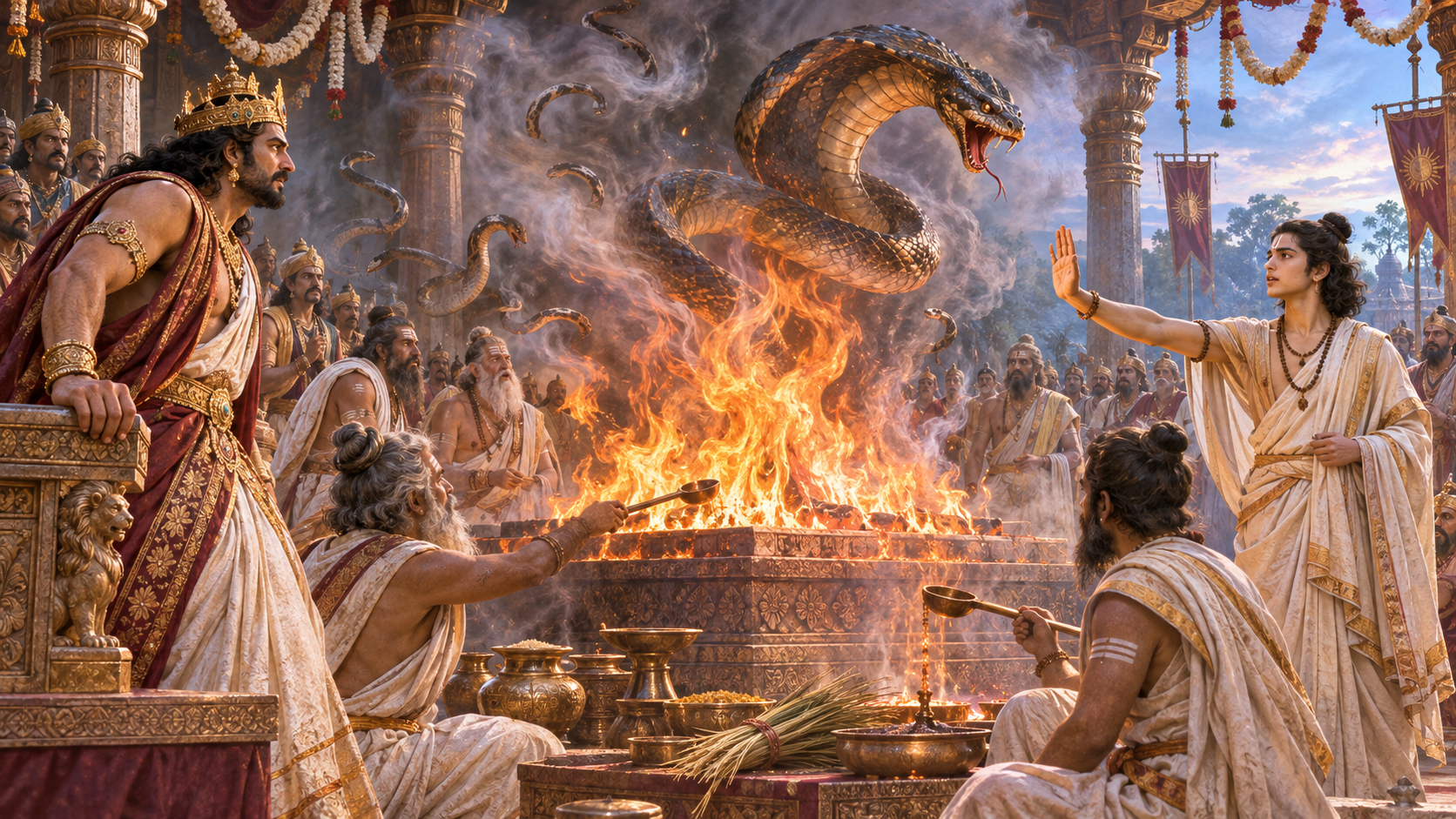
If you came to this episode wondering whether the Mahabharata excuses Janamejaya’s extermination campaign or declares Takshaka innocent, neither reading is adequate. The story begins with a son’s legitimate grief, allows vengeance to acquire terrifying momentum, and makes the interruption of that vengeance its decisive dharmic act.
You can understand the Sarpasatra by keeping three questions separate: What did Takshaka do? What did Janamejaya have the authority to do in response? And at what point did punishment become collective destruction? Once those questions are separated, Astika’s intervention stops looking like a convenient ending and becomes the moral center of the episode.
Key takeaways
- Takshaka’s responsibility for Parikshit’s death does not transfer guilt to every serpent.
- Janamejaya’s grief explains his anger, but it does not make the scale of his retaliation dharmic.
- Takshaka suffers because the machinery of collective vengeance eventually threatens even the powerful figure it was created to punish.
- Astika saves more than Takshaka: he restores moral limits to royal power and prevents an entire class of beings from being destroyed.
- The episode asks you to distinguish accountability from annihilation before anger makes that distinction difficult to recover.
How one death became a war against every serpent
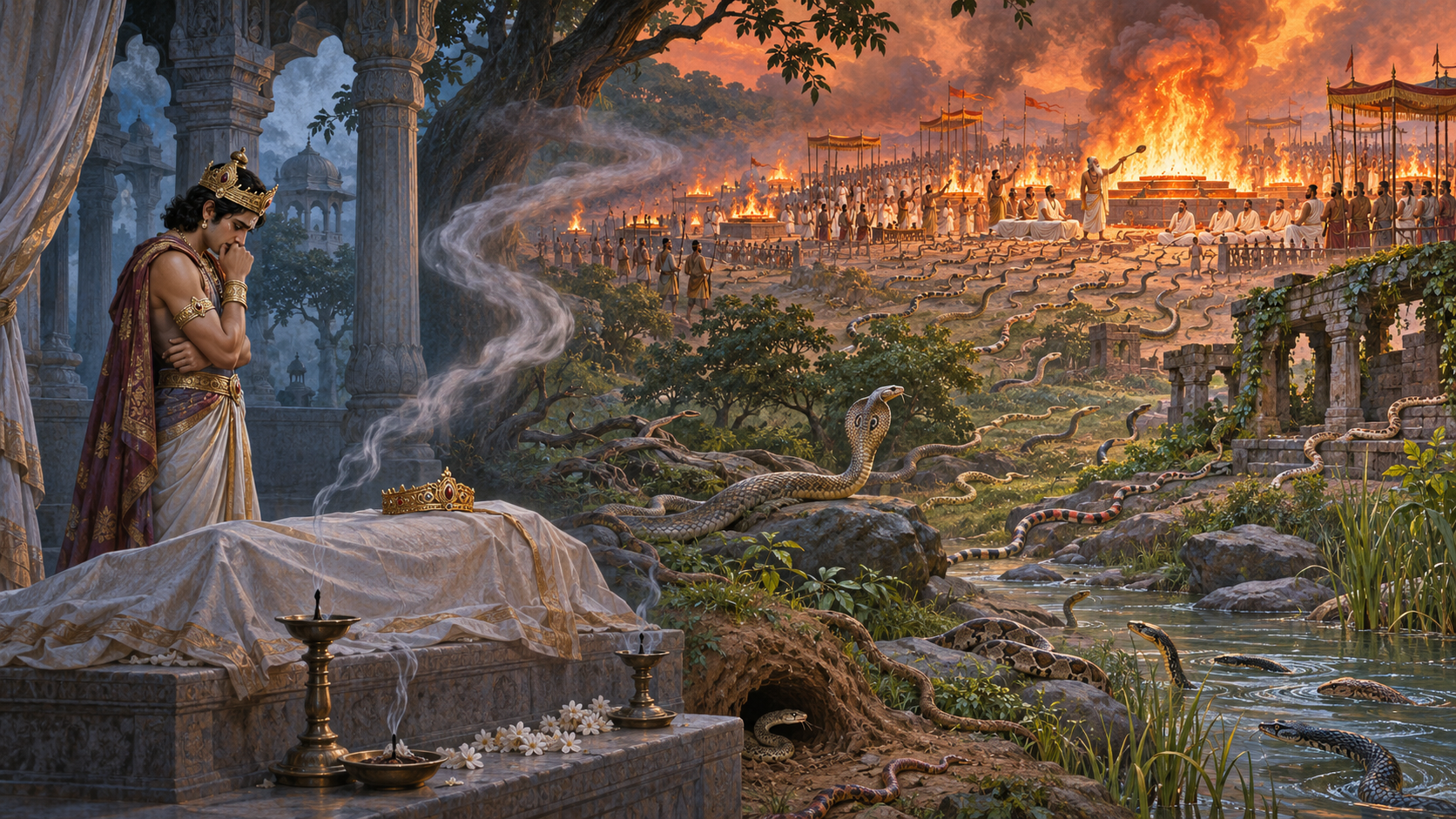
The episode belongs to the Astika Parva within the Adi Parva of the Mahabharata. King Janamejaya is the son of Parikshit. Takshaka, identified as the king of the serpents, kills Parikshit with his bite. Janamejaya responds by commissioning the Sarpasatra, a sacrifice intended to consume the serpents in its fire.
The crucial turn is easy to miss if you concentrate only on the spectacular ritual. Janamejaya does not confine his response to the being who killed his father. The category of the offender becomes the category of the condemned. Takshaka is a serpent, so serpents as a whole are made to pay.
That widening of blame is the engine of the tragedy. A specific chain of responsibility has become a general sentence:
- Parikshit dies from Takshaka’s bite.
- Janamejaya experiences grief and anger as a son.
- The king converts that personal injury into an exercise of royal power.
- The sacrifice no longer distinguishes Takshaka from serpents who had no part in Parikshit’s death.
- Destruction continues until Astika persuades the king to stop it.
This sequence matters more than any attempt to sort the characters into a simple hero-and-villain arrangement. Takshaka can be responsible for a grave deed while Janamejaya can still be wrong to answer it with indiscriminate destruction. The epic allows both judgements to remain true.
Takshaka’s act does not make every serpent guilty

A shallow reading treats the episode as a choice between sympathy for Parikshit and sympathy for the serpents. The Mahabharata presents a harder question: can a ruler pursue a genuine grievance through an unjust means?
Janamejaya’s pain is not imaginary. His father is dead, and Takshaka is directly connected to that death. But grief answers the question, “Why is the king furious?” It does not answer, “Who may justly be killed?” Those are different questions, and the sacrifice collapses them.
You can test the justice of Janamejaya’s response with one precise distinction: punishment should follow a deed, while the Sarpasatra makes death follow identity. The serpents are not examined according to what each one did. They are drawn into the same sentence because they belong to the same kind as Takshaka.
This is why stopping the sacrifice does not require you to proclaim Takshaka blameless. Mercy toward a threatened population is not an acquittal of the individual whose act provoked the crisis. Astika can save Takshaka from the fire without turning Parikshit’s death into something trivial. The story preserves accountability while refusing extermination.
That distinction is especially important when this episode is invoked in political or communal debate. It cannot honestly be reduced to “wrongdoers must never be punished.” Its sharper warning is that anger at an identifiable wrongdoer can make collective punishment feel reasonable. Once that happens, innocence is no longer judged by conduct; it is presumed or denied by group identity.
What Takshaka’s suffering actually reveals

Takshaka is not presented as a helpless creature at the beginning. He is a serpent king and the named object of Janamejaya’s wrath. Yet his rank cannot master a rite whose declared scope includes every serpent. As the sacrifice advances, Takshaka too is brought under its destructive force.
His suffering exposes a trap built into vengeance without limits. Janamejaya wants Takshaka, but he constructs a process that consumes indiscriminately. Takshaka remains the symbolic target while numerous other beings become actual victims. The king’s grievance gives the operation its emotional justification; the operation then grows larger than the grievance.
Notice what the Mahabharata does not require from you here. It does not require admiration for Takshaka before his life can be spared. It does not demand that the original injury be forgotten. It asks whether a person’s culpability can justify the destruction of everyone associated with him by nature or birth. The answer supplied by Astika’s successful intervention is no.
This prevents a second common misreading: that Takshaka survives merely because a powerful offender escapes justice. His rescue occurs within the cessation of a collective catastrophe. If Janamejaya must destroy a whole class of beings to reach one enemy, the method has already exceeded any proportionate idea of punishment.
Astika restores the limit that anger erased
Astika does not overcome Janamejaya by raising a larger army or producing a more destructive weapon. He enters the king’s sacrificial setting, gains a hearing, and asks that the Sarpasatra be stopped. His intervention works through speech, moral authority, and the king’s obligation to honor what he has granted.
That method is part of the teaching. The destructive process is interrupted from within the moral world that Janamejaya still inhabits. The king has not become incapable of dharma; his grief has narrowed his moral vision. Astika gives him an opportunity to act as a ruler again rather than merely as an injured son.
Stopping therefore should not be mistaken for weakness. Janamejaya possesses the power to continue. The harder act is to place a limit on power after the sacrifice has begun and after vengeance has received ritual sanction. A ruler who cannot stop an unjust course has less sovereignty over himself than his outward authority suggests.
Astika also performs a function that dharmic narratives repeatedly value: he prevents a single passion from pretending to be the whole of righteousness. Janamejaya can point to filial duty, royal honor, and punishment of his father’s killer. Those considerations are real, but none is sufficient by itself. Dharma requires attention to proportion, innocence, promises, consequences, and the possibility of restraint.
The episode’s most hopeful feature is that correction remains possible late in the process. Serpents have already suffered, the rite is active, and Takshaka is in danger. Astika cannot undo what has happened. He can still prevent completion of the intended extermination. Dharmic action is not reserved for the moment before anyone makes a mistake; it also includes stopping a wrong that is already under way.
How to use this episode when judging retaliation
You do not need a royal sacrifice to encounter Janamejaya’s mistake. The same structure appears whenever a particular injury is used to condemn a family, community, tradition, or population. The scale changes; the moral mechanism does not.
When anger is pressing for a sweeping response, use the episode as a five-part check:
- Name the deed precisely. State who did what. If your sentence begins replacing the responsible person with an entire group, the scope of blame has probably widened.
- Separate explanation from justification. Grief, fear, and outrage can explain why retaliation feels necessary. They do not decide who is guilty or what response is proportionate.
- Ask how the innocent are being distinguished. A response that has no mechanism for making that distinction is reproducing the logic of the Sarpasatra.
- Preserve a way to stop. Before supporting a powerful action, identify who can review it, what evidence can halt it, and whether leaders remain able to reverse course.
- Do not confuse restraint with acquittal. You can oppose collective destruction while still demanding accountability from the person responsible for the original wrong.
This is also a sound way to teach the episode. Begin with the narrow fact of Parikshit’s death. Then ask exactly when the circle of punishment expands. Finally, place Astika’s request beside Janamejaya’s choice. Students will see that the climax is not simply Takshaka’s physical escape; it is the recovery of a moral boundary.
The next time you encounter this story, do not ask only whether Takshaka deserved Janamejaya’s anger. Ask who else was made to suffer for Takshaka’s deed, and who had the courage to say that enough was enough. That is where the Sarpasatra becomes a practical lesson in dharma rather than merely a tale of revenge.
References

Leave a Reply
You must be logged in to post a comment.