

If you have paused over a devotional image or meditation and wondered why so much attention is given to Sri Radha’s chin, the question is worth taking seriously. Why should one small feature matter when the whole divine form is present?
The answer is not that the chin carries a secret meaning by itself. Its value lies in what careful attention can reveal: a gesture, a mood, a relationship, and a way of seeing that refuses to rush. Read properly, the detail leads you back to Sri Radha as a person and toward seva. Read poorly, it becomes either empty ornament or an isolated body part.
A small feature becomes a doorway, not a fragment
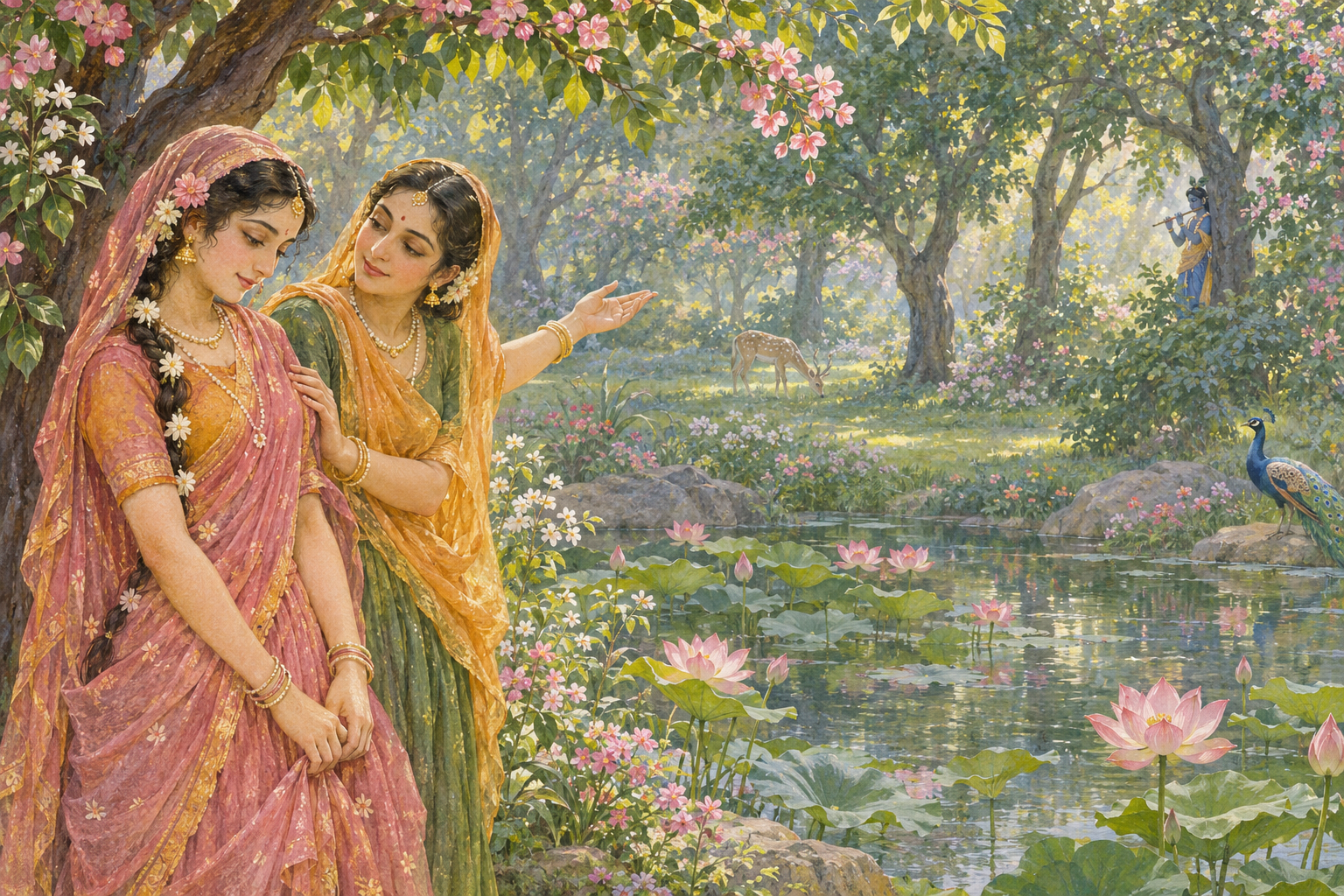
We rarely read a face as a collection of unrelated parts. A slightly lowered chin changes how the eyes appear. A raised chin alters the force of a smile. A turn of the head can create distance, invitation, reserve, confidence, or attentive listening, depending on everything around it.
Devotional aesthetics uses this sensitivity of perception. Instead of allowing the eye to pass vaguely over a beautiful form, it gives attention somewhere to rest. The purpose is not anatomical inspection. A focused meditation in which Sri Radha’s chin serves as a stimulation for ecstatic love treats the feature as an occasion for remembrance and devotional feeling.
This distinction matters. An object is examined for what can be extracted from it. A person is approached through relationship. In devotional reading, Sri Radha’s chin matters because it belongs to Sri Radha: to her expression, presence, disposition, and relationships. The detail must disclose the person rather than replace her.
When a poem, painting, murti, or spoken meditation draws your attention to the chin, ask three questions before trying to interpret it:
- What is actually present: an angle, curve, ornament, shadow, movement, or relation to another feature?
- What mood could the whole expression suggest, rather than what does the chin supposedly mean by itself?
- How does this detail return attention to Sri Radha’s person, relationships, and the possibility of service?
Those questions keep close attention from becoming either sentimental guesswork or detached art criticism.
Read the chin as a gesture, not a fixed code
A bodily gesture is contextual. The same angle can carry different emotional force when the eyes, mouth, hands, posture, companions, setting, or words change. You therefore should not treat a lowered or raised chin as if it were a symbol with one permanent translation.
| What you notice | What to examine next | What to avoid |
|---|---|---|
| The chin is lowered | Look at the eyes, mouth, posture, and situation. Ask whether the whole expression may convey reserve, inward attention, tenderness, or another mood. | Declaring that a lowered chin always means shyness. |
| The chin is raised | Ask whether the complete pose suggests confidence, playfulness, response, expectation, or attentive engagement. | Treating the angle as a universal emblem with no need for context. |
| The face turns partly away | Notice the relationship created by the turn: who is near, who is looking, and what the surrounding scene supports. | Inventing a narrative that neither the image nor the words provide. |
| Light or ornament emphasizes the chin | Follow where the emphasis guides your gaze: toward the smile, throat, face, or total expression. | Admiring a polished surface while forgetting the person whose form you behold. |
The safest interpretive habit is grammatical: use may suggest rather than means. Instead of saying, “A lowered chin means shyness,” say, “With downcast eyes and a restrained smile, the lowered chin may deepen the impression of reserve.” The second statement remains answerable to the whole form.
This is also where abhinaya offers a helpful way of thinking. Expression is carried through coordinated cues, not through one bodily sign detached from the rest. Even when you are looking at a still image rather than a performance, read each feature as part of an expressive field.
If the surrounding context is unavailable, leave the mood open. Reverent uncertainty is better than confident invention. You do not deepen devotion by turning a personal impression into doctrine.
A four-pass method for close devotional reading

You can use the following method with visual art, darshan, poetry, or a spoken description. Each pass corrects a different kind of misreading.
- Begin with what is given. Describe the feature without assigning a mood. Notice whether the chin is raised, lowered, turned, illuminated, ornamented, or related visually to the lips, neck, or rest of the face. Do not add details that are absent.
- Separate your response from the depicted mood. Tenderness may arise in you, but that does not prove that tenderness is the only emotion represented. Keep the viewer’s feeling distinct from a claim about Sri Radha’s inner state.
- Restore the relationship. Ask who else is present, who is seeing whom, what movement is underway, and what the words or setting allow you to infer. If the context does not answer those questions, do not manufacture answers.
- Turn attention toward devotion. Ask what the detail helps you honor and how it changes the quality of your attention. Let the contemplation lead toward remembrance, careful speech, prayer, or a concrete act of attentive service.
A compact note can keep the passes together: “Notice the visible detail; within the complete expression it may suggest a mood; let it return attention to Sri Radha and to service.” This is more disciplined than collecting decorative adjectives.
The sequence matters. Description without feeling remains external. Feeling without description drifts into projection. Mood without relationship becomes a label. Relationship without devotional response can remain an intellectual exercise. The four passes hold form, feeling, context, and practice together.
Keep sacred beauty devotional rather than consumptive
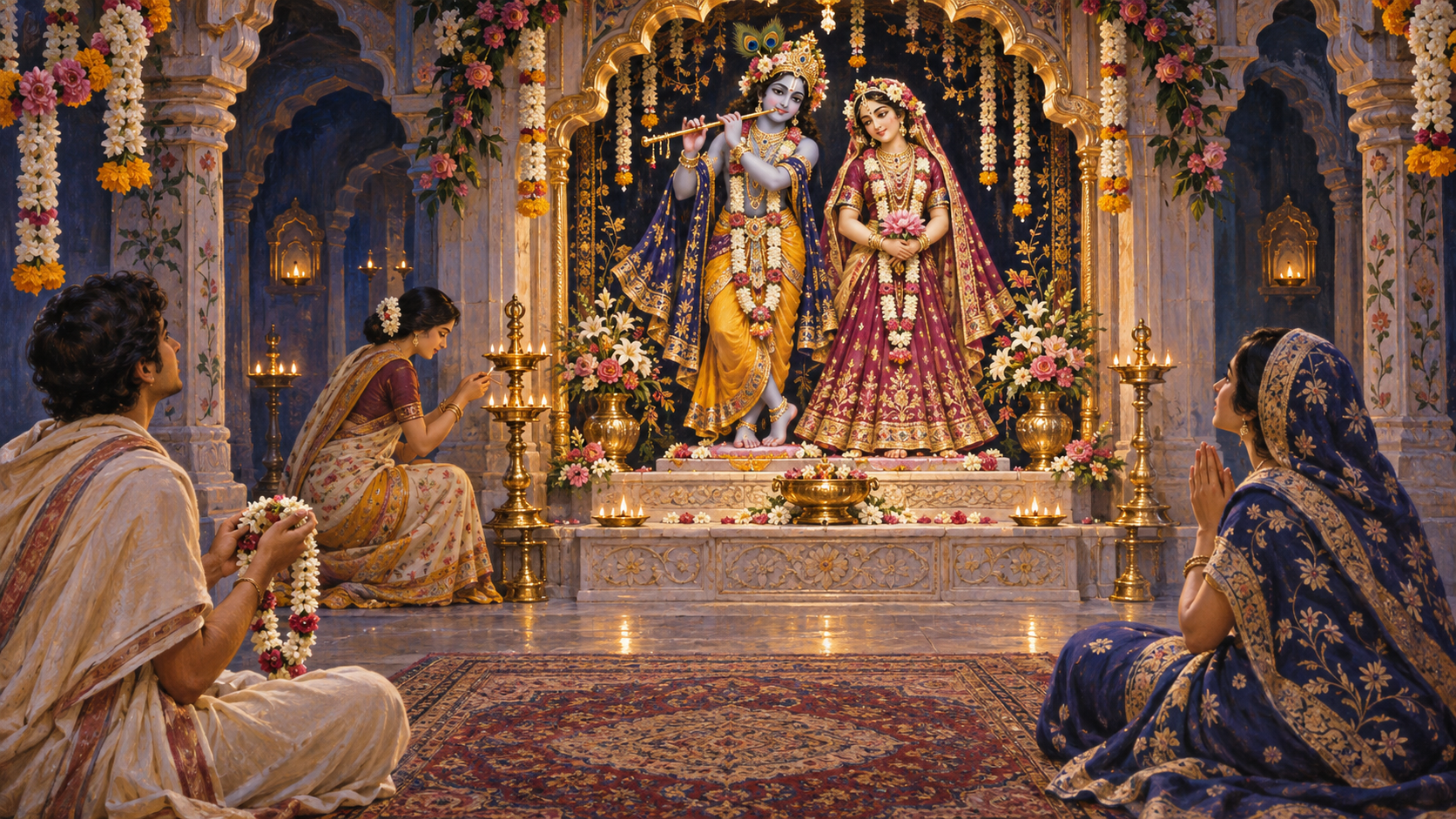
Embodied sacred beauty does not need to be erased or apologized for. The body is not the problem. The problem begins when a feature is detached from personhood and treated as a surface available for consumption.
Four tests can help you recognize the difference:
- The wholeness test: Does attention to the chin lead back to the complete face, pose, and person, or does the feature become a collectible fragment?
- The agency test: Does the interpretation preserve Sri Radha’s disposition, response, and relationships, or does it reduce her to what a viewer finds visually pleasing?
- The traceability test: Can you distinguish what the image or wording actually presents from an inherited explanation and from your own meditation? Label those layers honestly.
- The fruit test: Does the contemplation make your attention more reverent, patient, and service-oriented, or does it encourage comparison, possession, and the pursuit of sensation?
These tests are especially useful for teachers, artists, editors, and people sharing devotional images online. An isolated crop may intensify visual impact while removing the expression and relationship that make the detail intelligible. Whenever possible, preserve the whole face or pose. Give enough context for the viewer to understand why the feature matters.
Captions require similar care. If a mood is explicitly established by the accompanying words or a trusted tradition of interpretation, state it clearly. If it is your reading of an expression, present it as a possibility. That small distinction protects both devotional freedom and intellectual honesty.
When introducing the subject to a newcomer, begin with Sri Radha’s identity and relational place in devotion. Then explain how a physical detail can concentrate loving attention. Beginning with an anatomical catalogue reverses the order and makes misunderstanding more likely.
A short contemplation you can use
Choose an image or description that already belongs to your devotional practice. The aim is not to manufacture an extraordinary feeling. It is to make ordinary attention more faithful.
- Begin with Sri Radha’s complete form or the complete passage. Do not start by mentally cutting out the chin.
- Let your attention rest on the chin and name only what is present. Keep the description plain.
- Widen your attention to the eyes, mouth, head, hands, posture, setting, and any relationships shown.
- Name a possible mood with modest language: “This may suggest…” Keep more than one possibility open when the context permits it.
- Return to the complete form. Notice how the small feature now changes your perception of the whole expression.
- Close with a prayer, remembrance, or intention to serve more attentively. Do not use emotional intensity as a score for whether the contemplation succeeded.
If your attention becomes merely analytical, widen it again. If it becomes possessive or sensual, return to Sri Radha’s complete person, to the divine name, or to a familiar prayer from your tradition. The correction is not disgust toward beauty. It is the restoration of relationship.
Key takeaways
- Sri Radha’s chin matters as part of an expression and relationship, not as isolated anatomy.
- A bodily cue has no reliable meaning apart from the eyes, mouth, posture, setting, and accompanying words.
- Use “may suggest” for an interpretation unless the context clearly establishes the mood.
- Keep observation, personal response, inherited explanation, and doctrinal claim distinct.
- Let close attention end in remembrance or seva rather than in the collection of visual sensations.
The next time a devotional description lingers on Sri Radha’s chin, resist the urge either to dismiss the detail or to assign it an instant symbolic meaning. Observe it, restore the whole expression, and carry the resulting attentiveness into one act of service. That is where devotional aesthetics stops being decoration and begins to discipline perception.
References

Leave a Reply
You must be logged in to post a comment.