
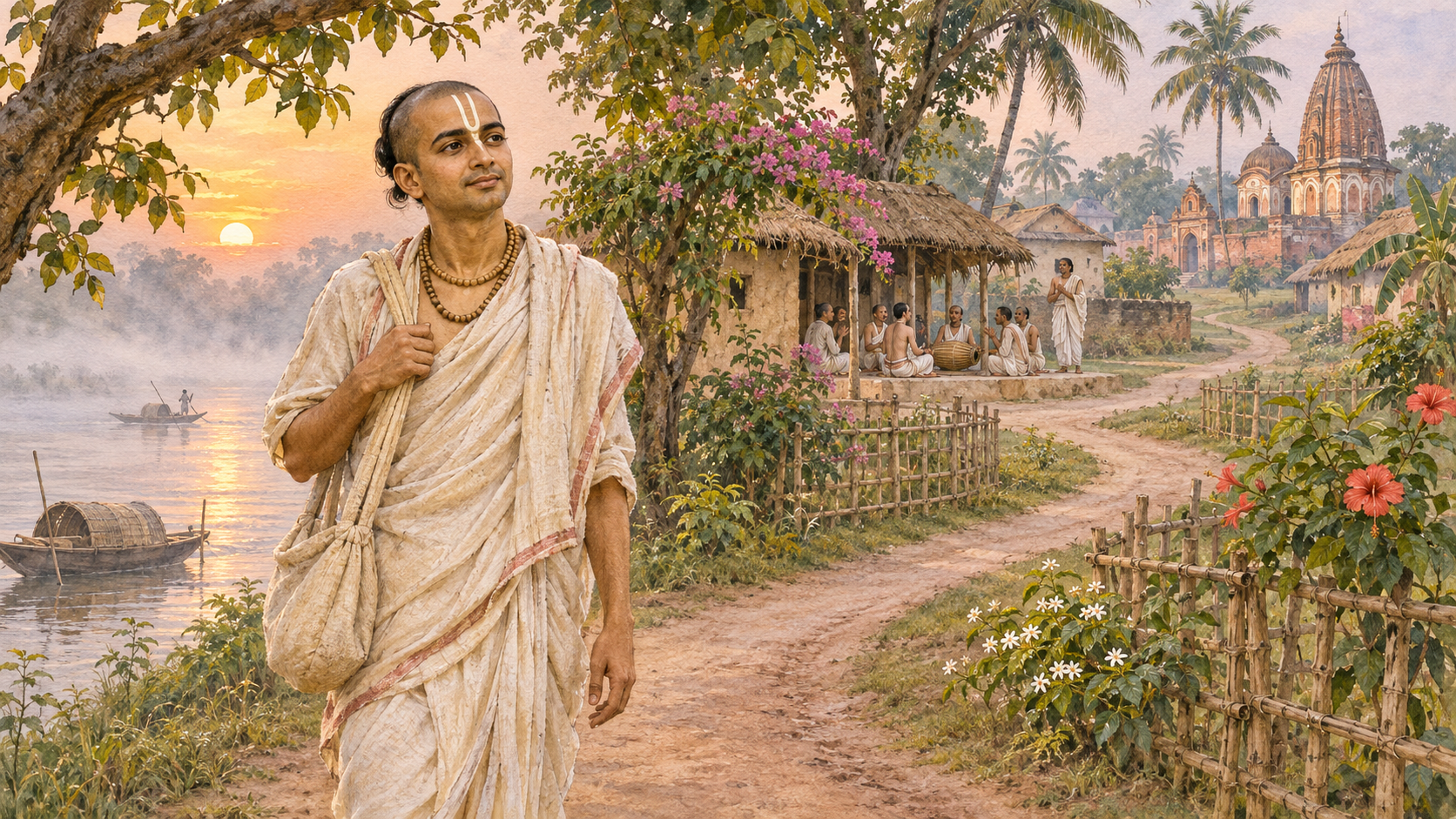
Perhaps you encountered Sri Gadadhara Dasa Goswami’s name during a disappearance-day observance and wanted to know why Gaudiya Vaishnavas remember him. The clearest answer is not a list of honorifics. It is the path his service took: toward Mahaprabhu, back into Bengal, into the care of devotees, and finally into the preservation of sacred memory at Katwa.
Follow that path and his life becomes immediately relevant to your own sadhana. It asks whether devotion is changing what you are willing to do, whom you are willing to care for, and what you are prepared to preserve for those who come after you.
Follow the changing form of his service
Sri Gadadhara Dasa first lived in Navadvipa. When Mahaprabhu went to reside at Nilacala, Gadadhara Dasa followed Him there. He did not remain indefinitely, however. Mahaprabhu later sent him back with Nityananda Prabhu to preach in Bengal. He stayed first at Eriyadahagram on the bank of the Ganges, returned to Navadvipa to care for Saci Mata and Visnupriya, and eventually settled at Katwa after their disappearance. Katwa was the place where Mahaprabhu had accepted sannyasa from Kesava Bharati. This movement from Navadvipa to Nilacala, Bengal, and Katwa is the framework through which his service can be understood.
The sequence matters. At one stage, service meant remaining physically near Mahaprabhu. At another, it meant leaving that proximity because Mahaprabhu had given him work elsewhere. Preaching then gave way to personal care for Saci Mata and Visnupriya. After their departure, he took responsibility for a place inseparably associated with Mahaprabhu’s renunciation.
This gives you a practical way to examine your own duties. Ask four questions in order: Where is your presence genuinely needed? What instruction have you already received but postponed? Who requires care rather than discourse? What part of your tradition will deteriorate unless someone accepts responsibility for it? Write down one concrete answer. The duty immediately in front of you may be less dramatic than the service you imagined, but Gadadhara Dasa’s path shows that a change of assignment need not mean a loss of devotion.
Confidential service was expressed through availability
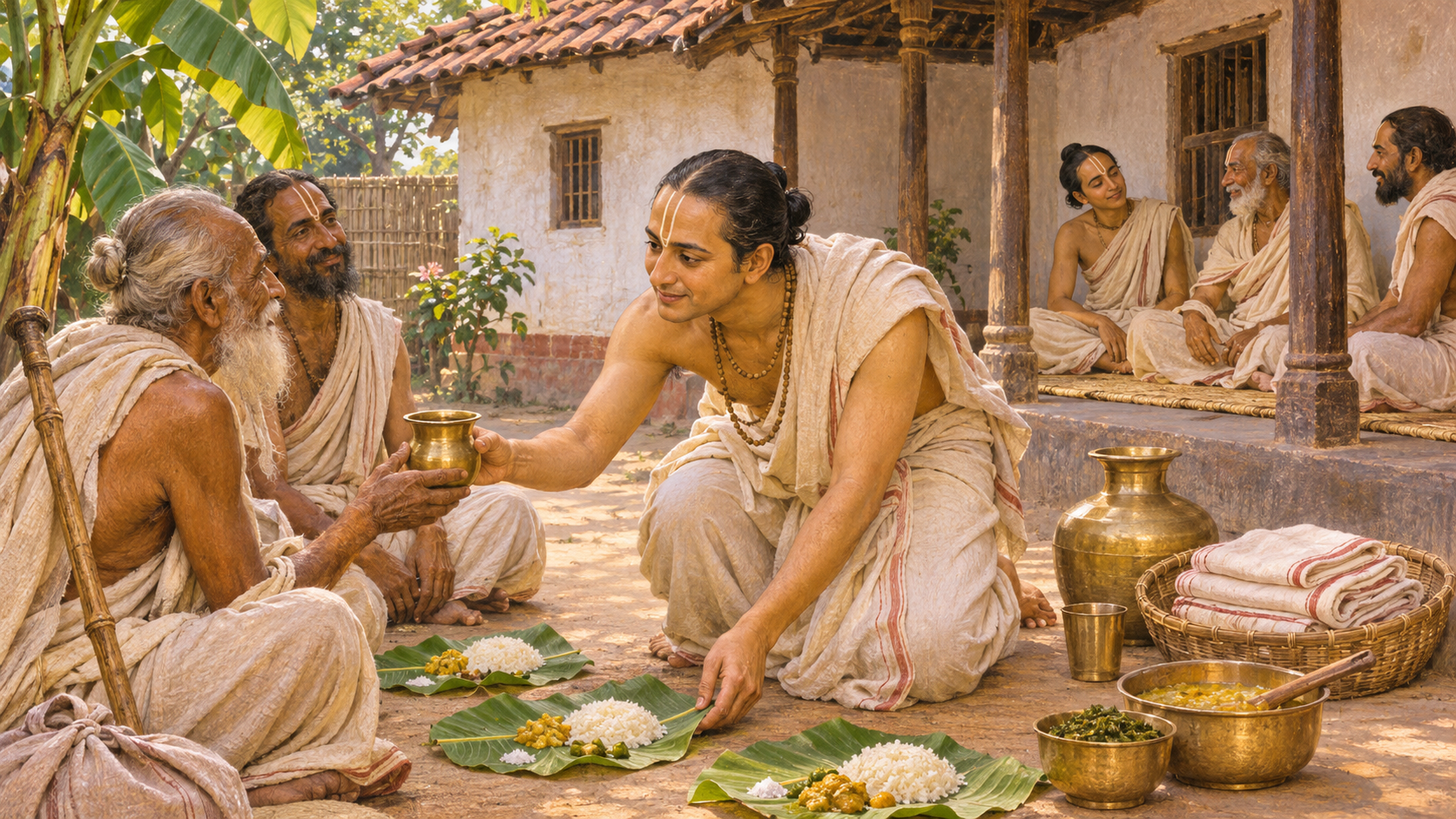
Gadadhara Dasa is remembered as a confidential associate of Sri Gaura and Sri Nityananda. The Sri Caitanya-bhagavata expresses his intimacy with Nityananda Prabhu in especially strong devotional language:
Nityananda Prabhu was personally present within the body of Sri Gadadhara das; such are his glories.
Sri Caitanya-bhagavata
The force of this praise lies in the closeness of purpose it conveys. Gadadhara Dasa did not merely admire Nityananda from a distance. He accompanied Him in the work of carrying Mahaprabhu’s mercy into Bengal. His importance appears through what he allowed divine instruction to accomplish through his life.
That distinction protects you from a common spiritual mistake: confusing access, emotion, or religious vocabulary with confidential service. A more demanding test is availability. When an instruction interrupts your preference, do you still serve? When public activity gives way to caring for particular people, do you regard that care as equally sacred? When no recognition follows, does the work continue?
Use one simple audit after worship, study, or kirtana: ask what became better cared for because you practised today. The answer might be a person, a neglected responsibility, a temple object, or a promise you finally kept. If the answer is repeatedly nothing, the remedy is not stronger devotional language. It is a completed act of seva.
Read his gopi-bhava with theological precision
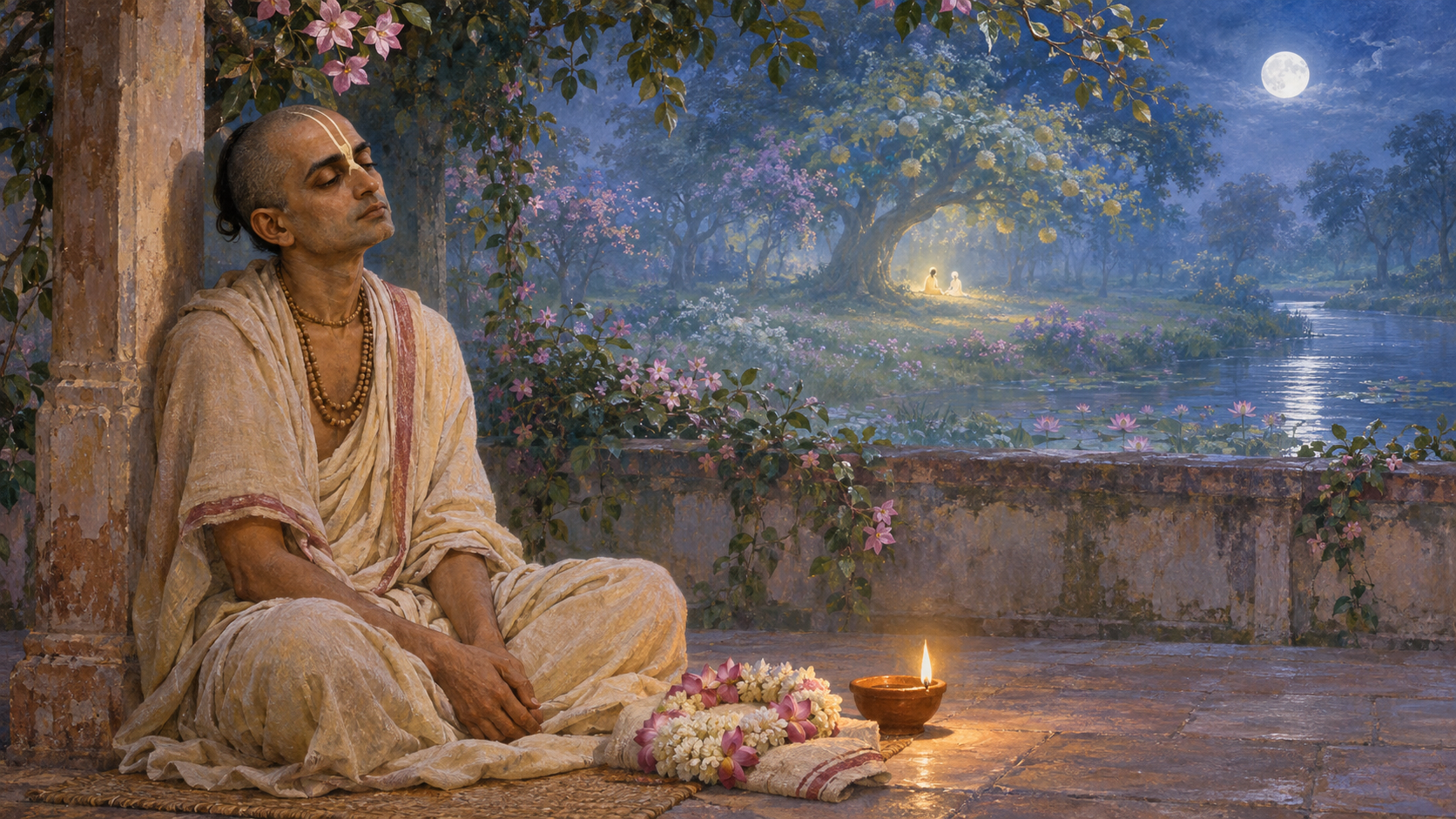
The Gaura-ganoddesa-dipika identifies Gadadhara Dasa as an incarnation of the effulgence of Srimati Radharani’s body and as an expansion of Purnananda gopi. This places him within the Gaudiya understanding of Mahaprabhu’s eternal associates rather than treating him only as a figure in a geographical chronology.
His place among Nityananda Prabhu’s companions is also distinctive. Many of those associates are understood as cowherd boys whose relationship is coloured by friendship, while Gadadhara Dasa is remembered as being absorbed in the devotional mood of a gopi. His outward association with Nityananda’s circle and his inward devotional orientation therefore should not be collapsed into a single generic category.
Two reading errors are worth avoiding. First, gopi-bhava is not a casual label for heightened emotion, personality, or social identity. It names a sacred devotional orientation within Gaudiya theology. Second, such descriptions should not become a ranking system for comparing devotees. Their purpose is to disclose the particular love through which an associate serves.
If you teach or discuss Gadadhara Dasa, keep the kinds of claims clear. You can describe his movements and activities as his remembered life. When speaking about his eternal identity, say plainly that the Gaudiya tradition identifies him in this way. That phrasing neither diminishes faith nor disguises a theological affirmation as an ordinary biographical finding.
At Katwa, sacred memory took a durable form
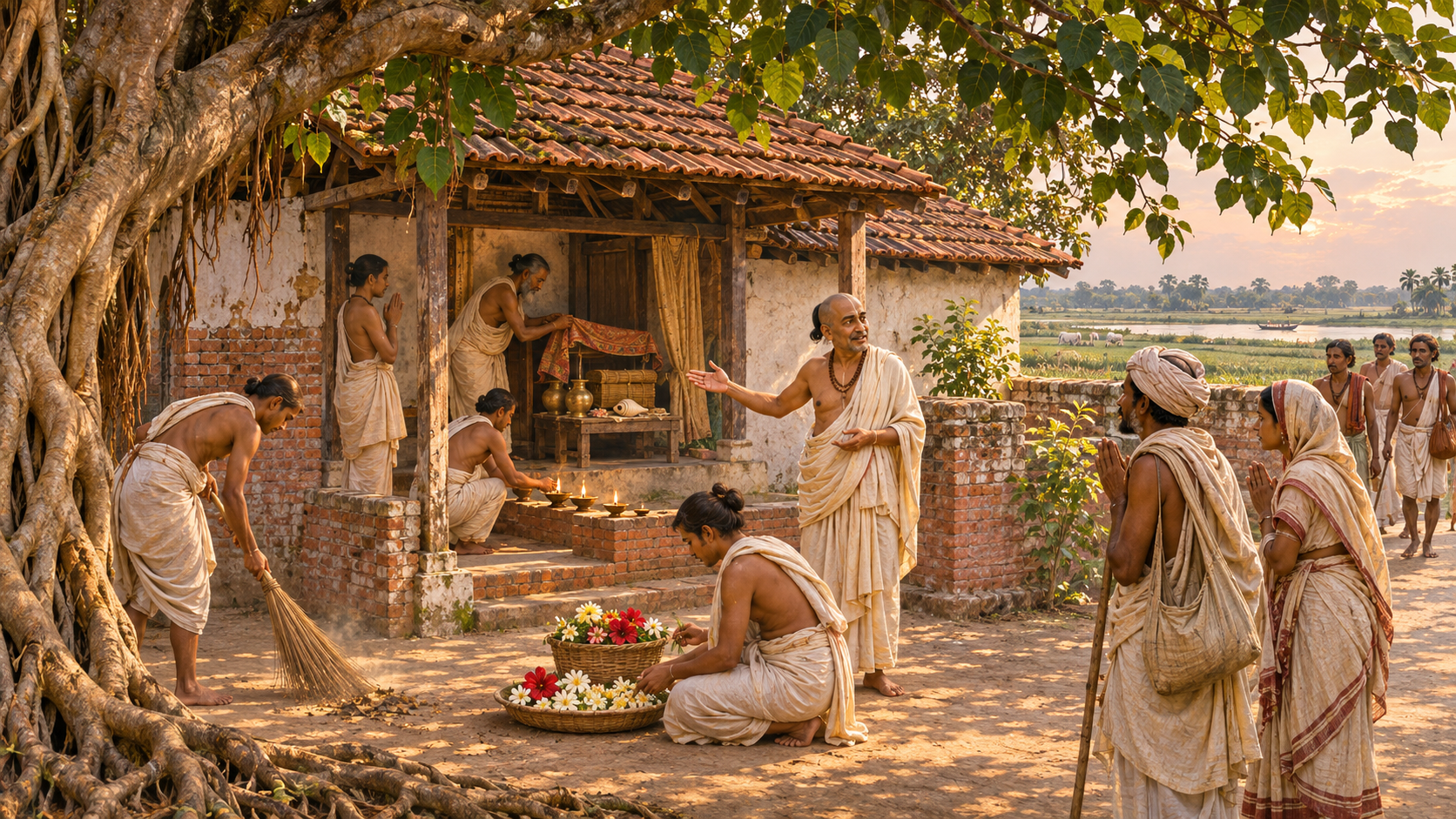
Gadadhara Dasa established a temple at the place in Katwa where Mahaprabhu had accepted sannyasa, and he personally installed a Deity of Lord Gauranga there. His response to a place of momentous separation was not to leave it as an unmarked memory. He made it a continuing place of worship.
The temple tradition connects that Gauranga Deity with two others at Sri Khanda. All three were carved from one Nimba tree. Mahaprabhu’s direction was received through dreams by Narahari Sarkar Thakura and the deity-maker on the same night; when they met the following day and discovered the shared instruction, they began carrying it out. A smaller Deity of Balarama, understood as Nityananda, came later. The Deities at Katwa consequently became known as Sri Sri Nitai-Gauranga.
This is more than an account of temple origins. It shows how memory becomes stewardship. An event is remembered, a place is cared for, worship is established, and the relationship between Gaura and Nitai is given a form that succeeding generations can approach.
You do not need to invent an elaborate ritual to remember Gadadhara Dasa. A fitting observance can remain simple:
- Read or recount his route in order: Navadvipa, Nilacala, Bengal, Eriyadahagram, Navadvipa again, and Katwa.
- Choose one transition in that route and consider what it reveals about accepting a new form of service.
- Offer prayer or kirtana to Gaura-Nityananda according to your established practice.
- Complete one act of care that has been waiting: help a devotee, fulfil a family duty, clean something used in worship, or preserve a sacred space.
The final step is essential. It keeps remembrance from becoming admiration without participation.
Key takeaways for remembering Gadadhara Dasa
- Follow his assignments, not merely his titles: proximity to Mahaprabhu, preaching with Nityananda, personal care in Navadvipa, and temple stewardship at Katwa were all forms of one service.
- Measure spiritual intimacy by faithful availability. The practical question is whether devotion makes you more dependable when another person or sacred duty needs care.
- Use Gaudiya theological language precisely. His identity in relation to Radharani and Purnananda gopi describes sacred devotional reality within the tradition, not an ordinary personality type.
- Let remembrance acquire a physical expression. Finish one neglected act of seva instead of leaving your appreciation at the level of words.
The next time Sri Gadadhara Dasa Goswami’s name appears in your devotional calendar, do not stop after offering pranama. Choose one unfinished duty that joins love with responsibility, and complete it that day. His life is best honoured when remembrance moves your hands as well as your heart.
References

Leave a Reply
You must be logged in to post a comment.