
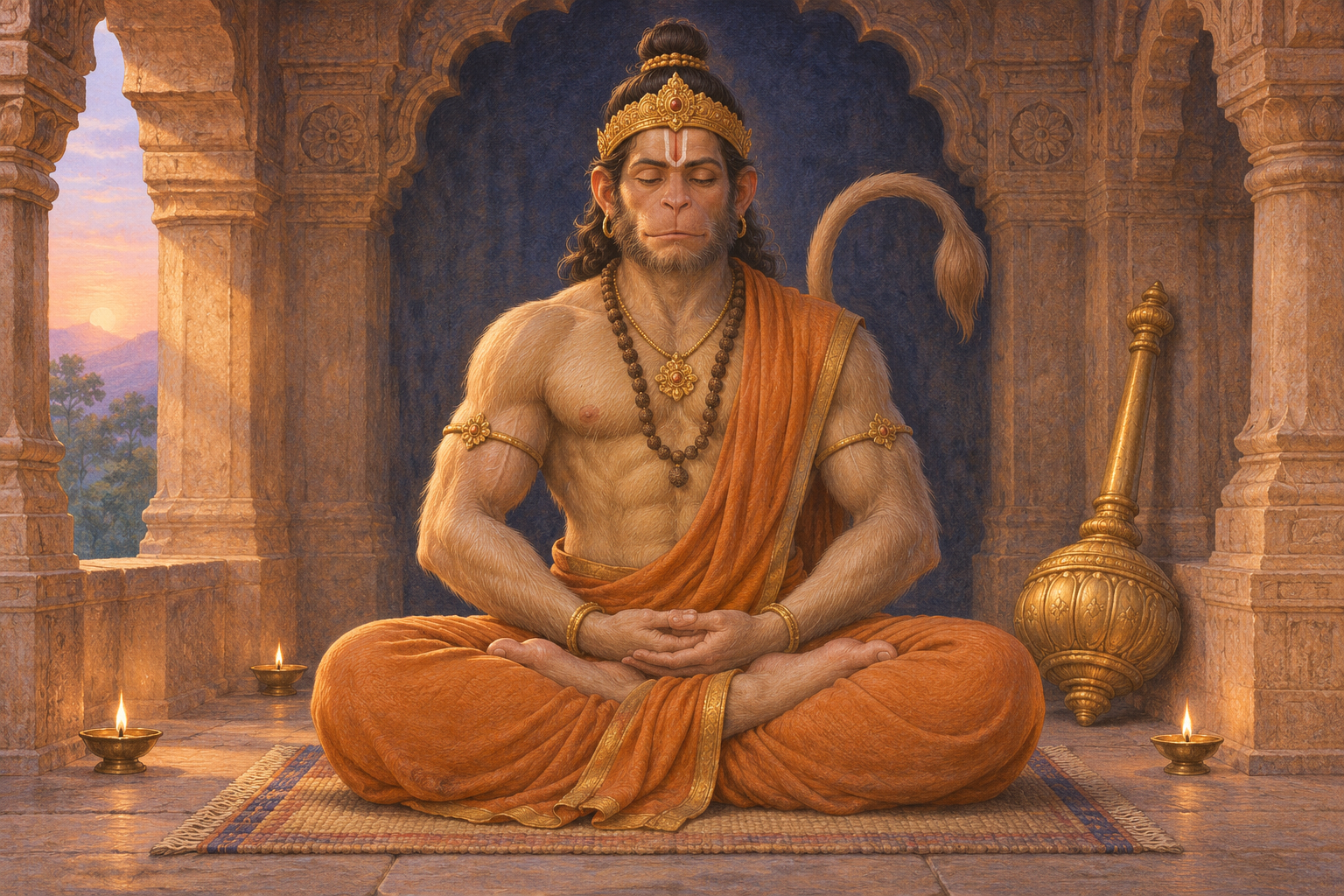
You may know Hanuman through images of movement, courage and heroic service. Then you encounter him sitting utterly still. The body is composed, the face is peaceful, and the familiar strength appears to have turned inward. What are you meant to notice?
Dhyana Hanuman shows that stillness is not the absence of strength. It is strength brought under discipline. Once you understand that visual grammar, you can distinguish this form from Hanuman’s more action-oriented images and use it as a practical focus for meditation, self-command and devotion.
Key takeaways
- Dhyana Hanuman presents Hanuman primarily as a meditating yogin, not as a warrior caught in heroic action.
- The seated posture, often padmasana, establishes physical stability and inward attention.
- A calm, introspective expression changes how you read Hanuman’s power: energy is present, but it is governed rather than displayed.
- The form joins three qualities that should not be separated in practice: discipline steadies the mind, devotion gives it direction, and inner strength sustains both.
- When choosing or placing such an image, judge the complete composition rather than relying only on a seller’s label.
How to recognise Dhyana Hanuman
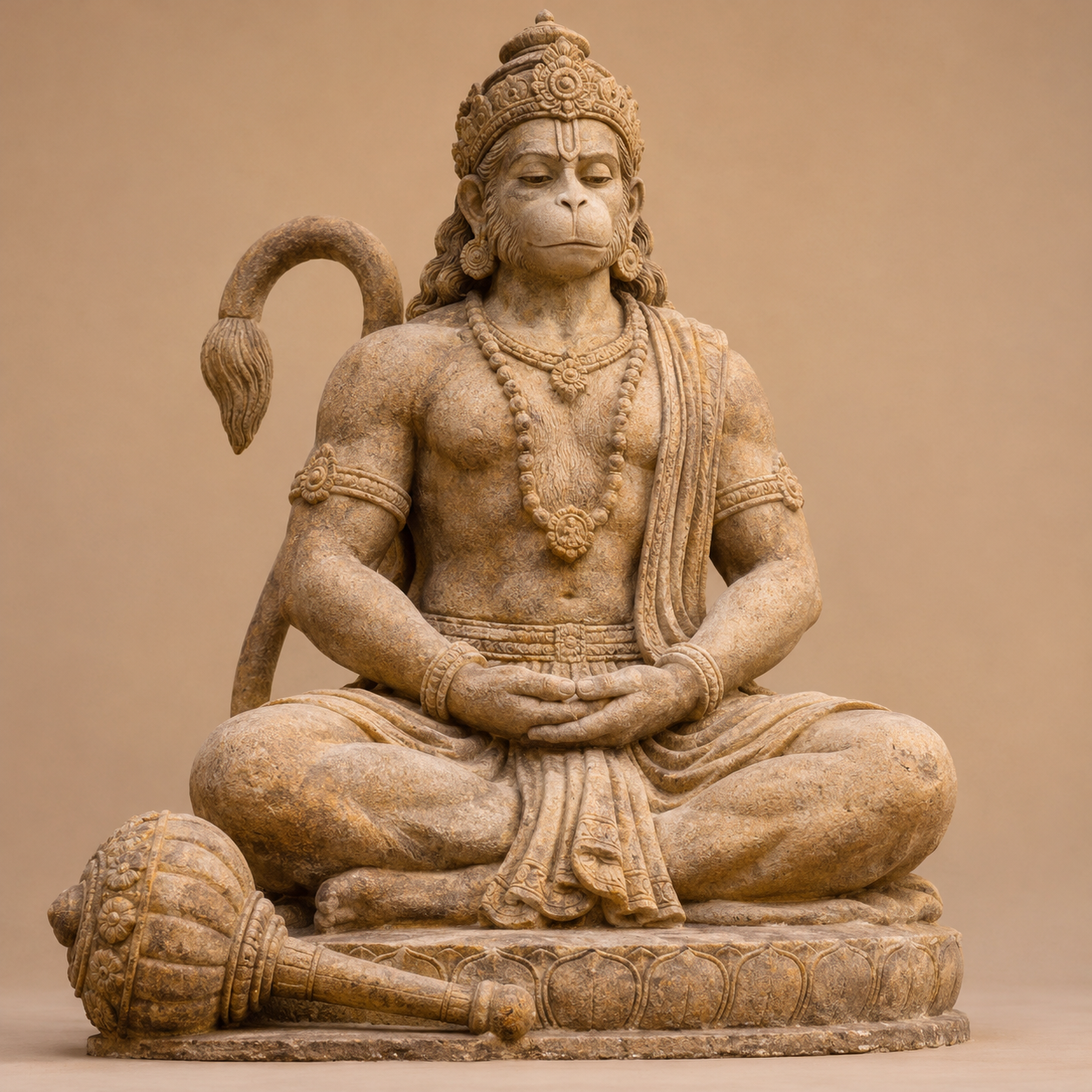
Begin with the governing action of the image. Ask a simple question: what is Hanuman doing? In Dhyana Hanuman, the answer is not leaping, fighting, carrying or confronting. He is sitting in meditation. That seated stillness is the first and most reliable clue.
The form is generally shown in a meditative posture, often padmasana, with a calm and introspective expression. Padmasana is the cross-legged lotus posture associated with a stable base for meditation. In an icon, it does more than describe how the legs are arranged: it tells you that the figure’s activity is inwardly gathered.
Next, read the face together with the body. A seated figure with an agitated expression would communicate tension, but the composure of Dhyana Hanuman indicates alert peace. Calmness here does not mean sleepiness, passivity or withdrawal from dharma. The body is still because attention is no longer scattered.
Finally, look at the composition as a whole. Sacred images vary in workmanship and regional treatment, so one minor detail should not carry the entire identification. The decisive combination is meditative seating, composure and inward orientation. If dramatic movement dominates the image, you are probably looking at another expression of Hanuman, even if the object is marketed under the word “dhyana.”
The icon turns heroic power inward
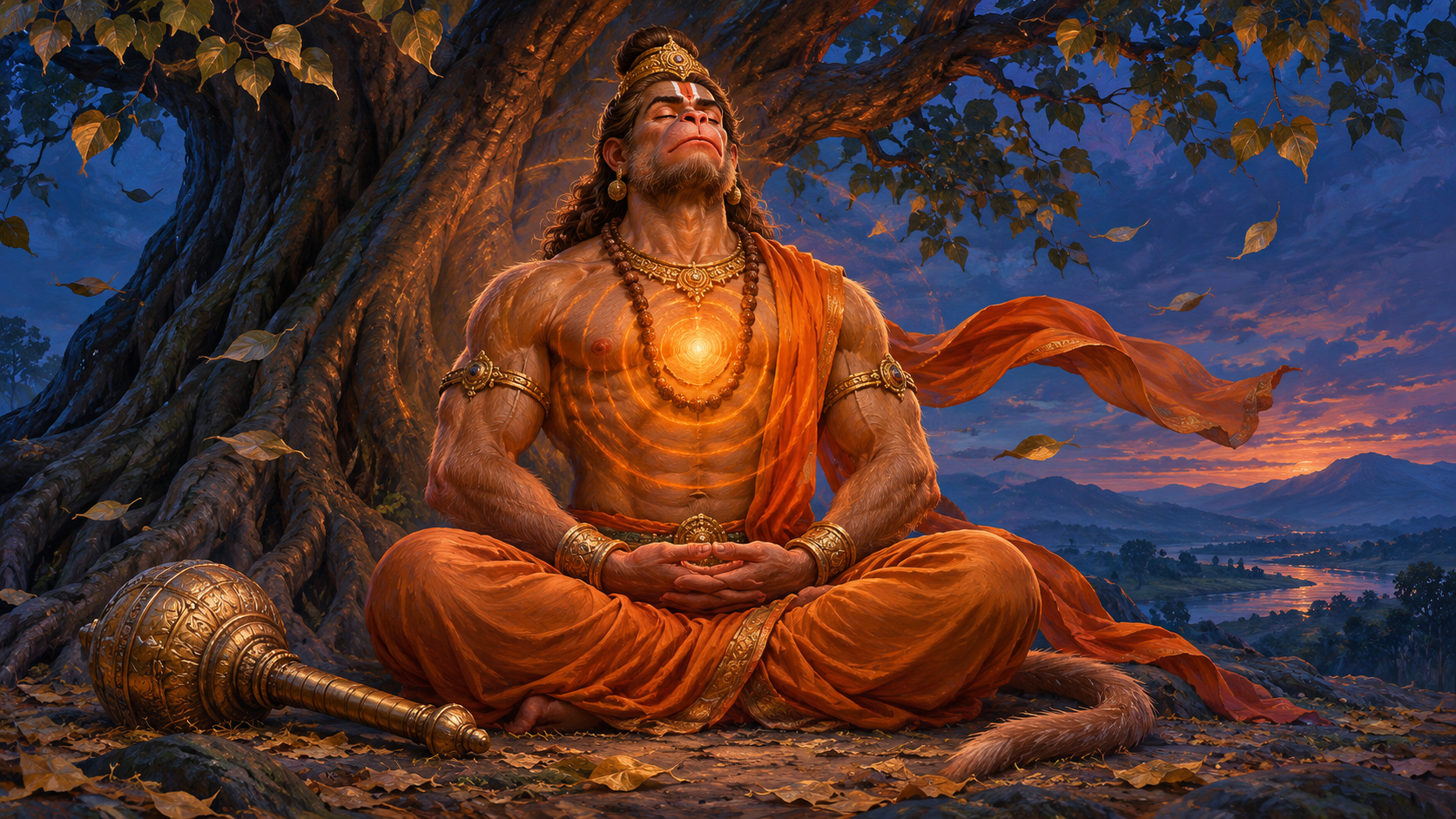
Hanuman’s heroic and contemplative forms should not be treated as opposites. The same strength can meet an outer obstacle or govern an inner impulse. Dhyana Hanuman makes the second movement visible.
This is why the form is especially helpful when you mistake restlessness for energy. Uncontrolled energy jumps from thought to thought and desire to desire. Disciplined energy can remain with a chosen object of attention. The unmoving posture therefore communicates capability under command, not capability lost.
The calm expression adds another correction. Inner strength is not the same as hardness. A clenched face might suggest forceful suppression; the meditative face suggests mastery without agitation. When using the image for contemplation, notice whether your own effort resembles steadiness or strain. If you are tightening the body and fighting every thought, the icon is showing you a different possibility: firm attention with a composed bearing.
This also changes the meaning of courage. Outward courage acts despite danger. Inward courage remains present before discomfort, distraction and the urge to escape. You can bring that reading into ordinary decisions. Before responding in anger, abandoning a difficult duty or chasing another distraction, pause and ask: what would strength under discipline look like in the next action?
Discipline and devotion belong together
A meditative image can be misunderstood as a celebration of technique alone: sit correctly, control the breath, silence the mind. Dhyana Hanuman resists that narrow reading because his discipline is joined to devotion. The purpose is not self-display or the construction of a superior spiritual identity. Attention is gathered so that it can be offered.
That distinction matters in daily sadhana. Discipline without devotion can become dry, proud or punitive. Devotion without discipline can remain dependent on mood. The icon holds both together. Devotion supplies orientation; discipline supplies continuity. Inner strength is what allows the practitioner to return when enthusiasm fades.
You can test your own practice against this three-part structure:
- Discipline: Have you chosen a definite practice, place and time, or are you waiting to feel inspired?
- Devotion: Is the practice an offering, or has it become a project of self-measurement?
- Inner strength: When attention wanders or a day goes poorly, do you return without turning the lapse into an excuse to quit?
This is a more useful way to read the image than treating every feature as a secret code. Iconography works first through the relationship among posture, expression and spiritual character. In Dhyana Hanuman, those elements converge on one instruction: collect your energy, direct it through devotion, and remain steady.
A simple way to practise with the image
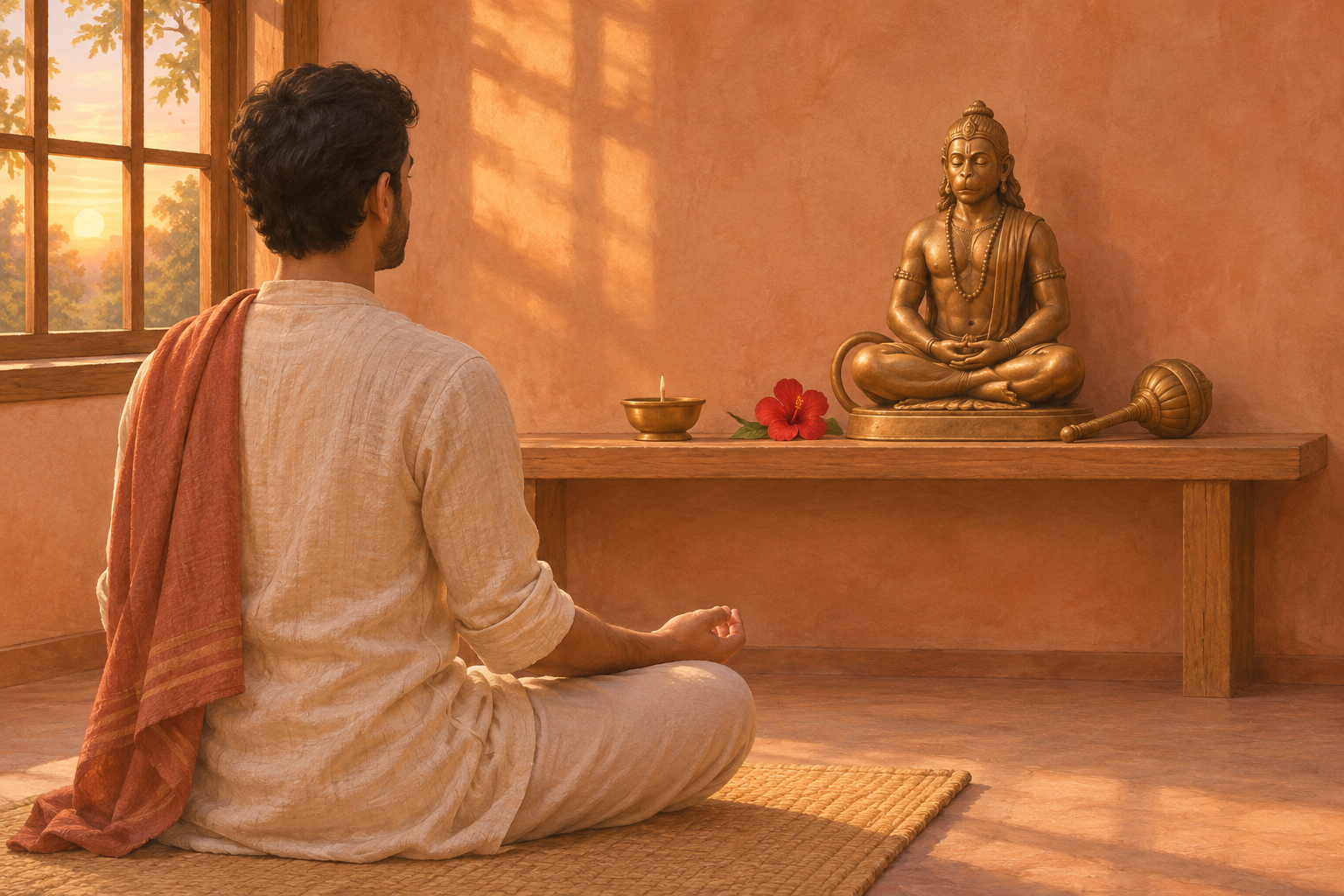
You do not need to invent an elaborate ritual to benefit from the form. If you already follow a family, temple or guru-given practice, keep its instructions. The following is a modest contemplative exercise for someone who wants to attend carefully to the icon rather than merely place it in a room.
- Choose a quiet position. Sit in a stable posture that you can maintain without unnecessary strain. You do not need to imitate padmasana if it is uncomfortable.
- Look at the whole image. Notice the settled base, the absence of dramatic movement and the composed expression. Let the complete form register before analysing individual details.
- Name the three qualities. Silently identify discipline, devotion and inner strength. This keeps the contemplation anchored in what the form communicates.
- Find the quality you presently lack. If you are scattered, attend to stability. If practice feels mechanical, attend to devotion. If you are discouraged, attend to quiet strength.
- Make one concrete commitment. Choose a small action that expresses the missing quality: complete a neglected duty, keep a regular period of practice, or delay a reactive response until the mind is composed.
- Close by carrying the image into action. Do not measure the session by whether you produced a special feeling. Measure it by whether recollection changes the next thing you do.
The distinction in the first step is important. An icon can present an ideal posture without requiring you to force your body into it. The practical lesson of padmasana is stability. A strained imitation that overwhelms attention would defeat that lesson.
You can also use Dhyana Hanuman at the threshold of a difficult task. Look briefly, allow the posture to remind you to gather scattered attention, and begin without drama. In this use, the image is not decoration and not a promise that obstacles will vanish. It is a demand that you meet them with steadiness.
Choosing and placing a Dhyana Hanuman murti or image
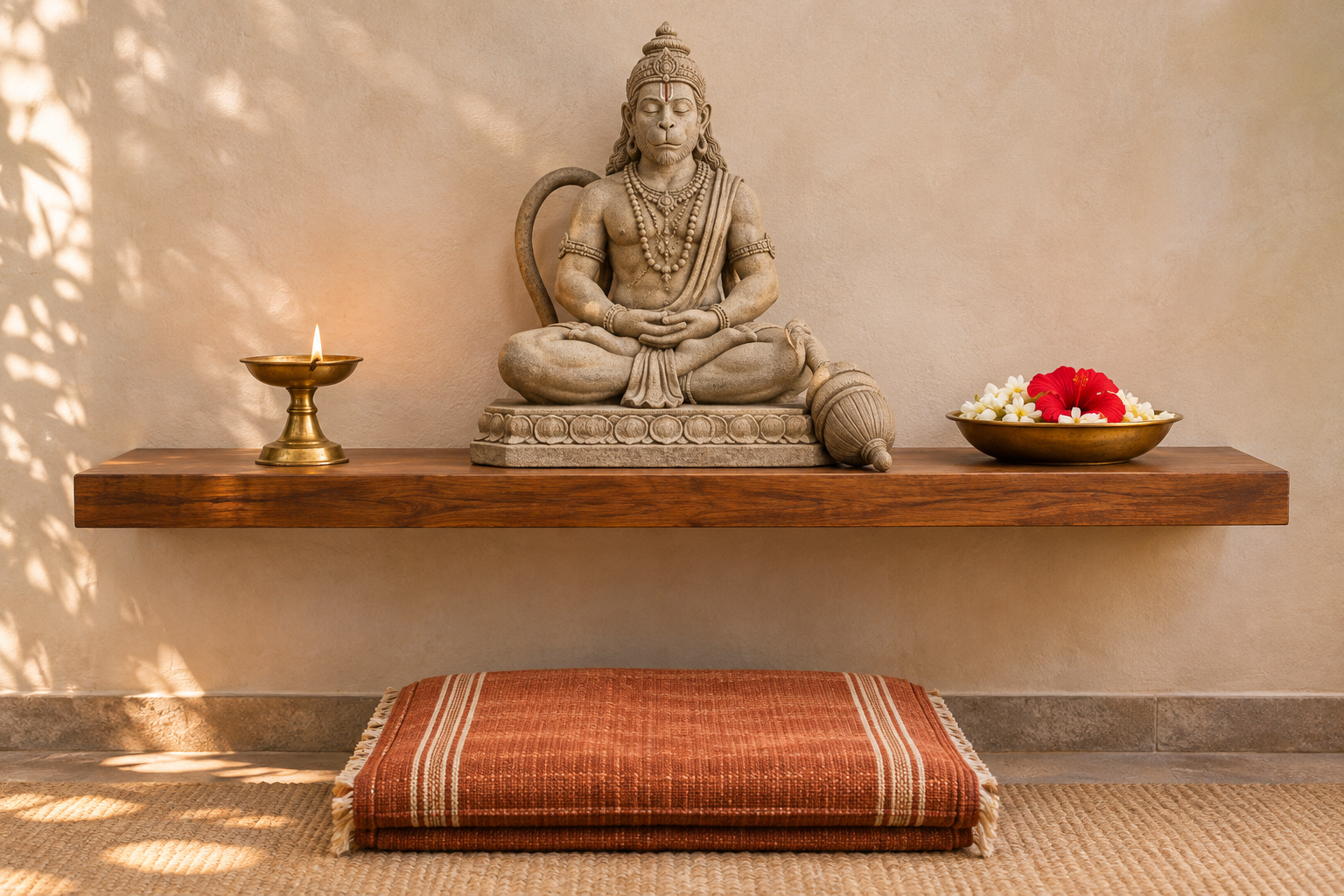
If you are selecting an image for a prayer or meditation space, do not start with ornamentation. Start with legibility. The form should make stillness, composure and meditative attention immediately clear. A technically impressive object that feels visually restless may be less suitable for this purpose than a simpler image with a coherent posture and expression.
Use these criteria before you decide:
- Posture: Is Hanuman unmistakably seated in meditation, often in padmasana?
- Expression: Does the face convey calm inward attention rather than aggression, anxiety or theatrical display?
- Unity: Do the posture and expression communicate the same state, or do they pull the eye in conflicting directions?
- Purpose: Will the image support prayer and recollection in the place you intend to use it?
- Respect: Can you give it a clean, intentional setting rather than treating it as an incidental ornament?
Placement should serve attention. Choose a clean location where you can see the image without visual clutter and where ordinary traffic will not make regular contemplation impractical. If the image belongs within an established household shrine, follow that shrine’s inherited discipline instead of rearranging it merely for aesthetic effect.
Most importantly, do not let acquisition replace practice. The point is not to own the most elaborate representation of meditative strength. Begin with the image available to you, sit before it with regularity, and let its stillness test the quality of your next action.
References

Leave a Reply
You must be logged in to post a comment.