
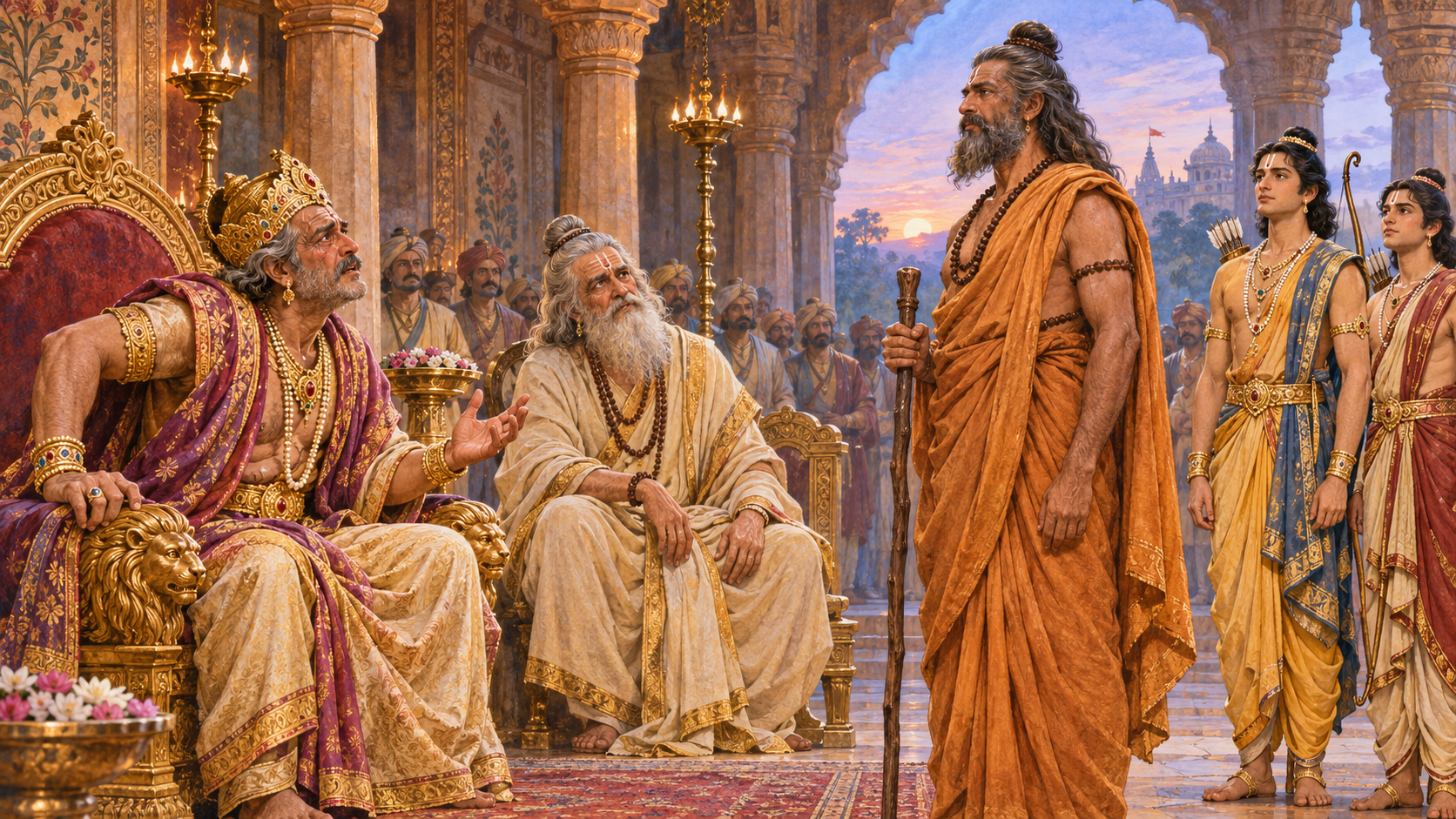
You may know exactly what Dasharatha feels when duty asks him to release the person he most wants to protect. His fear is not contemptible. It is a father’s love confronting a danger he cannot control. Yet the Ramayana does not let sincere love settle the question by itself.
Vasishtha helps Dasharatha see what fear has hidden: who Vishwamitra is, why the sage’s restraint should not be mistaken for helplessness, and why a king cannot abandon dharma merely because dharma has become personally costly. That counsel gives you a practical way to distinguish protection from possessiveness, caution from avoidance, and trust from blind obedience.
Dasharatha’s fear is understandable, but it cannot rule him
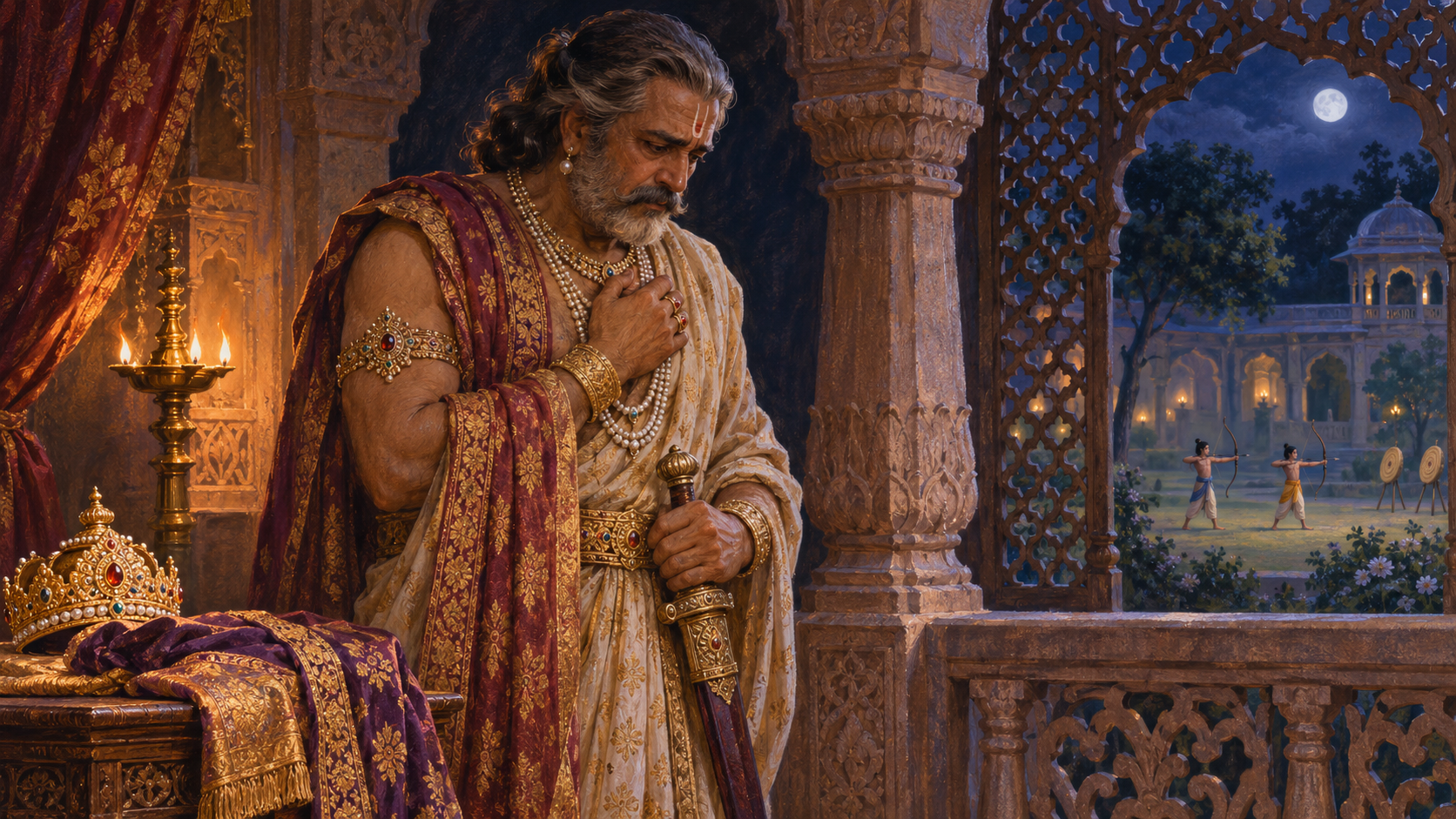
In Bala Kanda, Chapter 19 of the Valmiki Ramayana, Vishwamitra comes to Dasharatha because rakshasas are disrupting a yajna. The sage has accepted the discipline of the rite: while it is underway, he cannot take up weapons or surrender to anger. He therefore asks the king to send Rama to defend the sacrifice.
Dasharatha does not initially respond as a detached sovereign. He responds as an alarmed father. He tries to keep Rama away from the danger and looks for another way to meet the request. That reaction reveals a genuine collision between two obligations: the parent’s impulse to protect and the king’s duty to uphold his word, support a righteous undertaking, and place public responsibility above private attachment.
The mistake is not that Dasharatha loves Rama. The mistake would be allowing love to redefine every difficult duty as an unacceptable danger. Protection serves dharma when it guards someone from needless harm. It departs from dharma when it prevents a capable person from accepting a rightful responsibility under trustworthy guidance.
This distinction matters whenever you hold two roles at once. You may be a parent and a leader, a friend and a supervisor, or a family member entrusted with a public decision. Ask which role should govern the particular decision. If you let the most emotionally powerful role automatically overrule every other one, you may call the result compassion even when it is avoidance.
Vishwamitra’s request does not prove that he lacks power

A shallow reading produces an obvious objection: if Vishwamitra is so powerful, why does he need Rama? The premise is wrong. His request arises from disciplined restraint, not incapacity. The yajna binds him to a mode of conduct in which anger and armed retaliation would compromise the work he has undertaken.
That difference is central to the episode. Inability means that a person does not possess the power to act. Restraint means that the person possesses power but refuses to use it in a way that violates a higher commitment. Vishwamitra’s dependence on Rama during the rite is therefore compatible with his formidable spiritual power.
Dharma often distributes a task among people rather than asking one person to exercise every available power. Vishwamitra must preserve the sanctity of the yajna. Rama can protect it without breaking the sage’s discipline. Dasharatha has the authority to entrust Rama with that work. Vasishtha supplies the discernment that allows the king to judge the request properly. Each person has a different responsibility, and the righteous outcome depends on each one performing his own part.
You can apply that principle without pretending that every modern request resembles a rishi’s command. When someone capable asks for your help, do not decide from the request alone that the person is weak, manipulative, or unqualified. First identify the constraint. A principled limit, a vow, a professional boundary, or a legitimate division of responsibility may explain why another person must act.
At the same time, restraint is not a magic word that makes every demand legitimate. Examine whether the constraint is real, whether the requested task is righteous, whether the person being sent is prepared, and whether competent guidance will remain present. Dasharatha is not being asked to trust an unknown claimant. He is being asked to judge Vishwamitra with the help of Vasishtha, whose counsel clarifies both the sage’s stature and Rama’s safety.
Vasishtha replaces imagined danger with informed judgement
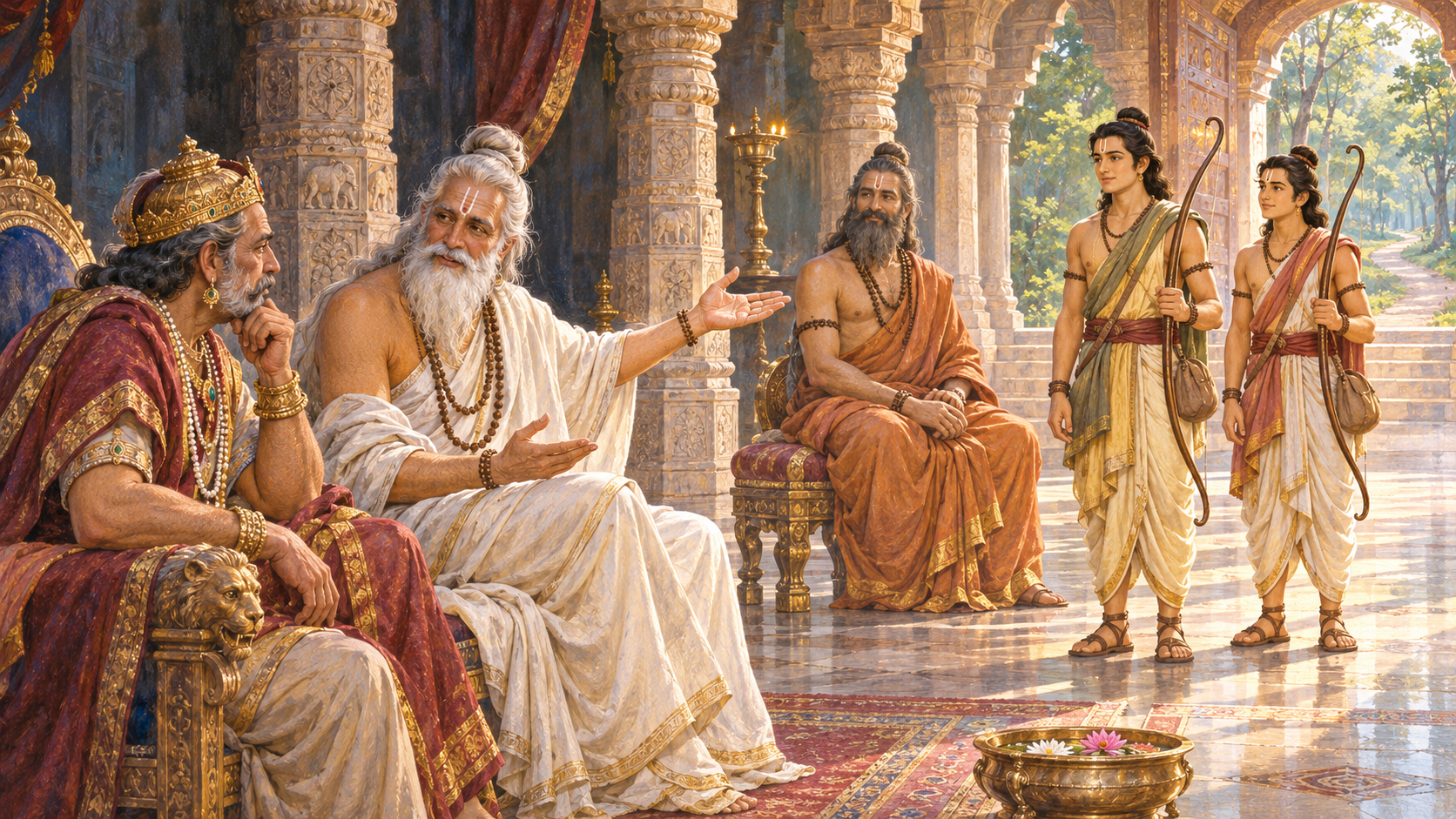
Dasharatha’s fear narrows his attention to one fact: Rama may face danger. Vasishtha widens the field. The king must also consider Vishwamitra’s power, knowledge, self-command, purpose, and capacity to protect and instruct Rama. Once those facts are restored, the decision no longer looks like an unprotected child being handed over to peril.
Vasishtha assures Dasharatha that Vishwamitra is fully capable of guarding Rama. The sage is not merely seeking a fighter. He is also a qualified guide under whose care Rama can meet an appropriate test. Dasharatha’s task is not to eliminate every risk; it is to determine whether the duty, guide, and protection are sufficient to make the risk rightful.
This is a more exact standard than either fearful refusal or unquestioning compliance. Before entrusting someone you love with a demanding responsibility, examine three separate questions:
- Is the purpose dharmic? The proposed action should protect, serve, teach, or fulfil a legitimate obligation. Prestige, pressure, and another person’s impatience are not enough.
- Is the guide worthy of trust? Look for proven competence, self-restraint, clarity of purpose, and a willingness to remain responsible for the person being guided.
- Is the challenge proportionate? Growth requires difficulty, but difficulty without preparation, guidance, or a worthy end is merely exposure to harm.
Notice what this test does not ask: whether you can obtain a guarantee that nothing uncomfortable will happen. Dasharatha cannot fulfil his duty while demanding a world in which Rama never meets danger. Nor should you mistake the absence of total certainty for evidence that refusal is wise. Dharma calls for discernment under uncertainty, not the fantasy of perfect control.
Vasishtha also shows the value of counsel that is neither emotionally captured nor indifferent. A good counsellor does not mock your attachment. Nor does such a counsellor simply confirm it. The counsellor identifies the fact you have underweighted, names the duty you are avoiding, and explains why the proposed course is trustworthy. When fear and responsibility pull in opposite directions, seek that kind of counsel.
A practical dharmic test for costly decisions

The episode becomes useful when you treat it as a method of discernment rather than a slogan about obedience. The lesson is not that every authority should be obeyed, every child should be exposed to danger, or every request made in the name of religion should be granted. Vishwamitra’s character, Vasishtha’s informed endorsement, the righteous purpose of the yajna, and Dasharatha’s royal obligation all matter.
- Name every role you occupy. Write down the duties attached to each role. Dasharatha is not only Rama’s father; he is also a king receiving a righteous request. Naming both roles prevents one attachment from silently erasing the other.
- Identify the promise or principle already in force. A commitment does not disappear when its cost becomes clear. Before reversing course, ask whether circumstances truly changed or whether you merely began to feel the weight of what you had accepted.
- State the feared harm precisely. Replace a general feeling of danger with a concrete concern. Then ask what evidence supports it and what protection addresses it. Vague fear expands indefinitely; a named risk can be evaluated.
- Evaluate the custodian, not just the challenge. A hard task under a disciplined and capable guide differs from the same task under a careless one. Vishwamitra’s stature changes the meaning of Rama’s departure.
- Separate discomfort from violation. A decision may be painful without being adharmic. If the purpose is worthy, the guide trustworthy, the duty genuinely yours, and the risk proportionate, emotional reluctance alone is not a sufficient reason to refuse.
- Act once sound counsel resolves the doubt. Reopening the same settled question can become another form of avoidance. After the relevant duties and protections have been examined, accept the cost of the rightful choice.
This method also protects you from abusing the story. No employer, teacher, religious figure, or relative becomes Vishwamitra merely by demanding trust. A request deserves confidence only when purpose, competence, restraint, proportionality, and accountability are visible. Vasishtha’s intervention is evidence-based counsel, not a command to suspend judgement.
Key takeaways
- Dasharatha’s love is real, but love cannot cancel the obligations of kingship whenever duty becomes frightening.
- Vishwamitra asks for help because the discipline of the yajna restrains how he may act, not because he possesses no power.
- Vasishtha does not ask for blind faith. He supplies the missing facts needed to judge Vishwamitra, the danger, and Rama’s protection.
- Dharmic trust rests on a worthy purpose, a capable guide, a proportionate challenge, and clear responsibility.
- When your private attachment conflicts with a public or moral duty, name both roles before deciding which claim should govern.
The next time protection and duty seem to conflict, do not begin by asking how to avoid all pain. Ask what your role requires, which fear is supported by fact, and whether a trustworthy guide makes the necessary challenge proportionate. Then make the decision you can defend by dharma, even when attachment would prefer an easier one.
References

Leave a Reply
You must be logged in to post a comment.