
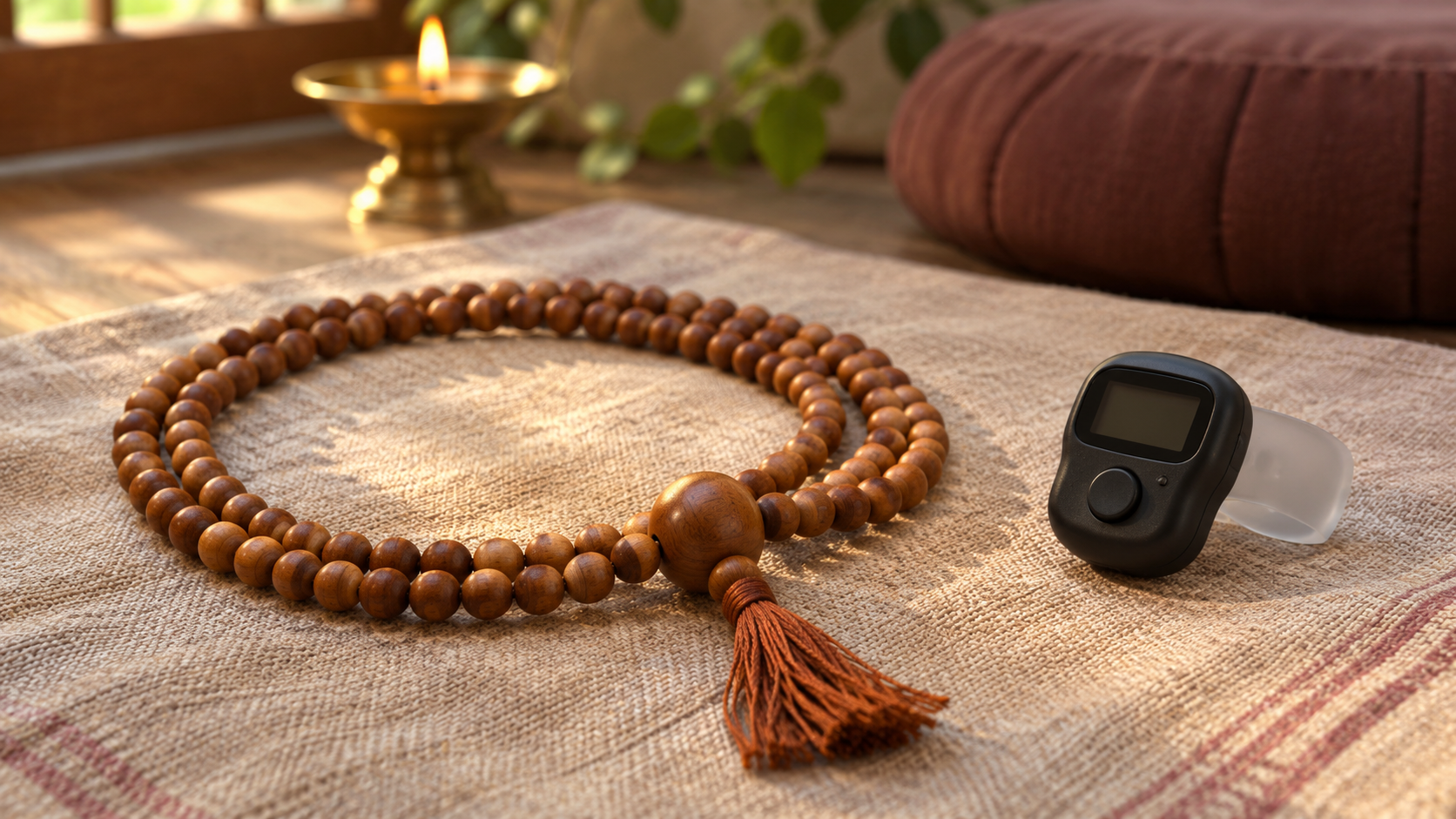
You want to keep an accurate japa count, but you don’t want counting to swallow the mantra. A ring counter or phone app looks efficient; a traditional mala may feel slower, less discreet, or inconvenient to carry. Does choosing the digital option actually weaken the practice?
For formal japa, use a mala when you reasonably can. A digital counter can preserve continuity when pain, limited hand movement, travel, work, or another real constraint makes the mala impractical. But it should be treated as an accommodation for counting, not as a complete replacement for the discipline a mala brings to your hand, attention, and pace.
Choose according to what the tool trains
Japa is the repetition of a mantra, but repetition is not merely the production of a number. The count provides a boundary: it tells you what you have undertaken and when that undertaking is complete. The purpose remains attentive remembrance of the mantra and, according to the practitioner’s path, devotion, contemplation, or inward steadiness.
A digital counter is excellent at one narrow task. It registers a tap. That precision can make the total feel like the central achievement, especially when an app adds goals, streaks, badges, history, or a prominent dashboard. Japa can then become a mechanical exercise: repeat, tap, advance, finish.
A mala trains something different. Each repetition is joined to a deliberate physical movement. The fingers receive a quiet task, while the mind returns to the mantra. The bead does not create concentration for you, and possessing a beautiful mala does not make anyone more spiritual. Its value is practical: it makes the count tactile and less visually demanding.
This gives you a useful test. Don’t ask only, “Which tool counts more easily?” Ask, “What habit does this tool strengthen while I count?” If convenience makes you hurry, divide attention, or chase totals, it is costing more than it saves.
What the mala adds to formal japa

The mala’s advantage is not nostalgia. It gives the body a role in the practice without asking the eyes to supervise a screen. That changes several small but important things.
- A tactile anchor: When the mind wanders, the bead in your fingers helps locate you in the practice. You do not have to look at a display to know that the repetition is being counted.
- A natural pace: Moving one bead after a complete mantra discourages frantic tapping. The hand can reveal when the mouth is reciting faster than attention can follow.
- A defined practice space: Taking up the mala marks a transition from ordinary activity to intentional japa. A phone usually carries the opposite associations: messages, work, news, entertainment, and interruption.
- Less fascination with the total: The count remains present, but it is not continually displayed. You can stay with the mantra instead of checking how much remains.
- Continuity with a received discipline: If a guru or lineage has taught you how to perform japa, using the prescribed method keeps the practice intact rather than redesigning it around convenience.
None of this means the mala should become an object of vanity or anxiety. Expensive materials do not compensate for inattentive recitation. Nor should you invent handling rules from fragments encountered online. Traditions differ, so follow the instructions attached to your own mantra and sampradaya. If you have received a specific method, that instruction takes priority over generic advice about either beads or counters.
When a digital counter is a legitimate aid

It is easy to turn this question into a purity test. That is unhelpful. A person who cannot comfortably manipulate beads has a different decision from someone who simply prefers to keep a phone in hand. The first question is whether the technology removes a genuine obstacle or merely removes useful discipline.
A digital counter may be the sensible choice when holding or advancing a mala causes pain, when limited movement makes bead handling unreliable, or when circumstances do not permit a visible mala. It may also be useful as a temporary backup when the alternative is abandoning an established daily practice. In these cases, accessibility serves continuity.
Convenience alone deserves closer examination. If the mala is available and usable, but the counter is attractive because you can click rapidly, watch the total rise, or combine japa with scrolling, the device is not solving a problem. It is changing the practice. Counting while your attention moves between a mantra and unrelated content may preserve a number, but it does not preserve undivided attention.
Use these decision rules:
- For a formal seated practice: Default to the mala, especially when that is how the mantra was taught to you.
- For an initiated or vowed practice: Do not change the counting method, mantra, pronunciation, or assigned discipline on your own. Ask the teacher or appropriate lineage authority when possible.
- For a physical or situational constraint: Use the simplest counter that allows attentive repetition without creating another obstacle.
- For casual remembrance outside the formal sitting: Decide whether a count is needed at all. Not every repetition has to become a metric unless your instruction requires it.
- For a preference based mainly on speed: Stay with the mala and examine the urge to finish. The impatience is part of what the practice is showing you.
If you do need a digital method, a dedicated tally counter is generally a better fit than a phone app. It does fewer things and therefore presents fewer invitations to leave the mantra. The point is not that electronics are spiritually impure. The point is to reduce competing demands on attention.
How to use a digital counter without losing the practice
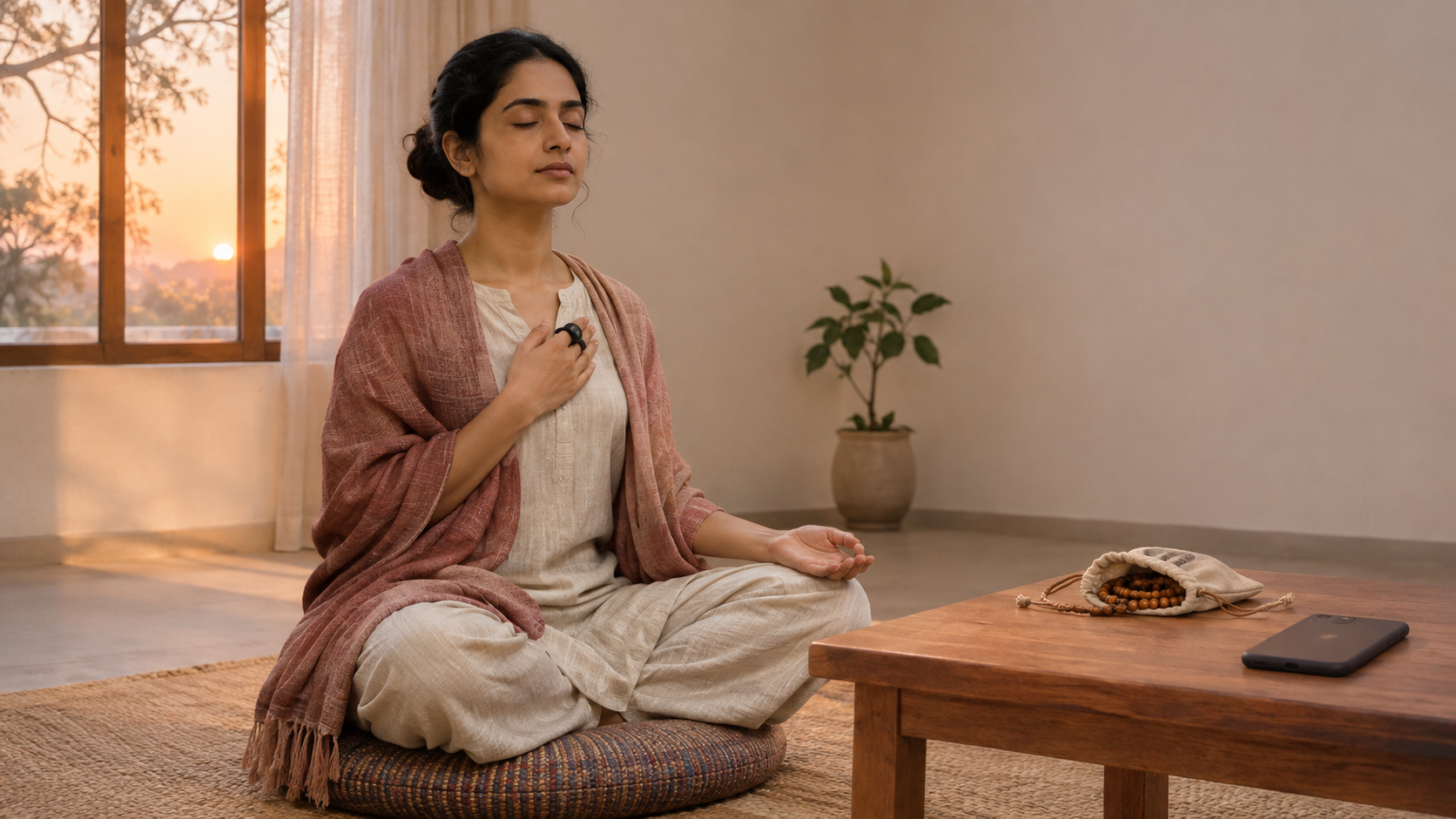
A digital count need not become careless. Give it clear boundaries before you begin rather than trying to recover attention after notifications, statistics, and speed have taken over.
- Settle the method first. Decide on the mantra, intended count, place, and posture before touching the counter. If these have been given by a teacher, keep them unchanged.
- Remove the counter from your visual centre. Hold a ring counter or small tally device where it can be advanced by touch. If you must use a phone, do not keep the total glowing in front of you.
- Silence interruptions. Enable the device’s do-not-disturb setting, close unrelated applications, and prevent the practice from becoming an opening through which messages and alerts enter.
- Advance only after a complete repetition. One tap should correspond to one mantra as you have been taught to recite it. Do not let the tapping hand establish a pace that clips or compresses the mantra.
- Notice the first sign of haste. A rapid clicking rhythm, shallow pronunciation, repeated checking of the total, or irritation at the remaining count means the metric has moved to the foreground. Pause, restore the mantra’s clarity, and then continue.
- Turn off gamification. Disable streaks, badges, social sharing, reminders, and performance graphs where the app permits it. They train you to protect an app record rather than deepen the practice.
- End deliberately. When the undertaking is complete, put the device away instead of browsing from the counter into other apps. Preserve the inward quiet for a moment rather than making the final tap a doorway back into distraction.
Do not use an accidental loss of the digital total as a reason for panic or compulsive recounting. If your practice carries a formal obligation, ask the person who gave that discipline how uncertainty should be handled. A counter is supposed to support the vow; fear of the display should not become a second vow of its own.
Key takeaways
- A mala is normally the better instrument for formal japa because it joins counting to touch, pace, and a deliberate boundary around the practice.
- A digital counter records repetitions, but it does not preserve attention, pronunciation, devotional feeling, or the integrity of a received method.
- Accessibility and genuine practical constraints are sound reasons to use a counter; impatience and the desire to accumulate totals quickly are reasons to reconsider it.
- If a guru or lineage has prescribed a method, follow that instruction rather than substituting a device on the basis of generic advice.
- When digital counting is necessary, use the simplest device available, silence distractions, hide performance statistics, and advance the count only after each complete mantra.
At your next formal sitting, place the phone out of reach and take up the mala if you are able. Then watch one thing closely: not how fast the count moves, but whether the hand keeps bringing the mind back to the mantra. If a digital aid is genuinely necessary, arrange it with the same care. Let the count serve the japa, never the other way around.
References

Leave a Reply
You must be logged in to post a comment.