

You may have enough leverage to make a person, institution, or piece of land yield to your will. That settles what you can do. It does not settle what you should do.
Balarama drawing Yamuna near with his plough gives you a demanding way to examine that gap. Read carefully, the episode neither glorifies domination nor asks you to become passive. It asks whether your strength is governed by dharma before it changes something beyond you.
The miracle is not a licence to imitate divine force
Within the Harivamsa and Bhagavata Purana traditions, Balarama draws the Yamuna toward himself with his plough. The scene presents an extraordinary concentration of power: a river’s course does not place the same constraint on Balarama that it would place on an ordinary human being.
The easiest misreading is to move from divine capacity to human permission: Balarama can compel the river, so human beings may treat nature as something to be compelled. That conclusion does not follow. An act within divine līlā is not automatically a general rule for human conduct. Human power is partial, human knowledge is incomplete, and human motives are mixed. Imitation is not the same as devotion.
When you encounter an overwhelming divine act, ask three questions before drawing a moral lesson from it: Who is acting? What authority does that being possess? Which part of the action, if any, can an ordinary person responsibly carry into daily life? These questions prevent you from turning an exceptional act into a convenient excuse.
The transferable lesson is not that sufficient strength makes resistance irrelevant. It is that power must answer to an order greater than personal appetite. Balarama’s divine sovereignty should make a human being more conscious of human limits, not less.
The plough turns strength into responsibility
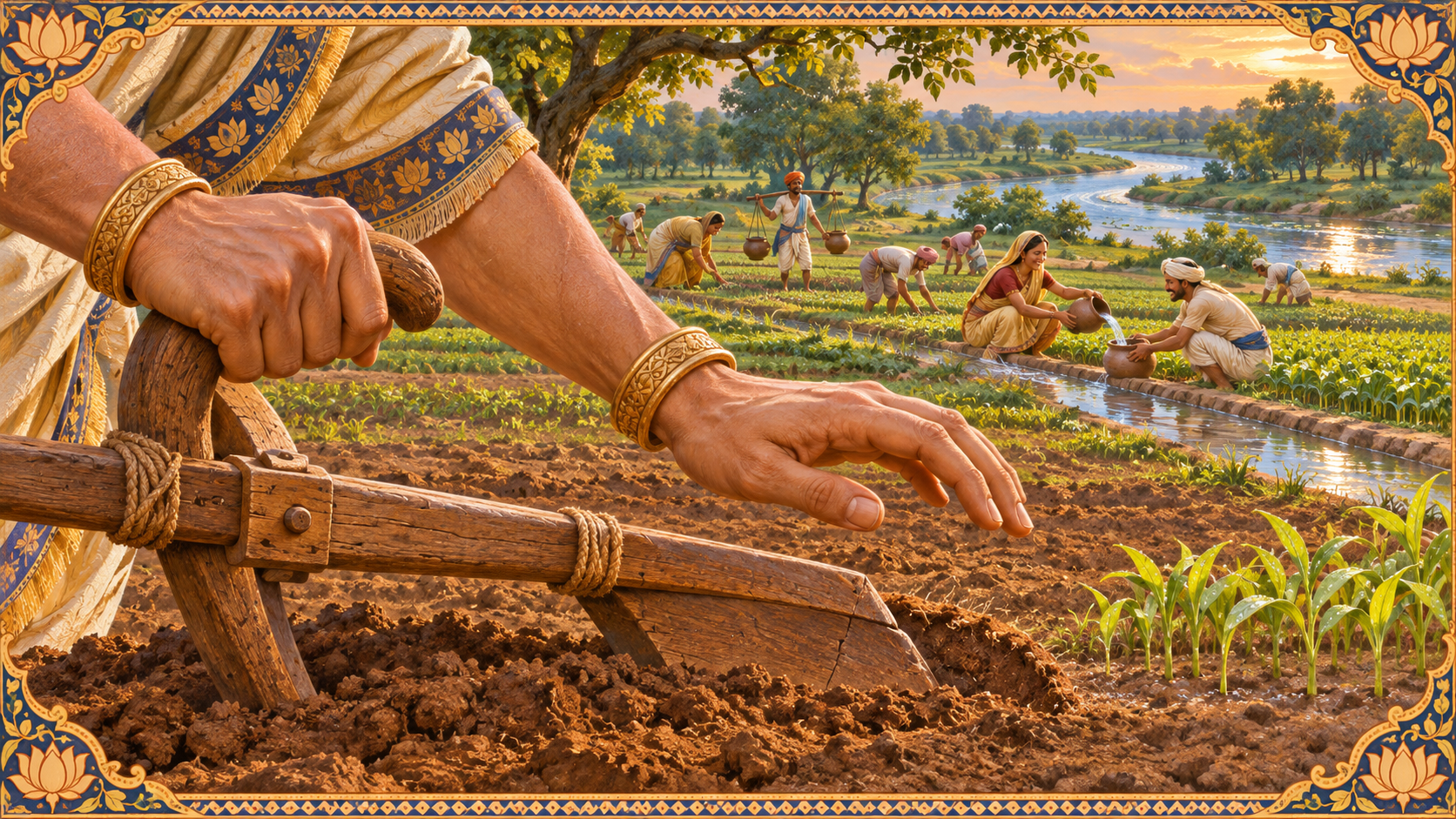
A plough is not merely an emblem of force. It is a tool of cultivation. It opens the earth so that nourishment can grow, joining physical strength to patience, timing, and care. In Balarama’s hands, however, it can also move what appears immovable. That combination makes the symbol morally sharper.
Every useful tool contains a similar tension. Authority can establish order or silence criticism. Wealth can sustain a community or make other people dependent. Machinery can cultivate land or exhaust it. Information can clarify a decision or manipulate it. The tool does not supply its own moral limit; the person using it must accept one.
Dharma therefore asks more than whether an intervention produces the result you want. It asks whether the purpose is legitimate, the force proportionate, and the person acting accountable for the consequences. If one of those conditions is missing, capability has outrun wisdom.
This is not an argument against cultivation, engineering, government, or decisive action. Restraint is not refusal to act. The practical distinction is between intervention that serves a defined duty and intervention that merely proves control. Before using a powerful tool, complete this sentence without vague language: “Because I am responsible for ___, I need to do ___.” If you can name only convenience, prestige, anger, or the desire to win, pause.
Yamuna must be encountered as more than an obstacle

A river can be reduced to a quantity of water, a line across a map, or a resource to be redirected. The Dharmic imagination resists that reduction. Yamuna is also a sacred presence within a web of memory, reverence, place, and relationship. That does not forbid practical use of a river. It changes the moral field in which use occurs.
Once you see a river only as material, anyone who cannot assert ownership becomes easy to ignore. Downstream communities, future users, non-human life, and the sacred character of the place disappear from the decision. A local benefit can then conceal a cost transferred elsewhere.
You can apply this insight without pretending that every practical choice has an easy answer. Before changing a living system, describe it through three lenses:
- Material: What physically changes, and where do the effects travel?
- Relational: Who depends on this place or system but is absent from the decision?
- Sacred: What obligation would remain even if no price could be assigned to it?
The same discipline applies outside environmental questions. An employee is more than an output figure. A child is more than a plan for the future. A temple is more than real estate. A tradition is more than content to be repackaged. When something has life, history, or sanctity, efficiency is relevant but insufficient.
Use this four-question dharmic test before applying force
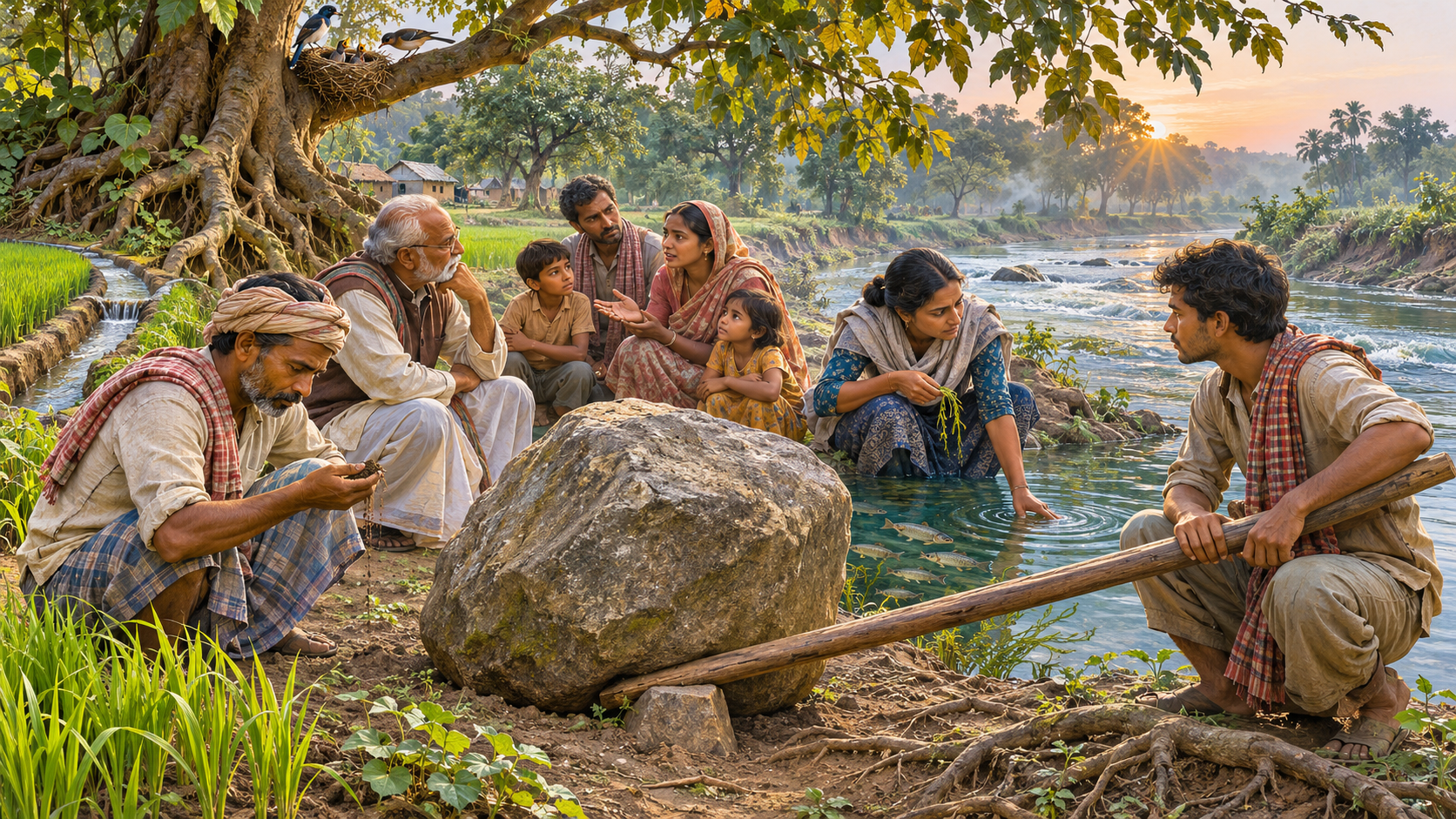
When you have the power to override resistance, do not rely on your good intentions alone. Put the proposed action through four concrete questions. They work for a personal dispute, an institutional decision, or an intervention involving land and water.
- What duty am I actually serving? State the responsibility, the person or good to whom it is owed, and the result required. “I want this” is a preference, not a duty. “This will be faster” describes an advantage, not a moral warrant.
- Who is being made to move so that I do not have to? Name every party carrying a cost, including those without influence in the room. Where consent or consultation is possible, seek it before fixing the decision.
- What remains outside my knowledge or control? List the assumptions on which the plan depends and the effects you cannot confidently predict. Treat serious uncertainty as a limit on permission, especially when the action is difficult to reverse.
- What is the least forceful effective step? Prefer a bounded, reversible measure when it can test the same judgment. Decide in advance what evidence would make you stop, who will review the result, and when that review will occur.
The second question is often the revealing one. Power disguises itself as necessity by making another being absorb the inconvenience. If your solution works only because the weaker party has no practical way to refuse, you have not yet shown that the solution is dharmic.
The fourth question guards against another common error: treating maximum force as proof of seriousness. A smaller intervention may require more discipline because it preserves room to learn. Reversibility is not timidity when your knowledge is limited; it is an honest response to that limitation.
Key takeaways
- Balarama’s extraordinary act displays divine power; it does not automatically authorise ordinary human domination.
- The plough joins capacity to cultivation, reminding you that a useful tool becomes dharmic only through purpose, proportion, and accountability.
- Seeing Yamuna as a sacred presence expands the decision beyond immediate utility and immediate beneficiaries.
- When knowledge is incomplete, choose the smallest effective action, make it reversible where possible, and define the stopping condition before you begin.
This reading avoids two opposite mistakes. One is to celebrate coercion merely because it succeeds. The other is to treat all intervention as a violation. Dharma demands the harder middle path: act when duty requires action, but do not let your capacity decide the boundaries of your duty.
Let what you should do govern what you can do

Human beings need strength. Families, communities, and civilisations cannot be protected by helplessness. But strength becomes destructive when it refuses correction, exports its costs, or mistakes compliance for harmony.
On your next consequential decision, draw two columns. In the first, write what you can make happen. In the second, write what you remain answerable for after it happens. Include the people, places, duties, and uncertainties that power would prefer to leave unnamed.
Do not proceed until the second column governs the first. That is a practical boundary for human power: not weakness, but strength placed under dharma.
References

Leave a Reply
You must be logged in to post a comment.