

You sit for meditation, stop speaking, and discover that an entire conversation is still running inside you. Arguments are rehearsed. Memories answer one another. A future explanation is polished for an audience that is not even present. The room is quiet, but consciousness is still speaking.
If you are practising meditation or mauna, this distinction changes the work. You do not have to fight every thought or manufacture a blank mind. You need to recognize where speech is arising, follow it toward its subtler beginnings, and learn when not to carry it into another sentence.
Key takeaways
- Not speaking is outer quiet; meditative silence also requires you to notice inner narration.
- The four levels of speech offer a practical inward map: Vaikhari, Madhyama, Pashyanti and Para.
- You reach subtler speech through observation, not by forcibly suppressing words or emotions.
- Chanting, devotional singing and reflective inquiry can prepare attention for silence when each is followed by genuine listening.
- The test of contemplative silence is not how withdrawn you become, but whether your eventual speech is clearer, more truthful and less compulsive.
Outer quiet is the threshold, not the destination
Silence is not a collection of different substances. What varies is what continues to fill the apparent silence: remembered voices, imagined replies, plans, judgments, images or a nearly wordless urge to react. In that sense, silence remains silence while the activity obscuring it takes different forms.
This is why a vow not to speak can reveal more noise rather than less. Audible speech has stopped, so the inward version becomes easier to hear. That discovery is not a failed meditation. It is the first accurate observation.
Do not grade a sitting only by the number of thoughts that appeared. Ask more useful questions. Did you notice a sentence before mentally repeating it? Did you feel the impulse behind a reply? Could you leave a thought unfinished without immediately replacing it? Those are observable movements from compulsion toward awareness.
Silence also must not become suppression. If irritation, grief or desire appears, pretending that it is absent merely drives the same movement underground. Acknowledge what has arisen without feeding it with an internal speech, an imagined debate or a story about what it means. The aim is not to become incapable of thought. It is to stop being carried away by every formation of speech.
The four levels of speech give you an inward map

A traditional Dharmic account distinguishes Para, Pashyanti, Madhyama and Vaikhari, with Vaikhari as the gross or outward level. Different traditions may place different metaphysical weight on these terms. For meditation, you can use them as a disciplined way to observe how an utterance moves from unformed potential into audible sound.
| Level | What you can notice | How to practise with it |
|---|---|---|
| Vaikhari | Speech expressed through the voice: words, tone, pace and emphasis. | Hear what you are actually saying. Notice whether the sound matches the meaning you intend. |
| Madhyama | Inner speech already shaped into words: rehearsal, commentary and silent self-talk. | Let the sentence be heard inwardly without completing, defending or repeating it. |
| Pashyanti | The whole movement of meaning before it becomes a finished sentence: an image, intention, felt direction or impulse to speak. | Notice what the coming words are trying to do before deciding whether they need expression. |
| Para | The undifferentiated source of speech, before meaning is divided into a particular speaker, sentence and sound. | Do not try to invent an image of it. Rest where no further verbal construction is required. |
These are not four voices hidden inside the head, and the table is not a neurological diagram. They are levels of discernment. The model becomes useful when you trace a real utterance inward rather than merely memorizing Sanskrit terms.
Suppose you are about to answer a criticism. Vaikhari is the reply leaving your mouth. Madhyama is the sentence you have already composed internally. Pashyanti is the more immediate intention beneath it: perhaps to clarify, defend, retaliate or recover dignity. The inward movement toward Para begins when you stop adding language and allow even that intention to be seen without automatically obeying it.
You may decide that a response is still necessary. The practice has not failed if you speak. Its value lies in preventing an unnoticed impulse from disguising itself as a considered word.
Trace one movement of speech back toward silence

Use the four levels during an ordinary meditation. The sequence matters more than duration. Work with what is present instead of trying to produce a special state.
- Settle the outward level. Sit where you are not expected to answer anyone. Let the body become still enough that every adjustment is not generating a new chain of commentary.
- Begin with Vaikhari if the mind is scattered. Recite a familiar prayer, mantra or devotional line clearly and without theatrical effort. Hear the sound as sound. Then stop.
- Listen for Madhyama. Notice whether the recitation continues inwardly, whether another thought comments on it, or whether the mind begins planning what comes next. Do not argue with that voice. Hear the sentence and decline to extend it.
- Recognize Pashyanti. As the inner words become less compelling, attend to the movement before them. It may appear as an image, a direction of attention, a felt objection or an impulse to name something. Stay with the whole movement before it becomes a verbal explanation.
- Do not turn Para into another object. If you begin thinking, “Now I have reached the deepest level,” Madhyama is speaking again. Let the label pass. Rest without demanding confirmation.
- Return deliberately. When you resume activity, notice the first sentence that forms. Let it pass through awareness before it becomes sound.
The crucial move is not pushing a thought away. It is withdrawing the extra cooperation that keeps it talking. An inner sentence often survives because you repeat it, answer it, improve it or build evidence for it. When you stop supplying the next line, the movement can end by itself.
Some sittings will remain full of Madhyama. Work there. Hearing inner speech accurately is more useful than pretending to rest in Para. The traditional vocabulary should sharpen honesty, not give the ego a hierarchy of experiences to claim.
Let sound and inquiry prepare the way for silence
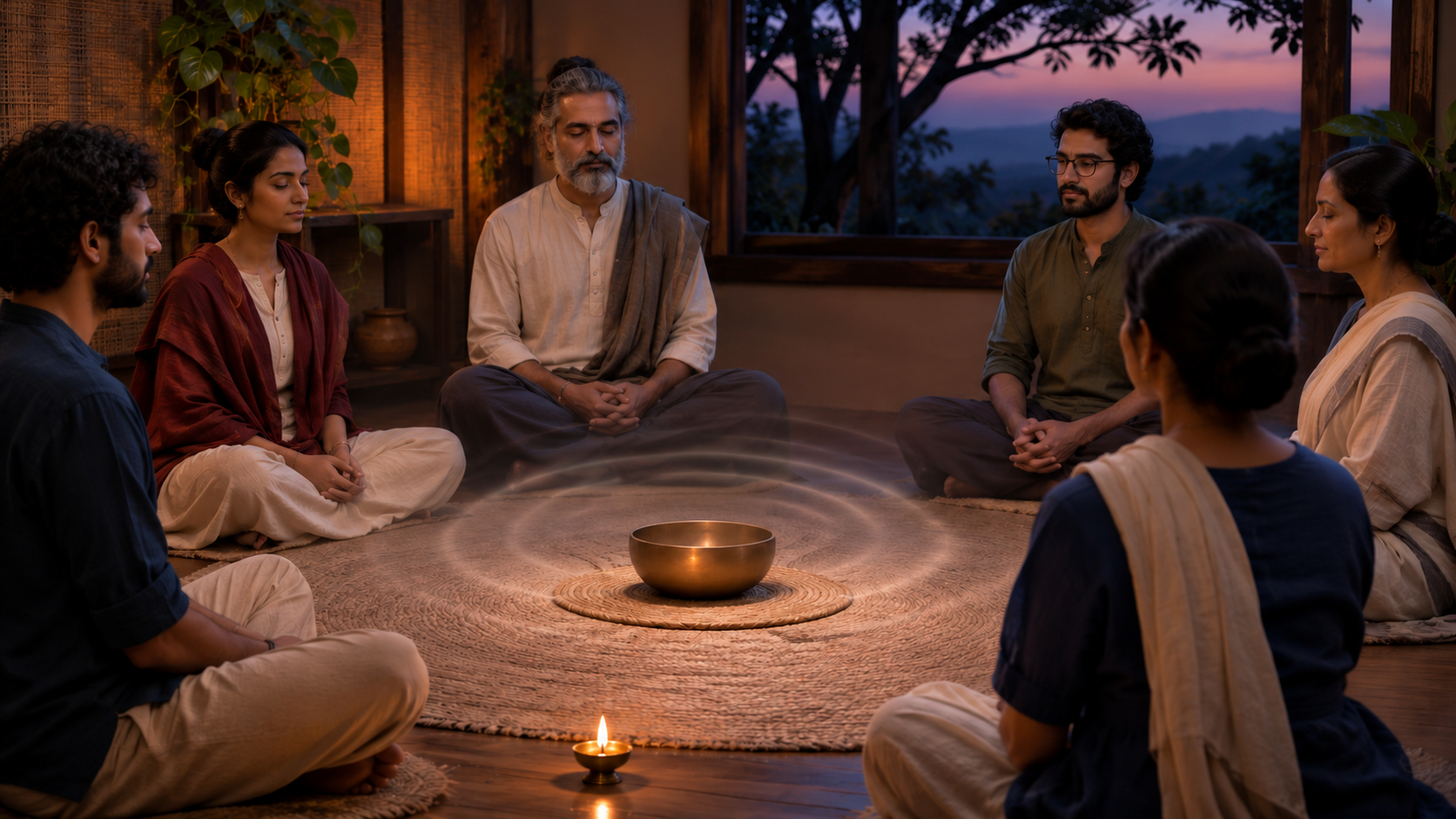
Silence and sacred sound are not enemies. A familiar satsang pattern combines singing with knowledge and logical discussion. The alternation matters: devotional sound can gather scattered feeling into one movement, while inquiry tests whether enthusiasm has become understanding.
This pairing is sometimes described through the shorthand of right-brain and left-brain activity. It is safer to use that language as a practical reminder that musical participation and logical examination are different modes of attention, not as a complete map of the brain. You do not need a neurological claim to notice the contemplative value of moving from expression to reflection and then into quiet.
You can apply that pattern without recreating a full satsang:
- Sing or recite something you already know, so attention is not occupied with learning new words.
- When the sound ends, listen to the silence after it. Do not rush to reproduce the pleasant part.
- Notice any inward commentary: “That was peaceful,” “I lost concentration,” or “I should do it again.” Recognize this as Madhyama.
- Bring in one clean question, such as “What is present before the next word?” Do not convert the question into a chain of speculative answers.
- Release the question and remain attentive.
If singing makes you self-conscious, use simple recitation. If analysis keeps multiplying concepts, stop introducing questions and return to listening. The purpose of each method is to prepare attention for the next movement, not to dominate the whole practice.
Do not measure meditation by whether it produces an unusual or altered state. A striking experience can become one more possession for Madhyama to describe, compare and seek again. The more dependable measure is whether you can notice speech earlier in its formation and choose more wisely what happens next.
Return to speech without abandoning silence

Dharmic silence is not an escape from relationship or duty. A person can remain outwardly mute while inwardly composing accusations. Another can speak firmly while retaining enough stillness not to be ruled by anger. The ethical question is not simply whether you spoke. It is whether awareness remained present as intention became language.
Before an important reply, move through the map in daily life:
- At Pashyanti, identify the intention. Are you trying to inform, request, protect, impress, punish or merely discharge discomfort?
- At Madhyama, hear the proposed sentence. Remove the exaggeration, imaginary motive and argument you cannot actually support.
- Before Vaikhari, allow a real pause. If the sentence is necessary, speak it plainly. If it is only carrying momentum, let it end unspoken.
- After Vaikhari, listen. Do not immediately prepare the next rebuttal. The silence after your words is part of responsible speech.
Four mistakes that keep the mind talking
- Forcing blankness: The command to have no thoughts becomes another loud thought. Observe the demand along with everything else.
- Collecting subtle experiences: Naming every sensation as Pashyanti or Para replaces meditation with classification. Use the map only when it increases discernment.
- Using silence to avoid necessary speech: Refusing to clarify, apologize, set a boundary or answer a legitimate question is not automatically spiritual. Silence should purify speech, not conceal responsibility.
- Explaining the practice while practising: If an internal lecturer narrates every level, you are still working with Madhyama. Notice the narration and leave the next sentence unfinished.
Try this in the next conversation that genuinely matters. Hear the inward sentence. Notice the intention beneath it. Leave a brief opening in which neither has to control you. Then speak only what remains necessary, and listen after you have spoken. That is where meditative consciousness stops being an isolated state and begins to shape conduct.
References
- Hindu Pad — Different Types of Speech, Different Types of Silence
- Hindu Pad — How to attain enlightenment (altered state of consciousness)

Leave a Reply
You must be logged in to post a comment.