
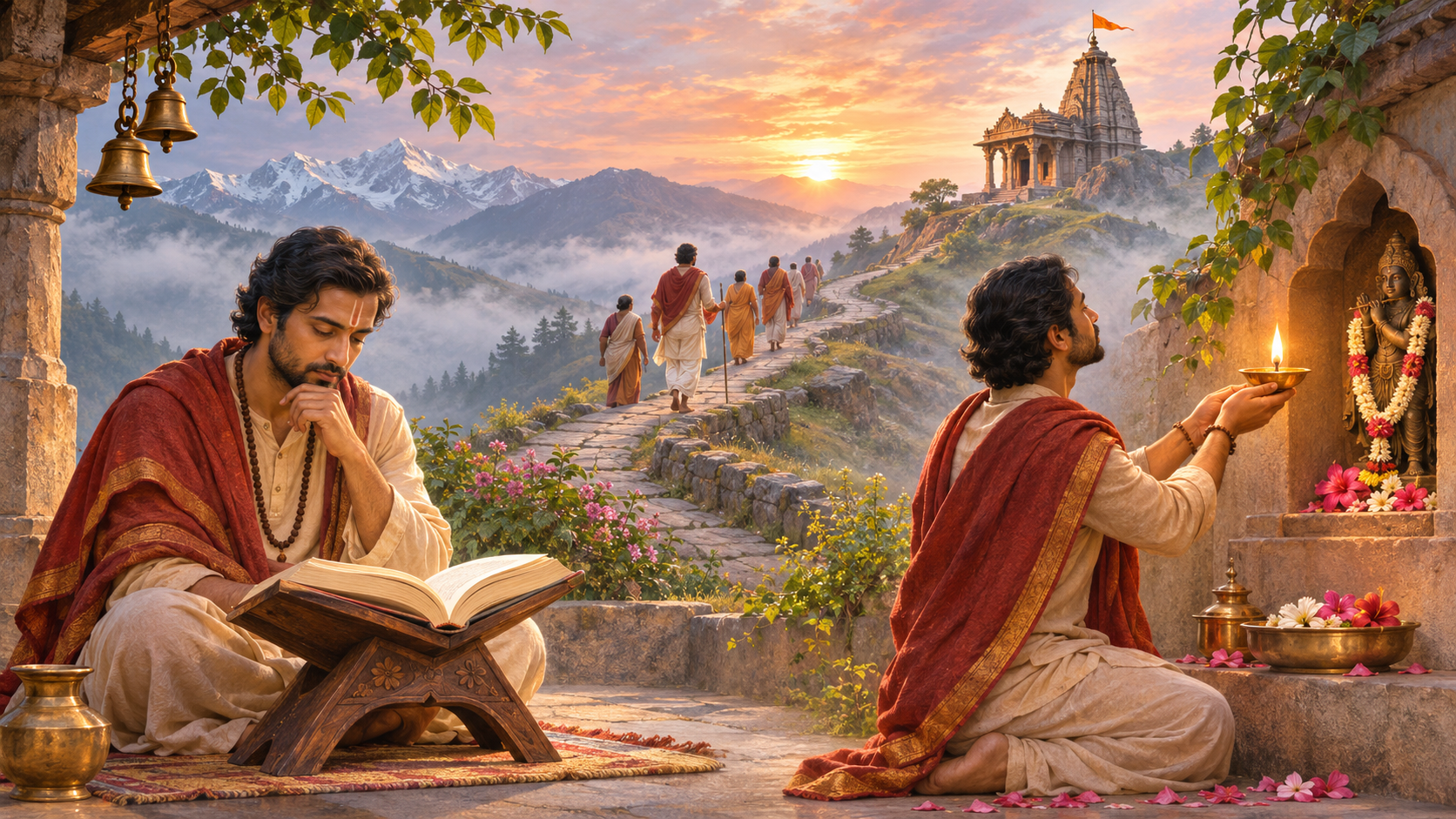
You may know this tension well: you read about dharma but rarely worship, perform puja but no longer feel present, or return from a temple journey inspired without knowing how to carry that feeling home. The problem isn’t that you chose the wrong form of devotion. It is usually that one form is being asked to do the work of all three.
Knowledge, ritual and pilgrimage train different parts of the devotee. Knowledge clarifies whom and why you worship. Ritual gives devotion a repeatable form. Pilgrimage removes you from ordinary habits and places you inside sacred time, place and community. You can use all three without pretending that every Hindu sampradaya interprets or ranks them in exactly the same way.
Begin with the weakness in your present practice
Don’t begin by asking which mode is highest in the abstract. Ask what is missing from your devotion now.
- If you practise without understanding, begin with knowledge. Learn the identity of the deity, the meaning of the central act and the purpose of the prayer you already use.
- If you understand but rarely practise, begin with ritual. Give devotion a place, a sequence and a regular point in the day or household calendar.
- If your practice feels enclosed or self-referential, begin with pilgrimage. Enter a temple or tirtha where inherited customs, other devotees and the discipline of travel can interrupt your private routine.
Each mode also has a characteristic failure. Knowledge can become argument or pride. Ritual can become automation. Pilgrimage can become tourism. The remedy is not to discard the weakened mode, but to connect it to one of the others. Study should lead to worship; worship should shape conduct; pilgrimage should return with you as a changed practice.
Some knowledge must precede deliberate devotion because desire needs an intelligible object. A familiar analogy makes the point through recognition and the desire for something already known. Yet complete intellectual mastery is not a prerequisite for prayer. If you wait until every theological question is settled, study can become a respectable way of postponing devotion.
Use knowledge to make devotion more precise
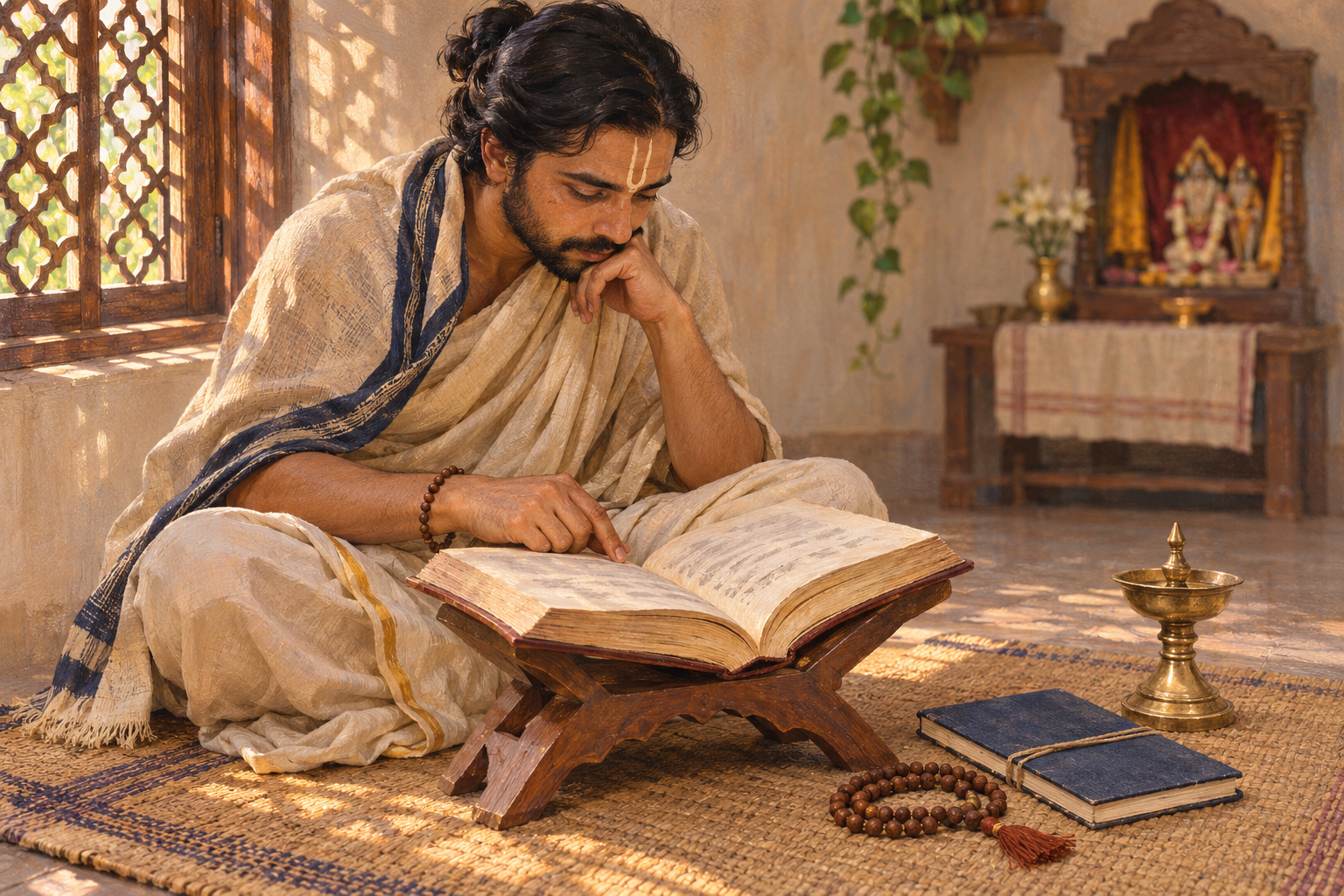
Knowledge in this setting is not the accumulation of religious facts, nor is it a claim that the path of knowledge and the path of devotion are interchangeable. It is the understanding that lets you worship attentively, recognise the limits of your competence and connect sacred action with dharmic conduct.
Before adopting a new vrata, mantra or puja, prepare a brief practice note. It should answer four questions:
- Whom am I approaching? Learn the deity’s name, form and the relationship in which your tradition approaches that form. Avoid treating every deity as an interchangeable symbol.
- What is the central act? Identify whether the practice centres on remembrance, recitation, offering, darshan, vigil, circumambulation or another discipline.
- Which instructions apply to me? Separate an open household practice from a mantra, initiation or specialised rite that requires guidance. Family custom and sampradaya are relevant here.
- What should this change outside worship? Name one quality the practice asks you to remember in speech, work, family life or service. Without this step, religious knowledge can remain decorative.
Keep the note short enough to consult before worship. If two teachers or communities give different instructions, don’t quietly combine them into a procedure of your own. Record the difference and follow the tradition to which the particular practice belongs. Hindu plurality is not permission to erase distinctions.
A practical test is simple. You should be able to explain why you perform the main act in a few clear sentences, name what you still do not understand and identify one consequence for your conduct. If you can recite a long account of a deity but cannot say what changes when you leave the shrine, more information is unlikely to solve the problem.
Let ritual train the attention that study cannot supply
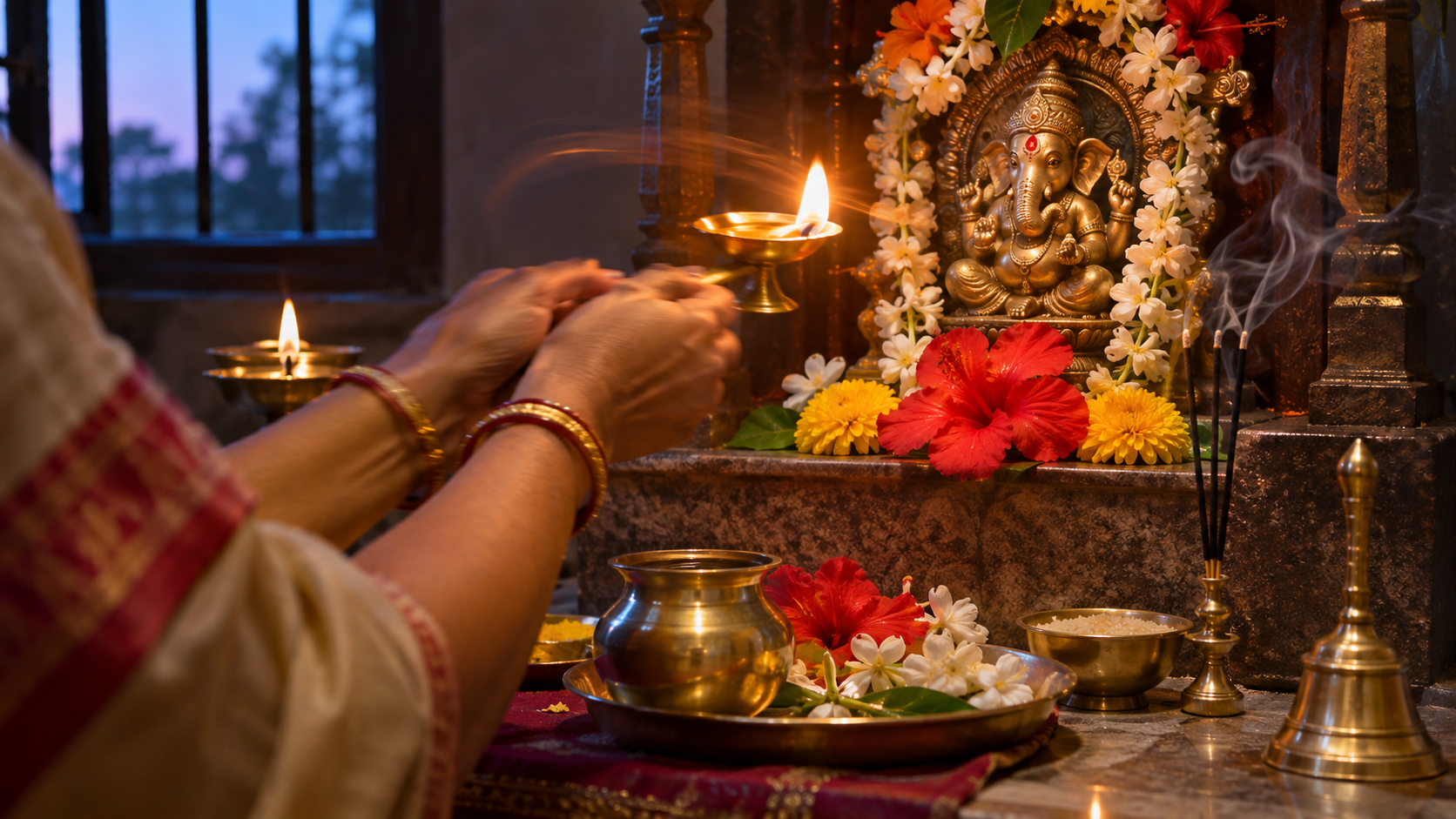
Ritual works through the body as well as the intellect. You clean a place, arrange what will be offered, recite, gesture, attend and close. The order creates a threshold between ordinary activity and worship. Repetition then makes that threshold easier to cross.
This is why sequence matters. A detailed Subramanyeshwara Swamy puja procedure, for example, opens with achamanam, including sips accompanied by divine names and the washing of the hands, before proceeding into the wider worship. Those acts are not loose decorations. They prepare the worshipper to enter the rite in an ordered way.
That example should not be mistaken for a universal script. A Subramanya puja is not automatically the right procedure for another deity, and a detailed temple or lineage practice should not be reproduced selectively merely because its instructions are available online. Follow your household custom where it is established. Ask a competent priest or teacher when a rite includes unfamiliar mantras, initiation requirements or specialised offerings.
For a modest home practice you already have authority to perform, use this framework:
- Prepare before beginning. Put away the phone, clean the worship space and assemble only the items you will actually use.
- Mark the transition. Wash as your custom requires, settle your posture and perform the opening act taught in your tradition.
- Invoke with something you know. Use a familiar name, prayer or stotra rather than multiplying words whose meaning and pronunciation you have not learned.
- Make the offering attentively. Water, flowers, light, food or another offering should be used as your practice permits. If an open flame is unsafe, do not leave one burning unattended; use a safe alternative.
- Allow an unhurried moment for darshan or remembrance. Don’t fill every pause with another recitation.
- Close the worship deliberately. Follow the customary conclusion, handle offerings respectfully and restore the space.
- Carry one quality into the next action. Decide before leaving the shrine how the worship will affect the conversation, duty or decision immediately ahead.
You can tell that ritual is becoming mechanical when speed becomes the measure of success, interruptions provoke more anger than recollection, or acquiring new items replaces attention to the acts you already perform. The corrective is usually subtraction. Keep the established essentials, slow down at the central offering and learn the meaning of one element before adding another.
Regularity matters more than occasional excess. A brief practice that you can perform with care is generally a sounder foundation than an elaborate procedure repeatedly rushed, abandoned or changed. Simplicity, however, does not mean inventing a casual rite. It means working faithfully within the form you can sustain.
Make pilgrimage a discipline, not sacred sightseeing
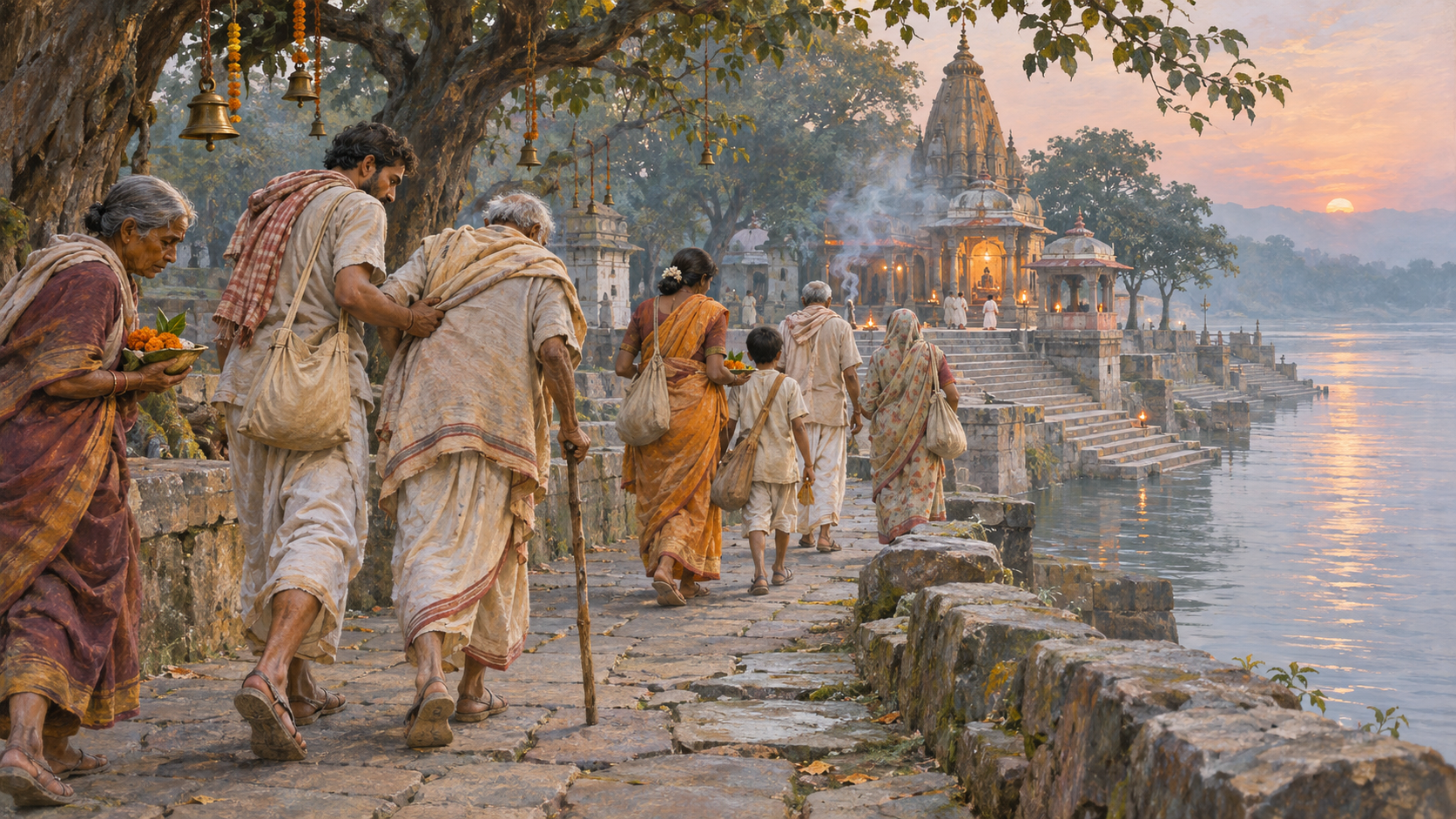
Pilgrimage adds conditions that home worship cannot reproduce. You travel toward a place rather than summoning every convenience to yourself. You accept the temple’s rhythm, encounter devotees outside your household and discover how attention behaves when comfort and routine no longer organise the day.
Time can itself become an offering. A ratri jagran at the ancient Kalika Mata Temple in Chittorgarh Fort places wakefulness, worship and a widely visited sacred site together. The vigil is not simply a late event added to a tour. Its timing asks the devotee to reorganise ordinary bodily expectations around remembrance.
Duration can serve a similar purpose. A recorded Ayodhya Dham Yatra in 2026 unfolds across successive days under spiritual guidance. A multi-day yatra makes devotion an itinerary rather than a single moment of darshan: attention must be renewed after tiredness, movement and the excitement of arrival.
Prepare for your own pilgrimage in three stages:
- Before leaving, write a clear sankalpa. State why you are going without demanding a dramatic experience. Learn the presiding deity, the significance of the place, the expected etiquette and any temple restrictions. Arrange travel so that your companions’ health, safety and accessibility needs are respected; hardship is not proof of superior devotion.
- At the sacred place, receive before recording. Follow local instructions, avoid obstructing worship and give the first attentive moment to darshan rather than photography. Notice the sounds, movements and forms of service that cannot be reproduced at home.
- After returning, convert memory into practice. Write down one teaching, one correction and one act you will continue. Place that act into your existing routine while the experience is still clear. Otherwise the yatra survives mainly as images and travel stories.
Distance alone does not make a pilgrim. If major travel is unavailable, approach a nearby temple with the same discipline: learn before going, reduce distraction while there and bring one obligation home. The smaller journey should not be falsely presented as identical to a major tirtha, but it can still train reverence, preparation and receptivity.
Build a rhythm in which all three modes correct one another
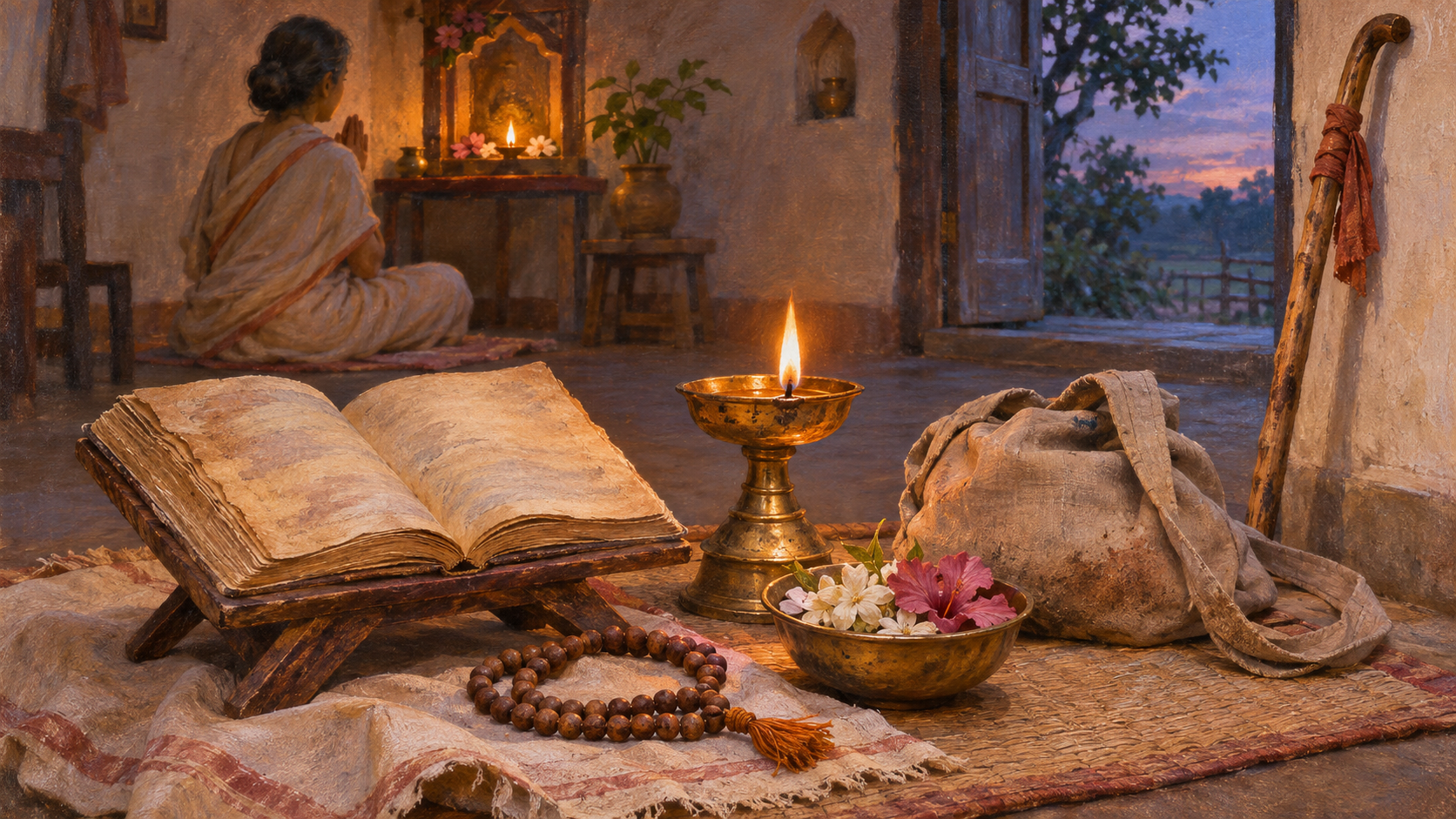
You do not need three competing religious schedules. Attach each mode to a cadence it can realistically sustain:
- In regular worship: keep a stable, recognisable ritual core instead of redesigning the puja whenever enthusiasm rises or falls.
- In recurring study: learn something directly connected to the prayer, deity, festival or ethical demand already present in your life.
- In temple visits and pilgrimage: seek what the home shrine cannot provide: darshan in a consecrated setting, participation in a living community and submission to a sacred place’s discipline.
- After each mode: record one question for study and one action for conduct. This keeps learning from becoming detached and experience from becoming vague.
Key takeaways
- Choose knowledge when confusion is weakening your practice, ritual when inconsistency is weakening it, and pilgrimage when isolation or habit is weakening it.
- Learn enough to worship responsibly, but don’t make perfect comprehension a condition for beginning.
- Keep ritual faithful, ordered and attentive; complexity is not a reliable measure of devotion.
- Prepare for pilgrimage before departure and assign it a concrete consequence after returning.
- Judge all three modes partly by what they do to your conduct beyond the shrine, book or sacred destination.
At your next worship, make one connection instead of adding a new burden. Learn the meaning of one act you already perform, slow down while performing it, and decide where that act should lead you beyond the shrine. When the opportunity for a temple journey comes, carry that question with you. That is how knowledge, ritual and pilgrimage stop competing for your attention and begin forming one devotional life.
References
- Hindu Pad — Relation between Knowledge & Devotion: Can Devotion be fruitful without Knowledge?
- Hindu Pad — Ratri Jagran at Kalika Mata Temple, Chittorgarh fort
- Hindu Pad — Subramanyeshwara Swamy Puja Vidhi, Procedure of Subramanya Pooja
- Dandavats — Ayodhya Dham Yatra 2026, Day 2, HH Radhanath Swami Maharaj

Leave a Reply
You must be logged in to post a comment.