
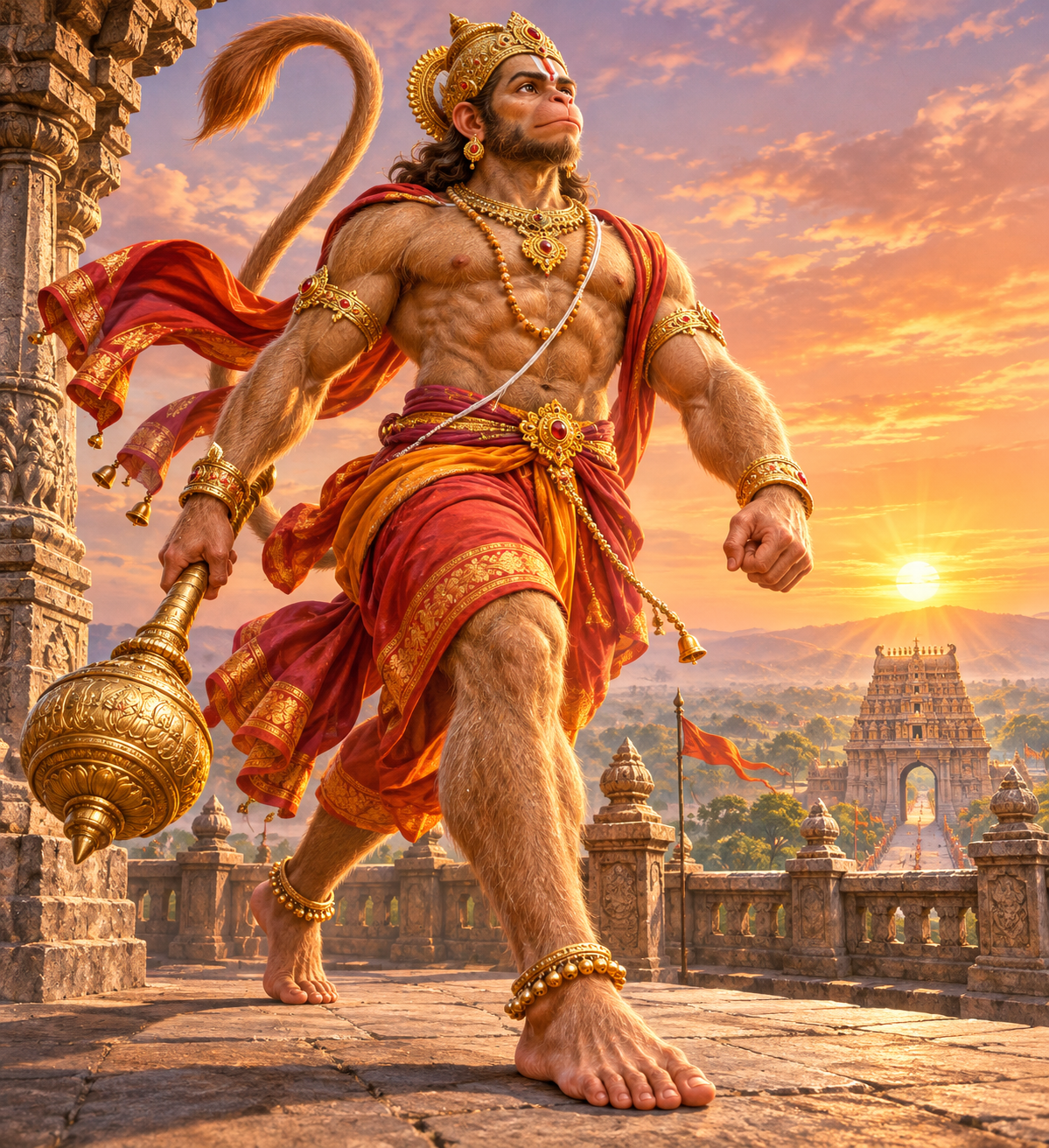
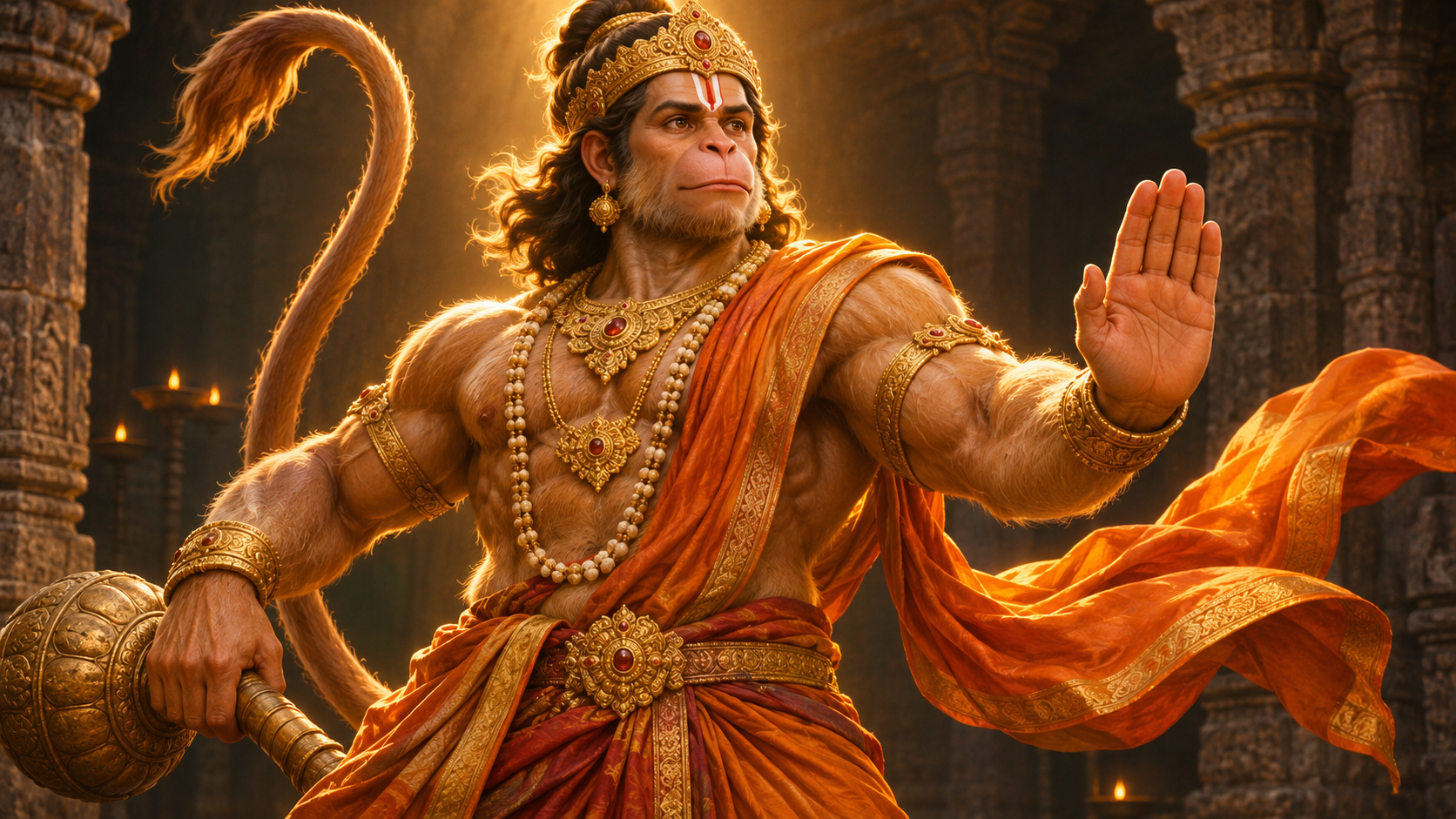
You are standing before a Veera Hanuman murti, calendar image, or temple sculpture. The form is unmistakably powerful, but what should you actually notice? Is the image about physical strength, martial anger, protection, devotion, or something deeper?
Begin with the relationship among movement, power, and purpose. Veera Hanuman does not glorify force for its own sake. The form presents strength made obedient to Bhagavan Rama, courage placed at the service of Dharma, and devotion prepared to act.
Read the posture before interpreting the details
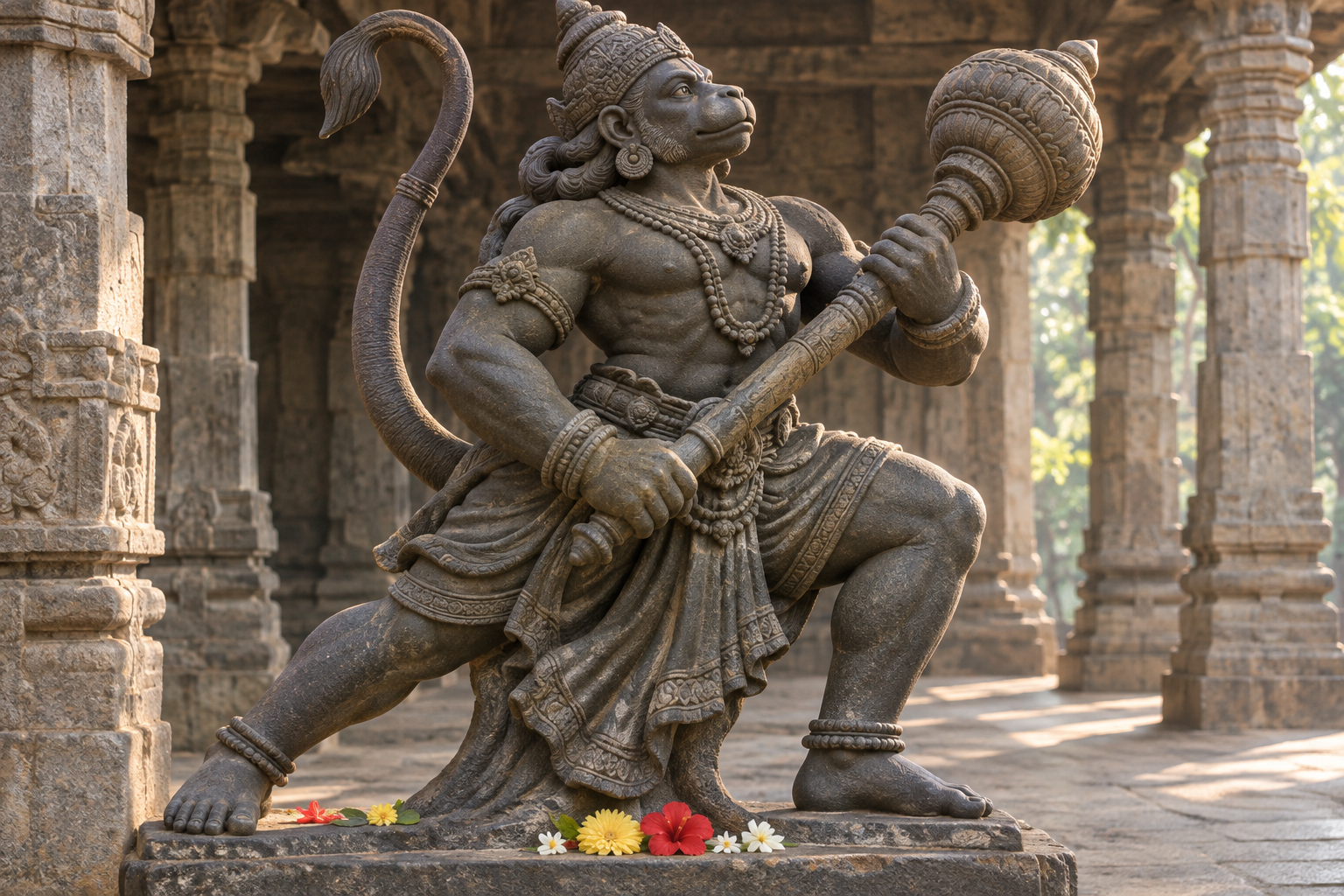
Veera means heroic or valiant in this context. That quality is communicated first through the figure as a whole. Veera Hanuman is commonly represented in a powerful standing or striding posture. The body does not appear withdrawn from the world. It is present, alert, and capable of immediate action.
When you encounter a particular image, resist the urge to begin with a single ornament, hand position, or object. Step back and read its silhouette. Is the figure firmly planted, already moving, or poised between stillness and movement? Does the composition feel merely heavy, or does its weight seem directed toward a task?
A standing form can communicate steadiness: Hanuman is not displaced by the threat before him. A striding form brings readiness to the foreground: devotion has become movement. Neither pose should be reduced to physical dominance. The important question is not simply, “How strong is he?” It is, “What governs this strength?”
Use four observations when reading the posture:
- Balance: A grounded figure conveys stability rather than panic.
- Direction: A forward-moving figure suggests that duty has already called for action.
- Alertness: An attentive bearing communicates preparedness, not uncontrolled fury.
- Integration: The face, torso, limbs, and overall movement should be read together. One dramatic detail cannot explain the entire form.
This whole-form reading is especially useful when two depictions differ. Veera Hanuman need not be frozen into one silhouette. The standing and striding possibilities already show that iconography can preserve one spiritual meaning through more than one visual arrangement.
Courage, protection, devotion, and readiness belong together
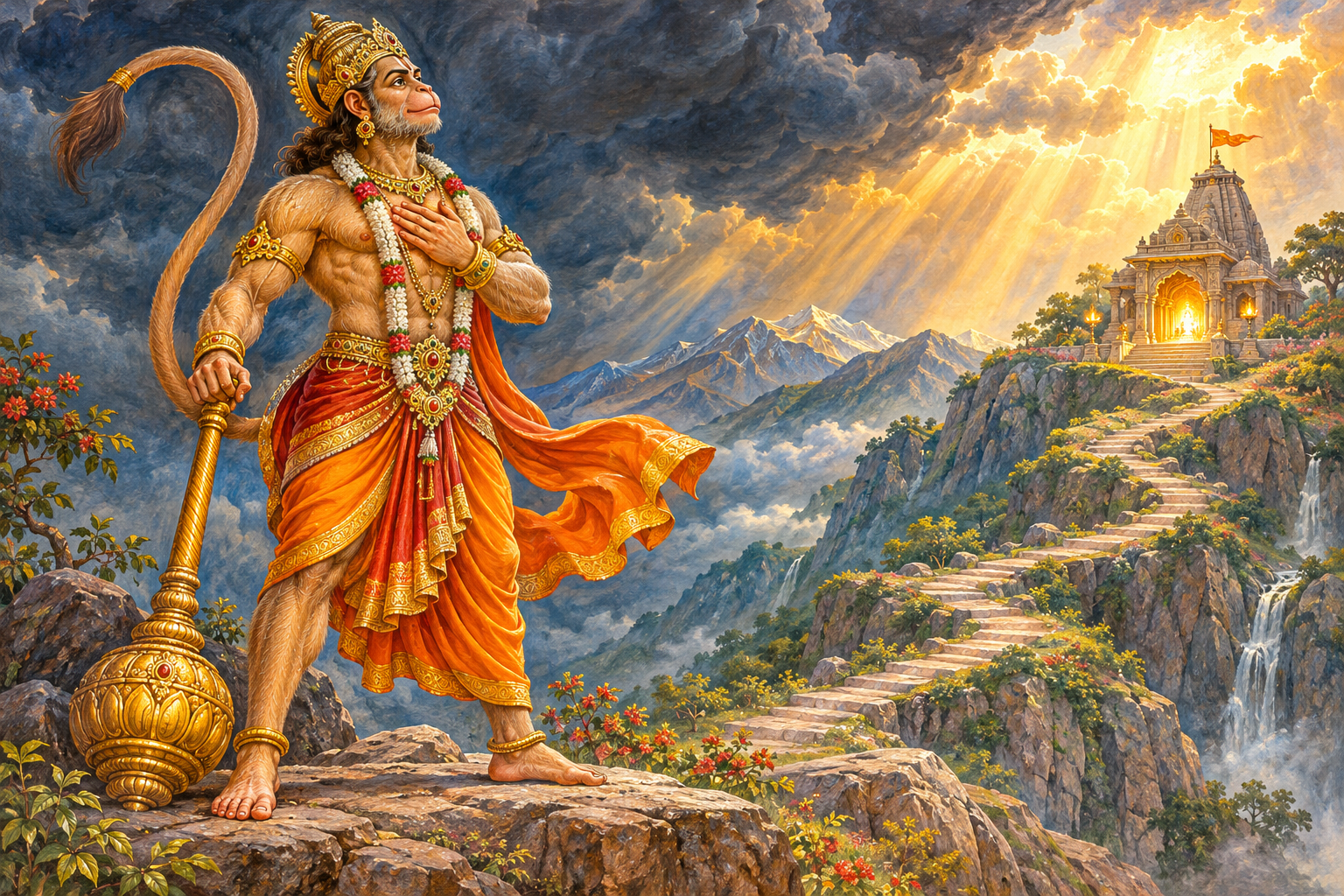
The Veera form holds four meanings in one visual statement. Separating them produces the most common misunderstandings.
Courage is the capacity to meet duty. Courage here is not theatrical fearlessness and not a taste for conflict. Hanuman’s powerful bearing tells you that difficulty does not cancel obligation. For a devotee, the practical lesson is precise: first identify what Dharma requires, then bring your strength to that task. Boldness without a rightful purpose is not the virtue the form celebrates.
Protection gives strength an outward responsibility. The heroic figure is ready to protect Dharma. Protection differs from domination. Domination treats power as proof of personal importance; protection measures power by what it preserves. When you contemplate the murti, ask whom or what your own abilities are protecting: a person entrusted to your care, a truthful commitment, a sacred practice, or a necessary boundary.
Devotion supplies direction. Veera Hanuman’s courage cannot be detached from complete devotion to Bhagavan Rama. This is the key that prevents the image from becoming a generic celebration of muscle or militancy. Hanuman is mighty, but his might is not self-referential. It belongs to seva, loyalty, and a purpose beyond personal display.
Readiness turns conviction into conduct. It is possible to admire Dharma while postponing every difficult duty. The active posture closes that gap. Veera Hanuman represents devotion that can respond when protection is required. The form therefore asks more of you than admiration: What are you prepared to do because of what you revere?
These meanings correct one another. Courage without devotion can become ego. Devotion without readiness can remain passive sentiment. Protection without Dharma can be used to excuse partisanship or possession. Readiness without discernment becomes mere reaction. Veera Hanuman holds all four in disciplined relation.
How to examine or choose a Veera Hanuman image
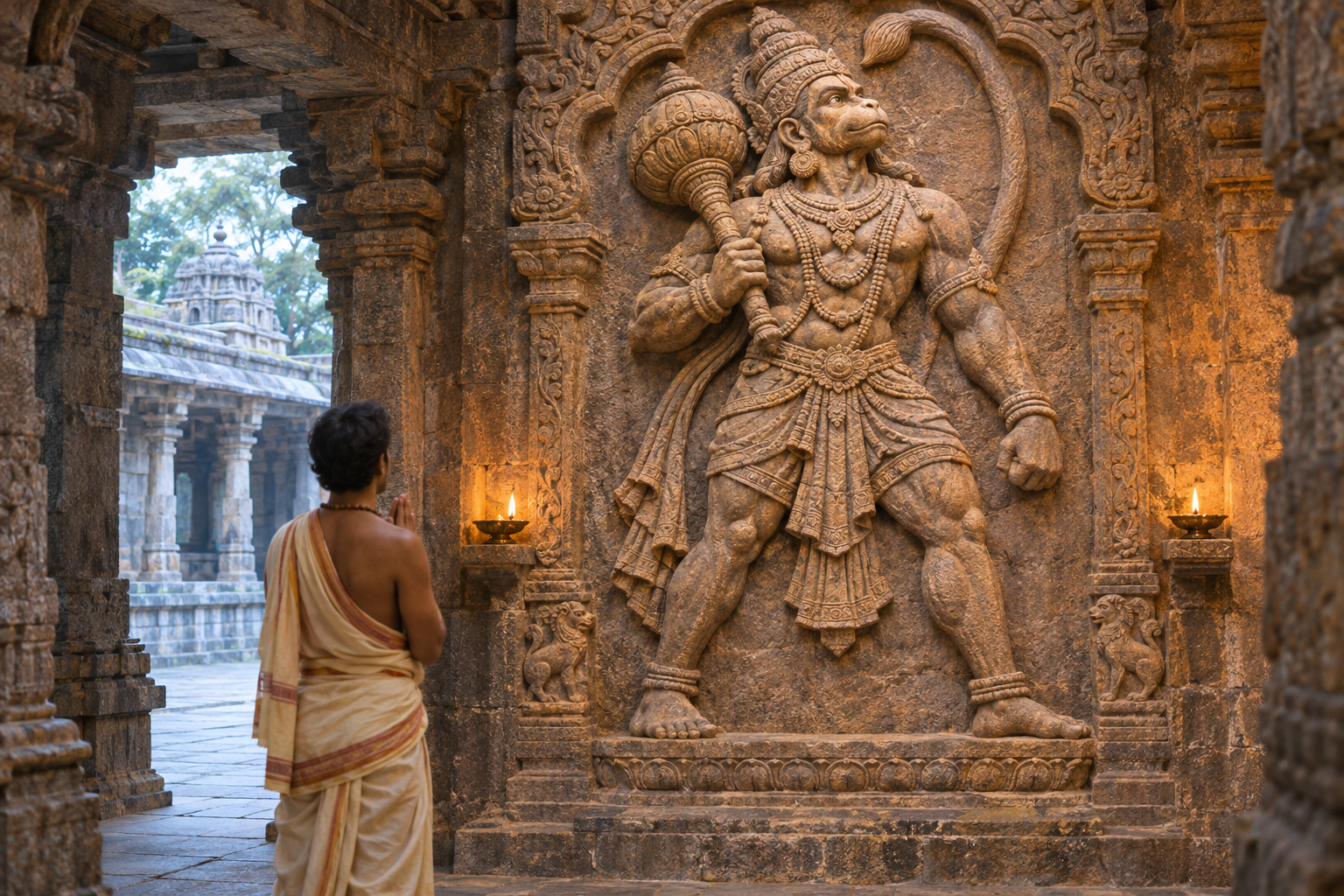
If you are studying a sculpture, selecting an image for a home shrine, or trying to understand a temple murti, use a sequence rather than an improvised list of symbolic claims.
- Name the form’s dominant action. Decide whether the figure reads as firmly standing, actively striding, or poised to move. Describe what you can see before assigning meaning to it.
- Identify the governing mood. Ask whether the power appears steady and purposeful or merely dramatic. Veera should lead you toward courage and protection, not fascination with aggression.
- Look for the devotional center. Consider whether the representation lets you understand strength as service to Bhagavan Rama and Dharma. If all you notice is physical force, your reading is incomplete.
- Interpret details within the whole image. A gesture or attribute gains meaning from its relationship to the posture, expression, and sacred setting. Do not extract one feature and build an absolute rule around it.
- Confirm unfamiliar features locally. When a temple, lineage, sculptor, or established worship tradition provides an explanation, let that context guide you. Avoid treating an unattributed caption or circulating social-media graphic as a universal iconographic rule.
If you are choosing between images, do not select solely by size, muscularity, ornament, or visual intensity. Choose the representation in which the spiritual relationship is clearest to you: strength governed by bhakti and directed toward protection. A visually restrained sculpture may communicate Veera more effectively than a busier one if its posture carries alertness, stability, and purpose.
For formal worship, especially where a family or sampradaya follows an established convention, consult the tradition you actually practice before treating a general description as a ritual prescription. Iconographic understanding can help you see the form; it does not erase the role of living practice.
You can also use the image as a focused contemplation rather than as decoration. Spend a few quiet moments with the complete posture, then ask three questions: What duty am I avoiding because it requires courage? What should my strength protect? How can I act without making myself the center of the action? These questions translate iconography into conduct without pretending that the murti is merely an allegory for self-improvement.
Common misreadings that flatten the form
“The more aggressive the image, the more authentically Veera it is.” Aggression is not the defining principle. The form’s power is protective, Dharmic, and devotional. Visual ferocity detached from those relationships tells only part of the story.
“Veera Hanuman represents physical power above everything else.” Physical force is visible because sacred art must make heroic capacity perceptible. Yet the deeper distinction is not between weakness and strength. It is between strength governed by devotion and strength governed by ego.
“A heroic form leaves no room for humility.” Hanuman’s devotion to Bhagavan Rama shows why this opposition fails. Humility does not mean incapacity, hesitation, or refusal to defend what is right. In the Veera form, humility governs power by placing it in service.
“Every Veera Hanuman image must have exactly the same pose.” The form may be standing or striding. What remains consistent is the convergence of courage, devotion, protection, and readiness. Treat those as your interpretive anchors, then examine how the particular sculpture expresses them.
“Symbolism lets us assign a secret meaning to every visible feature.” Responsible iconographic reading begins with the form that is actually present and the tradition in which it appears. When context is missing, it is better to leave a detail open than to invent certainty. The central symbolism of Veera Hanuman is already substantial; it does not need speculative embellishment.
Key takeaways
- Read Veera Hanuman’s complete posture before isolating a gesture, ornament, or attribute.
- Standing emphasizes stability; striding emphasizes active readiness. Both can express the heroic form.
- Courage, protection, devotion to Bhagavan Rama, and readiness to uphold Dharma must be interpreted together.
- The form does not glorify force for its own sake. It shows power disciplined by bhakti and placed in service.
- When choosing an image, prefer spiritual clarity over mere visual intensity.
- Confirm unfamiliar details through the temple or living tradition connected with the particular representation.
The next time you encounter Veera Hanuman, pause before cataloguing the objects in the image. Read the direction of the body, the quality of its strength, and the purpose that strength serves. Then carry one question away from the darshan: what would devotion prepared for action require from you now?
References

Leave a Reply
You must be logged in to post a comment.