
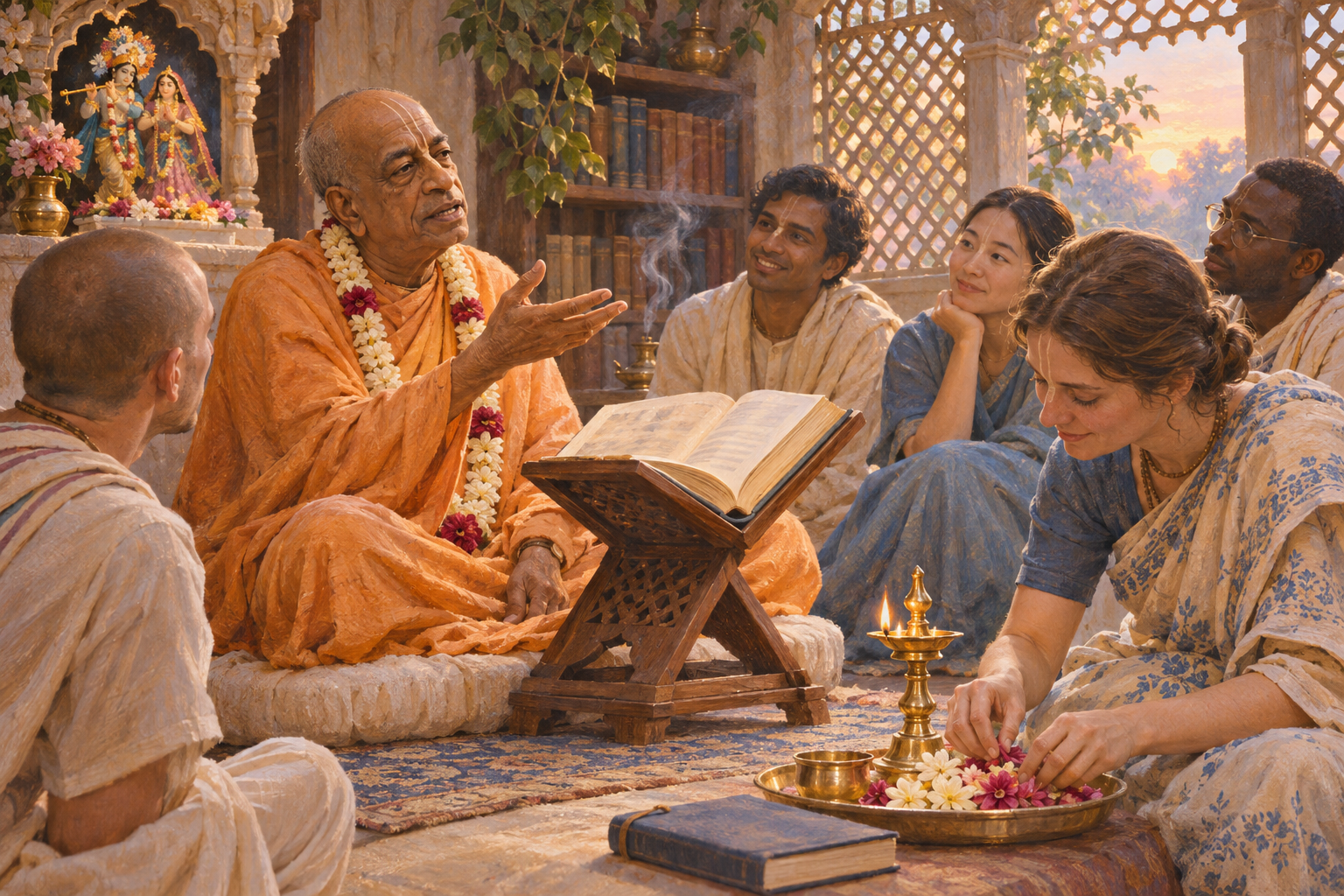
You may know Srila Prabhupada’s name through reverent tributes yet still be unsure how to approach his teachings. The useful starting question is not, “How can I absorb an entire legacy?” It is, “How can I meet one teaching faithfully enough that it changes how I live?”
Begin with three movements: hear him in context, distinguish his instruction from your own interpretation, and turn what you understand into a definite act of devotion or service. That keeps reverence from becoming vague admiration and study from becoming a purely intellectual exercise.
Start with one complete teaching, not a collection of quotations

A recorded 1976 exposition of Srimad Bhagavatam 1.7.44 gives you a concrete, bounded place to begin. One discourse cannot represent the whole of Srila Prabhupada’s teaching, but that is precisely why it is useful: you can hear it carefully, return to it, and resist the temptation to build conclusions from a detached sentence.
Use this five-step method for your first encounter:
- Write down the reference before listening. Record the speaker, scripture, text number, and year. Here, that means Srila Prabhupada, Srimad Bhagavatam 1.7.44, and 1976. These details allow you and others to find the teaching again.
- Read the verse in the edition available to you. Also read enough of the surrounding passage to identify the people, situation, and question involved. Do not assume that a statement arising in one setting automatically answers every other question.
- Hear the recording once without hunting for a quotation. Listen for the movement of the explanation: the issue being addressed, the principle used to address it, and the response expected from the listener.
- Hear it again with a notebook. Note repeated terms, scriptural connections, explicit instructions, and anything you do not understand. A question honestly recorded is better than a confident but inaccurate paraphrase.
- Close the recording and summarize the teaching in three sentences. State the central point, the reasoning that supports it, and one implication for your conduct. Then check your summary against what you actually heard.
This slower method protects you from a common error in devotional learning: remembering the emotional force of a discourse while forgetting its argument. If you cannot explain how the conclusion was reached, listen again before presenting that conclusion as Srila Prabhupada’s instruction.
Separate scripture, explanation, and personal inference

Sincerity does not automatically prevent misrepresentation. A sincere listener can merge the words of scripture, the teacher’s explanation, and a personal application until all three sound equally authoritative. Keep them distinct on the page.
- Scripture: What does the cited verse or passage actually say? Preserve its setting and do not replace it with what you expected it to say.
- Explanation: What point does Srila Prabhupada explicitly develop from that passage? Note the reasoning, not merely a memorable phrase.
- Inference: What do you think follows from the explanation? This may be insightful, but it remains your inference unless the teaching states it directly.
- Application: What will you do because of what you have understood? An application can be personal without being presented as a universal command.
A simple notebook page with these four headings will greatly improve both private study and group discussion. It also gives you an honest vocabulary when sharing what you learned: Srila Prabhupada taught a point; you understand it in a particular way; you are trying to apply it through a particular practice.
Be equally disciplined with quotations. Do not put quotation marks around a sentence reconstructed from memory. Return to the recording, check the wording, and retain the scripture reference and year. If you are paraphrasing, say so. Precision is not a scholarly ornament here; it is part of service to the teacher and to the next listener.
When a passage remains difficult, resist two shortcuts. Do not dismiss it merely because it challenges you, and do not pretend to understand it because others appear certain. Write the unresolved question in plain language and take it to a practitioner who can work through the relevant context with you. The goal is faithful understanding, not the performance of certainty.
Turn attentive hearing into a rule of daily practice
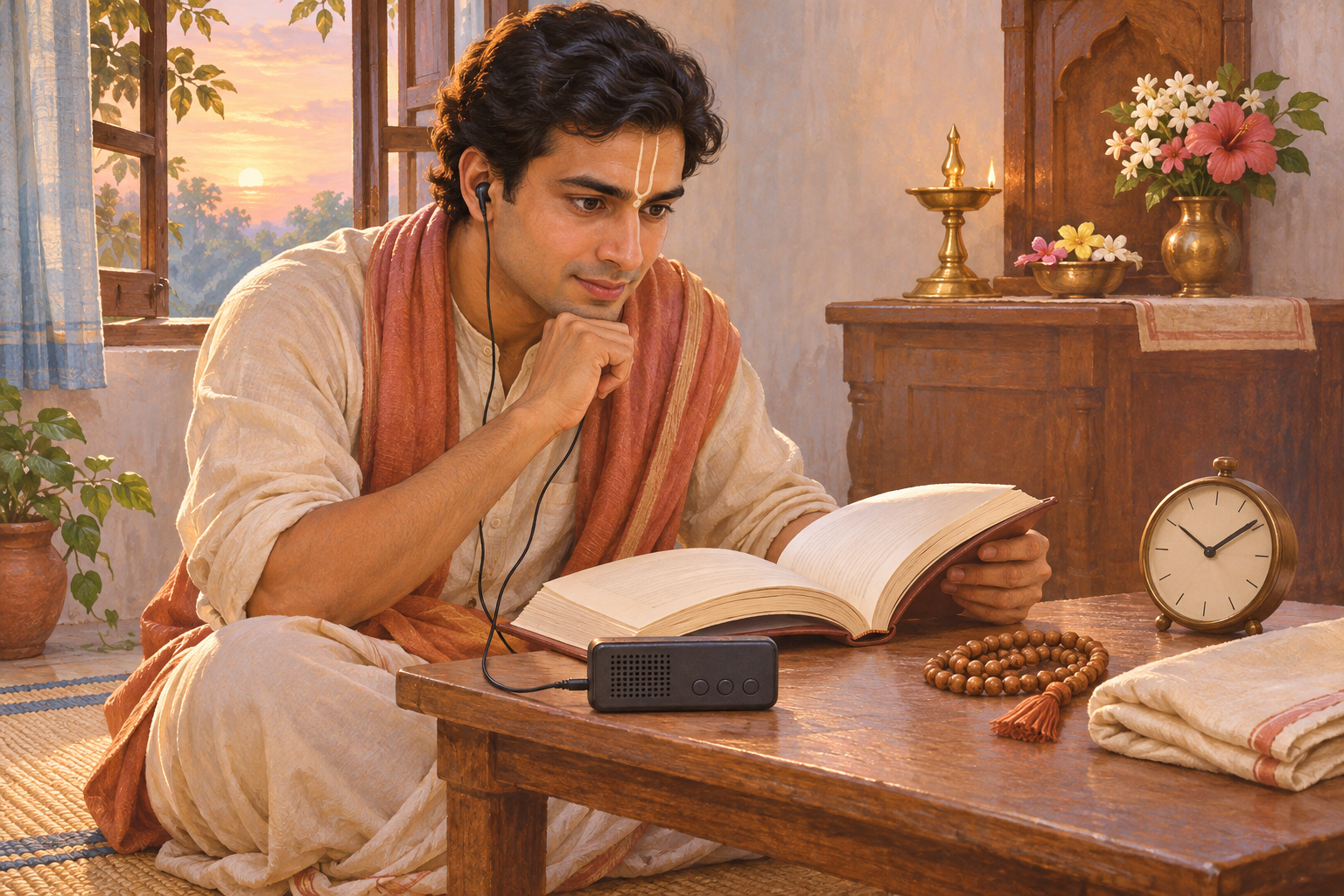
Bhakti is not admiration from a distance. Hearing, remembrance, and service become meaningful when they order your attention and conduct. Your study of Srila Prabhupada should therefore end with something more definite than “This was inspiring.”
Try this twenty-minute routine as a starting structure. The timing has no sacred status; it simply prevents the session from dissolving into unfocused consumption.
- Three minutes: Read the verse and write the question you are bringing to the session.
- Ten minutes: Hear a continuous portion without checking messages or opening unrelated material.
- Five minutes: Sort your notes under scripture, explanation, inference, and application.
- Two minutes: Choose one observable action and decide when you will do it.
Make the final action small enough to verify. If the principle concerns attention, the action might be one phone-free period of hearing. If it concerns speech, it might be a deliberate pause before replying in a difficult conversation. If it concerns service, it might be completing an unglamorous task without seeking recognition. These are only forms of application; the principle must come from the teaching you actually studied.
Carry the same resolution for seven days rather than choosing a fresh one after every recording. At the end of the week, ask three questions: Did you remember the principle at the relevant moment? Did it alter a choice? What resistance appeared? This is not an attempt to reduce devotion to habit tracking. It is a way to notice whether hearing has reached conduct.
If the practice does not hold, reduce its size before abandoning it. Five attentive minutes each day can form a more honest foundation than an ambitious schedule repeatedly postponed. Once the sequence of hearing, reflection, and application is stable, extend the time or add another passage.
Make remembrance answerable to study and service

A Vrindavan glorification dated 13 November 2026 marked Srila Prabhupada’s 49th disappearance day. Such remembrance can awaken gratitude and bring devotees together. Its lasting value, however, depends on what happens after the observance ends.
Use a disappearance-day observance as an annual examination of your relationship with the teaching. Before attending or watching a program, prepare answers to these questions:
- Which complete discourse or scriptural passage connected with Srila Prabhupada did you study carefully this year?
- Which instruction moved from your notebook into repeated conduct?
- Where have you been quoting from memory when you should verify the original wording and context?
- What act of service will carry your gratitude beyond the day of commemoration?
- Which teaching will you study over the next thirty days, and when will the first session occur?
This approach changes glorification from passive praise into renewed responsibility. A tribute can remind you why the teacher matters; disciplined study helps you understand what he taught; service gives that understanding a visible form.
It also strengthens community memory. When you lead a discussion, preserve the exact reference. When you share a quotation, provide enough information for another person to check it. When introducing a younger or newer devotee to Srila Prabhupada, begin with a complete, manageable teaching rather than a mass of disconnected claims. A devotional legacy remains living when it can be received, examined, practised, and passed on without careless distortion.
Key takeaways
- Begin with one complete recording tied to a specific scripture passage, not with isolated quotations.
- Keep scripture, Srila Prabhupada’s explanation, your inference, and your application in separate categories.
- Record the text number and year so that your understanding can be checked and shared responsibly.
- End every study session with one small action that can be carried into daily conduct.
- Let disappearance-day remembrance produce a new period of study and service, not only a day of praise.
Your next step can be modest and immediate. Set aside twenty minutes, open the 1976 recording on Srimad Bhagavatam 1.7.44, and make one page of notes using the four headings above. Before you finish, place one practical resolution on your calendar. That is enough to begin meeting Srila Prabhupada’s devotional legacy as a responsibility you can actually carry.
References
- Dandavats – Srimad Bhagavatam Text 1.7.44 VRN 1976 Speaker – Srila Prabhupada
- Dandavats – Glorification on Srila Prabhupada’s 49th Disappearance Day, 13.11.2026

Leave a Reply
You must be logged in to post a comment.