
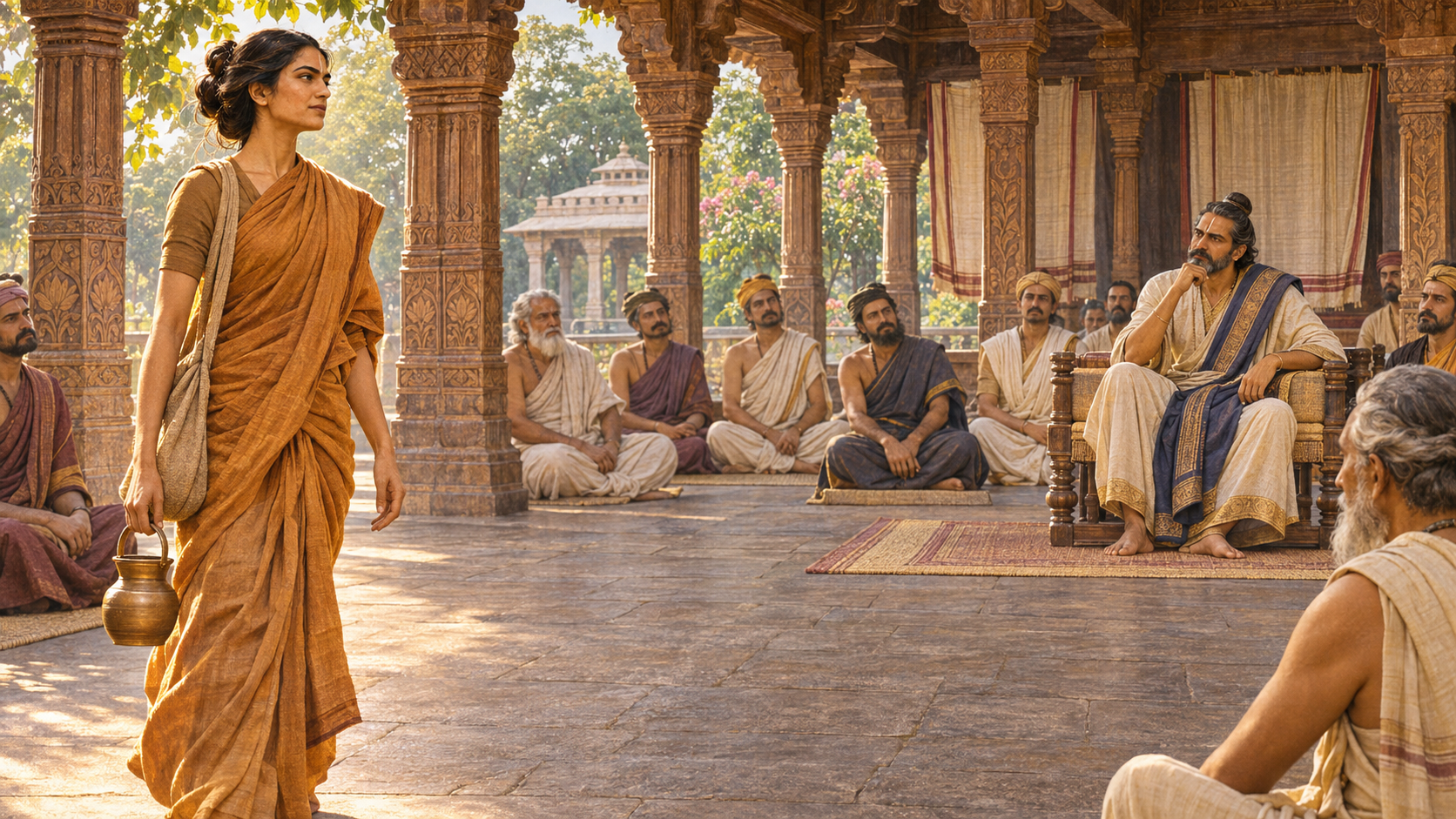
If you have been told that Hindu renunciation was, by definition, a male path, Sulabha gives you a precise scriptural reason to question that claim. She appears in the Mahabharata not merely as an admirable woman, but as a sannyasini whose spiritual competence is serious enough to test King Janaka, a ruler known as a knower of Brahman.
That does not settle every historical question about women’s access to ascetic institutions. It establishes something more focused: the epic can recognize a woman as an independent renouncer and an examiner of spiritual realization. Knowing that distinction will help you defend the significance of Sulabha without making claims the episode cannot carry.
What the Mahabharata places before the reader
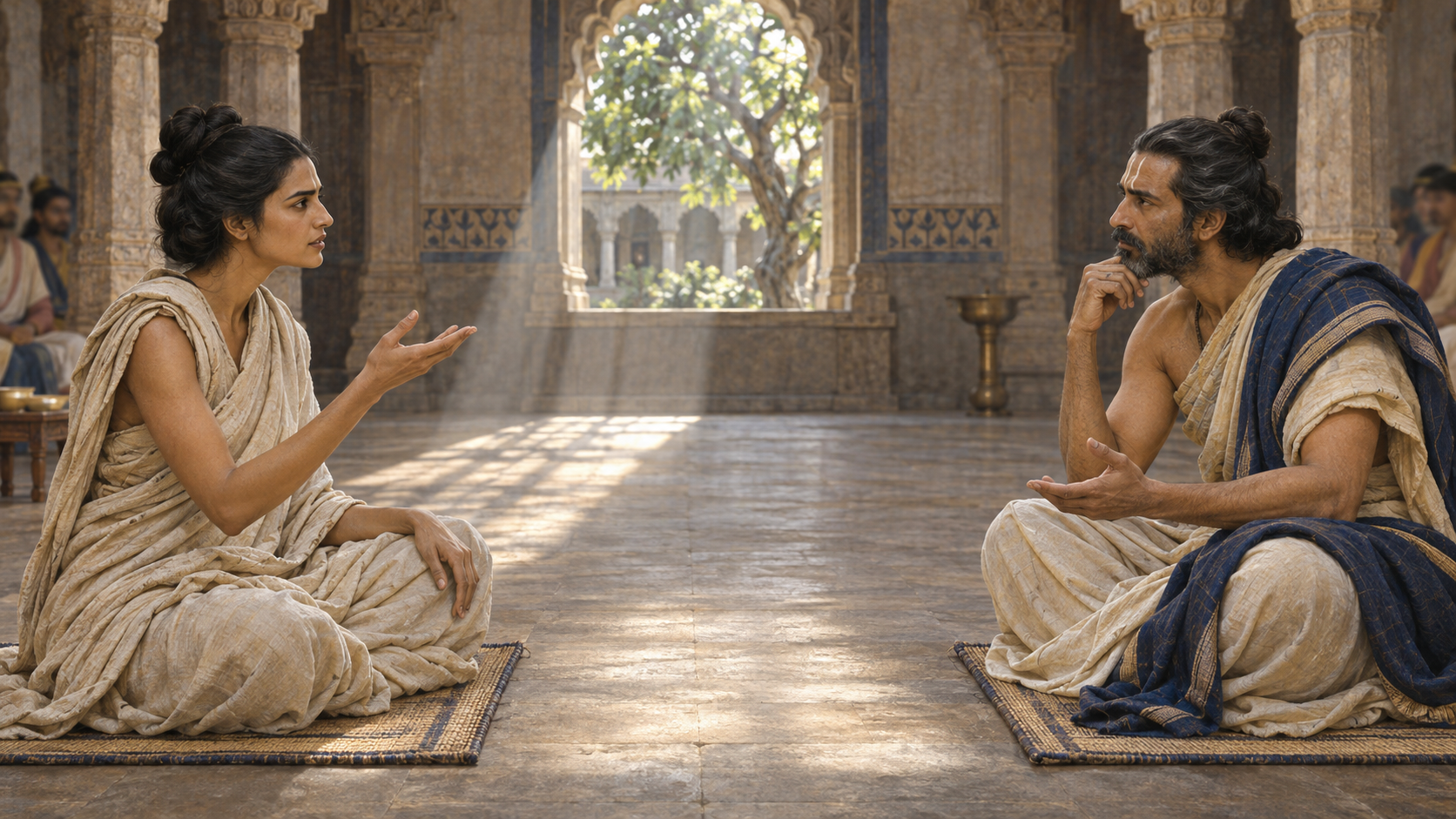
Bhishma narrates the encounter between Sulabha and Janaka to Yudhishthira in the Shanti Parva, Chapter 320. It belongs to Bhishma’s teaching on moksha dharma: the discipline and understanding connected with liberation. That setting matters. Sulabha is not inserted into a discussion of marriage, genealogy or domestic virtue. She enters a teaching concerned with spiritual freedom.
The encounter brings two kinds of authority face to face. Janaka has royal status and a reputation for knowing Brahman. Sulabha has the standing of a renouncer and comes to test whether that reputation corresponds to genuine realization. The king’s sex, office and public stature do not make examination unnecessary. Sulabha’s sex and lack of royal power do not make her unqualified to conduct it.
Notice the reversal. A conventional social arrangement might place the king in the role of questioner and a wandering woman in the role of petitioner. The spiritual arrangement is different. Janaka is the one whose knowledge must withstand scrutiny. Sulabha is the one capable of applying that scrutiny. The episode therefore gives her more than permission to seek: it gives her intellectual and spiritual agency.
This is why reducing Sulabha to an isolated example of a courageous woman misses the sharper point. Her presence affects the meaning of renunciation itself. If freedom depends on knowledge of reality rather than possession of a throne, a household role or a male body, then inherited status cannot be the final measure of spiritual authority.
What Sulabha proves, and what she does not

Sulabha is sometimes made to carry one of two exaggerated conclusions. One side treats her as proof that women enjoyed equal religious access everywhere in ancient Bharat. The other dismisses her as an exception and concludes that she tells us nothing. Neither approach reads carefully.
The episode supports several clear conclusions:
- The Mahabharata can present a woman as a sannyasini rather than defining her only through household relationships.
- A woman’s pursuit of spiritual knowledge is not treated as unintelligible or inherently disqualifying.
- A woman renouncer can engage a celebrated male ruler at the level of Brahman and liberation.
- Her discernment can test another person’s claim to spiritual knowledge.
- Her story is useful to Bhishma while instructing Yudhishthira about moksha dharma.
The same episode does not tell us how many women renounced, how every community received them, whether every institution admitted them, or what conditions women encountered across different regions and periods. Those are historical questions requiring wider evidence.
This distinction gives you a reliable rule: one named renouncer cannot establish universal social equality, but she can disprove a categorical assertion that female renunciation is absent, forbidden in principle or inconceivable within the epic. An exception may not reveal the statistical norm, yet it still defeats the word “never.”
There is also no need to force Sulabha into a modern political category before taking her seriously. Her significance does not depend on calling her a contemporary activist in ancient dress. The text gives her a distinctly Dharmic form of authority: disciplined renunciation, concern with liberation and the capacity to examine knowledge of Brahman. Let that form remain visible.
Why Sulabha’s test reaches beyond Janaka
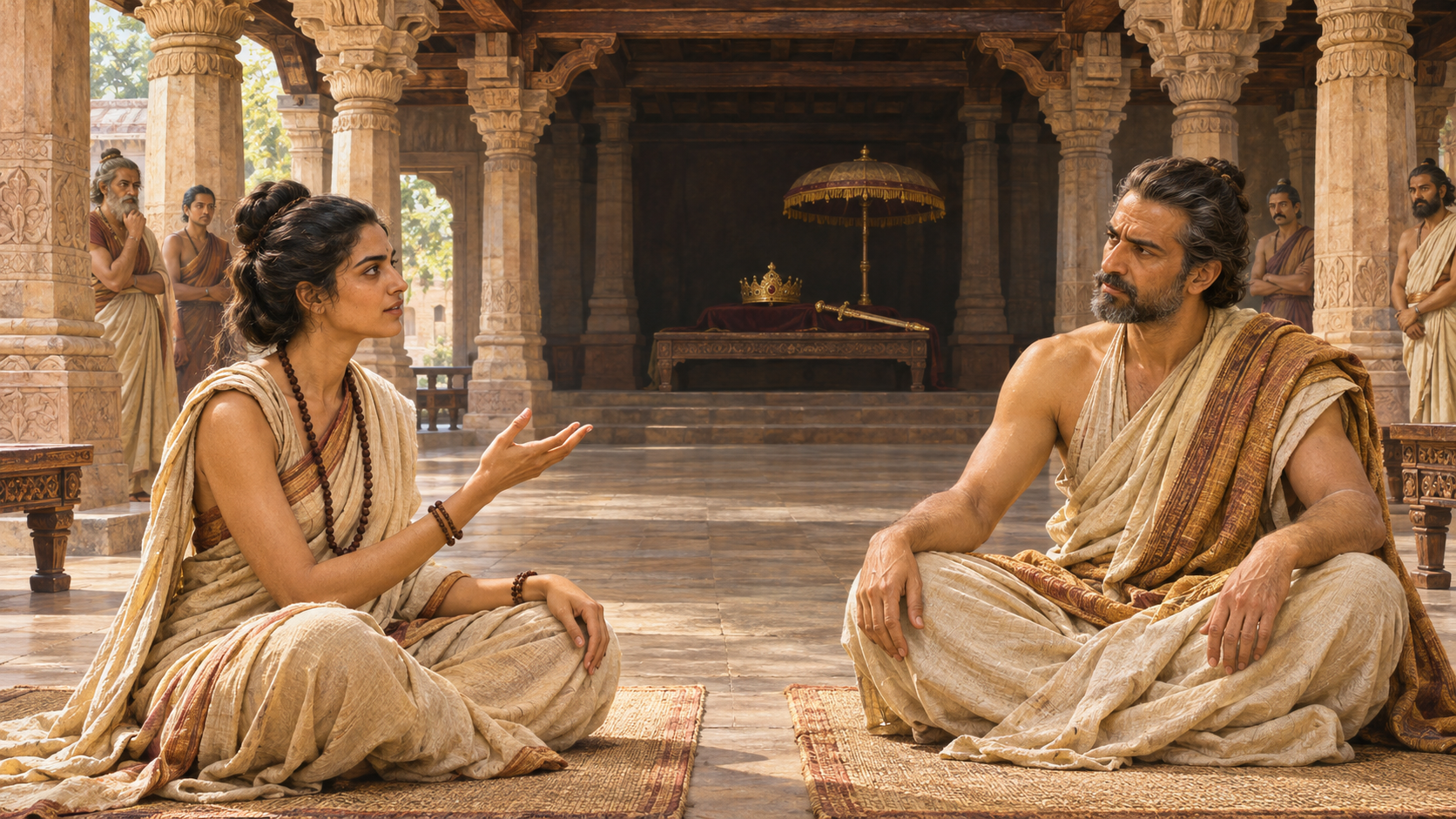
It is possible to speak impressively about Brahman while remaining attached to rank, reputation and bodily identity. That is why a test matters. The decisive question is not whether Janaka can repeat correct ideas, but whether his understanding survives an encounter that unsettles ordinary assumptions about who may teach and who must listen.
For the reader, the encounter opens three lines of examination:
- Epistemic: Will truth be assessed by the quality of understanding, or by the identity of the speaker?
- Ascetic: Is freedom merely claimed, or has attachment to status actually weakened?
- Social: Can a person who speaks of reality beyond bodily distinctions receive correction from a woman renouncer?
The third question is particularly uncomfortable, and therefore useful. A person may affirm that the deepest self is not reducible to the body, yet still decide in advance that a woman’s insight carries less weight. The contradiction is not repaired by repeating more metaphysics. It is repaired by applying the metaphysics to the encounter in front of you.
This does not mean that ultimate reality erases the ethical facts of embodied life. Invoking oneness to ignore exclusion would be another evasion. The better reading holds two levels together: social identities have real consequences in human life, while they do not determine a seeker’s ultimate capacity for liberation. Sulabha matters precisely because she stands at that meeting point.
Her gender is therefore relevant, but it is not the whole of her identity. If you discuss only the novelty of a woman speaking to a king, you risk overlooking what makes her formidable: she is a renouncer engaged with the question of freedom. The right response is not merely to admire her boldness. It is to attend to the spiritual standard her role imposes on everyone in the encounter.
How to use the passage without overstating it
When Sulabha comes up in a study group, classroom or discussion about women in Hindu traditions, use a four-step method. It keeps the conversation anchored in the text and prevents both romantic exaggeration and casual dismissal.
- Give the location. Identify the Mahabharata, Shanti Parva, Chapter 320, and Bhishma’s instruction to Yudhishthira on moksha dharma. A precise reference is stronger than a vague claim that ancient Hinduism had female sages.
- State the minimum secure conclusion. Sulabha is presented as a woman renouncer who tests Janaka, a knower of Brahman. Begin there before adding interpretation.
- Name the kind of question being asked. A textual question asks whether the epic can recognize female renunciation. A philosophical question asks what bodily identity means in relation to liberation. A historical question asks how commonly women renounced. These questions need different forms of evidence.
- Mark the limit honestly. The passage decisively establishes textual recognition, but it does not provide a census of renunciants or a complete social history.
A careful formulation you can use is: “The Shanti Parva includes Sulabha, a woman sannyasini, in a teaching on moksha dharma where she tests King Janaka’s knowledge of Brahman. This makes a categorical claim that female renunciation is absent or inconceivable in the Mahabharata untenable. The episode alone does not prove equal institutional access in every place and period.”
That formulation is narrower than a slogan, which is exactly why it is harder to refute. It respects the difference between scripture and social history without using that difference to empty scripture of meaning.
If you are leading a reading group, ask participants to make two columns. In the first, record external markers of authority: kingship, social position and gender. In the second, record the qualities by which spiritual authority is tested: understanding, freedom from attachment and the ability to withstand examination. Then ask which column the episode allows to decide the question of realization. This exercise exposes assumptions that an ordinary plot summary can leave untouched.
What Sulabha asks of Dharmic readers now
Sulabha should change more than the way we answer accusations about Hindu tradition. She should change how we read, teach and recognize authority. If she appears only during discussions devoted to “women in scripture,” she remains segregated from the philosophical tradition in which the Mahabharata places her. Study her when discussing moksha, renunciation, Brahman and the testing of spiritual claims.
The episode also gives communities a practical standard. Do not praise spiritual freedom in the abstract while judging a seeker first by sex or social position. Do not treat women only as devotees supporting someone else’s realization. And do not assume that institutional prominence proves inward freedom. Sulabha and Janaka meet where every claim to knowledge must eventually meet its test: in the difference between status and realization.
Key takeaways
- Sulabha is a woman sannyasini situated within the Mahabharata’s teaching on liberation.
- She does not merely receive instruction; she tests a celebrated king’s knowledge of Brahman.
- Her presence refutes a blanket claim that the epic cannot recognize women’s renunciation.
- One episode cannot prove equal social access for all women across every time and community.
- The strongest reading separates textual recognition, philosophical implication and historical frequency instead of confusing them.
- For present-day readers, the practical test is whether spiritual authority is judged by realization or by inherited status.
The next time you hear an absolute claim about women and renunciation in Hindu tradition, do not answer with another absolute. Open the Shanti Parva, identify Sulabha’s role, and make the narrow claim the passage securely supports. It is already a consequential one: the Mahabharata allows a woman renouncer to stand before a renowned king not as a dependent, but as a test of whether knowledge has become freedom.
References

Leave a Reply
You must be logged in to post a comment.