
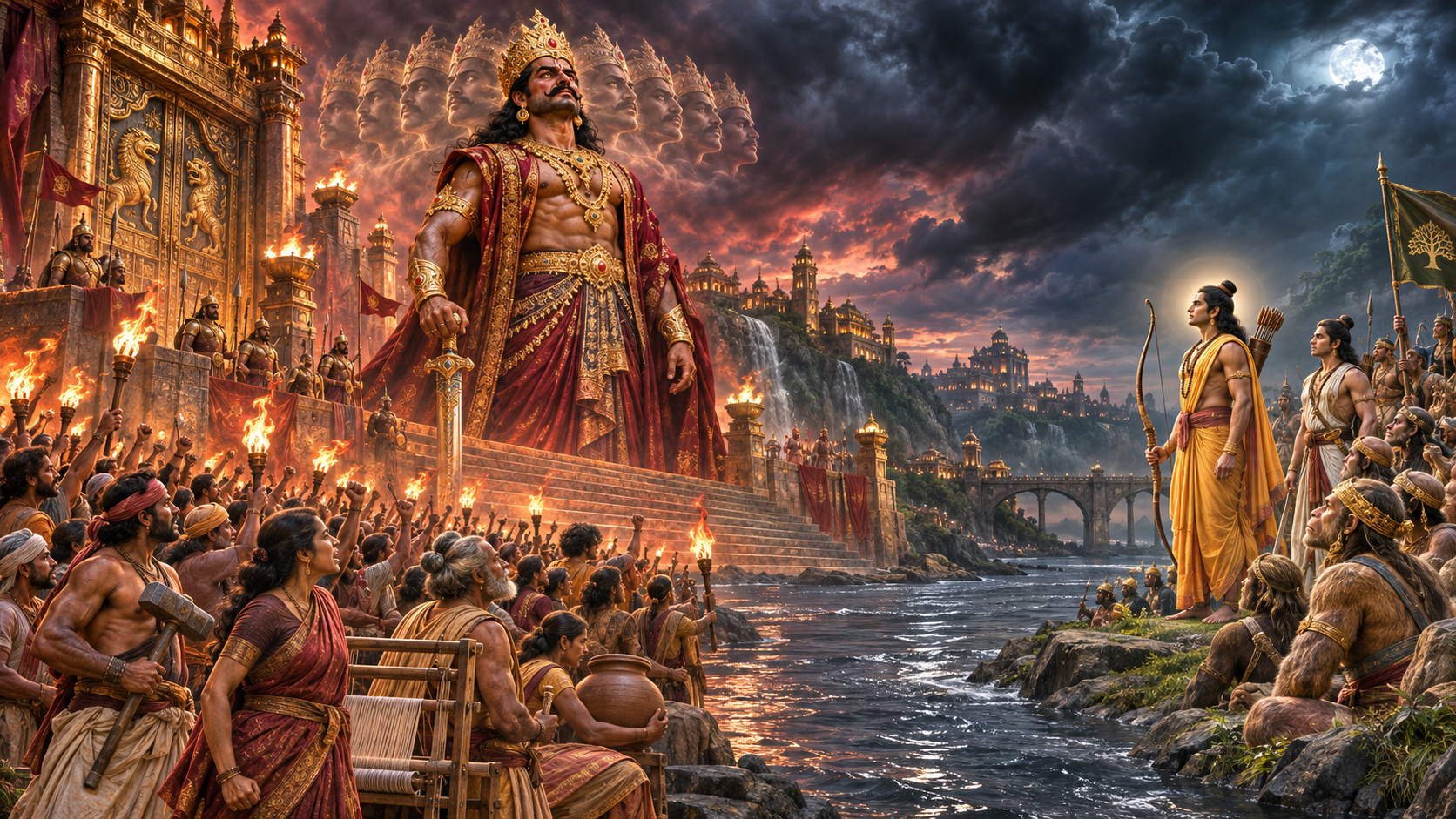
If you are deciding whether the new Ramayana film preserves the epic’s dharmic center, do not let its scale or visual beauty settle the question. Look at why Ravana acts, what the screenplay asks you to admire, and which facts it removes from the moral equation.
A film can honor Sri Rama and Maa Sita in its imagery while shifting its deepest sympathy toward Ravana. The useful test is not whether Ravana has been given complexity. It is whether his responsibility for adharma has been converted into the victimhood of a revolutionary.
The decisive change is not Ravana’s personality but his motive
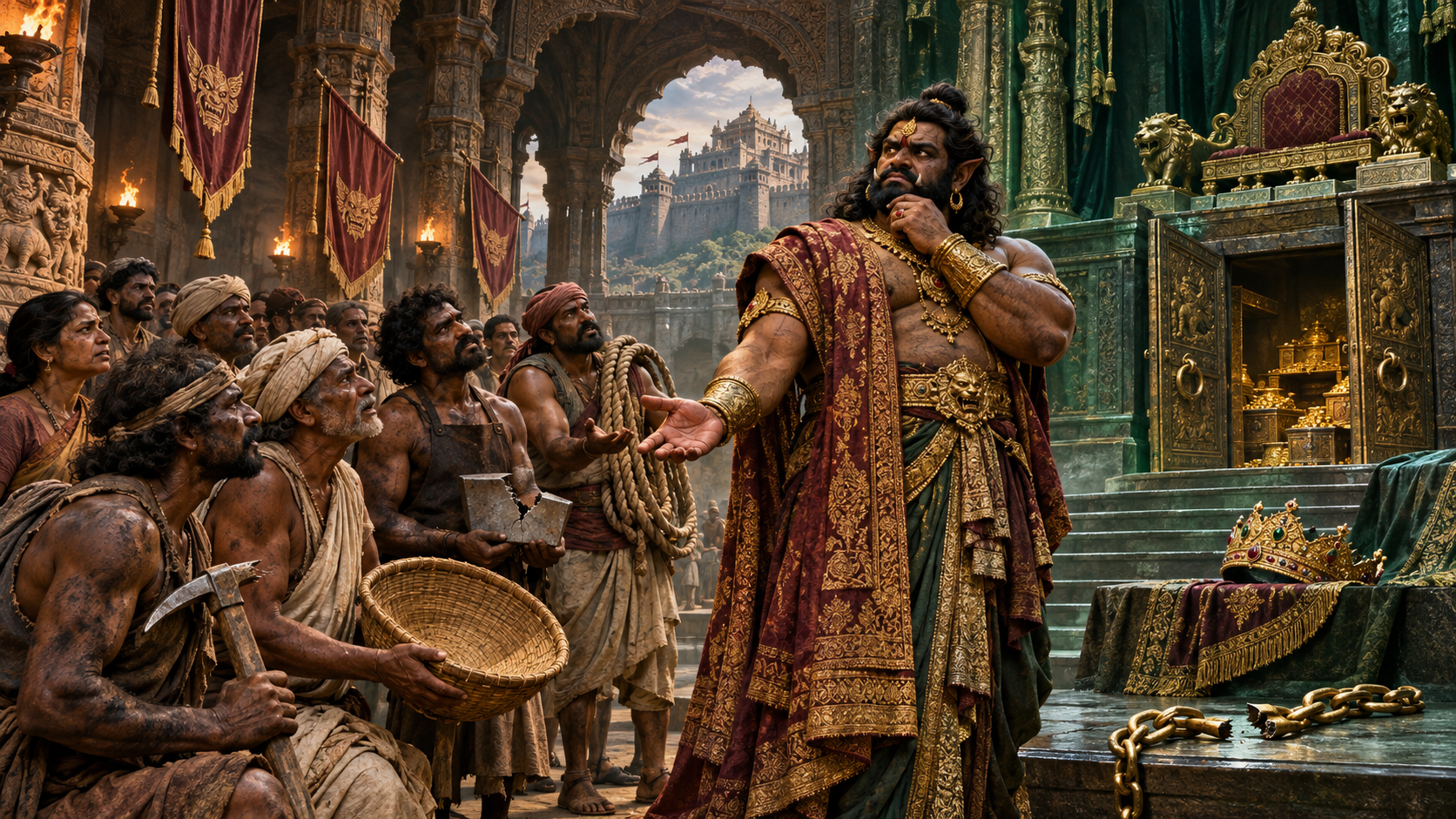
The first part of the film reportedly casts Ravana as a liberator fighting an oppressive social order. Kubera becomes Lanka’s exploitative ruler, the Devas resemble a capitalist ruling class, and Ravana appears as the champion of the masses.
That is more than a new backstory. Motive directs sympathy. If Ravana enters the story as the voice of the oppressed, viewers are primed to interpret his later conduct as the tragic excess of a righteous struggle rather than as freely chosen adharma.
An unjust order does not automatically make every opponent of that order just. This is where the class-war frame becomes a moral solvent: it can make the identity of the rebel seem more important than the character of his actions.
When you watch such a retelling, ask one question before debating costumes, effects, or performances: does the screenplay explain Ravana’s conduct, or does it quietly ask his grievance to excuse it?
Five narrative switches turn the antagonist into a revolutionary
Any single creative change may look harmless in isolation. The direction of the changes matters. Here, several choices move sympathy away from personal accountability and toward political vindication.
- The governing conflict changes. When Lanka is presented primarily through exploiters and exploited people, the struggle between dharma and adharma is pushed behind a struggle between elites and masses. Ravana then receives moral credit from the social group assigned to him before his own choices are judged.
- Ravana receives the credentials of a protector. The film has him kill a brother-in-law who molests a maid. Condemning molestation is not the problem. The scene’s dramatic function is to introduce Ravana as an executor of justice, encouraging the audience to carry that judgment into unrelated acts.
- His Rakshasa identity becomes an act of filial loyalty. Ravana turns Rakshasa to please his mother. The transformation can therefore be read as something undertaken for family rather than as a sign of his own moral direction. Once again, responsibility moves outward.
- Kubera becomes a class enemy while kinship recedes. Kubera was Ravana’s half-brother. Ignoring that relationship converts a conflict involving family, rule, and ambition into a cleaner confrontation between oppressor and liberator. The simplification is politically convenient because it removes a fact that complicates the revolutionary image.
- Maa Sita’s abduction becomes retaliation. The film frames the abduction as revenge for Surpanakha’s mutilation while suppressing the role of Ravana’s lust in Valmiki’s telling. This is the most consequential switch. It turns a violation committed against Sita into an answer to a grievance that was not hers, reducing both Ravana’s agency and Sita’s independent moral standing.
Read as one pattern, these changes do not merely make Ravana understandable. They repeatedly locate the cause of his conduct in an oppressive system, an injured relative, a demanding mother, or a corrupt ruler. The screenplay supplies a reason outside Ravana whenever the dharmic question requires us to look directly at Ravana.
Humanising Ravana is not the same as absolving him
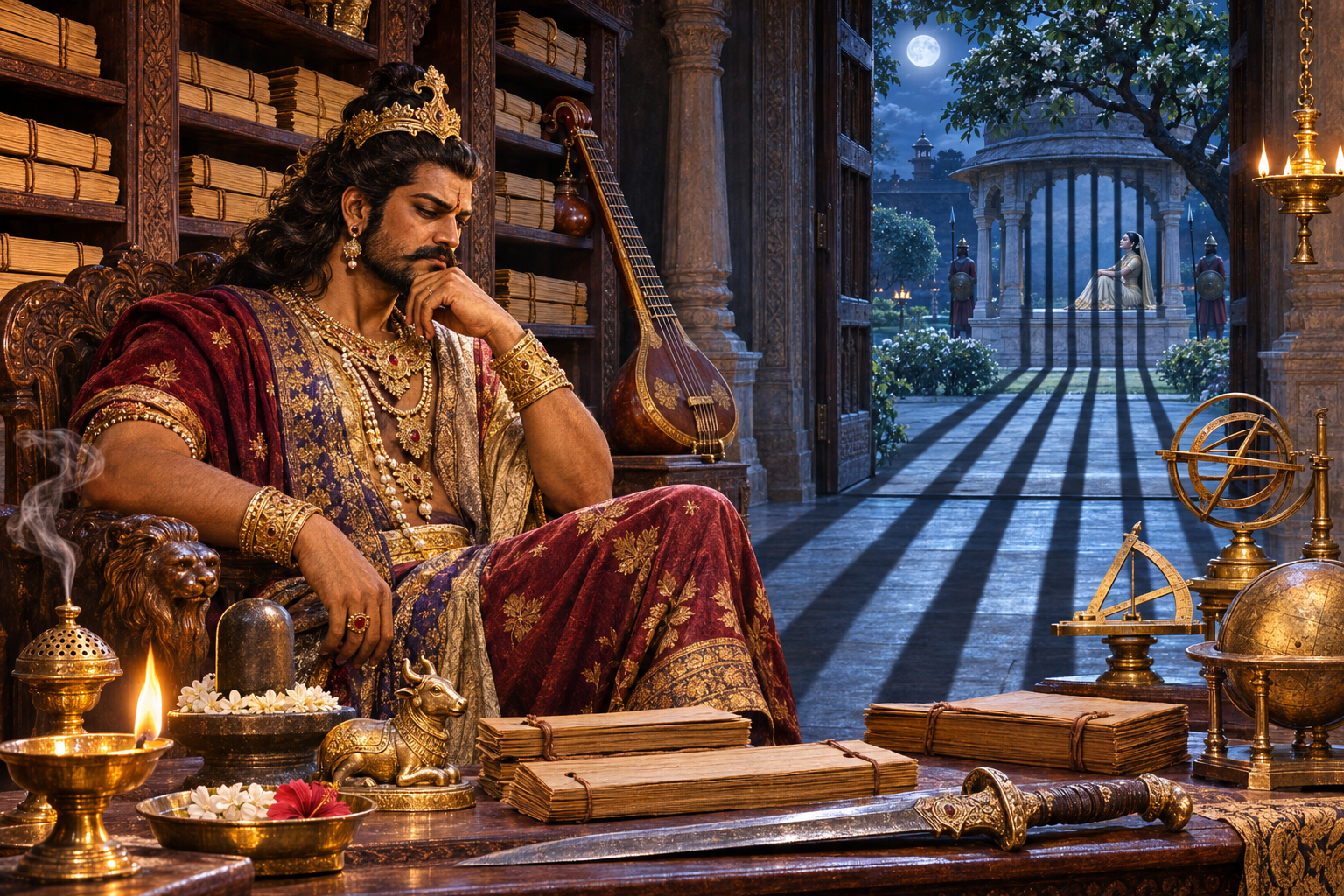
A serious antagonist need not be foolish, crude, or one-dimensional. Giving Ravana intelligence, affection, political grievances, or moments of apparent justice can make the drama stronger. None of those qualities, however, determines whether his later actions accord with dharma.
- Explanation is not justification. A motive can make an action intelligible without making it right.
- Suffering one injustice does not make every response just. A victim in one relationship can become a wrongdoer in another.
- Capacity is not character. Power, intelligence, eloquence, and courage acquire moral value only through the purposes they serve.
- Grievance is not dharma. A legitimate complaint does not authorize harm against a person who did not cause it.
This distinction also explains why Hindus continue to burn Ravana’s effigy. The ritual does not require Ravana to be a cardboard villain. Its force comes from a clear judgment that greatness without restraint can become an instrument of adharma.
A responsible adaptation may deepen Ravana without reversing that judgment. It can show the road to wrongdoing while keeping the wrongdoer responsible for walking it. The more charisma a retelling gives him, the more carefully it must preserve that causal clarity.
Why class struggle is too small a frame for dharma
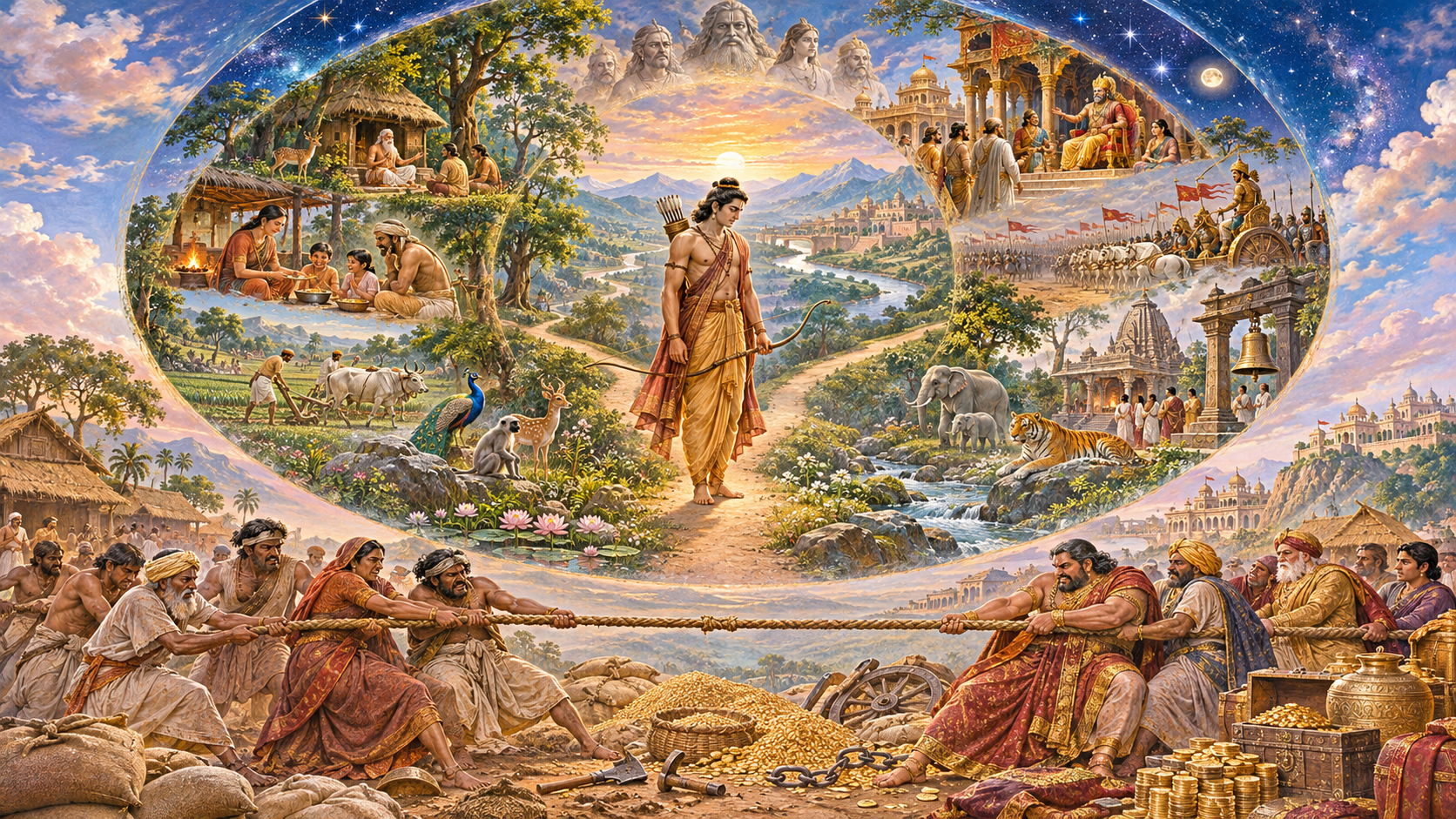
A class-war reading foregrounds wealth, hierarchy, control, and the conflict between rulers and the ruled. A dharmic reading asks different first questions: What duty governed the person? Was power restrained? Was another human being treated as an end or as an instrument? Was the response proportionate? Did the chosen means corrupt the declared purpose?
The two frames can overlap. Exploitation is not morally irrelevant, and political authority is not exempt from judgment. The error comes when social position becomes a complete verdict – as though an oppressed person cannot commit adharma, or a rebel’s transgression becomes righteous because his enemy is wealthy.
Apply that distinction to the film’s own premises. Even if Kubera exploited Lanka, that would establish a moral charge against Kubera; it would not grant Ravana authority over Maa Sita. Even if Surpanakha suffered a grievous injury, guilt would not transfer to Sita. Even if Ravana changed himself to satisfy his mother, filial motivation would not erase his agency.
This is the category error you should notice. A grievance that might explain one conflict is made to carry moral weight for unrelated conduct. Background becomes mitigation, mitigation becomes vindication, and vindication turns the antagonist into a messiah.
The change also affects Sri Rama. If Ravana is the emancipator of the masses, Rama risks being positioned as the defender of a suspect order even when the film’s dialogue and imagery remain reverential toward him. Spectacle can honor Rama aesthetically while the screenplay relocates the story’s moral authority elsewhere.
How to judge the adaptation without reducing the debate to outrage
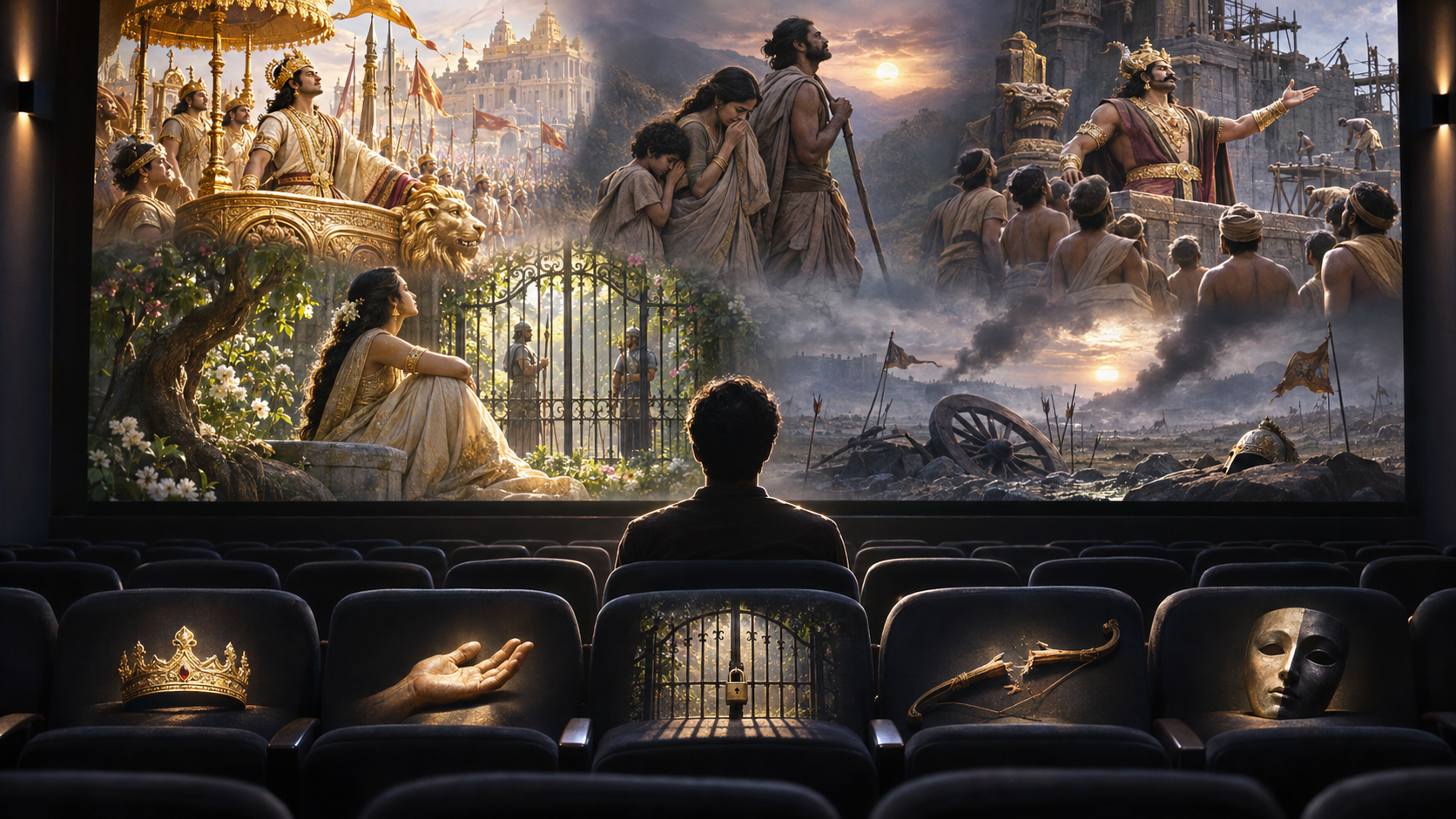
You do not need to guess what the filmmakers privately intended. Narrative effects can be evaluated from what appears on screen. Use the following method for every disputed scene.
- Record the event before interpreting it. Note what Ravana does, who is affected, and what happens immediately before the action. This prevents a stirring speech or sympathetic image from replacing the event itself.
- Classify the adaptation’s change. Is it an addition, an omission, or a reversal? The scene involving the maid is an addition. The reduced importance of Kubera’s kinship is an omission. Replacing desire with revenge as the motive for abduction is a reversal of moral emphasis.
- Track the movement of agency. Ask who gains sympathy, who loses a voice, and who is made responsible. If Ravana’s act is explained through Surpanakha while Sita becomes an instrument in their conflict, agency has shifted away from both the abductor and the abducted.
- Apply the non-transfer test. Would the claimed injury justify action against this particular person? If the answer is no, the story is using grievance to bridge a moral gap that grievance cannot bridge.
- State a scene-level judgment. Identify the exact change and its ethical effect. A precise criticism is harder to dismiss than a claim that the entire production is hostile or that every modern addition is illegitimate.
Do not call every sympathetic portrayal of Ravana Marxist. The label becomes useful only when repeated changes make material power and class identity the primary moral axis, cast Ravana as the representative of an oppressed collective, and reinterpret his wrongdoing as part of revolutionary necessity. One humane moment is characterisation; a systematic transfer of responsibility is ideological reconstruction.
Keep craft and interpretation separate as well. You can acknowledge grand visuals, a reverential portrayal of Sri Rama and Maa Sita, or a compelling performance without accepting the screenplay’s moral frame. Production design can express devotion while narrative causation redirects sympathy.
The strongest criticism is therefore specific: changing the motive for Sita’s abduction from desire to retaliation reduces Ravana’s responsibility; omitting Kubera’s kinship simplifies ambition into class revolt; and adding scenes of protective justice prepares the audience to receive Ravana as a liberator. That argument addresses what the film does without pretending to know why every person involved did it.
Key takeaways
- The central question is not whether Ravana may be complex, but whether complexity is being used to weaken his accountability.
- The film’s class-war framework reportedly turns Kubera and the Devas into oppressors while giving Ravana the moral identity of a popular liberator.
- Added virtue, omitted kinship, filial motivation, and retaliatory framing all move responsibility away from Ravana’s choices.
- No injury to Surpanakha can make Maa Sita a legitimate instrument of revenge; grievance does not transfer guilt.
- Judge each disputed scene as an addition, omission, or reversal, and describe its moral effect without claiming knowledge of the creators’ private intentions.
Before you recommend or criticise the film, make a short ledger of the scenes that matter: what was added, what was omitted, what was reversed, and whose agency changed. Then anchor your judgment in those choices. That gives your family, community, or reading group something more useful than a slogan.
The Ramayana does not need fragile protection from every artistic experiment. It does need viewers who can distinguish interpretation from moral inversion. Carry that distinction into the cinema, and do not let visual reverence substitute for fidelity to dharma.
References

Leave a Reply
You must be logged in to post a comment.