
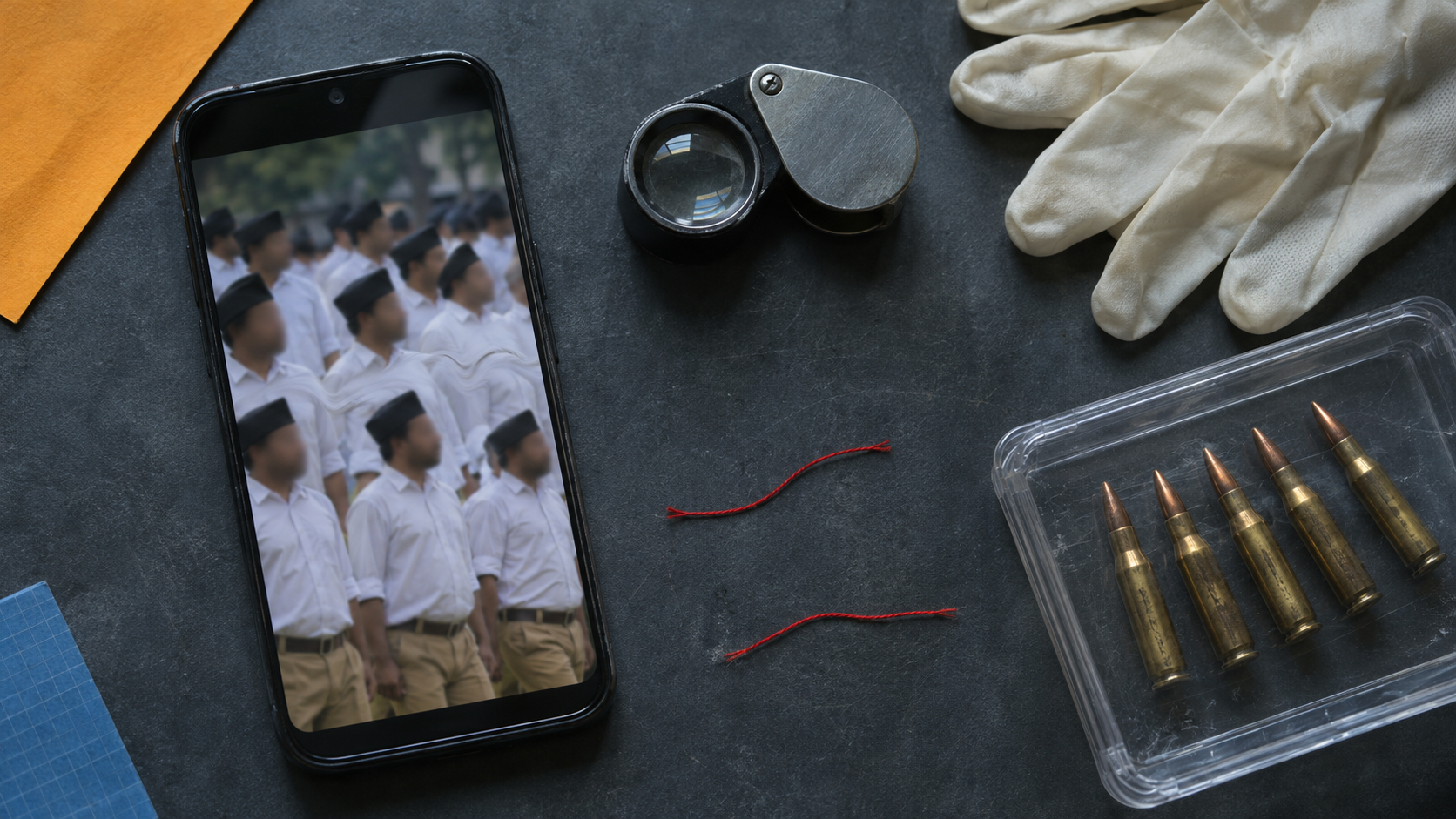
You see several men in similar RSS uniforms beside a claim about 44,250 live cartridges. The image invites you to complete the accusation before you have checked whether the clothing is real, whether the people are correctly identified, or whether the two cartridge recoveries are even part of one network.
That is how visual propaganda compresses a complicated investigation into an instant verdict. If you are deciding whether to share the image, defend the RSS, or challenge the person circulating it, use a standard that separates what is visible from what is merely implied.
The photograph is not the investigation
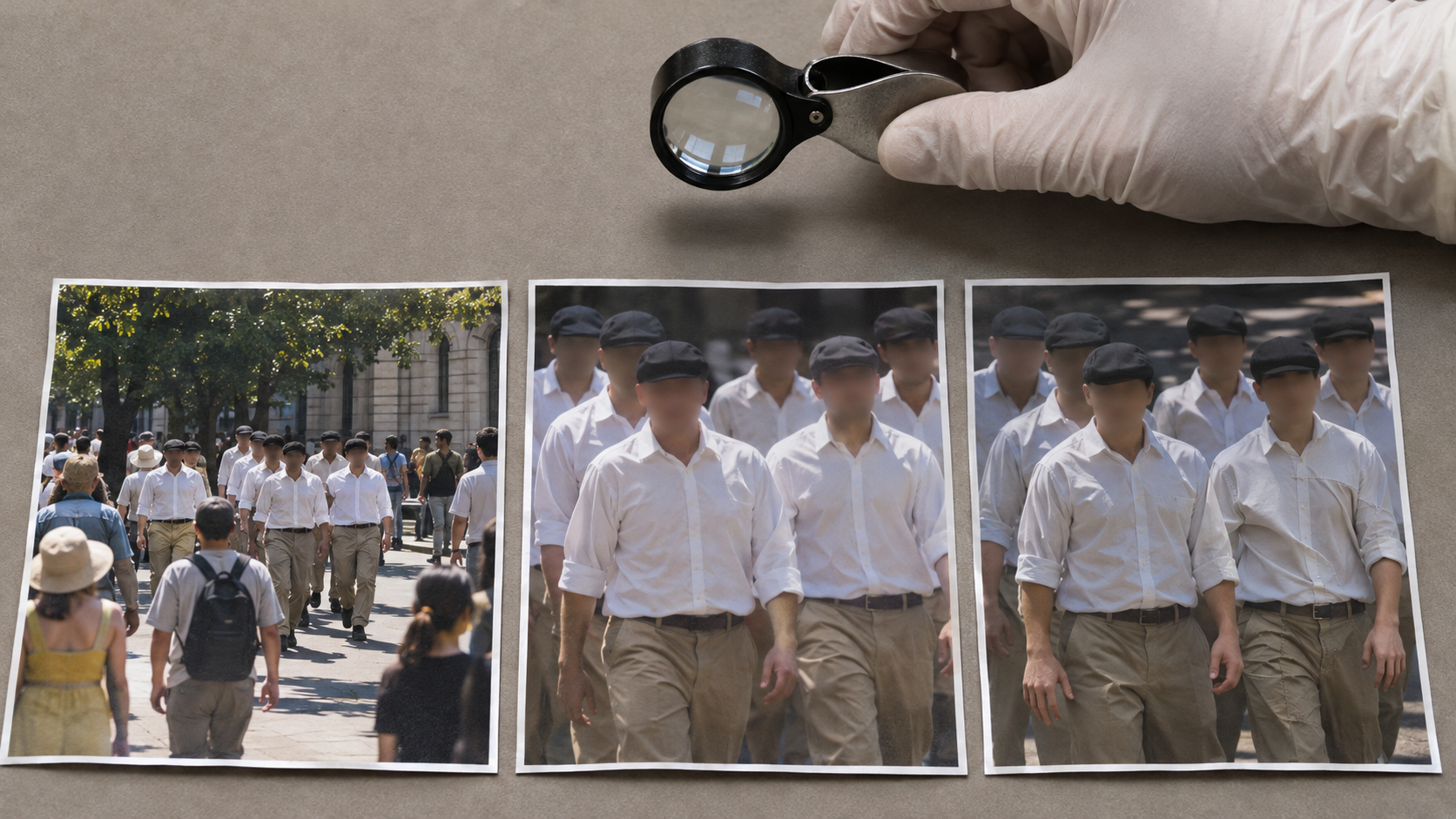
In the controversy involving Priyank Kharge, the earliest version identified in the public dispute was reportedly an Instagram upload published by Abhishek Tiwari on March 29, 2026. Only Tiwari reportedly wore an RSS uniform in that version. The widely circulated image appeared to place other people in similar clothing, while differences in faces, garments, and other visual details raised questions about alteration.
This comparison makes the circulated version unsuitable as clean evidence of a group-wide RSS association. It does not, by itself, establish which software was used, who changed the image, or whether generative AI rather than an ordinary editing tool produced the differences. Until those questions are answered, apparently altered is more accurate than definitively AI-generated.
There is an equally important limit on the original photograph. Even an authentic image of a person wearing an RSS uniform can show only that the person appeared in that clothing at a particular moment. Without additional evidence, it cannot establish current membership, an organisational position, participation in a crime, or responsibility on the part of the RSS.
| Claim being made | Most the picture can support | Additional evidence required |
|---|---|---|
| This person was present | An appearance in a scene, if the file is authentic and the identification is correct | Provenance, date, location, original context, and corroborated identity |
| This person belonged to the RSS | Clothing or a setting that appears associated with the RSS | Independent evidence of affiliation and the relevant time period |
| The RSS was involved in the offence | Nothing about organisational responsibility | Investigative evidence connecting direction, knowledge, financing, logistics, or other institutional conduct to the offence |
The caption and the pixels are separate evidence. A caption can make an authentic image misleading, while fabricated pixels can make a false caption feel self-evident. Check both.
Run this five-check verification routine

You do not need to become a digital-forensics specialist before declining to amplify a doubtful political image. You do need a repeatable process.
- Write down the exact claim. Is the claim that one person wore an RSS uniform, that every person pictured was an RSS member, or that the RSS participated in ammunition smuggling? These are different propositions. If a social-media message slides between them, separate them before examining the image.
- Find the earliest accessible version. Search for the full image, distinctive crops, the account name, and exact wording from the caption. Record the URL, upload date, account, and surrounding text. The earliest copy you locate is not automatically the original, but it is more useful than a screenshot stripped of its history.
- Compare versions side by side. Align the same faces, clothing, background objects, and image boundaries. Look for material differences rather than merely strange-looking pixels. Compression, resizing, and repeated reposting can damage edges and colours, so an awkward outline alone does not prove AI manipulation. Conversely, a polished image is not necessarily authentic.
- Corroborate identity and context independently. Confirm who is pictured, when the scene occurred, and what the occasion was. Multiple accounts repeating the same image are not multiple confirmations if they all descend from one upload. A uniform is a visual clue, not a membership register or proof of organisational authority.
- Give the claim an honest status. Use authenticated only when provenance and context are adequately supported; altered when versions contain material visual differences; miscontextualised when a genuine image is attached to the wrong event or inference; and unverified when the available evidence cannot settle the issue. Reserve AI-generated or AI-edited for cases where the method itself is supported.
If you obtain an original file, its metadata may help, but missing metadata proves little because messaging and social platforms often remove or rewrite it. Automated AI-detection scores are also leads rather than verdicts. The defensible finding comes from provenance, version comparison, corroborated context, and a clear account of what remains unknown.
When you cannot verify a person’s identity or affiliation, do not publish the allegation as fact. The safe and accurate alternative is simple: identify the image as disputed, state the precise uncertainty, link to the competing version, and ask the claimant to provide the original file or independent evidence.
Use a proof ladder before alleging RSS responsibility

Political messaging often jumps from resemblance to institutional guilt without showing the intermediate steps. A disciplined reader should insist on five separate levels of proof:
- Identity: Is the person correctly identified?
- Authenticity: Is the image unaltered, correctly dated, and shown in its original context?
- Affiliation: Was the person actually associated with the RSS at the relevant time, and in what capacity?
- Conduct: Is there evidence connecting that person to the alleged criminal activity?
- Organisational responsibility: Is there evidence that the RSS directed, knew of, enabled, financed, or otherwise participated in that conduct?
Failure at one level prevents the image from proving the levels above it. Similar clothing cannot carry an accusation of organisational complicity across all five steps.
This standard should not become special pleading for an organisation we favour. It should apply to every religious, cultural, social, and political body. A pro-Hindu response is strongest when it refuses both the original insinuation and the temptation to answer it with counter-speculation. Satya requires accuracy even when an inaccurate claim appears useful to your own side.
A careful debunk must also remain narrow. Evidence that an image was altered does not prove that no individual RSS connection exists. It proves that this image cannot establish the claimed connection. Any genuine association must be demonstrated independently through investigation, records, statements, and due process. That distinction prevents a justified correction from becoming another unsupported conclusion.
Put the 44,250 cartridges back at the centre
The number 44,250 is a combined total from two operations, not one seizure. On November 2, Bihar Police and the Special Task Force arrested three people near Kulharia Toll Plaza in Bhojpur district and recovered 19,250 live cartridges of different calibres and a country-made pistol from their vehicle. On November 3, Haryana’s Special Task Force recovered 25,000 cartridges from two vehicles near Rohad in Jhajjar district. The two amounts produce the combined figure of 44,250, but the operations remain distinct unless investigators establish a common chain.
That distinction matters. Consecutive dates and similar contraband can tempt people to speak of a single racket before the evidentiary link has been shown. Combining the quantities is arithmetic; combining the accused, suppliers, recipients, or motives is an investigative conclusion that requires proof.
The serious questions are therefore operational, not photographic:
- Where did the cartridges in each operation originate?
- Did a licensed dealer or authorised inventory supply any of them, and is diversion established or merely being examined?
- Who ordered, financed, collected, and transported each consignment?
- What destination and intended recipients are supported by communications, vehicle records, payments, or other evidence?
- Are the Bihar and Haryana operations connected through a supplier, intermediary, or recipient, rather than merely by timing?
- Which assertions are police allegations, which are active lines of inquiry, and which have been proved through the legal process?
A photograph of men in uniforms answers none of these questions. Allowing it to dominate the debate can benefit the ammunition network by replacing scrutiny of suppliers and recipients with a partisan argument over appearances.
A correction should repair the public record
Priyank Kharge used the disputed image while publicly questioning the accused and the RSS. Raising questions does not reduce the obligation to authenticate the premise on which those questions rest. If credible evidence of an organisational connection exists, it belongs with the investigating authorities and should be described on its own merits. A questionable image cannot serve as its substitute.
Whether an inaccurate image was shared deliberately or without adequate checking, the correction duty is the same. A responsible correction should:
- appear through the same account and channel that carried the disputed claim;
- identify the image and the specific inference that is unsupported;
- show or link to the earlier version so readers can examine the difference;
- withdraw any organisational allegation that depended on the altered image;
- preserve the distinction between correcting the image and continuing the legitimate ammunition investigation; and
- provide any independent evidence to investigators rather than using insinuation as a replacement for it.
Silent deletion is incomplete because screenshots and copied versions continue circulating without the correction. A visible clarification gives people who encountered the original claim a fair chance to encounter the repaired record.
Key takeaways
- Treat an image, its caption, and the political conclusion drawn from it as three separate things to verify.
- The reported comparison raises substantial concerns about alteration, but it does not by itself identify the editing method or the person responsible.
- An authentic RSS uniform can suggest appearance or context; it cannot independently prove membership, criminal conduct, or organisational complicity.
- The figure of 44,250 combines 19,250 cartridges recovered in Bihar and 25,000 recovered in Haryana. Do not describe two operations as one network without evidence linking them.
- Correct only what the evidence allows you to correct: reject the image as proof while leaving genuine investigative questions open.
Before you forward the next political image, write one sentence containing only what you have actually verified. If that sentence cannot support the accusation in the caption, do not share the accusation. Save the link, ask for the original, name the missing evidence, and keep following the ammunition trail. That habit gives the defence of RSS and other Dharmic institutions something propaganda cannot easily imitate: a documented chain from claim to fact.
References

Leave a Reply
You must be logged in to post a comment.