

You may reach Vishwamitra’s encounter with Maricha and Subahu and wonder why so powerful a rishi needed Rama’s help. If the sage could punish the rakshasas himself, why involve the prince at all?
The answer turns a familiar episode into a practical lesson about disciplined power. Vishwamitra’s restraint is not helplessness, hesitation, or fear. It is the refusal to let an immediate provocation dictate conduct that would compromise a larger purpose.
The real question is not whether Vishwamitra had power

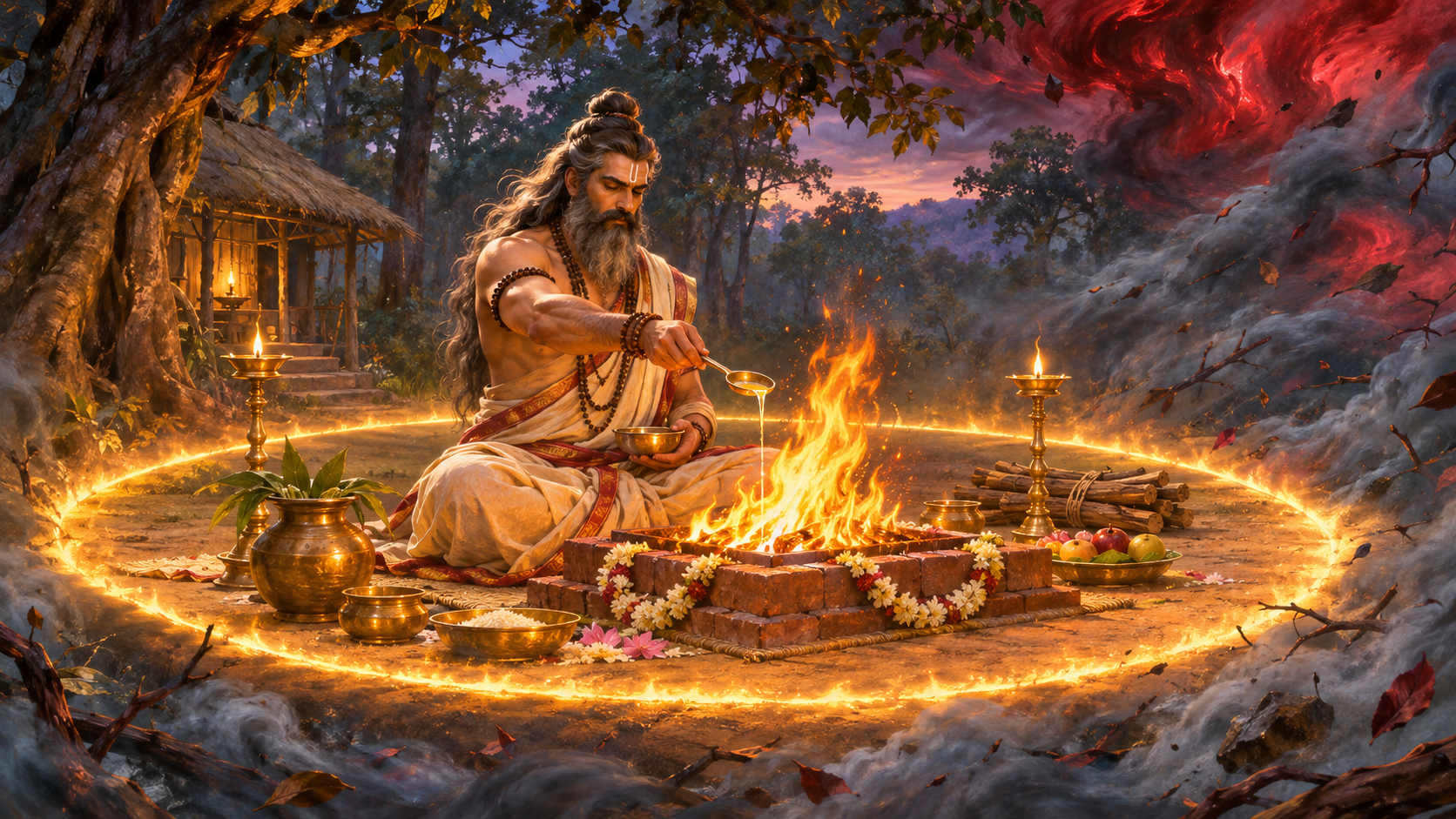
Vishwamitra comes to Ayodhya, where King Dasharatha receives him with honour. The sage then explains his difficulty: he is conducting a yajna, and Maricha and Subahu are disrupting it. He seeks Rama’s protection so that the sacred undertaking can be completed. This sequence establishes the problem clearly: Vishwamitra possesses the power to confront the offenders, yet chooses not to destroy them himself.
That distinction matters. If Vishwamitra were simply incapable of acting, there would be no lesson in restraint. Restraint becomes meaningful only when a person has both the capacity and the provocation to retaliate, but refuses to let retaliation overrule the duty already undertaken.
The yajna is not incidental scenery. It defines Vishwamitra’s proper action. He is committed to a consecrated work whose completion demands steadiness. To abandon that discipline whenever an enemy appears would allow the enemy to determine not merely whether the rite is interrupted, but what kind of person the rishi becomes during the interruption.
This is the first point to notice when you read the episode: the rakshasas threaten two things at once. They threaten the visible yajna, and they tempt its performer to surrender the inner discipline on which the yajna rests. Vishwamitra protects both by refusing to answer on their terms.
Restraint preserves the purpose that anger can displace
Anger narrows attention. It makes the offender seem like the whole problem and retaliation seem like the whole solution. Vishwamitra does not deny the danger or pretend that disruption should be tolerated. He distinguishes the necessary response from his own angry response.
That distinction is the heart of the episode. Maricha and Subahu must be stopped, but Vishwamitra does not therefore conclude that he must stop them by whatever means are available to him. He remains responsible for the yajna and seeks an appropriate protector. The threat is met without allowing the threat to rewrite his role.
In Dharmic terms, power is not self-authorising. The fact that you can do something does not prove that doing it is right in that moment. Capacity answers one question: “What am I able to do?” Dharma asks a harder one: “What is mine to do here, under this commitment, for this purpose?”
Vishwamitra’s tapas has not failed because he refrains from using destructive power. On the contrary, restraint shows that his power remains governed. Anger is present as a possibility, but it does not receive command. This is a more demanding achievement than merely defeating an opponent.
You can use this distinction whenever provocation arrives in the middle of serious work. First identify what you were trying to protect before the offence occurred. If your reaction sacrifices that purpose merely to punish the offender, the offence has already redirected you.
Calling Rama is disciplined delegation, not avoidance

Vishwamitra does not make restraint an excuse for passivity. He travels to Ayodhya, explains the danger, and asks for help suited to the task. His response therefore contains both self-command and decisive action.
This corrects a common misunderstanding of patience. Patience does not mean leaving wrongdoing unanswered until it becomes unmanageable. It means refusing a rash response while arranging an effective one. Vishwamitra neither abandons the yajna nor indulges in personal retaliation. He creates a path by which the sacred work can continue and the disruption can be confronted.
His request also makes room for Rama to assume responsibility. A teacher who personally resolves every danger may display impressive power, but leaves no field in which the disciple can act. Vishwamitra’s restraint is therefore not only inward discipline; it is also part of his role as a guide. He knows when his own intervention would crowd out another person’s duty and formation.
This does not mean that every act of delegation is wise. Passing a problem to someone else can be cowardice, manipulation, or an attempt to escape responsibility. Vishwamitra’s conduct points to a sharper test. Disciplined delegation has three marks:
- The danger is stated plainly rather than concealed.
- The person seeking help remains committed to the original responsibility.
- The chosen helper has a legitimate role in answering the danger.
If any of those is missing, “restraint” may simply be a noble label placed over avoidance. Vishwamitra does not disappear from the work. He seeks protection so that he can remain faithful to it.
Use Vishwamitra’s discipline when provocation interrupts duty
The episode gives you a practical sequence for moments when someone is obstructing work that matters. It can apply to a family responsibility, a temple project, an institution, a public cause, or a personal vrata. The scale changes; the discipline does not.
- Name the work before naming the enemy. State what must be completed, preserved, or repaired. This prevents resentment from becoming the centre of the decision.
- Identify the commitment that should survive the conflict. Ask which promise, rule, role, or discipline you must not discard merely because you have been provoked.
- Separate necessary protection from personal retaliation. Stopping harm may be required. Humiliating the offender, proving your superiority, or settling every grievance usually is not.
- Decide whether the response is properly yours. Having the ability to act is not the same as having the right role. A responsible authority, colleague, elder, or institution may be better placed to intervene.
- Choose help that lets the original work continue. The best response does more than confront disruption. It restores the conditions in which the duty can be fulfilled.
- Return attention to the purpose. Once the danger has been addressed, do not keep feeding the conflict for emotional satisfaction. Completion of the worthy work is the measure of success.
This sequence is not a command to remain silent in the face of harm. Vishwamitra actively seeks protection. Nor does it teach that anger is always evidence of spiritual failure. Anger may alert you to a real violation. The question is whether it provides information to your judgement or takes control of it.
A useful test is to imagine the obstruction removed. Would your chosen response still look proportionate and Dharmic, or would it look like excess committed under the shelter of righteous language? Vishwamitra’s example asks you to make that judgement before acting, while restraint can still shape the outcome.
Key takeaways
- Vishwamitra’s restraint matters because he has power; it is a choice, not an incapacity.
- The yajna fixes his primary duty. He refuses to let disruption pull him away from the discipline required to complete it.
- Restraint does not mean ignoring danger. He seeks Rama’s protection and arranges an effective response.
- Calling the right person can be an act of responsibility when it preserves the work and gives that person a proper field of action.
- The practical question under provocation is not only “What can I do?” but “What response protects dharma without making anger my master?”
The next time an offence interrupts something worthy, begin where Vishwamitra begins: hold fast to the purpose. Name the response the situation truly requires, place it in the right hands, and do not spend your discipline merely to prove that you possess power.
References

Leave a Reply
You must be logged in to post a comment.