

You encounter the declaration that prana is Brahman and an immediate question arises: does it mean that ordinary breathing is the Absolute? If so, would controlling the breath amount to knowing Brahman? Neither conclusion captures the full force of the teaching.
The declaration asks you to begin with the most intimate sign of life and then look beyond its physical appearance. Once you distinguish breath, vital power, cosmic prana, and Brahman, the passage becomes a disciplined contemplative instruction rather than a vague celebration of energy.
Read the equation at the right level

Prana does not carry exactly the same scope in every sentence. It can refer to the breath you can observe, the vital power sustaining a living being, or the cosmic principle that animates the universe. Brahman names Absolute Reality, not one more object or force within the universe.
The Kaushitaki Upanishad 2.1 identification of prana with Brahman therefore raises prana beyond its merely physical meaning. The passage does not make a laboratory claim that air, respiration, or gas exchange is the totality of Reality. It directs attention through the visible movement of life toward its universal ground.
Keep four levels distinct as you read:
- Breath is the observable movement associated with respiration.
- Individual prana is the vital principle understood through the life of a particular being.
- Cosmic prana is the universal power that pervades and animates the cosmos.
- Brahman is Absolute Reality, not a larger specimen of physical energy.
The lower level is not useless or false. Breath is valuable precisely because it gives you an immediate doorway into the inquiry. But a doorway is not the whole destination. If you stop at respiration, you reduce the teaching. If you abandon the concrete doorway and speak only in abstractions, you lose the method by which the teaching becomes intelligible.
You can therefore answer the question of literalness carefully. Yes, the identification of prana and Brahman is meant seriously at the spiritual and cosmic level. No, it does not turn every dictionary use of prana into a synonym for Brahman or reduce Brahman to the physical act of breathing. Context determines the level at which the word is operating.
Why prana is a powerful doorway to Brahman

The Upanishadic choice of prana is exact. Life can seem abstract when discussed as a philosophical category, but breath is immediately present. You do not need an instrument or a complicated theory to notice it. The teaching begins close to experience and then expands the meaning of what you have noticed.
Prana also unsettles the ordinary sense of ownership. You may say my breath or my life, but you did not create the principle of life and cannot reduce it to a personal possession. Breath passes between what you call the body and what you call the surrounding world. It is intimate without being privately manufactured.
This makes prana a bridge between the individual and the cosmos. The movement of inquiry is not from a small personal energy to a much bigger personal energy. It is from my life to the universal principle by which life is present, and from the many expressions of that principle to their ground in Brahman.
Notice what happens to the pronouns. At first, you attend to my breath. Then you contemplate the life force. Finally, the inquiry concerns Reality itself. The shift is philosophical and ethical as well as contemplative: life is no longer regarded merely as something the ego owns and uses.
This is why the declaration can change how you see other beings. If prana is contemplated as a cosmic principle rather than private property, the life before you is not wholly alien. Its particular form differs from yours, but the animating principle is not confined to your boundaries. Reverence for life then follows from insight, not sentiment alone.
Five common misreadings to leave behind
The sentence is short enough to memorize and easy enough to distort. Test your interpretation against these common errors.
- Reducing prana to inhaled air. Air is physical, while prana in this teaching has a vital and cosmic scope. Breathing makes prana approachable, but the two terms should not be collapsed without remainder.
- Treating Brahman as a measurable energy field. The language of cosmic energy points to universality and animation. It does not authorize you to rename electricity, oxygen, nerve activity, or an unspecified physical field as Brahman. Such claims would need evidence that the spiritual declaration does not provide.
- Taking a bodily sensation as metaphysical proof. Warmth, calm, lightness, tingling, or an unusual breathing pattern may be experiences within the body. None establishes by itself that you have understood Brahman. An experience can become another object of attachment.
- Turning the teaching into an egoic claim. The equation does not mean that the personality, its preferences, or its impulses have become absolute. Its direction is the reverse: it loosens the claim that life belongs exclusively to the separate ego.
- Confusing breath control with knowledge. A breathing practice may collect attention, but the ability to alter respiration is not the same as understanding what prana signifies. Technique can prepare attention; it cannot substitute for discrimination.
The third and fifth errors often appear together. A person manipulates the breath, experiences a striking state, and then treats the state as confirmation of a metaphysical conclusion. The safer intellectual sequence is simpler: observe what occurred, refuse to inflate it, and return to the distinction between a changing experience and the Reality being indicated.
There is an equally important error at the opposite extreme: calling the whole teaching merely poetic and therefore dismissing it. Symbolic language need not be decorative or imprecise. Here it performs a specific task. It carries attention from a perceptible sign of life to a principle that is not grasped as another sensory object.
A disciplined way to contemplate the teaching
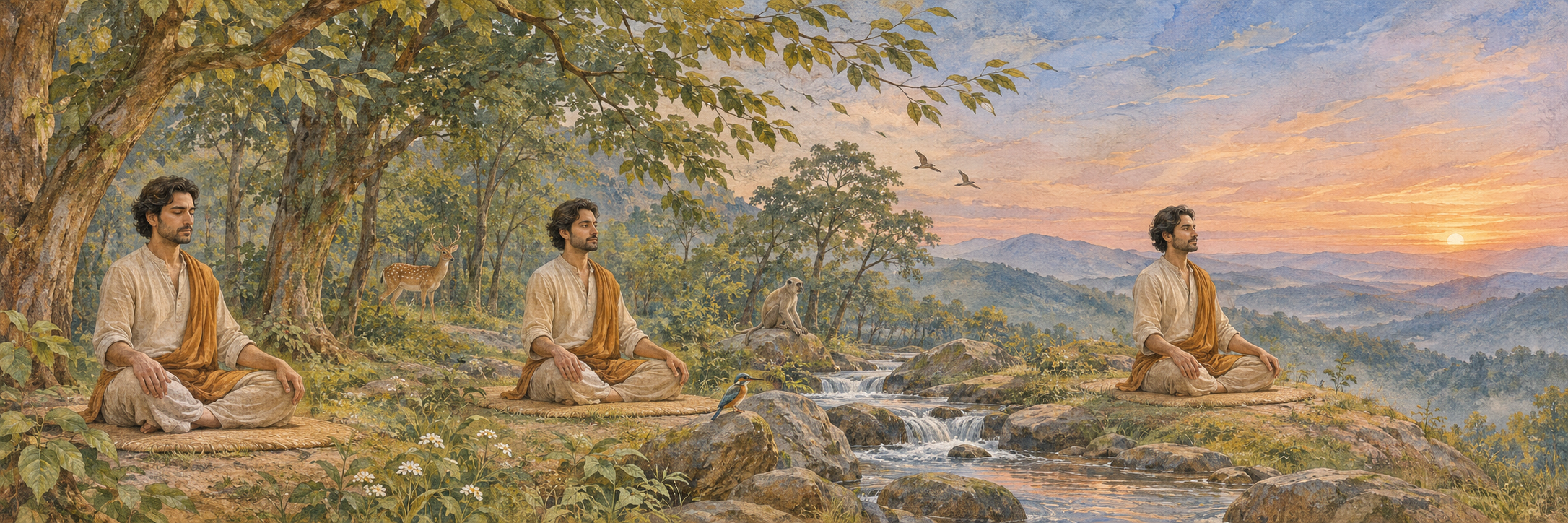
You can use the declaration as a contemplative inquiry without turning it into an exercise in forced breathing. Let the breath remain natural and comfortable. The purpose is to understand the movement from breath to prana and from prana to Brahman, not to manufacture an unusual state.
- Start with the actual sentence. Hold the identification of prana and Brahman in mind. Do not replace either term with a preferred modern slogan before examining what the terms are doing.
- Notice ordinary breath without controlling it. Recognize that the movement is immediately knowable. Then add the correction: this physical movement is the doorway to the teaching, not its entire meaning.
- Shift from movement to vitality. Attend to the fact that prana signifies living power, not air alone. Ask what changes when you stop thinking of breath as an isolated mechanical event and see it as a sign of life.
- Widen the scope beyond the individual. Release the possessive emphasis in the phrase my prana. Contemplate prana as the universal animating principle rather than a private reserve contained within one body.
- Examine the final identification. Ask why the Upanishadic teaching does not stop with cosmic vitality but identifies prana with Brahman. The question turns attention from manifestations of life toward their ultimate ground.
- Test the effect on the ego. If the contemplation makes you feel specially powerful, return to the beginning. If it weakens possessiveness and deepens reverence for life, you are following the direction of the teaching more faithfully.
Three questions can keep the inquiry precise:
- Am I contemplating prana, or only watching air move?
- Am I treating cosmic prana as a shared principle, or imagining a larger version of personal power?
- Am I seeking knowledge of Reality, or chasing a temporary sensation?
Do not demand a dramatic answer. The first useful result may be conceptual clarity: you stop using breath, prana, energy, and Brahman as interchangeable words. That clarity matters. It prevents both crude materialism and ungrounded spiritual claims, leaving the Upanishadic equation free to perform its real work.
Key takeaways
- Prana can mean more than physical breath; in the Upanishadic equation it carries a vital and cosmic meaning.
- Breath is an accessible sign through which you approach prana, not a complete definition of Brahman.
- The declaration connects individual life with the universal animating principle and ultimately with Absolute Reality.
- Prana should not be used casually as a label for every bodily sensation or hypothetical physical energy.
- Breath regulation and metaphysical knowledge are different achievements.
- A sound contemplation reduces possessiveness and enlarges reverence; it does not glorify the individual ego.
The next time you meet the declaration that prana is Brahman, pause at the word prana and ask which level of meaning is active. Begin with the breath, move beyond its physical form, and carry the resulting reverence into the way you regard life in yourself and others. If the reading makes breath seem special but leaves the ego untouched, begin the inquiry again.
References

Leave a Reply
You must be logged in to post a comment.