
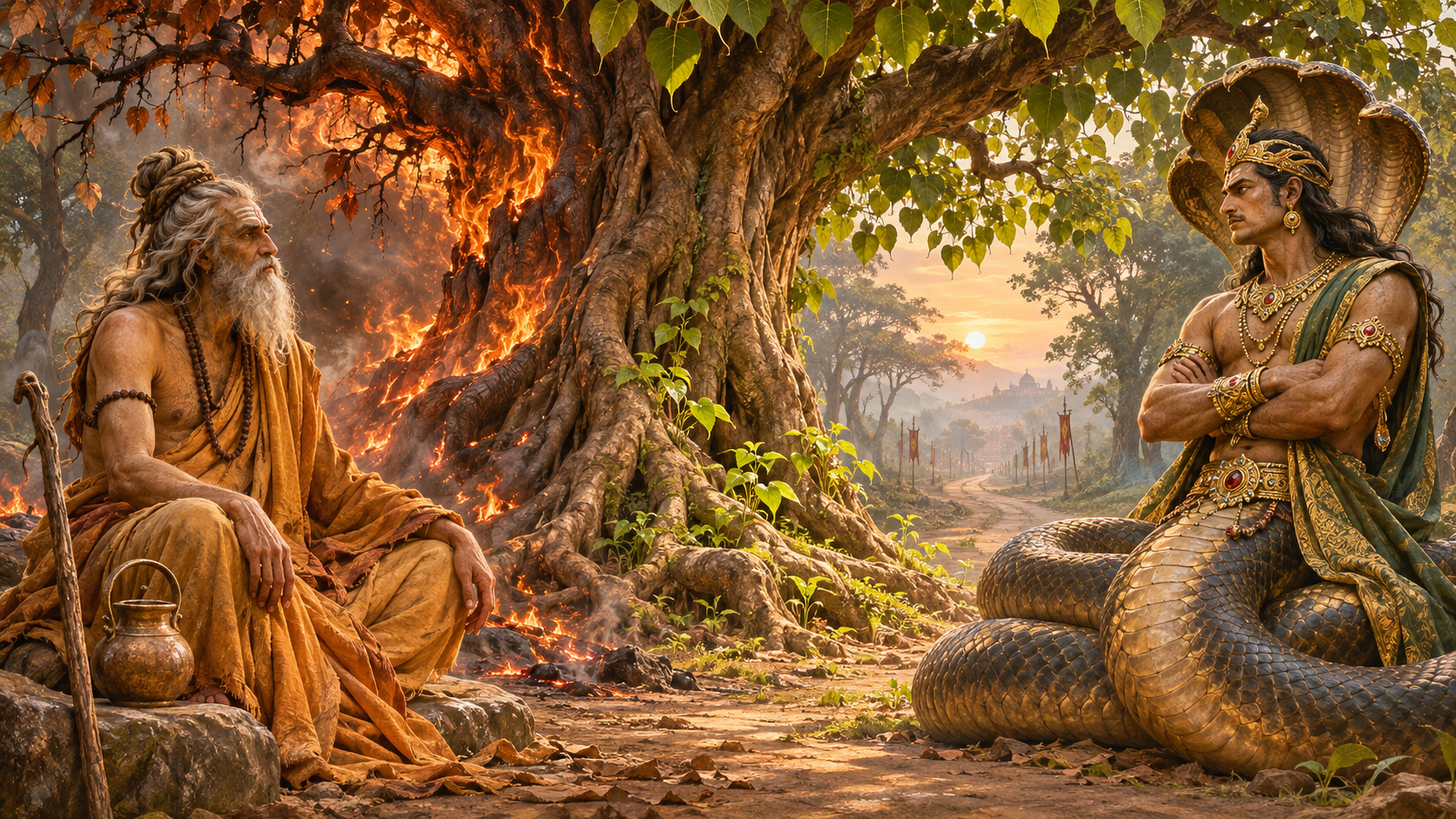
If you have reached the encounter between Kashyapa and Takshaka and wondered whether Kashyapa abandoned his duty, or whether Takshaka merely carried out an appointed end, do not rush to make one a saint and the other a simple villain. The Mahabharata makes both figures powerful. Its harder question is what should govern power when capacity, destiny, reward and public duty pull in different directions.
The burned fig tree and the man revived with it compress that question into one unforgettable test. Read the sequence carefully and you gain more than an opinion about two figures. You gain a practical method for judging moral claims made by people with exceptional ability or authority.
Reconstruct the encounter before judging it
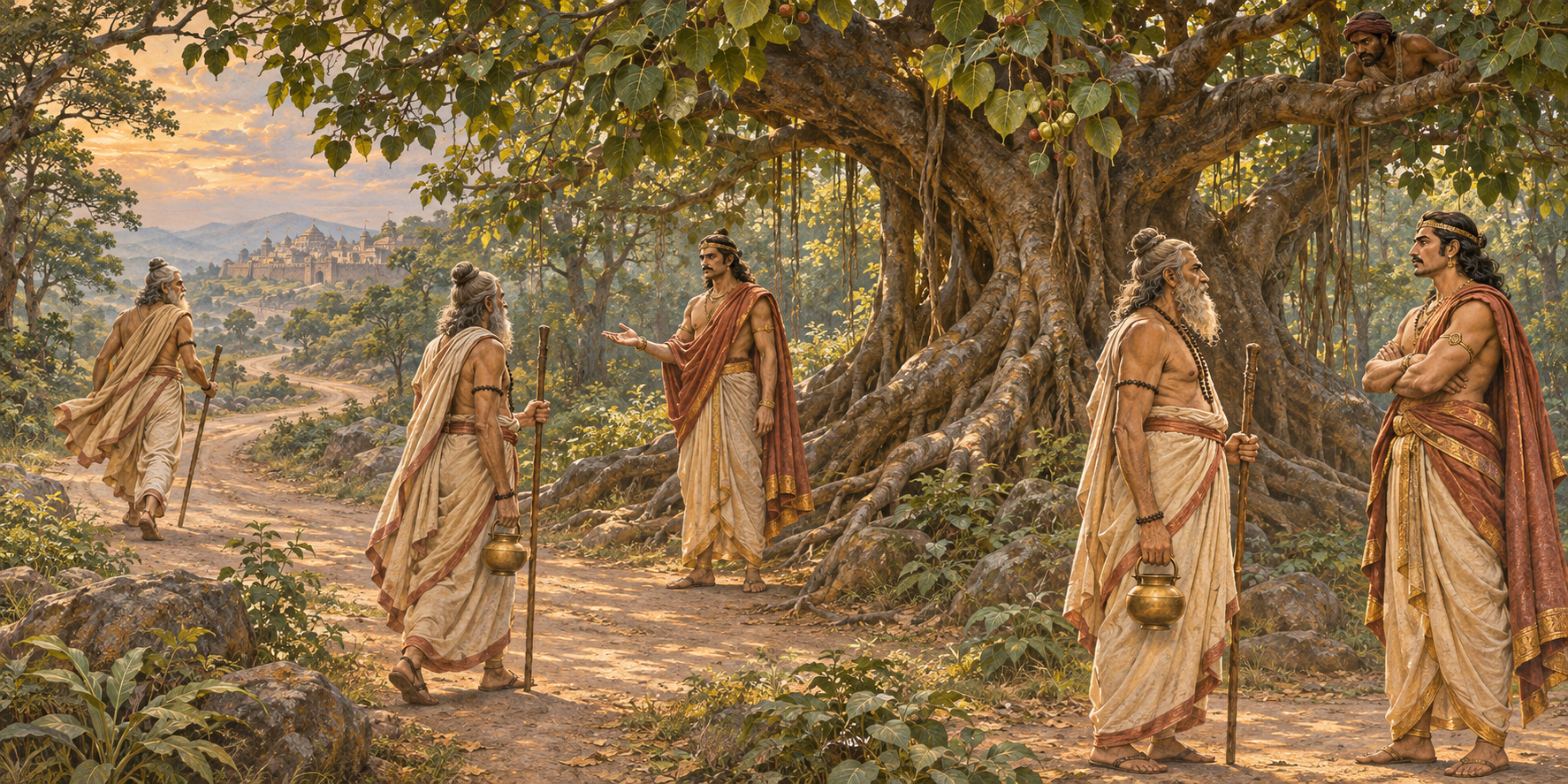
The meeting is related in chapters 39 and 46 of Astika Parva in the Adi Parva. King Parikshit faces death from Takshaka’s venom. Kashyapa travels toward the king with the knowledge and power to counter it. Takshaka meets him before he reaches Parikshit and challenges the claim that his venom can be overcome.
Takshaka burns a fig tree. Kashyapa restores it, together with a man who was upon it. The demonstration settles the question of ability: Kashyapa really can reverse Takshaka’s destructive power. Yet Kashyapa does not continue to the king. A material inducement from Takshaka and Kashyapa’s discernment that Parikshit’s allotted span has reached its end both enter the decision. Kashyapa turns back, and Takshaka reaches Parikshit.
Do not compress this sequence into a verdict such as “Kashyapa was bought” or “destiny made every choice irrelevant.” Keep four questions separate:
- Event: What did each person actually do?
- Capacity: What had each person proved he could do?
- Motive: What reasons and incentives shaped the choice?
- Evidence: How did anyone else learn what occurred?
This separation matters because an action, the power behind it, its motive and the evidence for it are not interchangeable. The Mahabharata gives you material for all four, but it does not relieve you of the work of weighing them.
The fig tree proves capacity, not righteousness
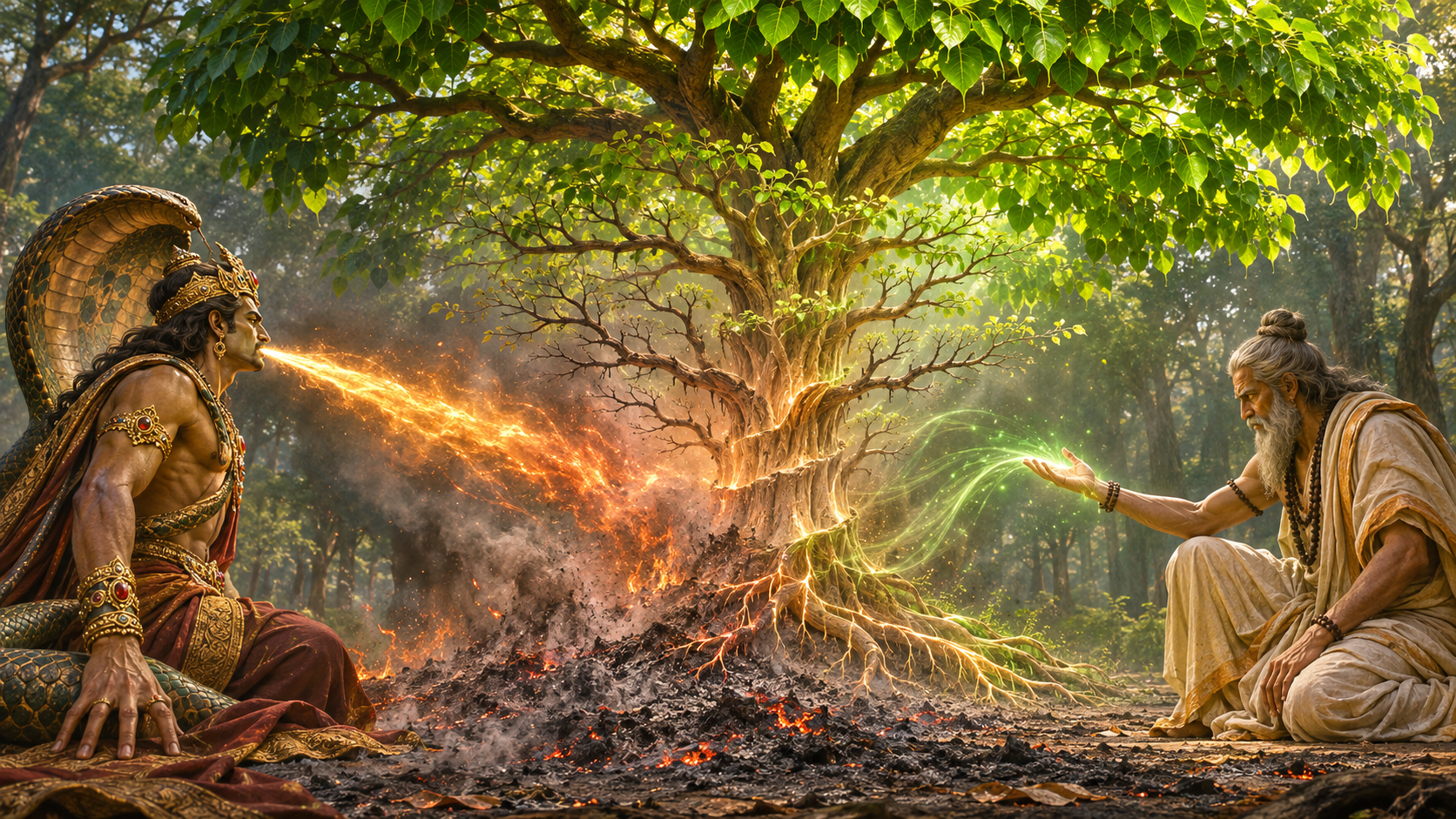
The encounter at the tree can look like a contest between two masters. Takshaka demonstrates the power to destroy. Kashyapa demonstrates the power to restore. The contrast is dramatic, but the result answers only one question: whether Kashyapa possesses an effective remedy.
It does not prove that every later decision Kashyapa makes is dharmic. Nor does Takshaka’s formidable power grant moral authority to whatever he chooses. Ability answers “Can this be done?” Dharma still asks “Should it be done, for what purpose, within what limits, and at whose cost?”
This distinction is easy to lose when power is impressive. A teacher’s learning, a ruler’s strength, an ascetic’s siddhi, a donor’s wealth or an expert’s technical success may establish competence. None of them makes the possessor morally infallible. When you are evaluating authority, refuse to let a display of capacity answer a question about character or duty.
The man on the tree makes this lesson sharper. Whether or not the two powerful figures noticed him before the burning, he prevents you from treating the test as a sterile spectacle. Their demonstration contains a human life. Kashyapa reverses the destruction, but the man’s presence still directs your attention toward the bystander who bears the risk when powerful people test one another.
That gives you a useful habit of attention. Whenever a conflict is narrated mainly as a clash between great figures, look for the person in the tree: the less visible person exposed to consequences without controlling the contest. Dharmic judgment is incomplete until that person’s position is counted.
Kashyapa’s withdrawal puts destiny beside incentive
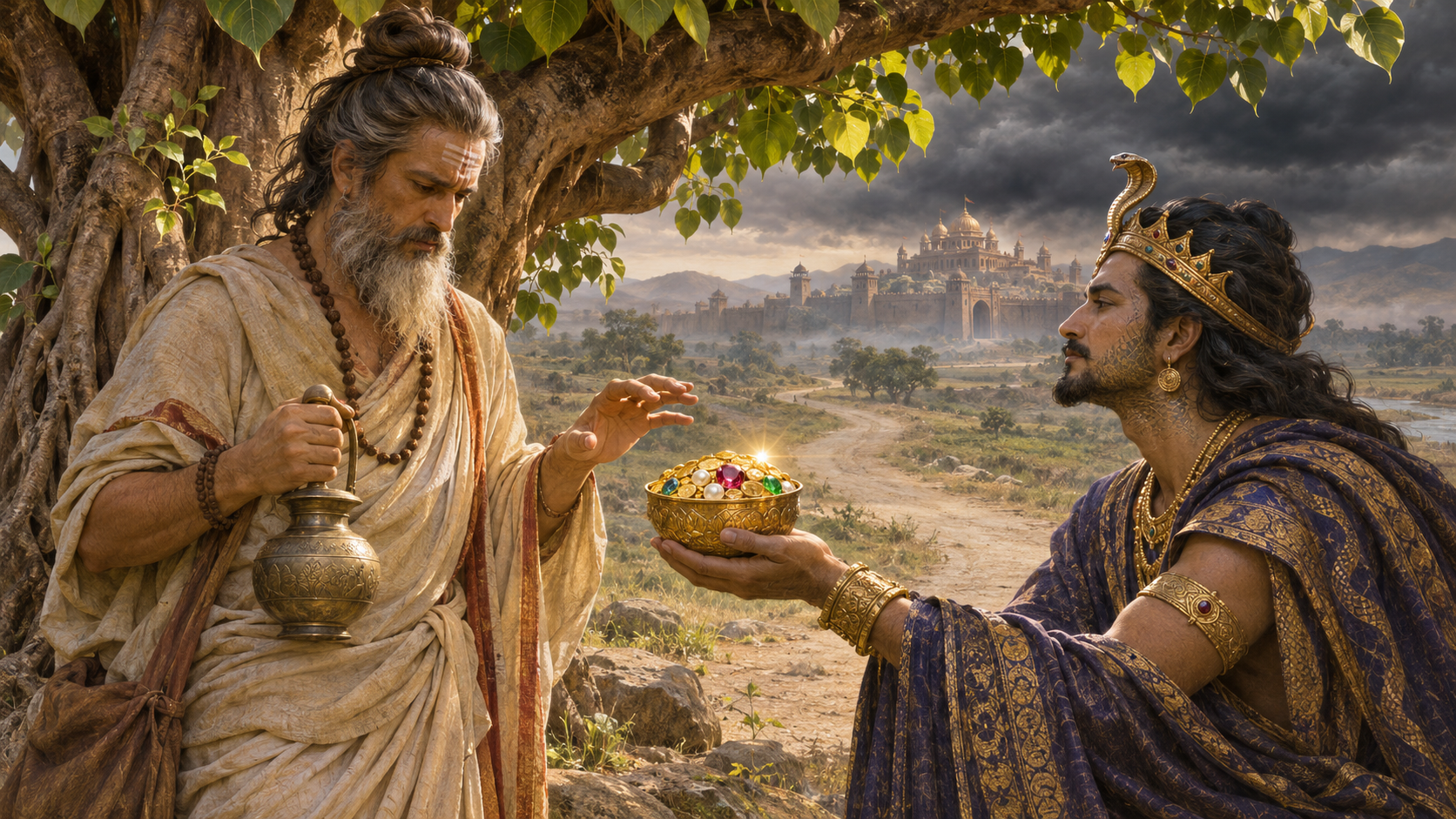
The morally difficult part of the episode is not Kashyapa’s restoration of the tree. It is his withdrawal after proving that he can resist Takshaka’s venom. Two considerations stand beside each other: the limit imposed by Parikshit’s allotted life and the benefit Kashyapa receives for turning back.
A shallow defence mentions destiny and erases the material inducement. A shallow accusation mentions the inducement and erases Kashyapa’s discernment. A serious reading does neither. The presence of wealth does not automatically prove corruption, but it removes any presumption that the decision needs no scrutiny. A spiritual explanation does not become false merely because a benefit accompanies it, but neither should it function as an all-purpose shield against questions.
Capability normally creates some responsibility. If you possess a remedy and are already travelling to help, your ability is morally relevant. It does not follow, however, that finite human agency must overturn every consequence associated with karma or an exhausted lifespan. The episode places those truths in tension instead of allowing either to swallow the other.
Use five questions when your own duty appears to conflict with a benefit or a claimed limit:
- Role: What obligation belonged to you before any reward or pressure appeared?
- Capacity: What can you actually do, rather than merely claim to do?
- Grounds: What evidence supports the limit, necessity or appeal to destiny?
- Incentive: Would you make the same decision if the personal benefit disappeared?
- Answerability: Can you explain the decision and its timing to the people who bear its cost?
The fourth question is especially demanding. If removing the benefit would change your decision, do not disguise preference as inevitability. If the decision truly would remain the same, record or state the reason before accepting the benefit. That sequence cannot make a person pure, but it makes self-deception harder and accountability more possible.
Destiny in the Mahabharata is not permission for moral laziness. Characters still choose, speak, accept, refuse and answer for their conduct within conditions they did not create. A fixed outcome may limit what an action can accomplish; it does not automatically make every action leading to that outcome equally dharmic.
The revived man makes power answerable
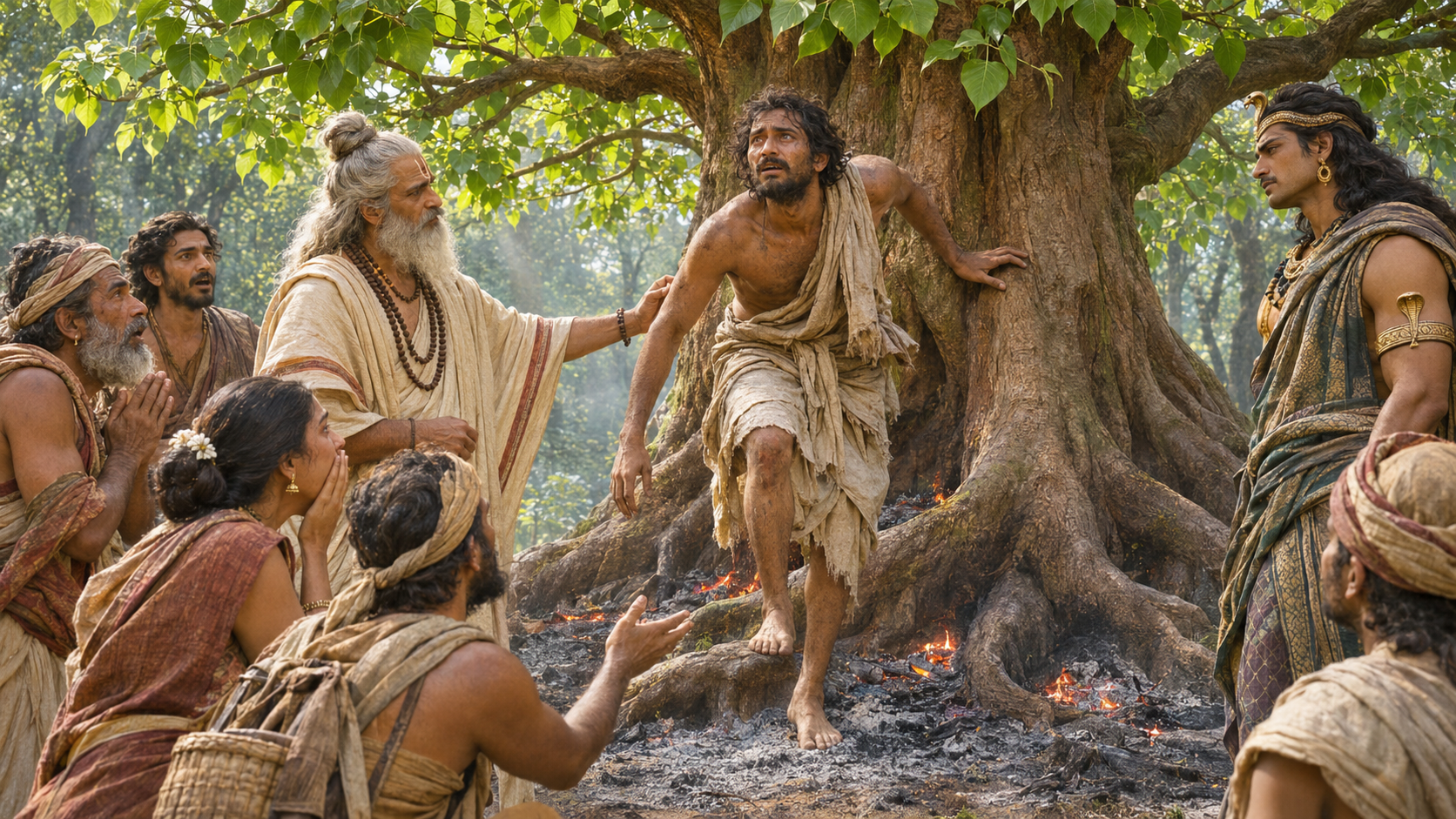
Chapter 46 adds a detail that changes how the encounter should be read. Janamejaya asks how his ministers learned about the exchange connected with his father. The man who survived the burning and restoration becomes the means by which the event is known.
In our reading, this gives Kashyapa’s restorative power an unplanned moral consequence. He does not save Parikshit, but by restoring the man he preserves a witness. The private meeting between two exceptional beings can therefore enter public memory, be reported to ministers and be questioned by a son seeking to understand his father’s death.
The witness does not make everyone omniscient. He can establish an exchange, its sequence and what he observed. He cannot give direct access to Kashyapa’s innermost discernment. That distinction is essential. Evidence can justify questions about conduct without proving every suspicion about motive.
Use the same discipline when judging a dispute in a family, institution or community. Establish the chronology. Separate observed conduct from inferred intention. Identify who benefited and who bore the consequence. Preserve what witnesses can genuinely establish, and leave uncertain what their testimony cannot settle. This is not indecision. It is the refusal to manufacture certainty for the sake of a cleaner story.
The revived man also corrects a common way of treating miracles in epic literature. The restoration is not merely an interruption of ethical reasoning by supernatural spectacle. It helps create the conditions for ethical reasoning. Power restores a life; the restored life carries testimony; testimony makes power answerable.
Key takeaways
- Read the entire sequence before assigning praise or blame. Capacity, choice, motive and evidence are different questions.
- The fig-tree test proves that Kashyapa can counter Takshaka’s power. It does not place Kashyapa beyond moral examination.
- An appeal to destiny does not erase agency, while the presence of a reward does not by itself prove corruption. Both must remain visible.
- The man on the tree represents the bystander endangered by a contest he does not control.
- His survival turns a private display of power into testimony and public accountability.
- When duty and benefit coincide, test the decision through role, capacity, grounds, incentive and answerability.
On your next reading of a difficult Mahabharata episode, mark four things in the margin: who can act, who benefits, who bears the risk and who can testify. That small discipline will keep power from masquerading as dharma and destiny from becoming an excuse for convenience.
References

Leave a Reply
You must be logged in to post a comment.