
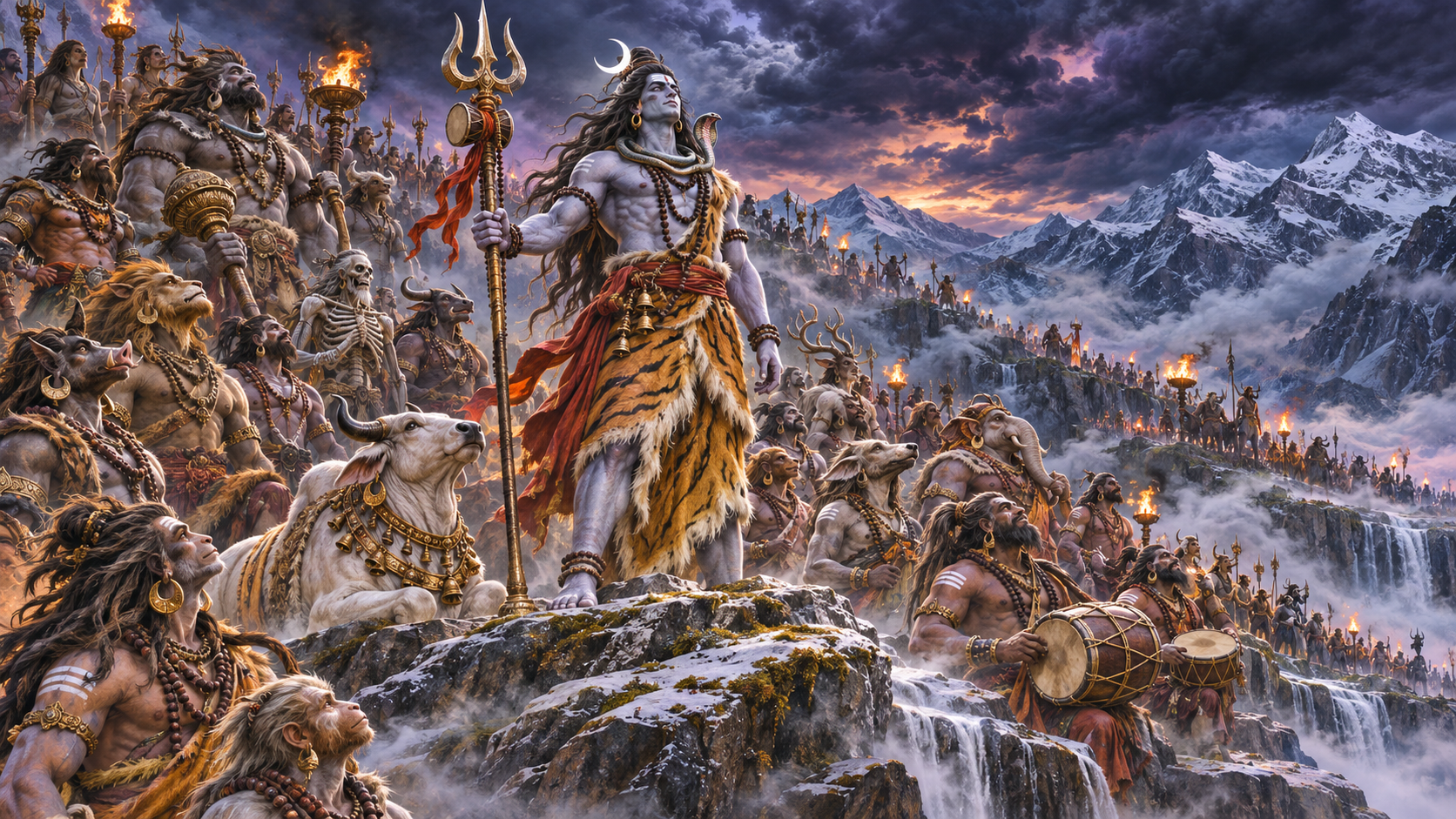
You may have encountered the Pramathaganas in a Shiva narrative and wondered what kind of beings they are. Are they demons, minor deities, spirits, soldiers, or simply a poetic name for Shiva’s followers? The traditional number attached to them – 360 million – can make the question even more confusing.
Begin with one governing idea: the Pramathaganas are Shiva’s fierce attendants. Their identity comes not only from their frightening power, but also from their allegiance. They belong to Shiva’s retinue, act under his authority, and express the severe side of cosmic order.
Start with the name, but do not stop at its etymology
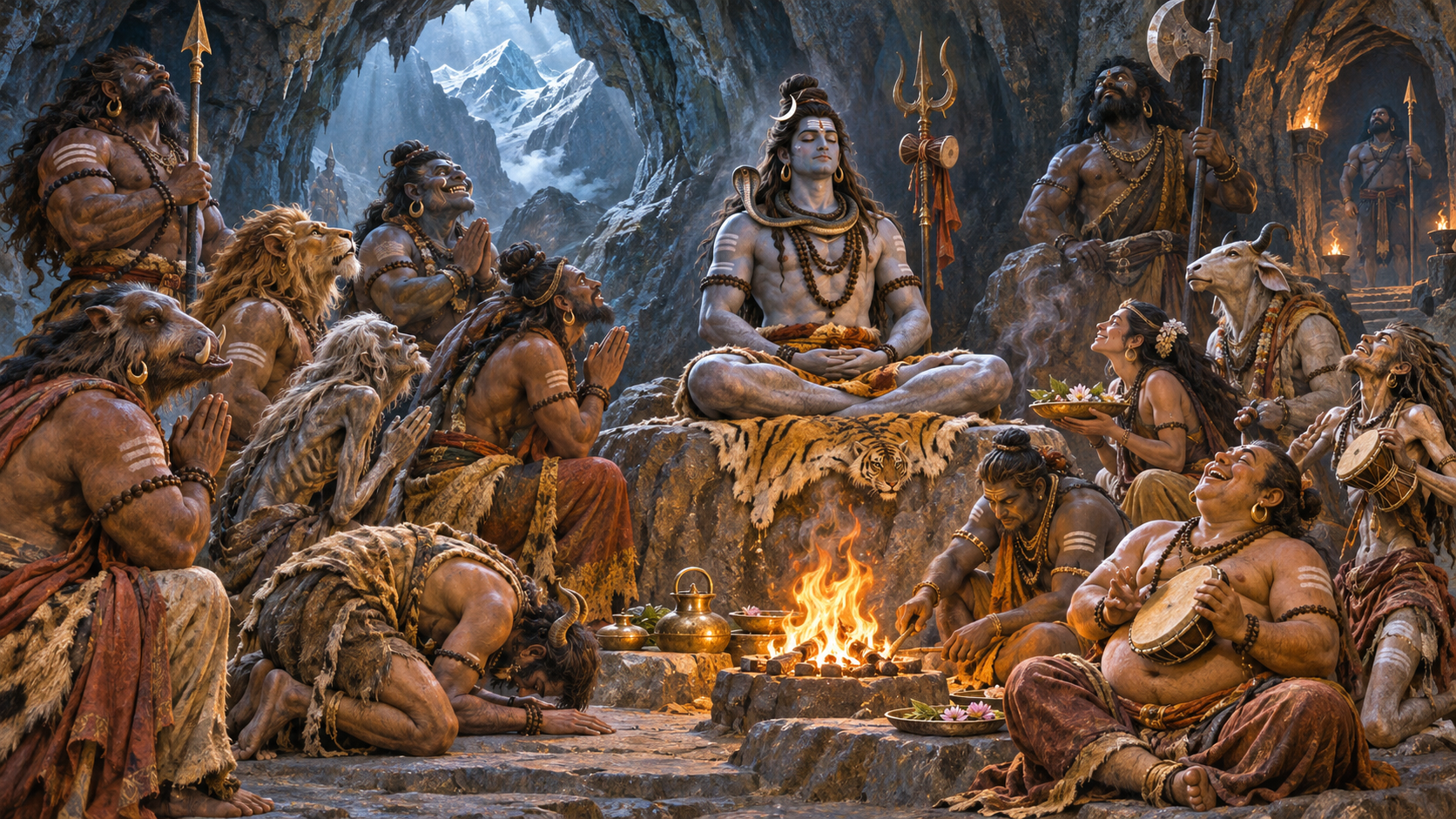
The word pramatha is associated with the Sanskrit senses “to torment” and “to punish”. Joined to gana, a group or host, the name identifies a collective whose force can terrify, subdue, and chastise.
That meaning is important, but an etymology is not a complete biography. It does not mean that every Pramathagana is always tormenting someone, that every appearance concerns punishment, or that cruelty is their defining virtue. It tells you what kind of potency the name foregrounds. The surrounding passage must still tell you how that potency is being used.
A disciplined reading therefore holds two facts together: these beings are formidable, and they are devoted attendants. If you retain only the first fact, they look like agents of disorder. If you retain only the second, their fierce name becomes meaningless. Their distinct character lies in the combination.
When you meet the term in a narrative, translation, discourse, or devotional explanation, check four details before deciding what it means:
- The exact word: Is the passage naming Pramathaganas specifically, or merely referring to attendants in general?
- The action: Are they accompanying Shiva, guarding, confronting, or punishing?
- The relationship: Does the passage present them as acting under Shiva’s command or simply place fierce beings in the same scene?
- The translator’s choice: Words such as “ghosts,” “demons,” “spirits,” “hosts,” and “attendants” carry different assumptions. Do not let one English label settle the theology by itself.
Read 360 million as sacred scale before treating it as arithmetic
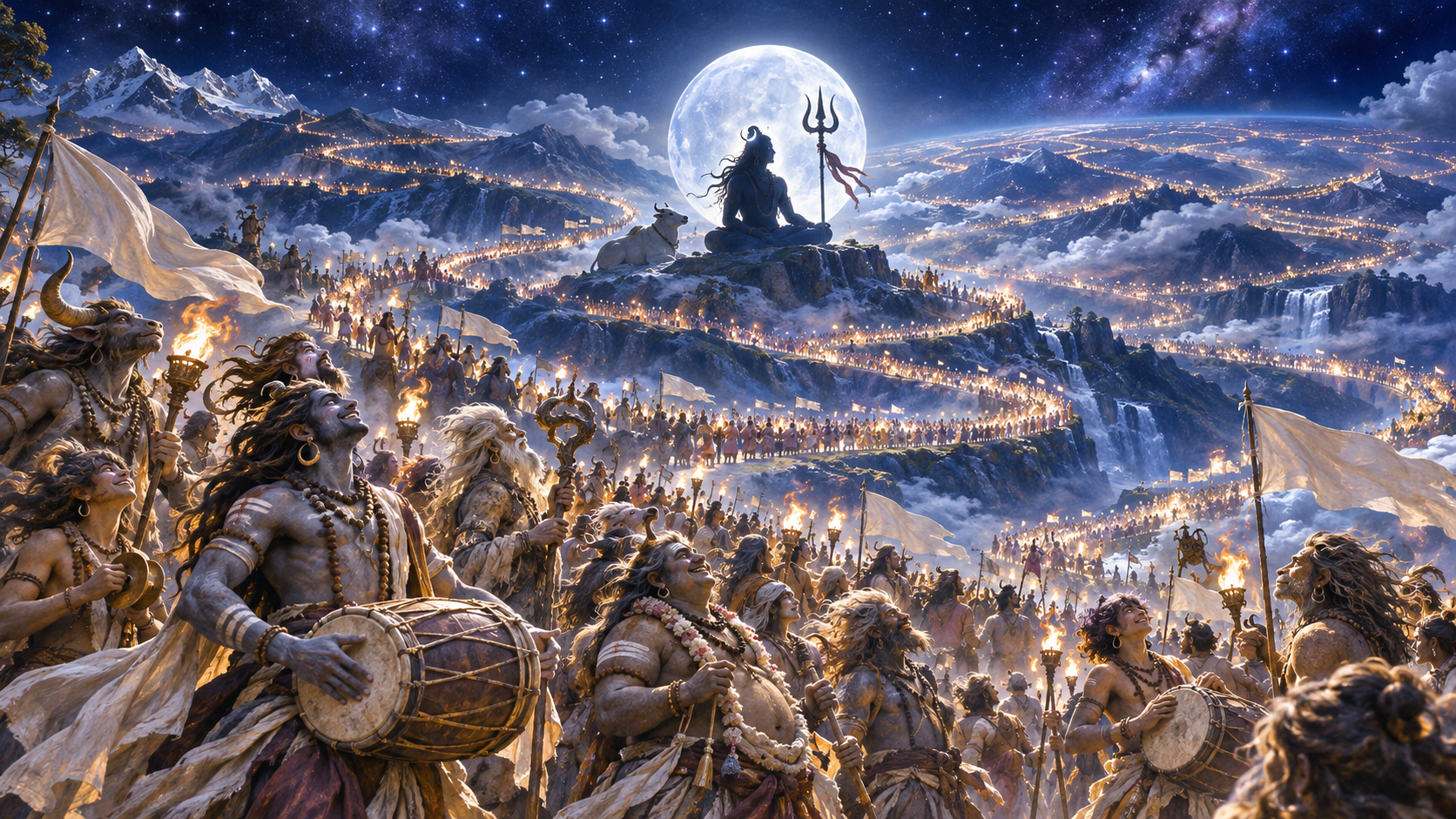
Traditional descriptions give Shiva an extraordinary retinue of 360 million Pramathaganas. You should preserve that number when explaining the tradition. You should also resist turning it into a modern census.
A precise sacred number can perform more than one function. Here it first communicates scale: Shiva is not surrounded by a small court with a few recognizable officers. His host is imagined as overwhelmingly vast, suited to a deity whose authority is cosmic rather than local.
This reading prevents two common mistakes. The first is dismissing the number because it does not behave like demographic data. The second is inventing details that the number itself does not supply. A total of 360 million does not establish that every attendant is individually named, that all have the same form, that they occupy identical ranks, or that a complete roster exists somewhere.
The responsible conclusion is narrower and stronger: the tradition portrays Shiva’s retinue as practically beyond ordinary enumeration. Any particular Pramathagana encountered in a story belongs within that much larger horizon. A named or depicted group need not be the whole host.
If you are teaching or discussing the number, say both parts plainly: “The traditional count is 360 million, and its immediate theological effect is to convey the immensity of Shiva’s following.” That respects the inherited statement without pretending to know a counting scheme that has not been provided.
Their fierceness is governed, not aimless
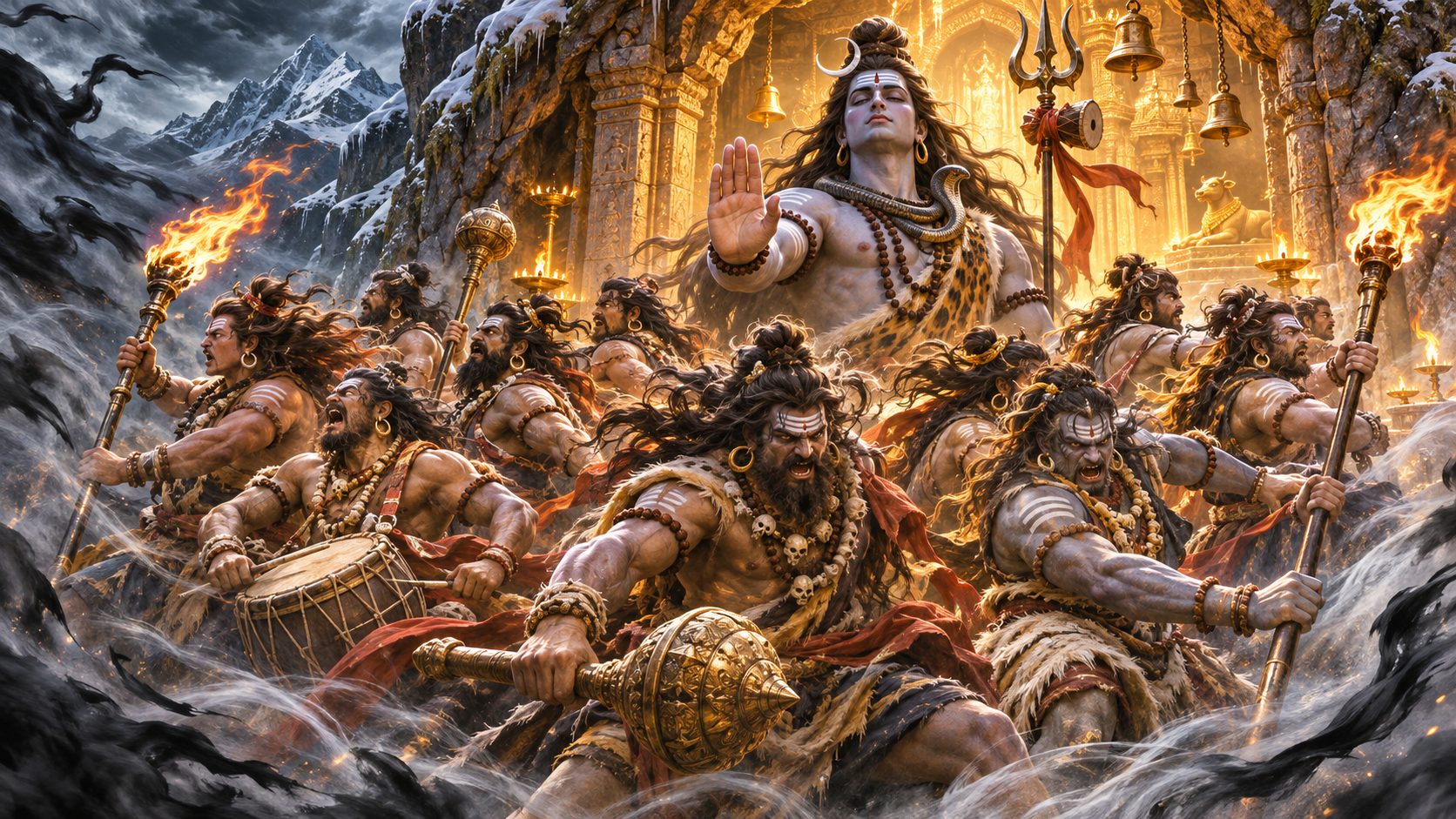
The Pramathaganas are described both as Shiva’s attendants and as a divine force connected with cosmic justice. That pairing changes how their fearsome character should be understood. Their power is not presented as independent chaos. It is power placed within Shiva’s order.
This matters because outward appearance is an unreliable moral test in Shiva’s world. A being may be unsettling without being an enemy of dharma. Conversely, a pleasant appearance does not by itself establish righteousness. Allegiance, purpose, and action matter more than whether a figure fits a comfortable image of divinity.
You can use three contrasts to keep the interpretation clear:
- Fierce does not automatically mean evil. The question is what the fierceness serves.
- Punitive does not mean arbitrary. The Pramathaganas’ identity is tied to Shiva’s authority, not to uncontrolled torment.
- Many attendants do not imply many rival sovereignties. Their multitude magnifies the reach of Shiva’s command because they form his retinue.
This is also an ethical boundary. The sacred image of a punitive divine host does not give human beings permission to glorify cruelty, imitate violence, or declare their personal anger to be cosmic justice. The point is that formidable power is subordinated to a higher order. Remove that subordination and you have removed the feature that makes the Pramathaganas Shiva’s attendants rather than a lawless mob.
Theologically, their presence also keeps us from reducing Shiva to a reassuring but incomplete image. Shiva’s realm can contain what ordinary social vision avoids: the fearsome, the marginal, and the difficult. Yet inclusion does not erase order. The host remains a host because its many members gather around a centre.
Use this four-question method when you encounter them
You do not need an invented catalogue of names or ranks to read a Pramathagana passage intelligently. Work from what the passage actually gives you.
- Identify the relationship to Shiva. Look first for attendance, command, service, or proximity. This establishes whether the beings are functioning as his retinue in that scene.
- Identify the immediate task. Do not assume that their etymology determines every action. If they are merely accompanying Shiva, do not embellish the scene into a punishment narrative. If they are chastising an opponent, do not soften the scene into harmless pageantry.
- Ask what their fierceness accomplishes. Does it protect an order, answer a transgression, display Shiva’s reach, or make an approaching divine presence overwhelming? Let the action determine the emphasis.
- Separate observation from interpretation. “The passage presents a vast, fierce retinue” is an observation. “The retinue represents every untamed force in the human mind” is an interpretation. Symbolic readings may be fruitful, but label them as readings rather than as the only definition of the beings.
This method is especially useful when two explanations appear to conflict. One may emphasize devoted service, while another emphasizes punishment. Those descriptions are not necessarily rivals. Service describes the Pramathaganas’ relationship to Shiva; punishment describes one kind of work associated with their name and role.
It also helps you evaluate modern claims. Be cautious when someone supplies an elaborate hierarchy, a complete list, or a fixed psychological meaning without identifying where that detail comes from. The secure core is already substantial: an immense host, devoted to Shiva, fearsome in character, and capable of serving cosmic justice.
Key takeaways
- The Pramathaganas are Shiva’s celestial attendants, not merely a collection of unrelated frightening beings.
- The name foregrounds the power to torment or punish, but context determines what they are doing in any particular appearance.
- The traditional total of 360 million conveys the overwhelming scale of Shiva’s retinue; it should not be expanded into an unsupported census or hierarchy.
- Their fierce appearance must be read together with their devotion and subordination to Shiva’s authority.
- Their connection with cosmic justice does not sanctify personal cruelty or uncontrolled anger.
- When reading a passage, examine the exact term, the action, the relationship to Shiva, and the difference between textual description and symbolic interpretation.
The next time you meet the Pramathaganas, resist the urge to force them immediately into the category of either “god” or “demon.” First notice whom they attend, what they are doing, and what their multitude communicates. You will then see the central idea more clearly: Shiva’s vast domain does not exclude fierce powers, but gathers them into service.
References

Leave a Reply
You must be logged in to post a comment.