
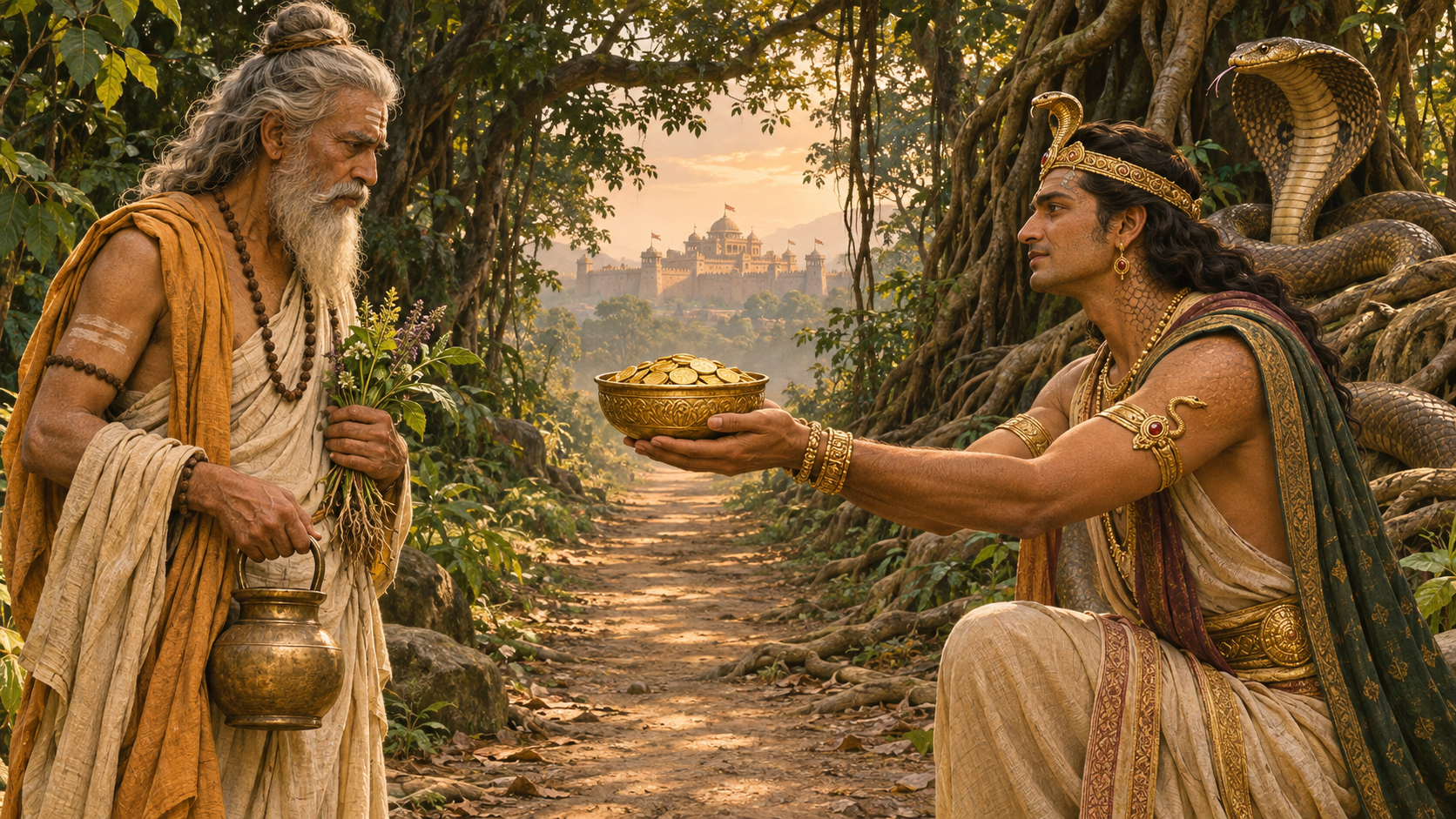
If you came to this episode wondering whether Sage Kashyapa was simply bribed, you are asking the right question at the wrong level. The decisive issue is not merely that money changed hands. It is what Takshaka’s payment purchased from a person whose knowledge could have saved a life.
Takshaka did not reward Kashyapa for using his skill. He paid him to withdraw it. Yet the presence of a curse, Kashyapa’s recognition of fate, and his expectation of a royal reward prevent an easy verdict. Read carefully, the encounter becomes a practical lesson in distinguishing legitimate compensation from an inducement that redirects duty.
What happens between Takshaka and Kashyapa
King Parikshit has been condemned by a curse to die through Takshaka’s bite. Kashyapa, who possesses the knowledge needed to counter serpent venom, sets out to reach the king. He expects that saving a monarch will bring a substantial reward.
Takshaka meets him on the way. The encounter is not a dispute between an ignorant serpent and a boastful healer: Takshaka tests his venom on a tree, and Kashyapa demonstrates that he can restore what the poison destroyed. The test removes any doubt about Kashyapa’s ability. Takshaka now knows that the sage may be able to obstruct the death appointed for Parikshit.
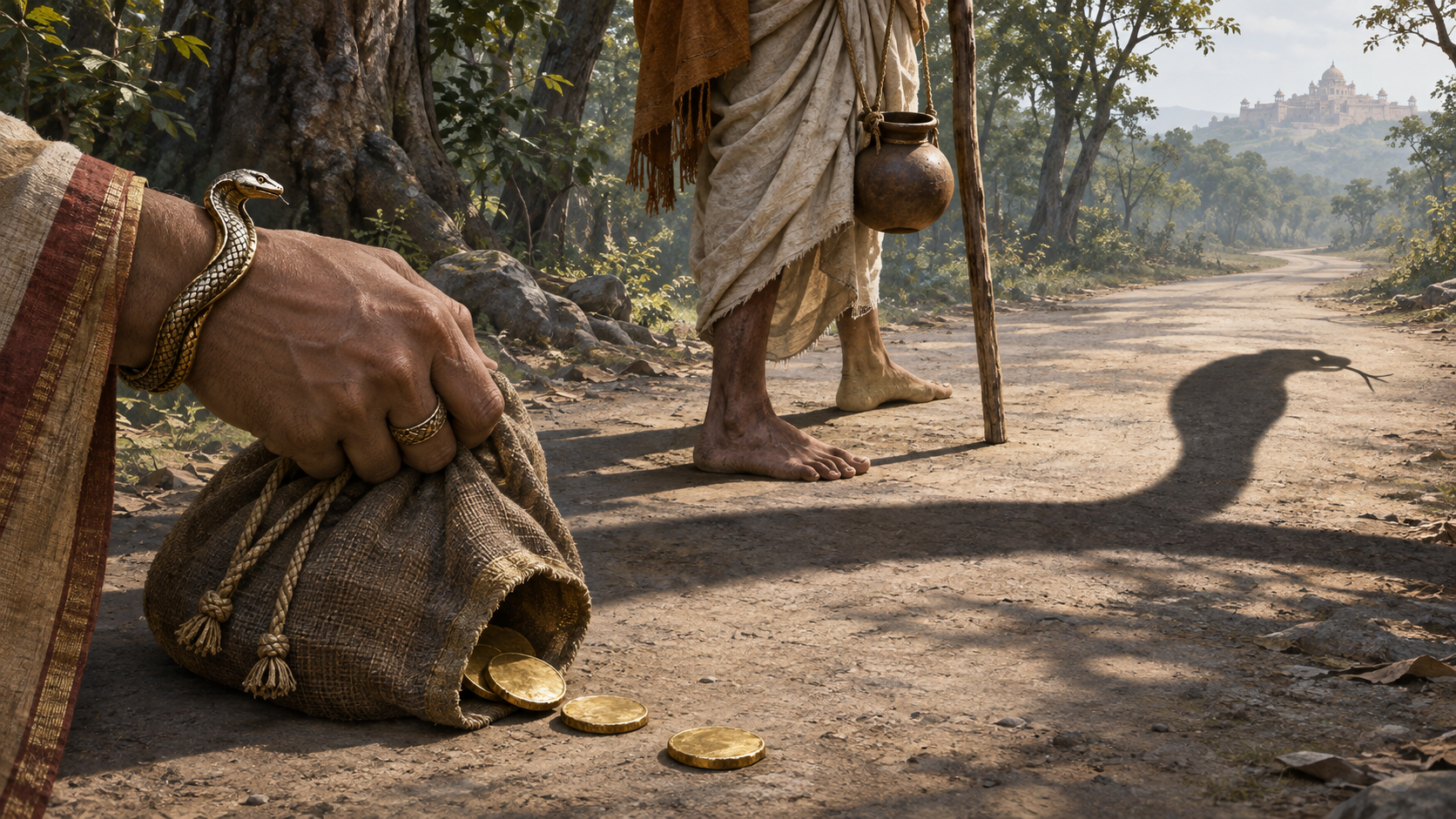
Takshaka therefore offers Kashyapa more wealth than the sage expects to receive from the king. The condition is decisive: Kashyapa must turn back. Kashyapa accepts the payment and abandons his journey. The narrative also brings destiny into the decision, for Kashyapa discerns that Parikshit’s allotted life has reached its end.
The incident belongs to the Astika Parva of the Adi Parva and is associated mainly with Chapters 39 and 46, though chapter numbering can vary between editions. Three moments must be kept separate: Kashyapa proves his power, Takshaka purchases his withdrawal, and fate is invoked as a reason that intervention would not finally succeed. If you collapse those moments into one, you will either condemn Kashyapa too quickly or excuse the transaction too easily.
Why the word “bribe” is useful but incomplete
Calling Takshaka’s payment a bribe captures its moral pressure. Money is offered by an interested party to stop a capable person from intervening. But the modern word can also smuggle in assumptions that the episode does not establish. Kashyapa is not presented here as a salaried royal physician, a court officer, or an agent already commissioned by Parikshit.
A cleaner ethical question is: what did the payment buy?
| Kind of payment | What the payer purchases | Effect on duty |
|---|---|---|
| Fee for service | The use of knowledge or labour | Payment supports the act the skill is meant to perform |
| Counter-payment | Withdrawal, silence, or non-intervention | Payment redirects the skilled person away from the proposed act |
| Gift after a completed act | No immediate change to the decision already made | Direct leverage is weaker, although future influence may remain |
The reward Kashyapa anticipates from Parikshit belongs to the first category: payment for curing the king. Takshaka’s offer belongs to the second. He is not hiring Kashyapa to perform another healing. He is purchasing the healer’s absence.
This distinction matters because neither wealth nor compensation is automatically opposed to dharma. Artha, material means and prosperity, has a legitimate place in Dharmic life. A healer’s need for livelihood does not invalidate healing, just as a teacher’s compensation does not invalidate teaching. The problem begins when payment severs knowledge from the good that gives the knowledge its purpose.
Fate complicates causal responsibility without erasing moral agency. If Parikshit’s end cannot be averted, Kashyapa’s return may not be what causes the king’s death. But the transaction still reveals what each party is willing to buy or sell. An action can make no difference to the final outcome and still disclose intention, allegiance, and character.
Takshaka’s wealth is a form of power
Traditional naga imagery links serpents with hidden, stored, and guarded treasure. Takshaka’s ability to offer more than a king makes that association concrete. The episode does not merely tell you that a naga possesses riches. It shows wealth being used to control whether another person’s power enters the field.
Takshaka’s treasure operates at three levels. As a resource, it can satisfy Kashyapa’s desire for reward. As leverage, it changes the sage’s course. As a test, it exposes whether Kashyapa’s journey is governed principally by the wish to preserve life, the hope of wealth, discernment about destiny, or some mixture of all three.
The inversion is easy to miss. Parikshit possesses royal authority, yet the king does not control this transaction. Takshaka, acting outside the human court, can outbid the anticipated royal reward and redirect the one man who has demonstrated an answer to his venom. Wealth here approaches sovereignty: it determines which ability will be present and which will remain absent.
That does not make treasure inherently corrupt, and it does not turn Takshaka’s superior offer into evidence of superior virtue. Wealth takes its ethical colour from the relationship it creates. Money that equips a person to fulfil a sound responsibility differs from money that makes responsibility inconvenient, negotiable, or invisible.
Five questions for judging money against duty
You can use the encounter as a compact ethical audit whenever money may be changing a professional, familial, or public responsibility. Answer these questions before deciding, not after the payment has made the preferred answer easier to defend.
- What exact act is being purchased? Replace vague words such as “consulting,” “support,” or “consideration” with the concrete result. Is the payer buying work, or buying silence, delay, withdrawal, access, endorsement, or non-intervention?
- What duty existed before the offer? Separate possession of a useful ability from a formal obligation to use it. A contract, entrusted office, promise, professional code, or dependent relationship creates a stronger claim than the mere fact that you could help. Greater capacity raises the moral stakes, but it does not by itself prove that every possible beneficiary has a claim on you.
- Would you make the same decision without the money? Remove the offer from the thought experiment. If you would still withdraw because the action is futile, improper, or outside your responsibility, the payment may be incidental. If the decision changes with the offer, money is doing the real work.
- Are you confusing a fixed outcome with a harmless choice? “It would have happened anyway” addresses consequence, not necessarily integrity. Ask whether the payment bought consent to something you otherwise regarded as wrong, even if the final outcome was beyond your control.
- Could you explain the arrangement to the affected person? State who paid, what changed, and why. If the explanation depends on concealing the condition attached to the money, you have identified the conflict that needs attention.
Write one sentence for each answer. The exercise prevents a large payment from hiding behind an abstract justification. It also stops you from mistaking every paid decision for corruption: sometimes compensation supports duty, sometimes it competes with duty, and sometimes no prior duty existed.
If an offer is conditioned on silence, withdrawal, or non-intervention while you hold a formal responsibility, pause before accepting it. Applicable law, contract terms, and professional codes govern real-world obligations; an epic episode can clarify the conflict, but it cannot cancel those rules.
Key takeaways
- Kashyapa’s demonstrated ability matters: Takshaka pays him because the sage is a credible obstacle, not because he is merely passing by.
- The ethically significant fact is that Takshaka purchases withdrawal rather than service.
- Kashyapa’s hope of reward does not make wealth itself impure; the direction in which money turns his knowledge is the harder issue.
- Destiny may explain why Parikshit cannot ultimately be saved, but it does not make the bargain ethically meaningless.
- Takshaka’s riches express naga power as practical leverage: treasure can decide whose ability enters an event.
- In your own decisions, ask what the payment changes, what obligation already exists, and whether you would act the same way without the money.
The next time money and duty pull in different directions, do not begin by asking whether wealth is pure or impure. Name the act being bought. Identify the responsibility that existed before the offer. Then test whether your reason survives after the money is removed. That is where the Takshaka-Kashyapa encounter stops being an old puzzle and becomes a living discipline of discernment.


References

Leave a Reply
You must be logged in to post a comment.