
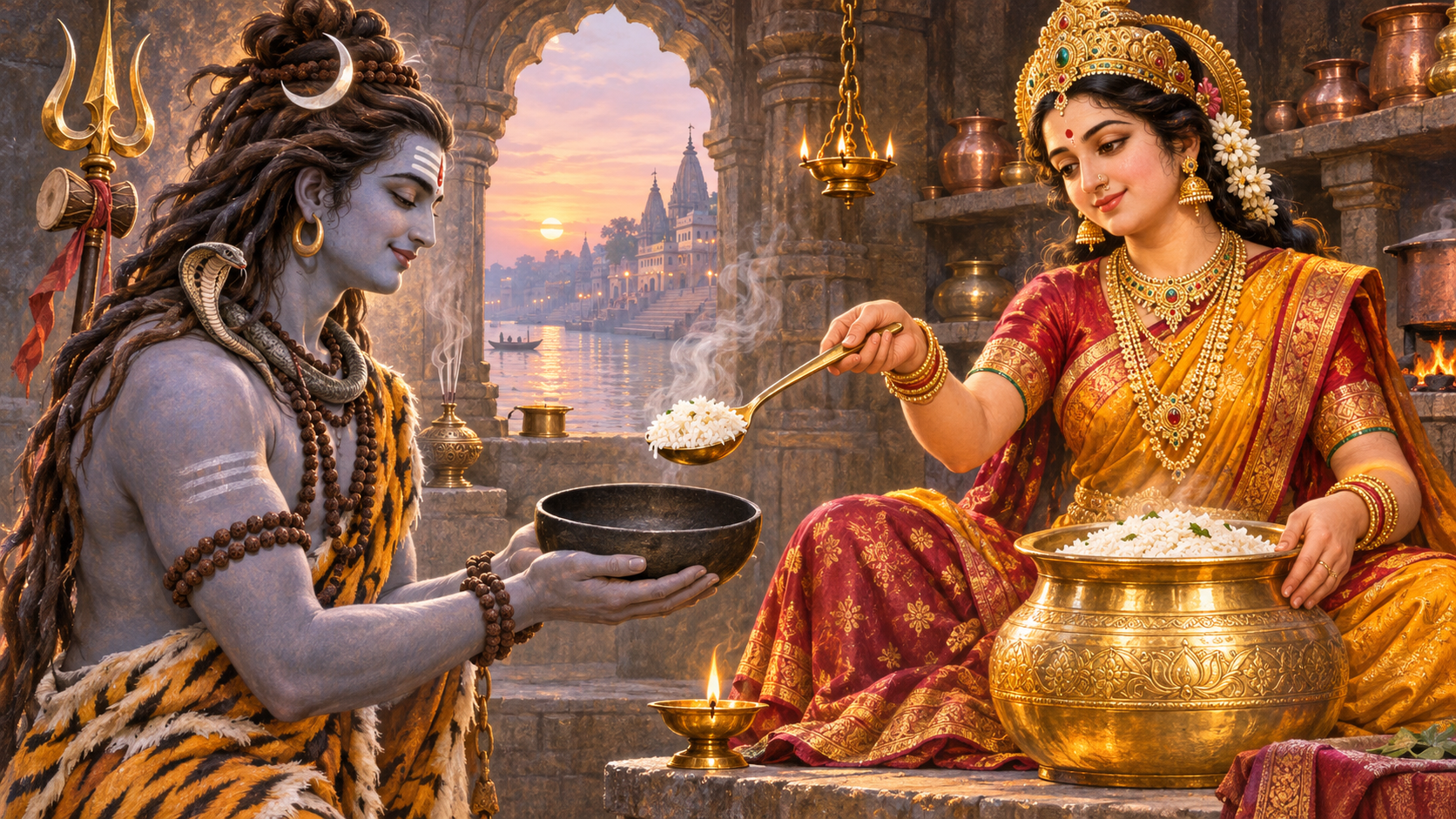
You may have paused before the image and wondered: why should Mahadev, free from attachment, stand with an empty bowl before Annapurna? If you read the scene only as one person giving food to another, it can look like a contradiction. Read symbolically, and the contradiction becomes the teaching.
The image brings two truths into the same frame. You need inner emptiness if you are to receive anything without grasping, but you also need nourishment if you are to live, serve, and practise dharma. Shiva shows the freedom of non-possession. Annapurna shows the sacred fullness that sustains embodied life.
The paradox is the teaching
The central image is Mahadev, the ascetic who has relinquished attachment, standing before Maa Parvati as Annapurna with an empty bowl. Nothing in the scene needs to be treated as an embarrassment. The apparent reversal is precisely what makes it spiritually useful.
Three visual details should guide your reading:
- The bowl is empty. It represents capacity rather than accumulated possession. What is already crowded cannot receive.
- Shiva is the recipient. Spiritual stature does not abolish receptivity. Even the great ascetic is shown in relation, not in proud isolation.
- Annapurna is the giver. Food and care are not placed beneath spiritual life. They appear as divine power sustaining it.
The scene therefore does not portray Shiva as defeated or Annapurna as merely performing a domestic task. Shiva’s extended bowl is a posture of openness. Annapurna’s gift is an expression of sacred abundance. Neither meaning is complete if the other figure is removed.
When you contemplate the image, begin with a direct question: where have you confused independence with a refusal to receive? That question may expose pride more quickly than a general meditation on humility.
Shiva’s emptiness is readiness, not deficiency

An empty bowl is not valuable because emptiness itself is miserable. It is valuable because emptiness makes receiving possible. In Shiva’s hands, the bowl can be read as non-possession: he does not approach Annapurna with a claim of ownership, a store of excess, or an illusion of self-sufficiency.
This distinction matters in ordinary life. A mind crowded with status, certainty, resentment, and the need to control every outcome may possess many things while remaining unable to receive correction, affection, grace, or help. Shiva’s bowl asks you to make space, not to cultivate lack for its own sake.
Keep three conditions separate:
- Renunciation is the loosening of attachment. You may use and receive what is needed without making it the foundation of your identity.
- Deprivation is the absence of what a person needs. It should not be romanticised as automatic spiritual advancement.
- Neglect is the refusal to meet a real responsibility. Ascetic language cannot excuse indifference toward a body, family, guest, or dependent entrusted to your care.
This prevents a common misreading. Shiva’s emptiness does not instruct you to despise food, the body, or material duties. It instructs you to stop treating possession as sovereignty. You can care for what has been placed in your hands without pretending that you created, control, or permanently own it.
Before a meal or prayer, pause and ask: what am I carrying that leaves no room to receive? Name one attachment plainly. It may be the need to win an argument, appear invulnerable, or control how another person helps you. That is the part of your bowl that needs emptying.
Annapurna reveals nourishment as sacred fullness
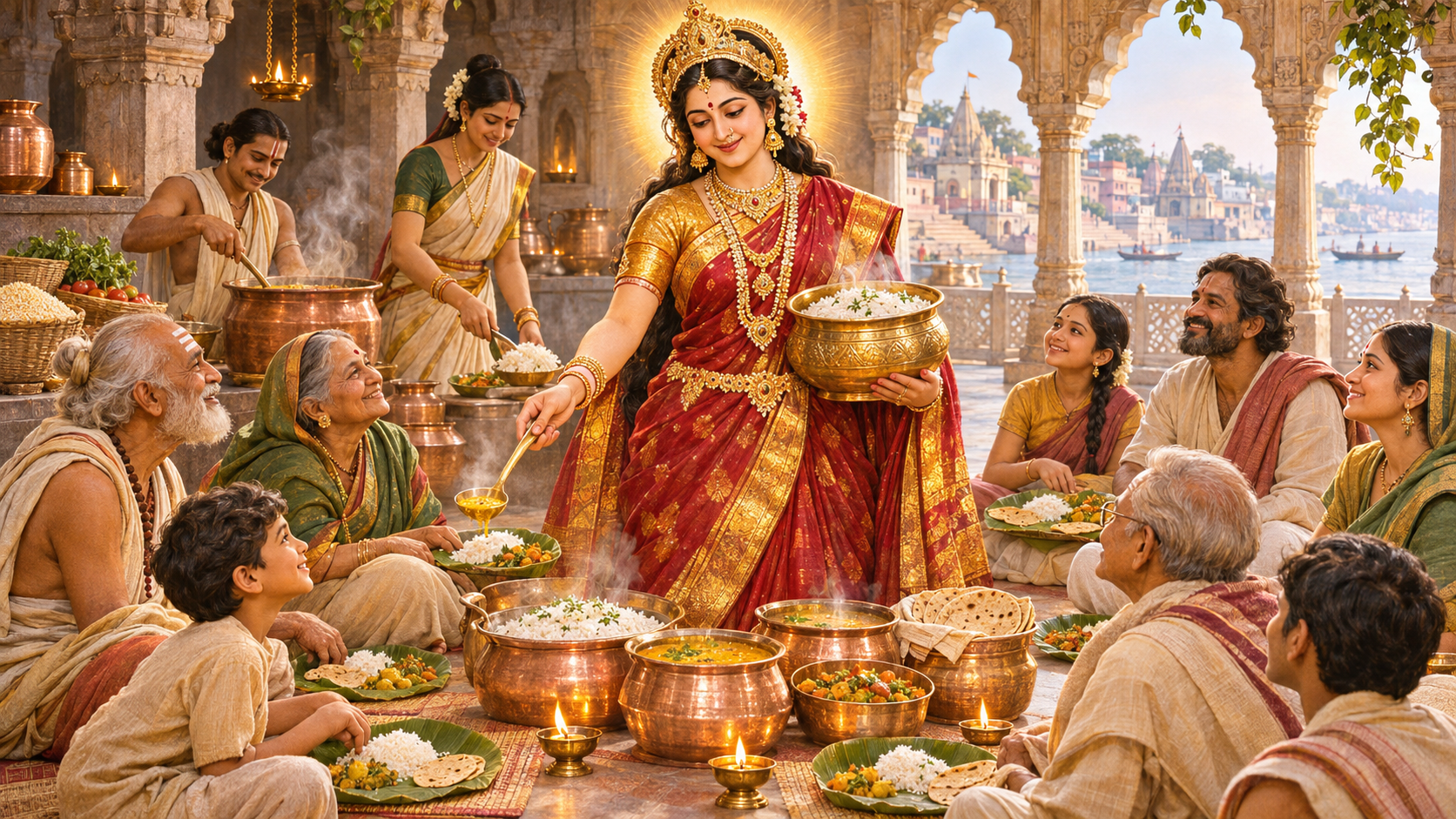
Anna means food, while purna conveys fullness or completeness. Annapurna therefore gives us more than an image of food as fuel. Her form draws attention to nourishment as a sacred condition of embodied existence.
The expression Annam Parabrahmam places food in relation to the Absolute. Its practical force is easy to miss when a meal is treated as an anonymous product that simply appears. Food connects you to soil, water, sunlight, living beings, human effort, knowledge, transport, cooking, and service. You did not produce that entire chain by yourself. Recognising this dependence is not weakness; it is accurate perception.
Annapurna also corrects the habit of treating care as spiritually secondary. A person may speak eloquently about liberation while overlooking the hands that prepare, serve, clean, cultivate, and provide. Her presence makes that blindness difficult to defend. Nourishment is not an interruption to dharma. It enables a person to carry dharma into action.
You can honour this meaning without inventing an elaborate ritual:
- Take an amount you intend to finish, so abundance does not become carelessness.
- Notice at least one form of labour behind the meal instead of treating the food as self-created.
- Thank the person who cooked or served, especially when that work is normally invisible.
- Share food in a way that preserves the recipient’s dignity rather than turning generosity into a display of superiority.
- Receive nourishment without entitlement, but also without shame when you genuinely need care.
Do not use this symbolism to tell a hungry person that hunger is spiritually beneficial. Involuntary hunger calls for nourishment. The lesson of Annapurna is not that unmet need should be admired; it is that feeding life carries sacred significance.
Shiva and Annapurna correct two incomplete spiritualities
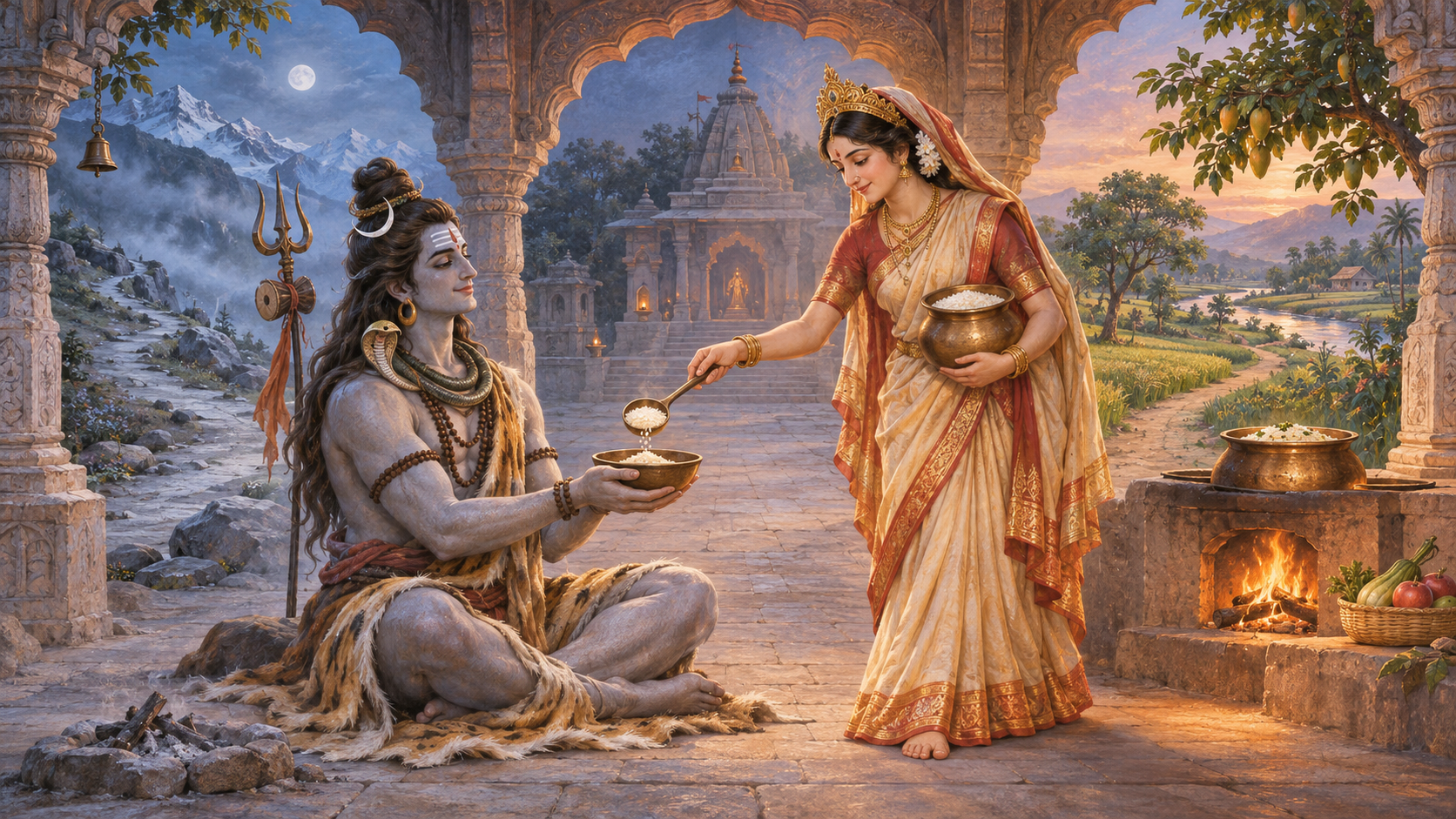
Shiva without Annapurna can be misread as spirituality through escape: the body is dismissed, dependence is denied, and the work of care becomes invisible. Annapurna without Shiva can be misread as abundance through accumulation: more food, comfort, and possession are assumed to produce fulfilment by themselves.
The complete image refuses both errors. Shiva asks whether you can possess less without becoming bitter. Annapurna asks whether you can nourish life without turning the gift into control. His bowl makes room; her food fills it. His receptivity honours her giving; her giving answers a real need without diminishing him.
This is complementarity, not a hierarchy. The scene should not be reduced to the claim that men represent spirituality while women belong in the kitchen. Parvati appears as Annapurna, the divine giver before whom Shiva receives. Reducing her to household subordination empties the image of its theological force. At the same time, Shiva’s act of receiving does not make him inferior. Dependence within a sacred relationship is not humiliation.
You can apply that correction wherever giving and receiving meet:
- At home: do not let the labour of obtaining, preparing, and serving food disappear behind habit.
- In community service: meet need without making the recipient perform gratitude or surrender dignity.
- In spiritual practice: do not mistake harshness toward the body for freedom from attachment.
- When accepting help: receive what is genuinely offered without pretending that self-sufficiency is a higher virtue.
- When caring for others: serve without using your service to create emotional debt.
The image becomes especially sharp when you occupy both roles in the same day. You may be Annapurna while feeding someone in the morning and Shiva while accepting another person’s patience in the evening. A mature dharmic life requires competence in both giving and receiving.
Key takeaways
- Shiva’s empty bowl represents receptive non-possession, not spiritual failure.
- Annapurna’s food represents sacred nourishment, not a merely domestic service.
- The image joins renunciation to responsibility: release attachment while still caring for embodied life.
- Voluntary simplicity must not be confused with imposed deprivation or neglect of duty.
- Giving should preserve dignity, and receiving should be free of both entitlement and false shame.
- The symbolism becomes practical when you waste less, recognise hidden labour, share food, and accept necessary care with humility.
At your next meal, let your plate or bowl remind you of both deities. Notice the empty capacity that had to receive, then notice the fullness that arrived through lives and labour beyond your own. Make one response before you move on: prevent waste, thank the person who served, share food, or accept care without embarrassment. That is how Shiva and Annapurna move from an admired image into lived dharma.
References

Leave a Reply
You must be logged in to post a comment.