
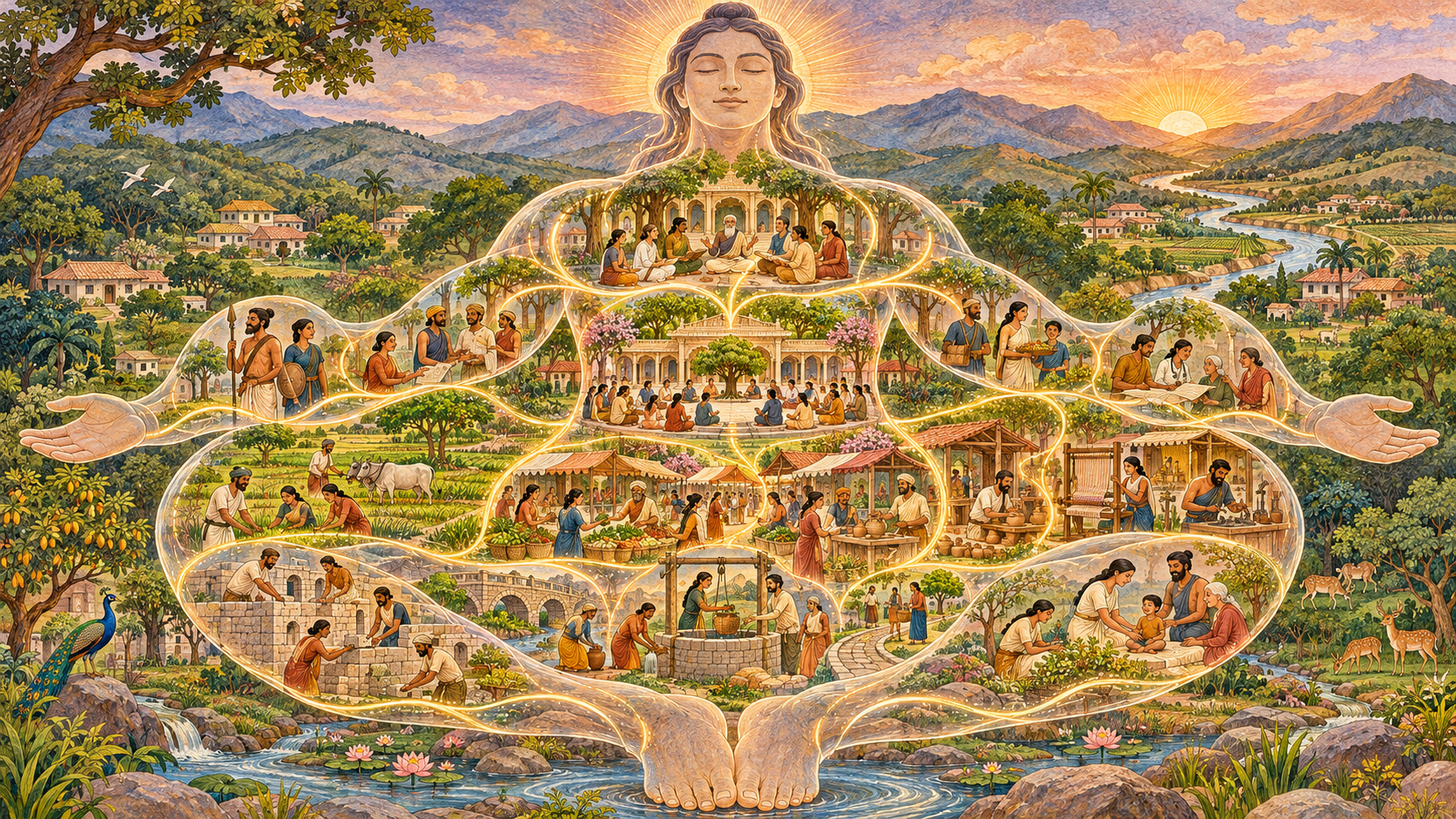
If you want to use Dharmic thought to understand civilisation, the image of Purusha presents an immediate difficulty. Read it only as a ranking of people, and it becomes an argument about status. Reject it for that reason, and you miss its more useful question: how can radically different social functions belong to one living order?
That question matters whenever you assess a nation, temple, school, family, movement or public institution. Purusha gives you a way to notice which function is directing the whole, which one is carrying its weight, and which one has quietly been sacrificed.
One body changes the question from rank to relationship
In the Purusha Sukta of the Rig Veda, the cosmic being is presented through a head, arms, trunk and legs, with different social orders emerging from that body. Here, we are using this as a civilisational metaphor. It is not the only possible interpretation of the hymn, and it cannot by itself settle historical or theological arguments about social order.
The crucial image is not a staircase. It is an organism. A staircase invites you to ask who stands above whom. A body forces you to ask whether its differentiated parts remain connected, whether each performs its proper work, and whether the life of the whole reaches every part.
This distinction prevents two opposite errors. The first is to treat every inequality inherited from the past as sacred merely because it can be placed beneath a traditional label. The second is to imagine that justice requires all differences of role, aptitude and responsibility to disappear. A living body has real differentiation, but differentiation does not mean that one organ can dispense with the others.
- Difference is not separation. A function becomes intelligible through what it contributes to the whole.
- Prominence is not self-sufficiency. The most visible part can still be helpless when the less celebrated parts fail.
- Unity is not sameness. Coordination does not require every person or institution to perform an identical task.
- Order is not automatically dharmic. An arrangement deserves respect only when its relationships serve the whole rather than protect one part from accountability.
When someone invokes Purusha to justify an existing institution, ask a concrete question: does this arrangement circulate responsibility, honour and support through the whole body, or does it use sacred language to make one-sided privilege appear natural? The metaphor is valuable precisely because it lets you test the relationship rather than merely admire the label.
The four bodily regions describe work a civilisation must do
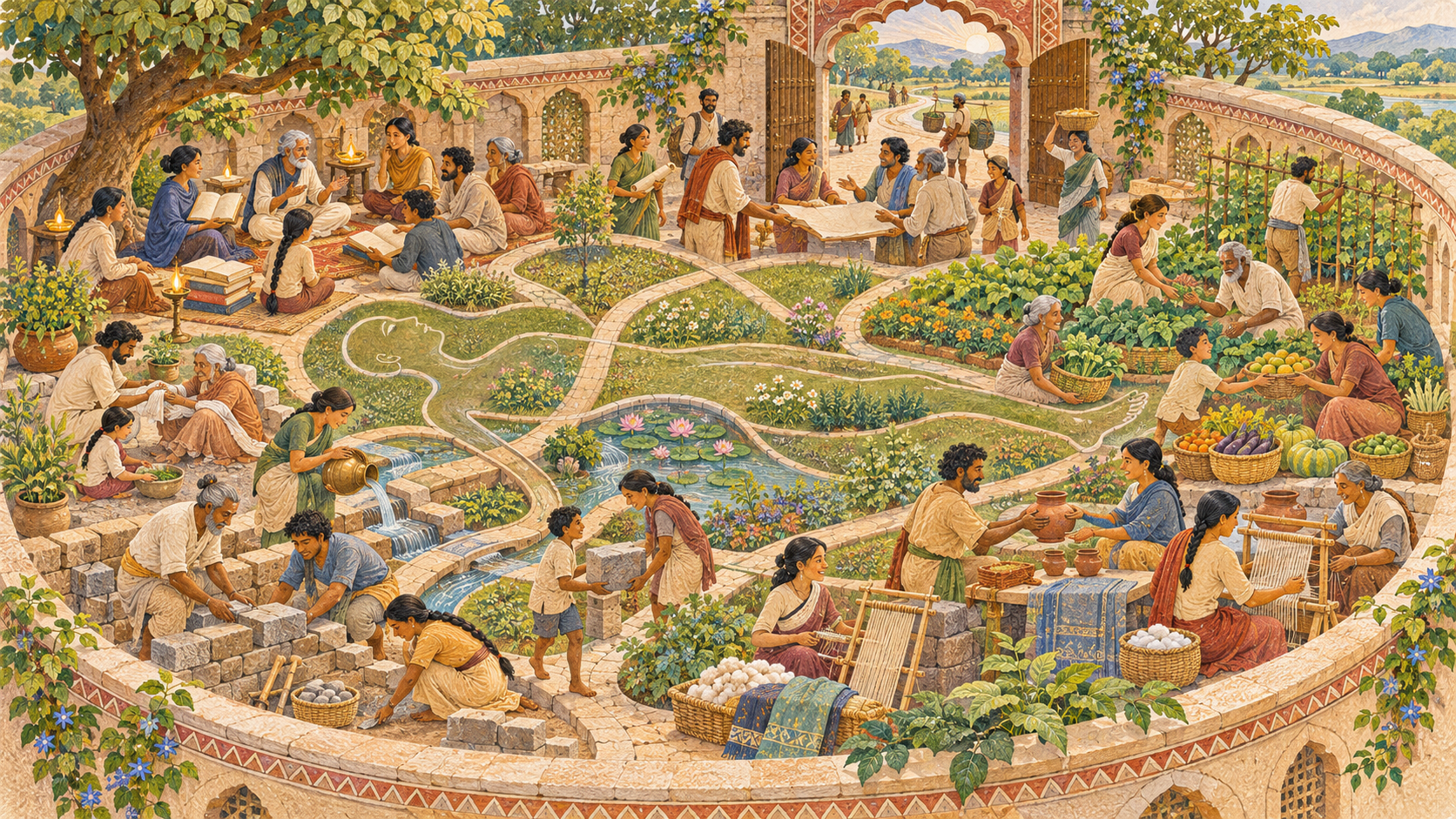
You do not need to assign every person permanently to one compartment. In an actual life, the same person may teach, defend, produce and serve at different times. The useful move is to identify the functions themselves. Every durable civilisation must orient itself, protect its order, sustain material life and carry out the daily work on which everything else rests.
The head gives orientation
The head represents the work of discernment: preserving memory, seeking truth, transmitting knowledge, forming judgement and identifying the ends toward which collective effort should move. This function may be distributed among teachers, parents, scholars, spiritual lineages and institutions entrusted with interpretation. It should not be confused with whoever happens to possess administrative power.
You can test the health of this function by asking: who can explain what the community is for? Who can tell power or wealth that a proposed action is effective but wrong? What standard can they name when they do so? If no one can answer, the civilisation may still possess information, slogans and credentials, but its head is no longer orienting the body.
The arms turn intention into protection and action
The arms represent organised capacity: defending boundaries, enforcing legitimate decisions, accepting risk and acting when discussion must become duty. This function is larger than military force. It includes the discipline required to protect people, institutions and inherited goods from neglect as well as attack.
Its practical test is accountability. Can those who exercise force explain the purpose they serve, the limits they accept and the conditions under which their authority ends? Strong arms are necessary. Arms that appoint themselves the source of truth eventually turn protection into control.
The trunk sustains material life
The trunk represents nourishment, production, storage and exchange. A civilisation needs food, tools, homes, trade, skills and the means to maintain institutions across time. Prosperity is not an embarrassment to dharma. Material activity becomes disordered when its measures become the only measures that society recognises.
To examine this function, look at what happens when value cannot be expressed as a price. Are learning, worship, care, ecological restraint and obligations between generations still treated as real? If every decision must justify itself through immediate gain, sustenance has stopped serving civilisation and begun defining it.
The legs carry civilisation through ordinary practice
The legs represent labour, maintenance, movement and repetition. Grand declarations do not cook food, repair a roof, prepare a festival, clean a public place, care for an elder or teach a child a daily discipline. Civilisation survives because ordinary people repeatedly embody what its intellectual and political leadership claims to value.
The warning sign here is invisibility. When essential work receives neither respect nor support, the upper parts of the social body begin living on borrowed strength. Ask which people must absorb exhaustion, insecurity or humiliation for an institution to appear successful. Their condition tells you more about its structural health than its ceremonial language does.
Civilisation decays when one function claims to be the whole

A failing civilisation does not always lose all four functions at once. More often, one function expands beyond its proper domain and interprets every problem through its own instrument. The imbalance may initially look like efficiency because fewer voices complicate decisions. Fragility appears later, after neglected capacities have weakened.
- When the head claims the whole, doctrine becomes detached from lived conditions. People are expected to fit an elegant scheme even when experience exposes its defects.
- When the arms claim the whole, obedience becomes the measure of truth. Disagreement is treated as disloyalty, and temporary powers seek a permanent justification.
- When the trunk claims the whole, citizens become consumers, knowledge becomes a credential and sacred inheritance becomes content or merchandise.
- When the legs claim the whole, immediate pressure can crowd out memory, judgement and long-term direction. Motion continues, but no shared account of the destination remains.
You can usually detect this capture by listening to the institution’s dominant vocabulary. Does every difficulty become a communication problem, a security problem, a funding problem or a workload problem? Repeatedly forcing unlike problems into one category is a sign that one organ’s logic has colonised the whole body.
The remedy is not to enthrone a different organ. Replacing commercial domination with unchecked coercion, or bureaucratic control with directionless resentment, merely changes the imbalance. Restoration means recovering right relationship: knowledge must orient power, power must protect the conditions of life, material capacity must sustain worthy ends, and daily labour must receive the support needed to carry them.
Culture gives nature form but cannot abolish its limits
Culture begins whenever human beings give form to what nature provides. Sound becomes language and mantra. Food becomes cuisine, hospitality and offering. Space becomes home, settlement, pilgrimage route and sacred geography. Impulse is shaped by discipline; memory is shaped by story and ritual.
Calling this an imposition does not necessarily mean calling it an act of violence. Form requires selection, restraint and repetition. A language excludes some possible sounds. A vrata limits possible actions. A calendar directs attention toward some times rather than others. Without such limits, there is no durable culture, only uncoordinated possibility.
Yet culture remains embodied. No decree can remove the need for rest, nourishment, trust, reproduction of skills, physical maintenance or a habitable environment. When a social order treats these conditions as inconveniences, nature does not need to refute its theory. The neglected body answers through exhaustion, breakdown, scarcity and loss of continuity.
This gives you a sharper way to read decline. Do not assume every crisis is a failure of messaging or loyalty. Ask whether the formal order has drifted away from the conditions that allow people to inhabit it. A rule may be internally consistent and still demand more time, attention, land, labour or sacrifice than the living body can provide.
The same test applies to cultural preservation. If a tradition survives only by exhausting the people expected to carry it, preservation has been confused with extraction. Reduce unnecessary burdens, teach the meaning of the practice, distribute work and give the next generation a real role. Continuity depends on transmission through living people, not on increasing the number of ceremonial demands placed upon them.
Use a Purusha audit before proposing reform
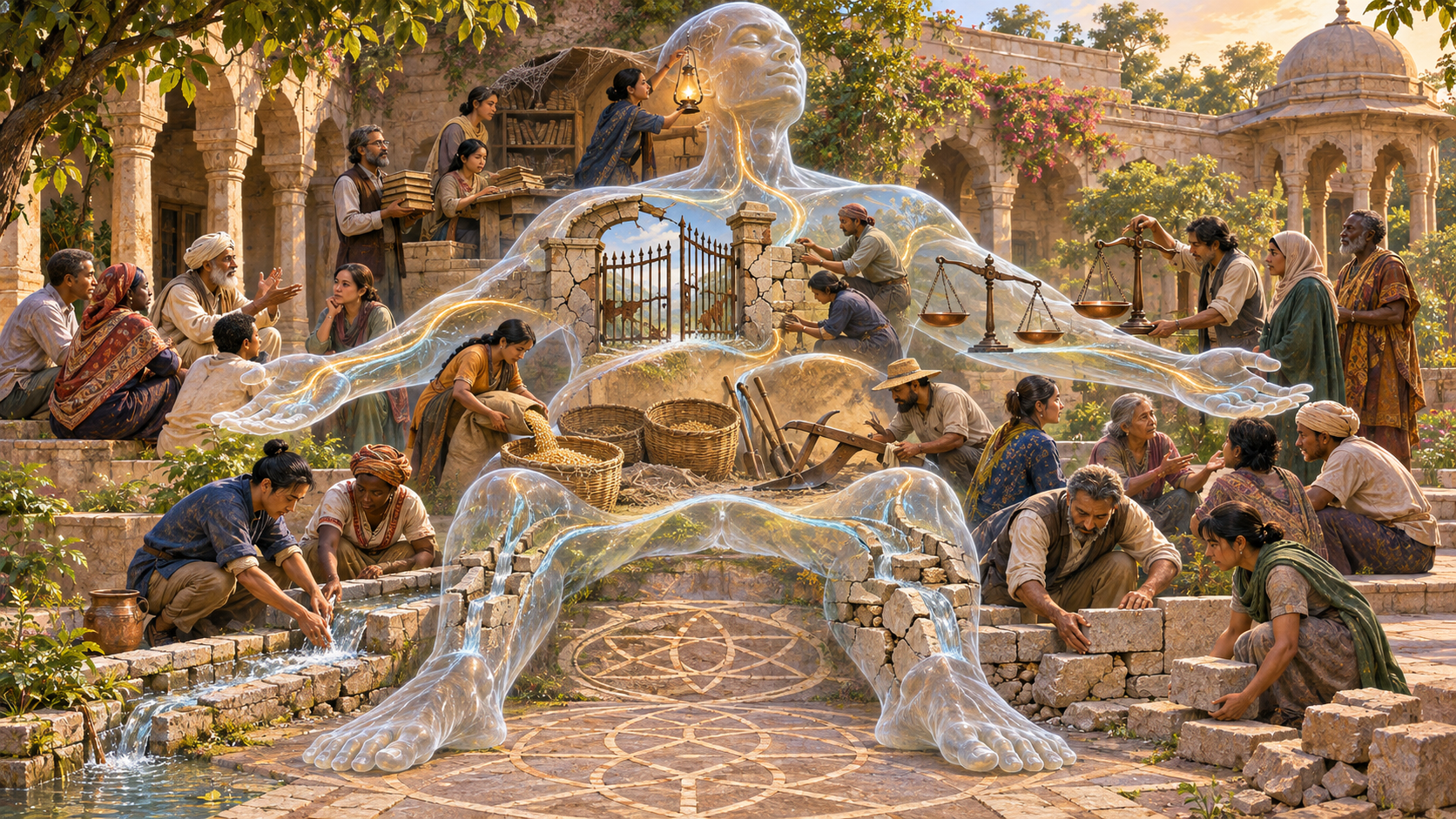
You can apply the metaphor without pretending that a nation or community is literally a person. Choose one institution you know well and work through these five questions. Keep the object narrow enough that your answers name actual responsibilities rather than abstractions.
- Name the whole. Is it a household, temple, school, association, movement or state institution? Write one sentence describing the good it exists to serve.
- Locate the four functions. Who provides orientation, who exercises protective or executive power, who supplies material capacity, and who performs the recurring work?
- Find the dominant measure. Does the institution recognise only doctrinal conformity, command, revenue, popularity or output? The exclusive metric often reveals the dominant organ.
- Trace the exchanges. What does each function receive from the others, and what is it expected to return? Look for responsibility without authority, authority without correction, revenue without purpose, and labour without honour.
- Repair a relationship. Do not begin with a new slogan or a total redesign. Change one exchange: give workers a voice in scheduling, require power to state its limits, connect expenditure to a named purpose, or restore serious teaching before demanding greater participation.
Consider a temple committee with adequate funds and detailed rules but exhausted volunteers and little transmission of meaning. More fundraising would strengthen a function that is already strong. More regulation would do the same. A Purusha diagnosis points elsewhere: reduce avoidable demands, create space for teaching, distribute maintenance fairly and make decision-makers answer to the people carrying out the work.
The audit also protects reformers from a common mistake. Visible weakness in one part may originate in another. Poor execution can result from confused direction. Financial stress can follow from undisciplined authority. Public apathy can reflect years of unrecognised service. Diagnose the relationships before blaming the most visible symptom.
Key takeaways
- Read Purusha first as an image of differentiated interdependence, not as a simple ladder of human worth.
- Judge a social role by its contribution and accountability to the whole, not by the prestige attached to its name.
- Look for four necessary functions: orientation, protection, material sustenance and daily execution.
- Expect fragility when one function forces every problem into its own vocabulary.
- Test cultural demands against embodied limits such as time, labour, attention, maintenance and transmission.
- Repair the weakest relationship between functions before adding more power, money, rules or activity.
Take one institution you care about and perform the audit before its next major decision. Name the overextended function, the neglected function and one exchange between them that can be corrected. Purusha becomes politically and culturally useful at that point: not when it freezes people into positions, but when it teaches you to restore proportion within a shared life.
References

Leave a Reply
You must be logged in to post a comment.