

You may have seen another report of a Hindu girl disappearing in Pakistan, converting to Islam and marrying almost immediately. The public argument then collapses into two incompatible claims: her family says she was abducted, while religious figures or the alleged husband say she chose to leave. If you want to know whether “forced conversion” is the right description, do not begin with the certificate. Begin with the conditions under which consent was supposedly given.
You do not have to choose between outrage and accuracy. Follow the timeline, the girl’s age, who controls her movement, whether she can speak privately, and what happens after the cameras leave. That method reveals why the persecution of Pakistan’s Hindus is not simply a collection of disputed marriages. It is a recurring process through which vulnerable people can lose family, freedom, religious identity and access to an effective remedy.
The pattern begins with a disappearance, not a conversion
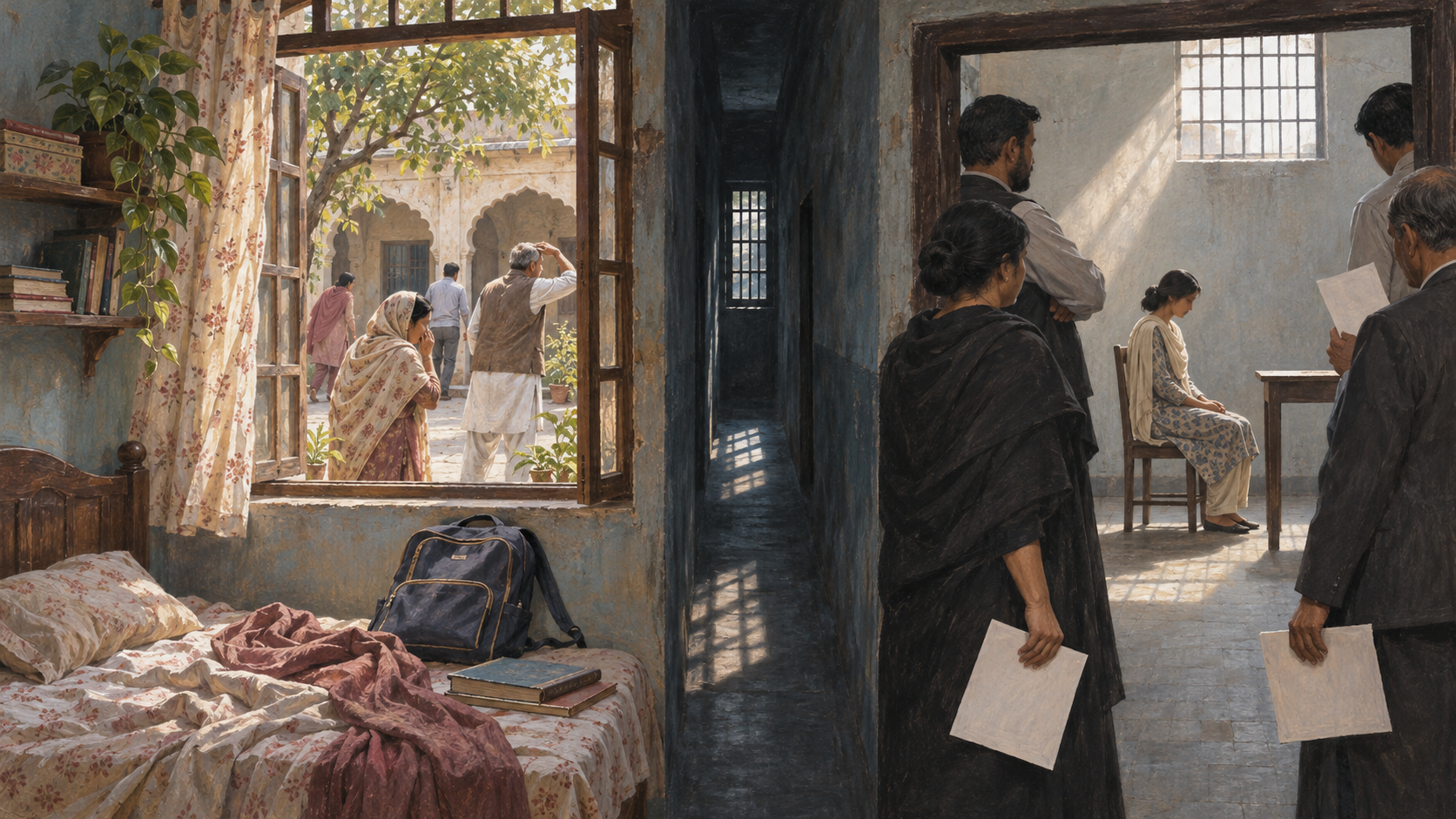
On the night of 23-24 February 2012, 19-year-old Hindu student Rinkle Kumari disappeared from her family home in Mirpur Mathelo, in Sindh’s Ghotki district. By the following day, she had been converted to Islam, renamed Faryal Bibi and married to a Muslim neighbour, Naveed Shah. The conversion and nikah occurred at a residence linked to Mian Abdul Haq, widely known as Mian Mithu, who was then a Pakistan Peoples Party member of the National Assembly. Her family alleged that she had been taken at gunpoint. Local Muslim figures maintained that she had left voluntarily after a secret relationship.
That disagreement mattered, but the surrounding conditions mattered just as much. In court, Rinkle made statements supporting voluntary conversion. Yet contemporary accounts described her as distressed and uncertain. When she saw her parents, she said she wanted to go with them, and at one stage she did not sign a statement. Chief Justice Iftikhar Muhammad Chaudhry observed that marriages of this kind did not occur in ordinary circumstances and that criminal involvement could not be excluded. The Supreme Court briefly placed Rinkle and two other Hindu women in a shelter before deciding their cases.
The point is not that a Hindu woman can never freely convert or marry a Muslim man. An adult’s genuine choice must be respected even when her family rejects it. The point is that a conversion certificate and nikah cannot, by themselves, establish freedom. If a woman disappears, is rapidly given a new religious identity, marries while under another party’s control and reaches court without a clearly independent opportunity to speak, the central question remains unresolved.
The recurring sequence is what you should notice:
- A Hindu or Christian girl disappears, often after an alleged abduction.
- A conversion certificate is produced quickly.
- A marriage follows, creating a second claim over her custody and status.
- She is presented before officials or a court while still connected to the alleged abductor and his supporters.
- A statement of “free will” becomes the decisive evidence, even when age, threats, isolation or access to independent advice remain disputed.
- The conversion and marriage are treated as accomplished facts before the alleged abduction has been fully examined.
Not every interfaith marriage follows that sequence, and an accusation from relatives is not proof. But when the sequence repeats across many cases, it is no longer responsible to assess each certificate in isolation. The procedure itself has to be tested for coercion.
How to test whether a claim of consent is credible

Consent is more than the word “yes.” It requires a person who can refuse without punishment, leave without being detained, obtain independent advice and speak outside the presence or influence of anyone accused of coercing her. A court statement may be important evidence, but its reliability depends on how that statement was obtained.
When you read or document a disputed conversion case, ask these questions in order:
- What is the girl’s verified age, and are her identity documents disputed?
- When was she last in independent contact with her family, school or another trusted person?
- How much time passed between her disappearance, conversion and marriage?
- Who transported her, arranged the religious ceremony and paid for legal representation?
- Where was she living when she made her statement, and who controlled her ability to leave?
- Was she interviewed privately, without the alleged husband, religious intermediary, family members or crowds nearby?
- Did she have an independent lawyer or advocate whose duty was owed to her alone?
- Was an abduction complaint investigated separately, or did the conversion certificate effectively end that inquiry?
- What happened after the ruling: did she remain with the alleged husband, enter a genuinely neutral shelter, return to her family or disappear from public view?
No single answer automatically proves coercion. Together, however, these details tell you whether “choice” was tested or merely asserted. A rapid conversion is not proof of force, but speed can prevent age verification, private consultation and a serious investigation. A courtroom appearance is not proof of safety if the person expects to be returned immediately to those she fears.
The safeguards should therefore come before recognition of the marriage, not after it. Where age or coercion is disputed, authorities should verify identity documents, separate the girl from all interested parties, provide independent counsel and obtain confidential testimony in a neutral setting. Child-marriage protections should not become optional because a religious ceremony has already occurred. UN experts have warned that forced marriages and conversions can be validated through religious-law arguments, leaving victims with their alleged abductors instead of restoring their freedom.
This distinction also protects genuine converts. A fair process does not presume that every woman belongs to her birth community. It gives her the practical ability to choose either path without an abductor, husband, cleric, political patron or family making the decision for her.
The scale matters, but the numbers must be used honestly
Human-rights groups and independent assessments have placed the number of forced-conversion and marriage cases involving Hindu and Christian girls at approximately 1,000 a year. Treat that as an estimate of scale, not as a complete national registry. Underreporting, disputed ages, inconsistent official classification and the difficulty of contacting victims all limit the precision of any annual figure.
The distribution is nevertheless difficult to dismiss. UN expert statements issued in 2024 and 2026 found that roughly 75 percent of documented victims were Hindu and about 80 percent of incidents occurred in Sindh. Girls aged 14 to 18 were heavily represented, with some reported victims even younger. These figures identify a concentrated vulnerability: minority girls in Sindh face a risk that cannot be explained away as ordinary family disagreement over marriage.
Pakistan’s long-term demographic change adds context but needs careful interpretation. The Hindu share of the population fell from about 14.6 percent in 1941 to roughly 2.17 percent in 2023. A change in population share does not, on its own, prove why the change occurred. Partition, migration, territorial change, fertility, census categories and persecution can all affect demographic proportions. Use the census trend as a warning signal, not as a substitute for case-level evidence.
The stronger case for erasure comes from the mechanisms that operate alongside the demographic decline. Constitutional arrangements and rules affecting property and religious registration have been criticised for placing minorities at an institutional disadvantage. Bills intended to criminalise forced conversion have repeatedly been blocked. Child-marriage restrictions are inconsistently enforced. When alleged abduction is followed by a state-recognised conversion and marriage, the victim’s new identity can become an obstacle to investigating how that identity was imposed.
That is how persecution becomes more than a series of private crimes. Social coercion supplies the victim. A religious intermediary supplies legitimacy. Political influence discourages intervention. Administrative paperwork makes the new status appear settled. A court may then consider the conversion a question of personal choice without first creating conditions in which a free choice can be measured. Each institution handles only one fragment, while the combined process leaves the victim with no effective exit.
Turn concern into disciplined advocacy

If you want to help, your most useful contribution is not a louder adjective. It is a record that officials, journalists and human-rights organisations cannot easily evade. For each case, create a one-page chronology containing the victim’s reported age, the source of that age, the last known voluntary contact, the date of disappearance, the police complaint, the conversion date, the marriage date, the location of court appearances, custody at each stage and the final known outcome.
Separate established facts from allegations. Write “the family alleges abduction” when that is what is known. Write “a conversion certificate was produced the following day” when the document or court record supports it. Do not upgrade an unverified social-media claim into a finding, and do not treat an official certificate as proof of consent. Precision makes advocacy harder to discredit.
Then ask for safeguards that can be measured:
- Independent verification of age before a disputed marriage is recognised.
- A neutral shelter separated from the alleged husband, religious intermediary and both families while coercion is assessed.
- Confidential access to independent legal counsel chosen for the girl, not by an interested party.
- A separate investigation of abduction, threats and forged age documents even when a conversion certificate exists.
- Consistent enforcement of child-marriage protections.
- Public reporting of case outcomes, including whether the victim was able to leave safely.
- Legislation that penalises coercion without criminalising genuine adult conversion.
If you belong to a mandir, diaspora association or civil-rights group, send the chronology and those specific requests to elected representatives, foreign-affairs offices, human-rights bodies and newsrooms. Ask what safeguards were used in the named case and request a written answer. A general condemnation is easy to acknowledge and forget; a question about age verification, independent counsel or custody requires an accountable response.
Protect the victim while doing this work. Do not publish a shelter address, private telephone number, travel plan or confidential legal strategy. Do not circulate images that expose a minor merely to prove that the case exists. Coordinate public disclosure with the family and competent legal or human-rights representatives where possible. Visibility can create pressure, but uncontrolled exposure can also make escape or safe placement more difficult.
Name the affected community. The phrase “religious minorities” is sometimes necessary, but it can conceal the fact that Hindus form the large majority of documented victims in the cited UN assessments. At the same time, acknowledge that Christian girls are also targeted. Accuracy does not dilute Hindu advocacy; it shows the recurring mechanism across vulnerable communities while preserving the disproportionate burden borne by Hindus.
Use legal terms carefully. Abduction, coercion, forced marriage, child marriage, religious persecution and institutional discrimination are already grave descriptions when the facts support them. “Genocide” has a specific legal meaning and should not be used as a substitute for showing the mechanism. If every discussion is forced into a debate over the largest possible label, officials gain an excuse to avoid the immediate questions: Was the girl safe, was her age verified, could she refuse, and was the alleged crime investigated?
Key takeaways
- A conversion certificate, marriage document or courtroom statement does not by itself establish free consent.
- The decisive evidence often lies in custody, age verification, private access to counsel and the ability to leave safely.
- The estimate of about 1,000 cases a year shows the reported scale, but it should not be presented as a complete official count.
- The concentration among Hindu girls and in Sindh makes generic language about “family disputes” inadequate.
- The fall in Pakistan’s Hindu population share is a serious warning sign, not standalone proof of the cause.
- Effective advocacy records the timeline, protects the victim’s location and demands procedural safeguards that can be checked.
The next time a case appears, open a blank page before opening social media. Record the age claim, disappearance, conversion, marriage, custody, private testimony and final outcome. Then direct one precise demand to someone with institutional responsibility. Pakistan’s Hindu minority does not need its suffering blurred by careless claims or reduced to a passing headline. It needs witnesses who can show, case by case, exactly where freedom was denied and what must change to protect it.
References
- Hindu Post – The Slow Erasure of Pakistan’s Hindus: A Persecution the Abrahamic World Won’t See
- News18 – Disappearing Hindus Of Pakistan: The World’s Blind Spot

Leave a Reply
You must be logged in to post a comment.