
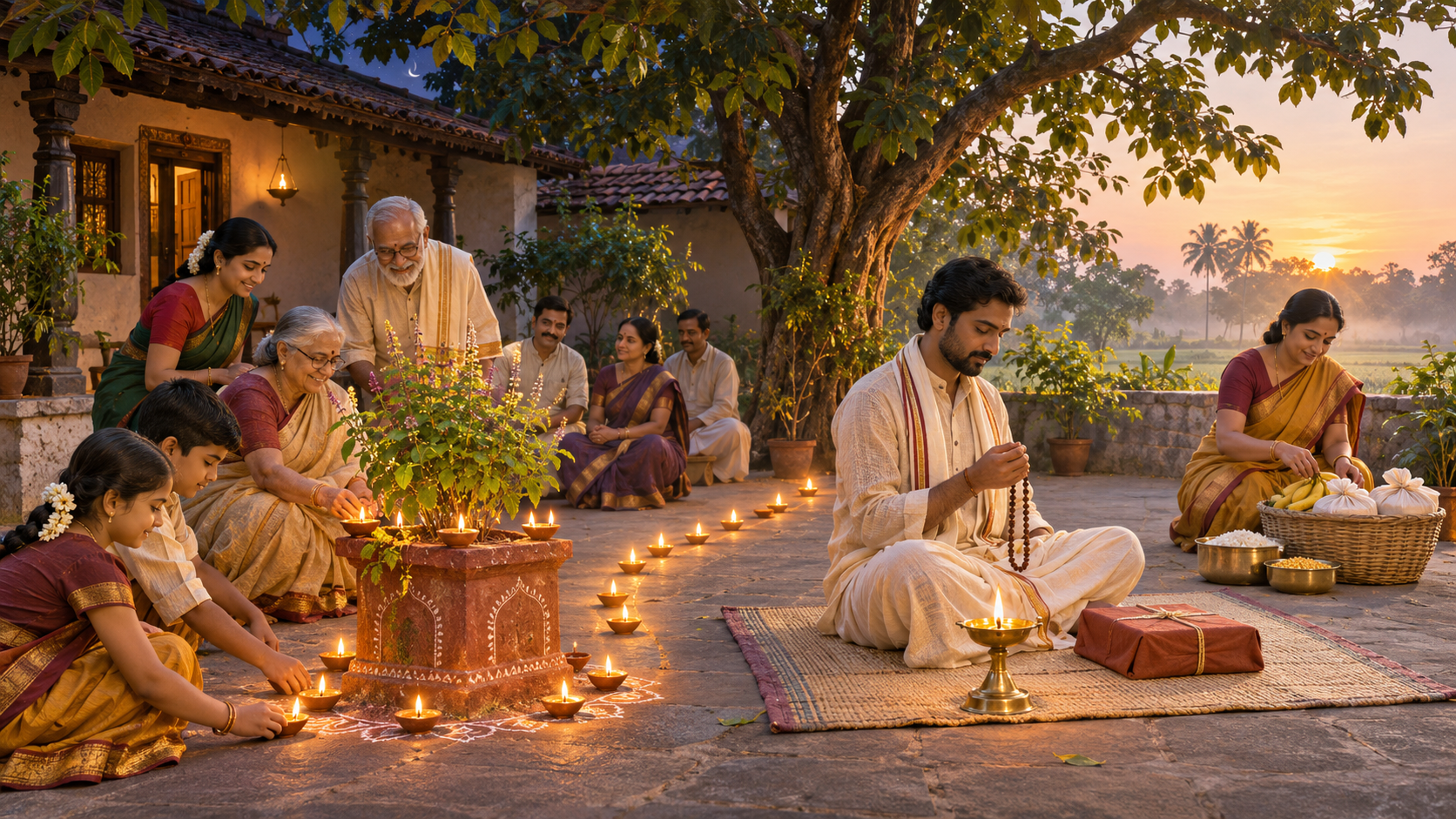
You may know that Kartika and Margashirsha are auspicious, yet still be unsure what to do beyond finding the months on a calendar. The useful question is not how many observances you can fit in. It is how the movement from one month to the next can change the way you gather, pay attention, and practice.
A workable approach is to give each month one clear emphasis. Let Kartika draw you into community and reverence for the living world. Let Margashirsha carry that attention into scripture, discipline, and daily conduct. This is not a replacement for your family’s vrata, puja, or sampradaya. It is a practical framework for observing the season coherently, especially if you are rebuilding a household tradition or practicing away from home.
See the two months as one spiritual movement
In Andhra Pradesh, one Kartika custom takes the form of Vanabhojanam, a garden gathering or picnic arranged by some organizations and traditional families. Its setting matters. The meal takes place in the presence of the natural world rather than treating nature as scenery outside religious life.
Tulasi, Usiri or Amla, Bilva, and Durva are among the plants regarded as sacred and useful within Hindu practice. That combination is instructive: sacredness and usefulness need not be opposites. A plant can sustain embodied life and also train the mind to recognize divine presence beyond the human world.
Vanabhojanam should not be turned into a claim that every Hindu family observes Kartika in the same way. It is a regional and familial practice, not a universal requirement. Its wider lesson is still available to you: fellowship, food, place, and reverence can belong to a single Dharmic act.
Margashirsha changes the emphasis. It is traditionally counted as the ninth month, honored as especially auspicious, and associated with Lord Krishna’s identification of himself with Margashirsha in the Bhagavad Gita. That scriptural connection makes the month a natural time to consolidate attention rather than allowing Kartika’s observances to end as pleasant memories.
You do not need to manufacture a rigid contrast in which Kartika is only outward and Margashirsha is only inward. Both months can contain worship, study, service, and community. The distinction is a planning aid: choose one outward anchor for Kartika and one repeatable inward anchor for Margashirsha. That is more likely to shape your life than an ambitious checklist abandoned after a few days.
Make a Kartika gathering more than a picnic
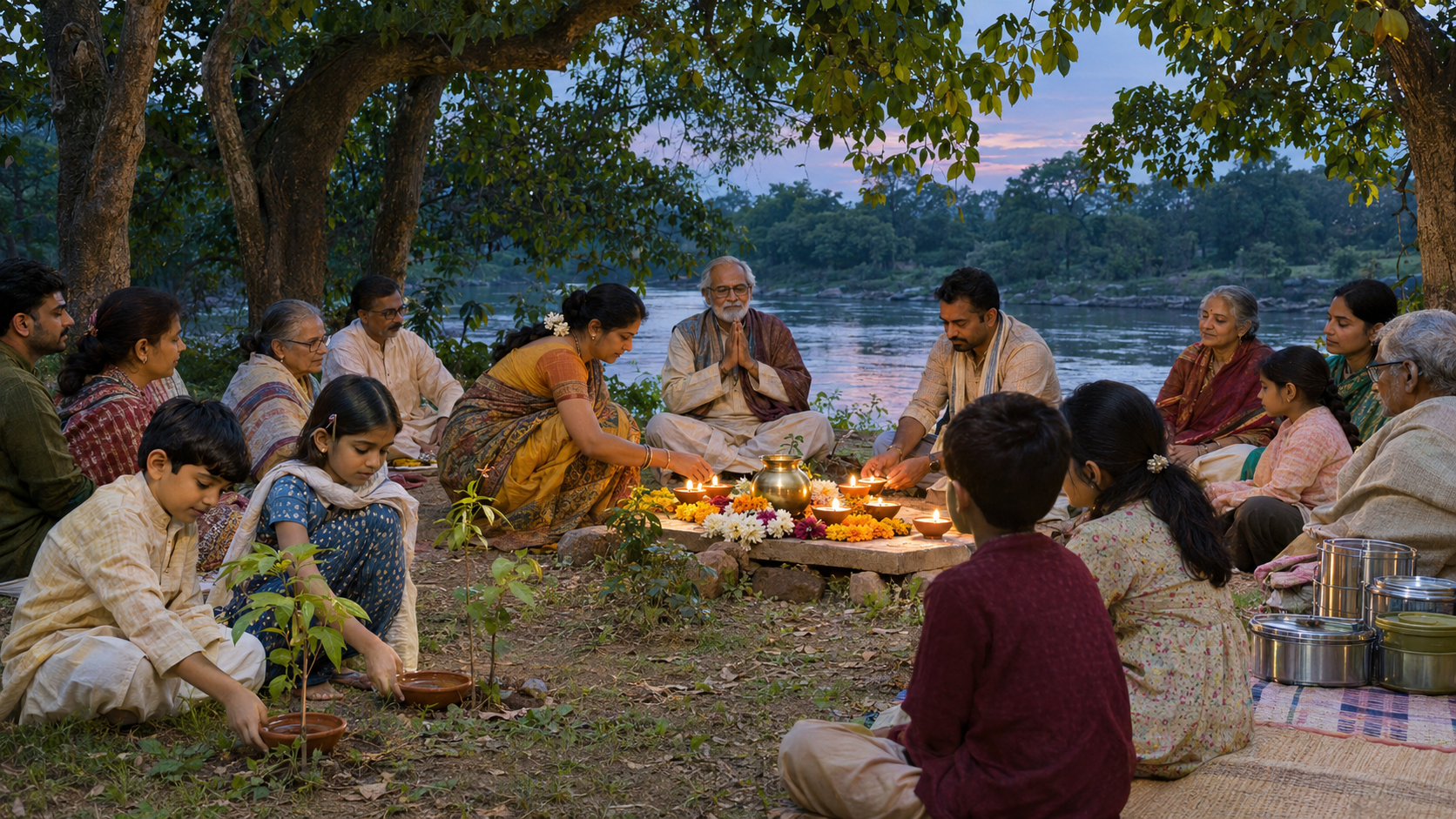
If Vanabhojanam belongs to your inherited tradition, follow the procedures taught by your family, temple, or community. If it does not, you can still organize a Kartika meal in a garden or another appropriate outdoor setting. Describe it honestly as a Kartika community gathering rather than presenting a newly assembled event as an ancient family rite.
- Confirm the calendar used by your community. Hindu month boundaries and observance dates can vary with regional calendars and traditions. Ask which panchanga your family or temple follows before announcing a date. A generic online date should not overrule the living calendar of the community you intend to gather.
- Choose an accessible, lawful setting. A garden, orchard, temple ground, or public green space may serve, provided you have permission and can follow its rules. Consider elders, children, mobility needs, shade, sanitation, and safe food handling when choosing the location.
- Plan the meal around the participants’ actual practice. Agree on what food is appropriate for the households taking part. Label dishes when ingredients may be unclear, and do not pressure someone to violate a family vrata or dietary discipline for the sake of a uniform menu.
- Direct attention toward living plants. If Tulasi, Usiri, Bilva, Durva, or other locally revered plants are present, let someone familiar with them explain their place in the tradition. Do not pluck, move, or decorate a living plant without permission. Reverence begins with restraint.
- Keep formal worship within competent guidance. A shared prayer, remembrance, or reading can give the gathering a center. If a specific puja is intended, ask someone trained in that procedure to lead it. An improvised ritual assembled from unrelated internet instructions can confuse regional customs and family lineages.
- Leave the place visibly cared for. Remove food waste, serving materials, and decorations. Avoid damaging plants for photographs or temporary displays. A nature-facing observance contradicts itself if the site bears the cost afterward.
Before everyone leaves, invite each household to name one practice it will carry into Margashirsha. Keep the question concrete: a regular reading time, a form of seva, more disciplined speech, or consistent care for a plant already in the home. This final step turns a communal event into the beginning of continuity.
Give Margashirsha one text, one time, and one act
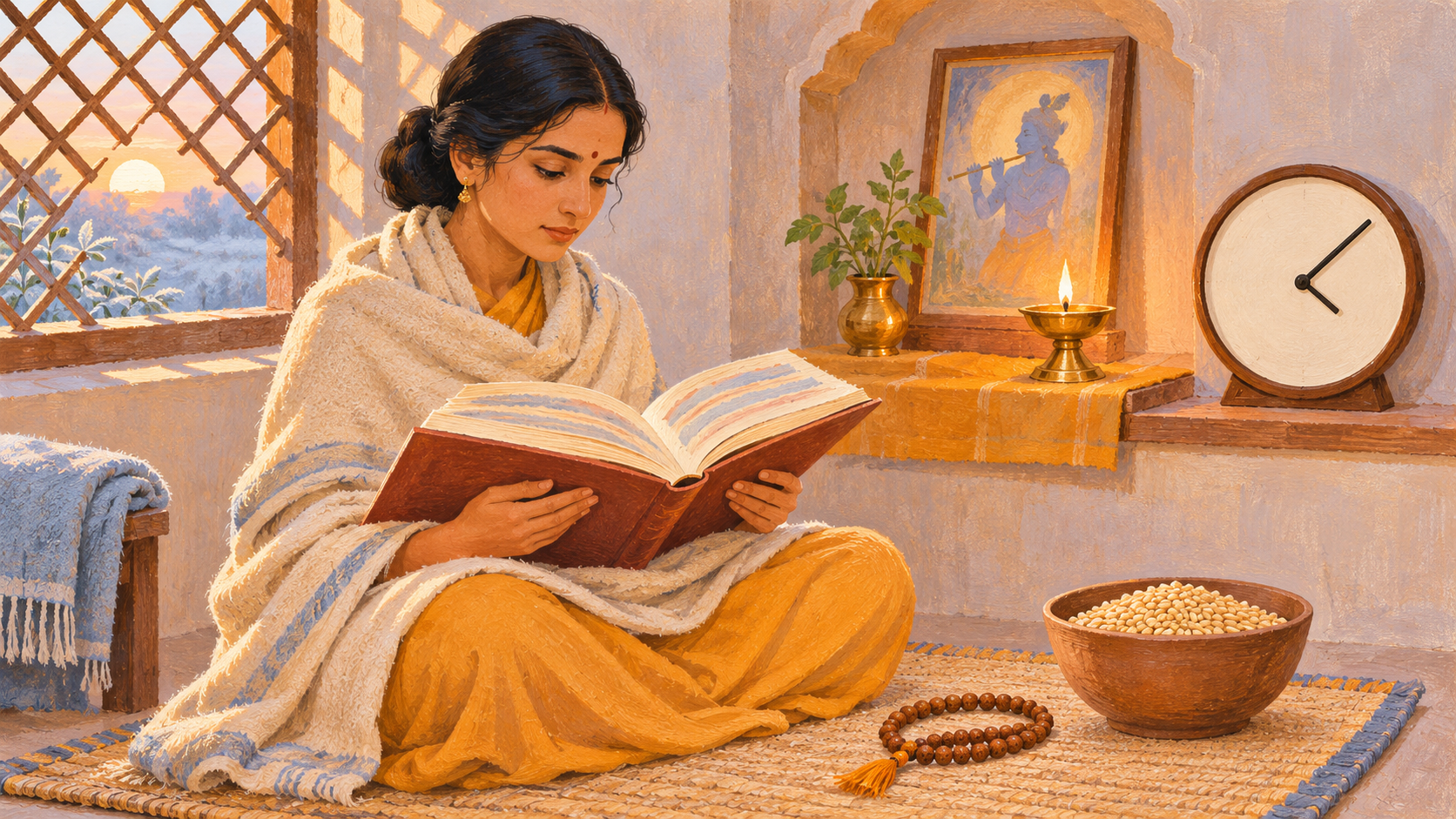
Calling Margashirsha auspicious does not by itself tell you how to live through it. It also does not guarantee that every undertaking will succeed. Treat auspiciousness as a call to become more receptive, deliberate, and aligned with Dharma.
A simple home discipline can be built from three decisions. This is an adaptable practice, not a universal prescription:
- Choose one text. The Bhagavad Gita is especially fitting because Margashirsha is explicitly honored within it. Use the edition, commentary, or recitation tradition trusted by your family or sampradaya. If you are not attached to a particular lineage, choose a complete edition with a clear translation and resist hopping among isolated quotations.
- Choose one dependable time. Daily reading is useful only if it is realistic. If your household cannot sustain it, set a weekly time and protect it. Read a manageable passage slowly enough to identify its demand on conduct, not merely its philosophical vocabulary.
- Choose one embodied act. Connect the reading to something observable: service within the household, a community responsibility, restraint in speech, care for a living plant, or another duty already in front of you. The act should be specific enough that you can tell whether you did it.
After each reading, answer one question in a notebook or conversation: What does this teaching ask me to do differently before the next reading? This prevents scriptural study from becoming only the collection of inspiring lines.
If you are reading as a family, rotate one modest responsibility. One person reads, another paraphrases the central point, and another names a practical application. Do not make children or newcomers perform interpretations they do not yet understand. A sincere question is a better outcome than a rehearsed answer.
Your inherited observances still take priority. Where your household keeps a particular vrata, puja, temple visit, or mode of recitation, place this framework around that practice rather than over it. The aim is continuity, not standardization.
Key takeaways
- Use the panchanga followed by your family or temple; do not assume one online date applies to every regional calendar.
- Treat Vanabhojanam as an Andhra-linked family and community custom, not as a mandatory observance for every Hindu.
- If you adapt the outdoor gathering, preserve its Dharmic center through community, reverence for plants, responsible food sharing, and care for the site.
- Give Margashirsha a repeatable discipline built around one trusted text, one sustainable time, and one concrete act.
- Let inherited family and sampradaya procedures guide formal worship. A practical framework should support living tradition, not flatten it.
A simple plan for your next observance cycle
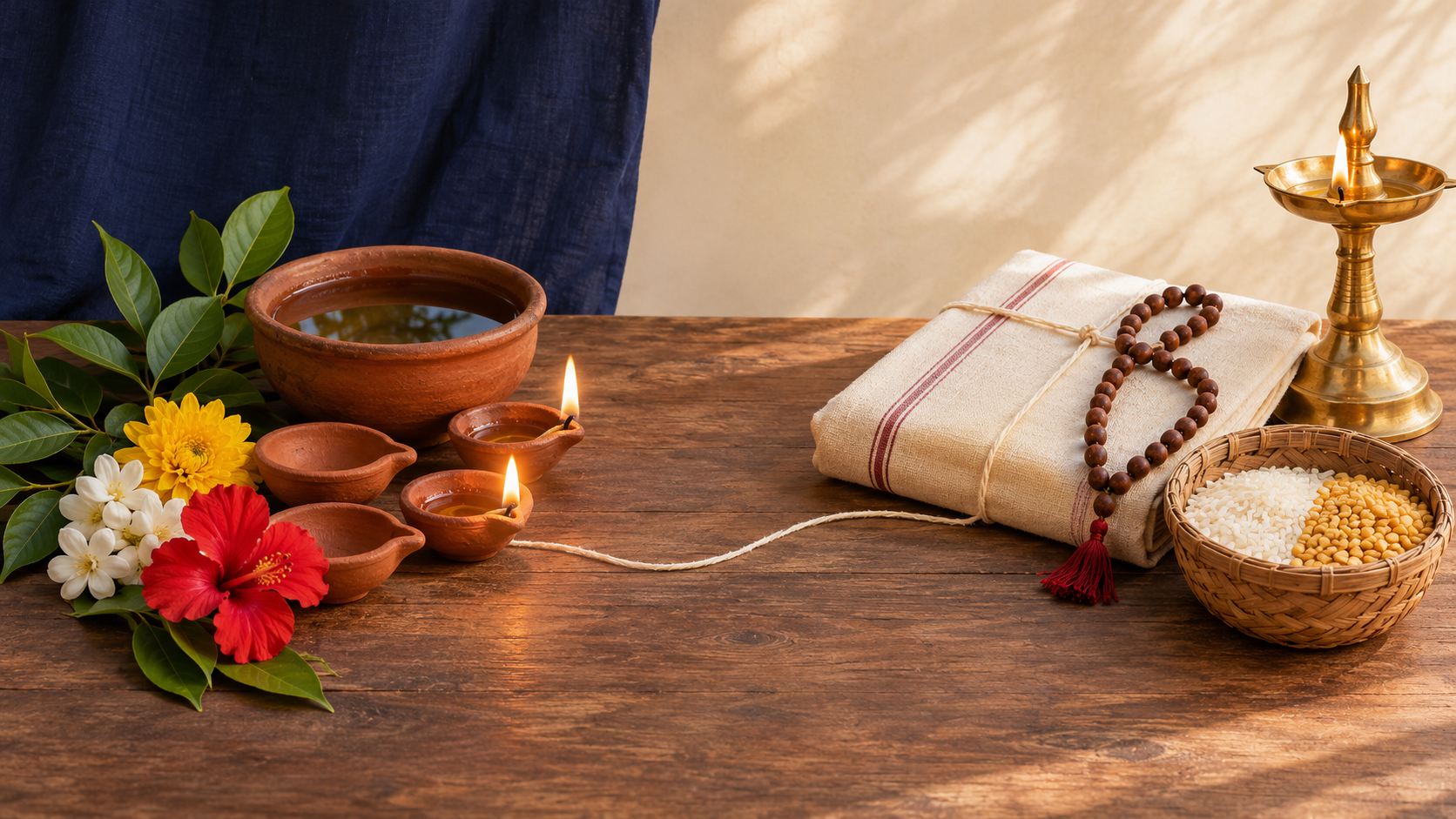
You can prepare without turning the two months into a project-management exercise. Before the Kartika gathering, confirm the calendar, speak with the people whose tradition you are following, choose the location, and agree on the meal. Decide who can explain the significance of any sacred plants present and who, if needed, is qualified to guide worship.
On the day, make space for three things: shared food, attentive recognition of the living setting, and a clean departure. Before dispersing, name the discipline that will continue into Margashirsha.
At the beginning of Margashirsha, place your chosen Bhagavad Gita edition where you will actually use it and put the reading time on the household calendar. Partway through the month, ask whether the schedule is functioning. If it is not, reduce the frequency or passage length instead of abandoning the practice. At the end of the month, retain the one habit that has genuinely entered daily life.
Start now with two conversations: one with the family or temple authority who can confirm your calendar and customs, and one with the person who will share the observance with you. Then choose the text and the time you will carry forward. Kartika becomes more than an event, and Margashirsha more than a name on the calendar, when the gathering gives birth to practice.
References
- Hindu Pad – Kartika Vanabhojanam | Kartika Masa Vana Mahotsavam
- Hindu Pad – Importance of Margashirsha Maas, Margashira masam as per Bhagvad Gita

Leave a Reply
You must be logged in to post a comment.