
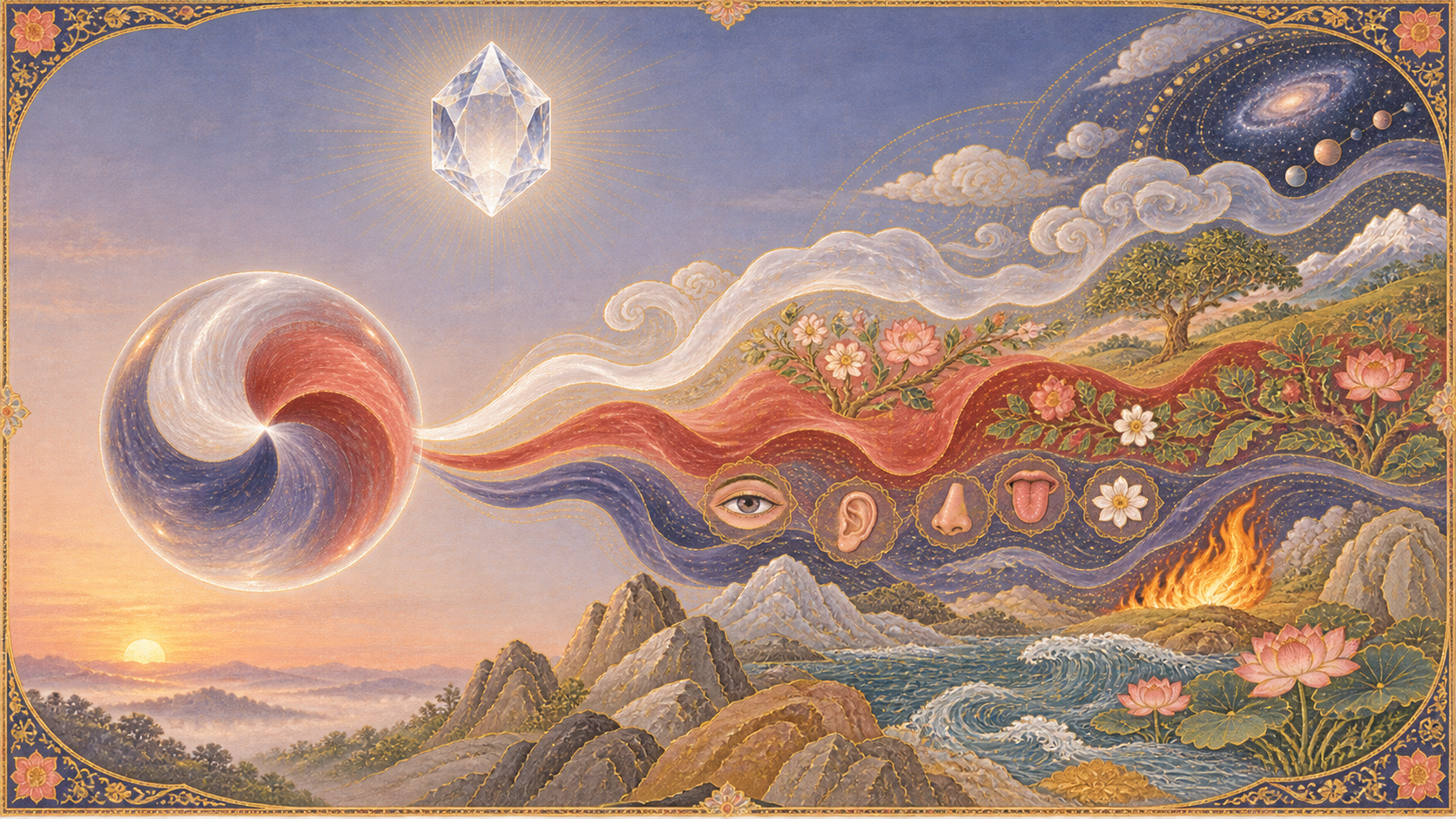
You may have encountered Virupa Parinama while trying to solve a deceptively simple problem: if everything is already latent in Prakriti, how can a world of distinct minds, senses, qualities and objects emerge from it? The term identifies the hinge between undifferentiated potential and manifest diversity.
Once you understand that hinge, Samkhya’s account stops looking like an arbitrary list of cosmic stages. It becomes a disciplined explanation of what changes, what remains unchanged and why manifestation is transformation rather than creation from nothing.
What changes—and what does not

Virupa Parinama means transformation into a different or differentiated form. Virupa indicates an altered, dissimilar or distinguishable form; parinama is a real transformation. In Samkhya, the expression describes a change in Prakriti through which effects unlike its previously unmanifest condition become perceptible.
The word real matters here. The manifest cosmos is not placed beside Prakriti as a second, independently created substance. Nor does an entirely new material reality appear without a cause. Prakriti itself assumes determinate forms. An effect is therefore connected to its material cause even when it no longer looks like that cause’s earlier condition.
Do not imagine the future world as a collection of miniature objects stored inside primordial matter. To say that an effect is latent in its cause is to say that the cause has the capacity and constitution required for that effect. Manifestation makes a previously unexpressed possibility determinate.
A useful image is a thoroughly blended field of colours separating into distinct patterns. Nothing has to be imported from outside the field, yet a real difference appears within it. The comparison is only an aid: Prakriti is not physical paint, and the gunas are not pigments that could be isolated in containers.
Purusha occupies the other side of the distinction. Purusha is consciousness, the witness for whom Prakriti becomes an experienced world. Purusha does not turn into intellect, ego, senses or elements. Virupa Parinama belongs to Prakriti and its products, not to consciousness itself. Keep that distinction in view and much of Samkhya’s cosmology becomes easier to read.
From balanced potential to a differentiated cosmos

Prakriti is constituted by the three gunas: sattva, associated with illumination and clarity; rajas, associated with activation and movement; and tamas, associated with inertia, weight and resistance. These descriptions identify functional tendencies. They should not be mistaken for three separately existing substances.
In the unmanifest condition, the gunas are held in equilibrium. Equilibrium does not mean that Prakriti has ceased to exist or that it is an empty nothing. It means that no guna has gained the relative predominance required to produce a distinct effect. The capacities of manifestation are present, but their differences have not yet unfolded into the experienced order.
Virupa Parinama begins when that relation changes. One tendency becomes relatively prominent while the others continue to participate. The result is not the removal of two gunas and the survival of one. Every product of Prakriti remains constituted through their interaction, although their relative functions differ.
- Prakriti is unmanifest. Its gunas are in equilibrium, so distinguishable cosmic products have not emerged.
- The equilibrium is disturbed. The gunas acquire unequal functional prominence, opening the movement from potentiality to determination.
- Mahat or buddhi emerges. This is the principle of determination and intelligence, not merely an individual person’s brain or private thoughts.
- Ahamkara differentiates from mahat. Ahamkara is the individuating or I-making principle. Reducing it to vanity misses its cosmological role.
- The field becomes increasingly articulated. Mental and sensory capacities, powers of action, subtle qualities and gross elemental forms belong to this further differentiation of Prakriti.
This sequence is best read as an order of dependence. It tells you which principles presuppose which other principles. It need not be imagined as a clocked series of events with measurable intervals between them. Samkhya cosmology is mapping the structure of manifestation, not supplying a modern laboratory chronology.
The contrast with undifferentiated change is especially helpful. A condition can undergo change while retaining the same general balance and producing no new level of determinate manifestation. Virupa Parinama is the change in which the relation among the gunas yields distinguishable effects. The ingredients have not come from elsewhere; their configuration and relative predominance now express something different.
Four common misreadings that distort the doctrine

It is not creation from absolute nothing
If you read Virupa Parinama as the sudden production of being from non-being, you reverse its purpose. Samkhya explains continuity between cause and effect. The effect becomes manifest because its material basis is already present in Prakriti. Ask what has been transformed, rather than asking where an entirely foreign substance entered the system.
It is not a transformation of Purusha
Experiences change, but the witnessing principle is not thereby converted into those experiences. Pleasure, pain, thought, self-identification and material form belong to the changing field of Prakriti. Purusha makes experience possible as consciousness, but it is not one more product in Prakriti’s chain. When a passage describes cosmic evolution, mark every predicate of change as belonging to Prakriti unless the argument explicitly indicates otherwise.
It is not merely a moral story about good and bad qualities
Sattva, rajas and tamas can help explain psychological and ethical tendencies, but their cosmological function is broader. Treating sattva as simple goodness and tamas as simple wickedness turns a theory of manifestation into a moral slogan. In cosmic differentiation, illumination, activity and resistance all have functions. Without distinction, activation and stabilization, no structured field of experience could appear.
It is not a substitute for modern physical cosmology
Virupa Parinama addresses metaphysical questions about causation, manifestation, consciousness and material nature. It should not be repackaged as a prediction about particles or a hidden description of a particular scientific model. Such claims blur two different kinds of inquiry and make the Samkhya position harder, not easier, to understand. Let the doctrine answer the question it was built to answer: how differentiated experience can arise through real transformations of a continuous material principle.
A practical method for reading Samkhya passages
When you meet a dense account of Samkhya evolution, do not begin by memorising every term. First identify the kind of change being described. The following five questions will usually reveal the passage’s logic.
- What is the material basis? Determine whether the passage is speaking about Prakriti generally or about one of its already differentiated products.
- What new distinction has appeared? Name the capacity introduced at this stage: determination, individuation, sensing, acting, subtle quality or gross form.
- What continues from the cause into the effect? Look for continuity of material nature and the gunas, even when the effect has a new function or appearance.
- Has consciousness been confused with a mental product? Intellect and ego are subtle products of Prakriti in Samkhya. They are not Purusha merely because they seem inward or intelligent.
- Is the sequence chronological or structural? Unless timing is genuinely being discussed, read one stage arising from another as a statement of ontological dependence.
For example, the movement from Prakriti to mahat and then to ahamkara should not be flattened into the claim that physical matter first produced a human brain and the brain then became conceited. The sequence is more fundamental. Undifferentiated material potential becomes determinate order; determinate order becomes individuated organisation; further differentiation then makes particular modes of experience possible.
You can also use a two-column note while studying. In the first column, write what changes at each stage. In the second, write what must not be assigned that change. Beside mahat, for instance, you might write determination in the first column and Purusha does not become intellect in the second. This simple practice prevents the most persistent category error in reading Samkhya: attributing Prakriti’s functions to consciousness.
The same discipline applies when connecting cosmology with personal experience. Your shifting moods can illustrate the changing predominance of the gunas, but a private mood is not the whole cosmic process. Use the correspondence to clarify a principle, not to collapse cosmology into self-help language.
Key takeaways
- Virupa Parinama is the real transformation of Prakriti into differentiated forms.
- The unmanifest condition is balanced potential, not non-existence.
- Manifestation occurs through changing relations among sattva, rajas and tamas, not through the arrival of material from outside Prakriti.
- The effect remains connected to its cause even when it has a different name, function or appearance.
- Purusha witnesses the transformations of Prakriti but does not become one of its products.
- The cosmological sequence is most useful as a map of dependence; it should not automatically be read as a measurable physical timeline.
The next time you encounter a Samkhya sequence, pause before memorising it. Mark the cause, the new distinction and the unchanged witness at every stage. That turns Virupa Parinama from an unfamiliar Sanskrit expression into the organising principle of the entire cosmological map.
References

Leave a Reply
You must be logged in to post a comment.