
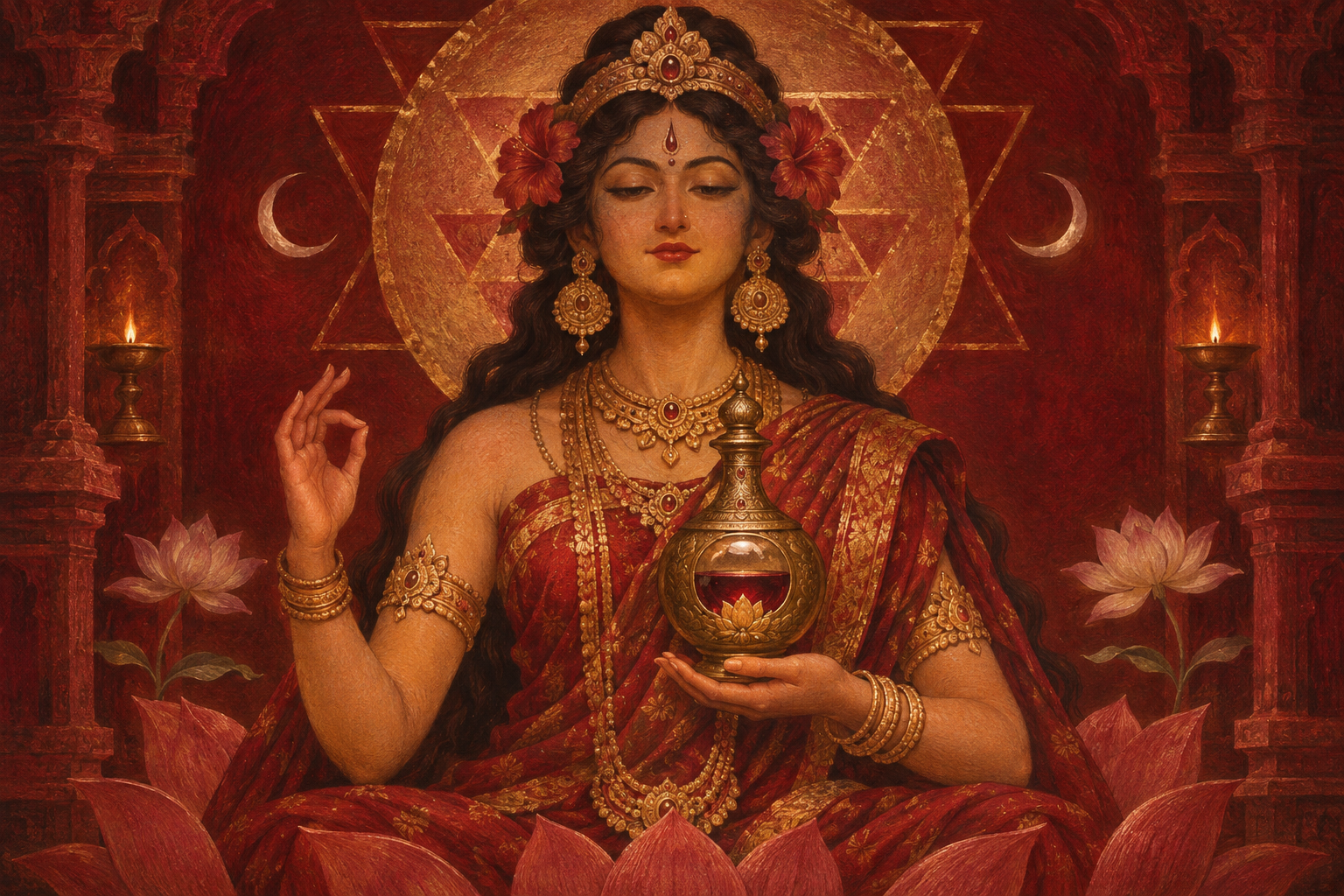
You see a Tantric goddess holding a vessel of liquor. Should you read it as approval of intoxication, a ritual instruction, or a metaphor for spiritual bliss? None of those conclusions is safe on its own.
The useful question is not simply, “Why is liquor present?” Ask why a potent substance appears inside a bounded vessel and under the control of the Devi. That relationship between potency, containment and mastery is where the image begins to speak.
The first correction: a symbol is not permission

Tantric imagery often places spiritually charged and socially unsettling things before the viewer. Their presence does not automatically turn them into instructions for ordinary behaviour. An image can ask you to confront attraction, fear or disgust without commanding you to act on any of them.
This distinction is essential with the liquor vessel. Ordinary intoxication can diminish attention and self-command. The Tantric image, by contrast, places liquor within a structure of restraint: it is held, bounded and associated with divine agency. The tension between intoxication and control is not an inconvenience to be explained away. It is part of the teaching.
So do not reduce the vessel to either of two slogans: “Tantra permits drinking” or “the liquor cannot be literal.” The first turns iconography into a licence. The second may erase the deliberately challenging character of the symbol. A more careful reading allows literal, ritual and contemplative meanings to remain distinct until a particular tradition supplies the context.
If the image makes you curious about practice, do not treat it—or an online explanation of it—as authorization to consume alcohol. Alcohol can impair judgment and cause harm. A lineage-specific rite requires lineage-specific instruction; contemplation of the symbol requires no consumption at all.
Read the image as a relationship, not an isolated object
The liquor, the vessel and the hand of the goddess form one symbolic statement. Separating them produces a shallow interpretation. Read them together and a more disciplined meaning emerges.
The liquor signifies potency that can overtake you
Liquor alters ordinary awareness. Symbolically, that makes it a fitting image for an intensity that loosens familiar boundaries: ecstasy, desire, absorption or bliss. Yet the same quality also makes liquor a sign of danger. A force capable of carrying you beyond habitual identity can also overwhelm discrimination.
When you encounter this symbol, notice both possibilities. If you retain only “bliss,” you sentimentalize the image. If you retain only “danger,” you miss why a Tantric tradition might use a charged substance rather than a harmless ornament.
The vessel gives power a boundary
A liquid spreads unless something contains it. The bowl therefore matters as much as its contents. It introduces measure, form and a boundary. It does not destroy the liquor’s potency; it makes that potency holdable.
This is the central practical insight. Spiritual intensity is not the same thing as spiritual maturity. An experience becomes useful only when attention, discrimination and discipline can contain it. The vessel asks you to examine the form holding your own intensity: a vow, a daily practice, ethical restraint, a mantra received through proper instruction, or the capacity to remain lucid when emotion rises.
The goddess’s hand changes the meaning
The bowl is held by the Devi. The substance is therefore not depicted as an accidental temptation wandering through the scene. It stands under divine possession and command.
That detail reverses the ordinary relation between a person and an intoxicant. In habitual intoxication, the substance may master the person. In the icon, the goddess masters the vessel. What could bind is shown as subordinate to Shakti.
Use that reversal as an interpretive test. Ask, “Who governs whom?” If desire, excitement or altered experience governs the practitioner, the vessel’s teaching has not been understood. If the force is recognized, bounded and placed in service of worship, the image’s inner logic becomes clearer.
Nitya Klinna places the vessel inside a lunar system
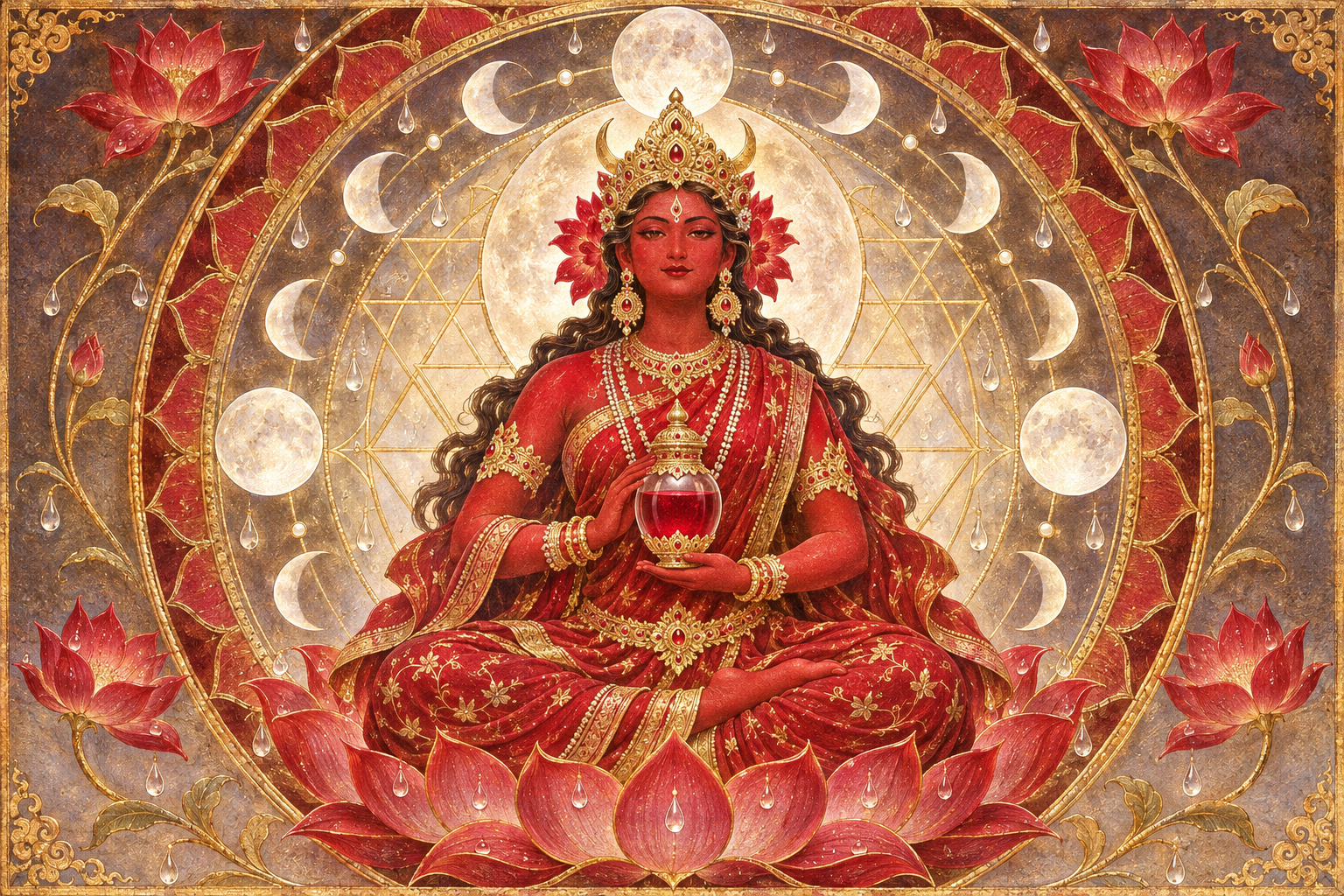
A liquor vessel cannot be interpreted responsibly while the identity of its bearer is ignored. In this setting, the figure is Nitya Klinna, one of the sixteen Nitya Devis connected with the sixteen tithis, or lunar days. Nitya Klinna is associated with Tritiya tithi, the third lunar day.
This identification tells you that the bowl belongs to a patterned sacred system. The goddess is not merely a generic figure carrying a provocative accessory. Her image participates in a sequence linking forms of the Divine Mother with movements of lunar time.
That context should change how you look. Before assigning a universal meaning to any attribute, identify the deity, the ritual family and the temporal setting. The same object can carry a different emphasis when held by another deity or placed in another system. “Liquor always means one thing in Tantra” is therefore too blunt to be reliable.
It also means you should resist inventing an interpretation from the object alone. The proper sequence is deity first, system second, attribute third. Beginning with the most sensational detail usually produces the least accurate reading.
A five-step method for reading the liquor vessel
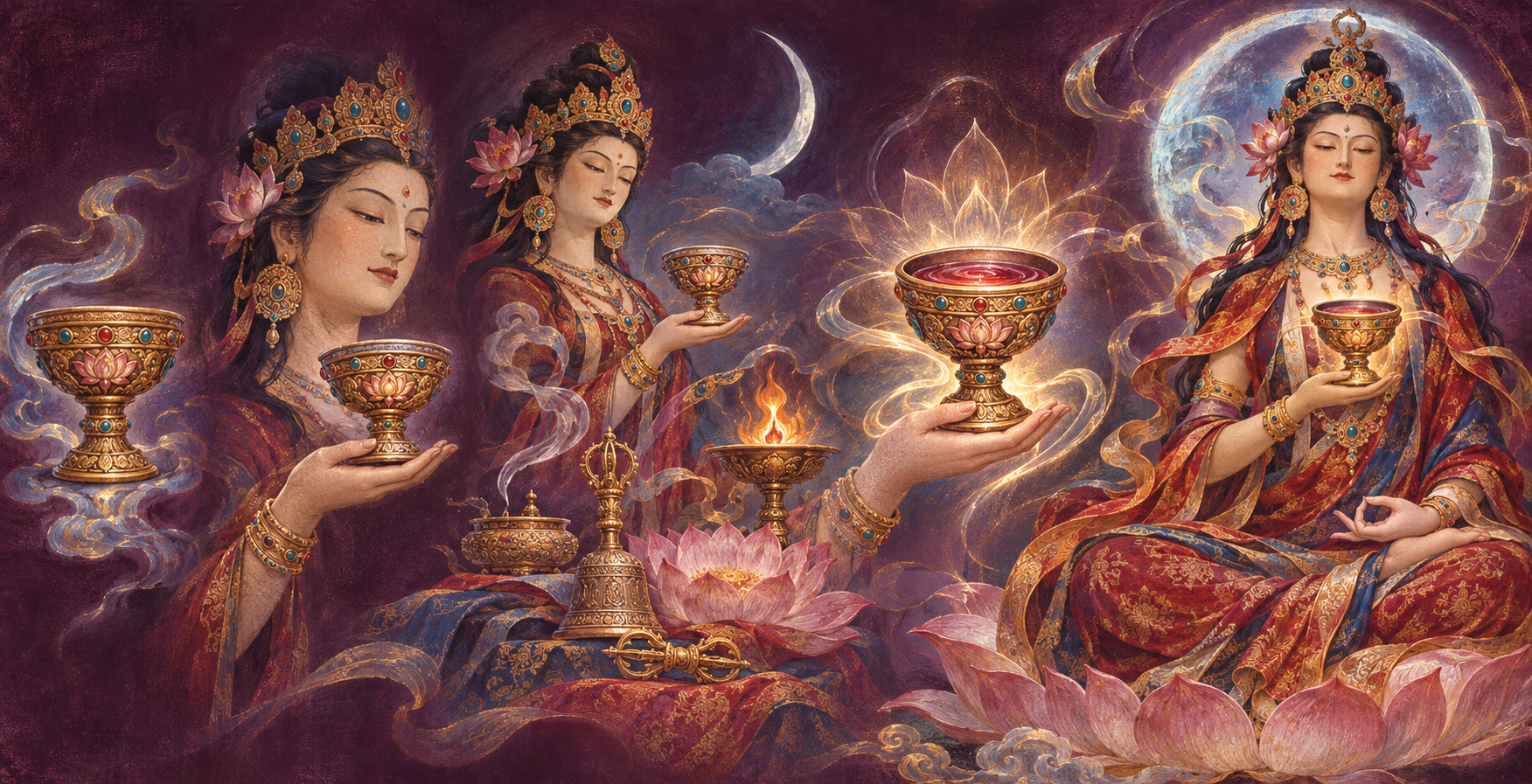
You can use the following method when the vessel appears in an image, temple description or discussion of Tantric worship.
- Identify the bearer. Confirm which Devi holds the vessel. For Nitya Klinna, retain her place among the Nitya Devis and her connection with Tritiya instead of treating the figure as anonymous.
- Inventory the complete image. Record the vessel alongside the goddess’s posture, gestures and other attributes. Do not let the most provocative object erase the rest of the iconography.
- Study the relationship. Ask whether the vessel is held, offered, received or merely present. A substance governed by the deity communicates something different from a substance governing the worshipper.
- Separate three possible levels. At the iconographic level, the vessel communicates through visual contrast. At the ritual level, its use depends on the rules of a particular tradition. At the contemplative level, it can direct attention toward bliss, attachment, restraint and mastery. Do not assume that evidence for one level proves the others.
- Test your interpretation against discipline. A reading that excuses compulsion while ignoring containment has probably isolated the liquor from the bowl. A reading that acknowledges potency but asks how it is governed better fits the complete image.
This method also protects you from a common modern mistake: treating transgression as the essence of Tantra. Breaking a convention is not, by itself, liberation. Without clarity and restraint, transgression can remain another form of bondage. The vessel makes that distinction visible by showing intensity inside a limit.
The next time you meet this image, pause before asking whether Tantra approves or condemns the substance. Identify the Devi, observe who holds the bowl, and look for the discipline that contains its power. That will take you closer to the symbol’s teaching than either scandal or romanticism can.
Key takeaways
- The liquor vessel is not a blanket instruction to drink; imagery, formal ritual and ordinary behaviour must not be confused.
- Liquor represents a potency that may suggest bliss or absorption but can also overwhelm discrimination.
- The bowl adds measure and containment, while the goddess’s hand places the potent substance under divine mastery.
- Nitya Klinna’s identity and association with Tritiya tithi must be established before interpreting her attribute.
- You can contemplate the tension between intensity and restraint without consuming alcohol or imitating a rite.
References

Leave a Reply
You must be logged in to post a comment.