
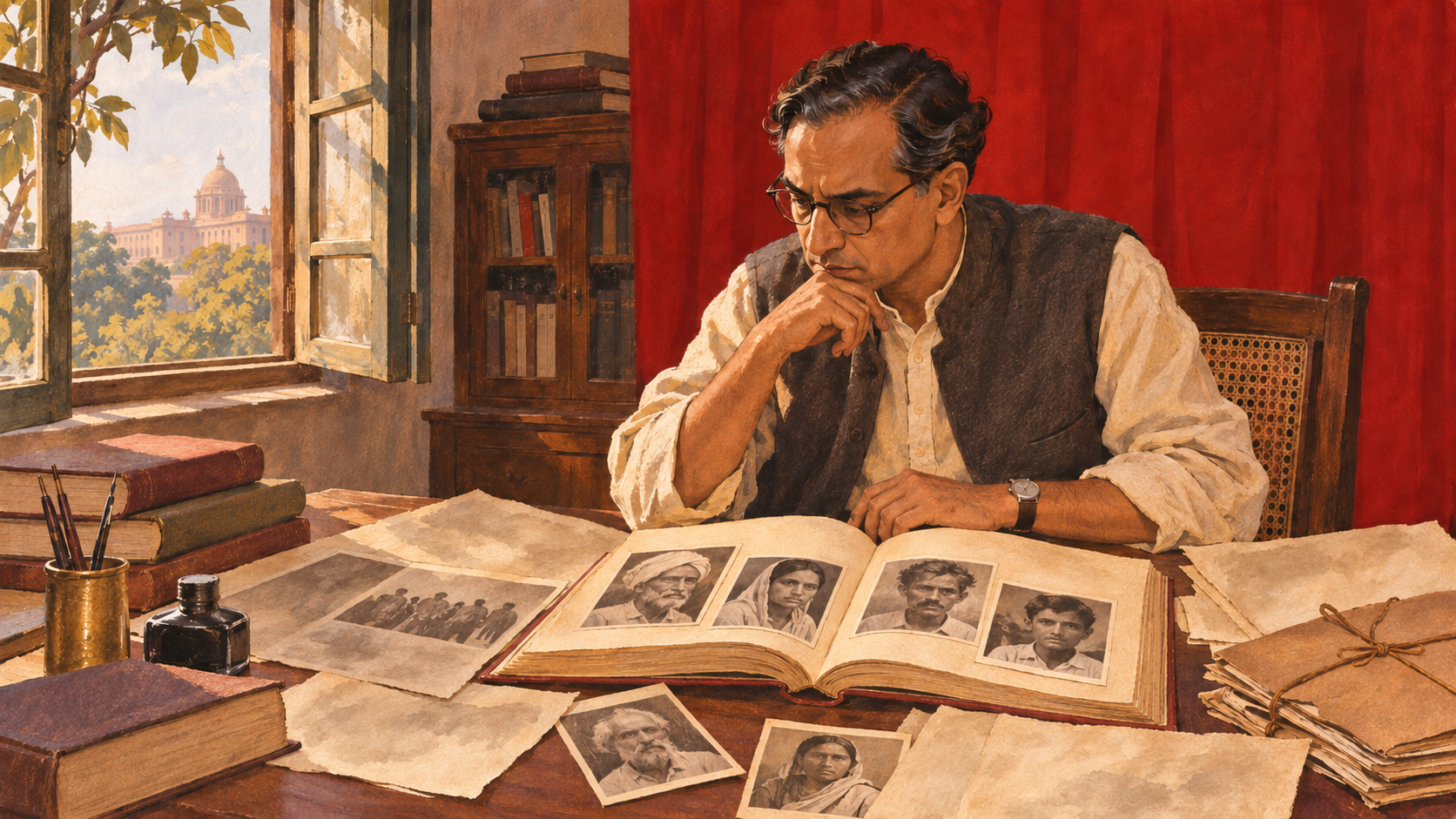
If you have seen Sita Ram Goel invoked as proof that Indian Communism was anti-national, the label alone tells you very little. You need to know what he was criticizing, why his own break with Communism mattered, and how to distinguish a serious historical argument from a slogan.
Goel’s central warning concerned ideological capture. A movement can begin with sympathy for suffering and end by teaching its adherents to ignore evidence, excuse coercion, and judge Bharat through the interests of a transnational political creed. That warning remains useful, but only when applied precisely. It is not a warrant to treat every concern about inequality, every left-wing proposal, or every communist voter as identical.
Why Goel’s own break with Communism matters
Goel did not approach Communism as a distant conservative who had never understood its appeal. He had engaged with it in Calcutta and then turned against it. In 1953, he translated the 1949 collection The God That Failed into Hindi and worked to circulate it.
That biography strengthens his critique in a particular way. A former adherent can describe the moral attraction of an ideology, the pressures that preserve loyalty, and the moment when contrary facts become impossible to explain away. An outsider may see the public doctrine; an insider can also recognize the habits of mind that protect it.
But conversion is not proof. Former believers can identify mechanisms that loyalists overlook, and they can also overcorrect after a painful break. You should therefore treat Goel’s experience as privileged testimony, not as an exemption from evidence.
His choice of translation reveals the method. In 1949, six writers who had committed themselves to Communism recounted why they joined and why they eventually left. The aim was not merely to repeat anti-communist accusations. It was to reconstruct the conditions under which intelligent, morally serious people could surrender their judgment to a political movement. The decisive break was sometimes called a Kronstadt moment: the point at which someone moves beyond quietly leaving and begins actively opposing the system once defended.
When you encounter any political conversion story, including Goel’s, ask three questions:
- What was attractive at the beginning? If the account cannot explain the attraction, it probably caricatures the movement rather than understanding it.
- What specific evidence broke the believer’s confidence? Disappointment with personalities is different from discovering a defect in the doctrine or system.
- What did the break cost? Loss of status, friendships, or institutional access can help explain why people remain loyal after their doubts begin.
This procedure turns personal testimony into usable evidence without treating memory as a final verdict.
How a humane promise can disable political judgment
Goel’s critique becomes clearer when you understand why Communism attracted intellectuals in the first place. Between the Russian Revolution and the Stalin-Hitler pact, many European and American thinkers saw the established order repeatedly fail. The First World War damaged Europe’s confidence. The Depression of 1929-30 shook capitalism and democratic institutions. Mussolini and Hitler rose, while the conflicts involving Spain, Abyssinia, and Czechoslovakia exposed the weakness of the old liberal establishment.
Against that background, Soviet Russia could appear to offer more than another government. It promised a new society and even a new kind of human being. Nineteenth-century confidence in scientific, economic, and cultural progress had already trained many educated people to expect a future golden age. Communism supplied that expectation with an apparent agent, programme, and destination.
There was also a reactive element. Some of Communism’s loudest enemies were capitalists, imperialists, Fascists, and Nazis. A person repelled by those forces could begin sympathizing with their opponent without independently testing what that opponent was doing. The error is easy to repeat: if a bad actor condemns something, we assume the condemned thing must be good.
The moral promise eventually collided with the Soviet record. During the Moscow Trials of 1935-38, Stalin’s regime eliminated principal associates of Lenin and treated people who retained memories of the revolutionary period as enemies. At that point, continued loyalty required more than optimism. It required a method for neutralizing unwelcome facts.
Goel wanted Indian readers to notice four habits by which ideological loyalty can survive such collisions:
- Intentions replace outcomes. A movement is judged by the society it promises, while its opponents are judged by every injustice they actually produce.
- Enemies become character certificates. Hostility from an imperialist or reactionary is treated as evidence that the movement under attack must be virtuous.
- Doubt becomes a moral defect. Contrary evidence is attributed to cowardice, class interest, prejudice, or betrayal instead of being answered.
- Failure is charged to imperfect implementation. The promised future remains innocent because every destructive result is blamed on the wrong leader, the wrong stage, or insufficient revolutionary commitment.
You can test a political argument for these habits without first deciding whether it is left-wing or right-wing. Ask what evidence would count against it. Ask whether declared aims are being used to excuse actual methods. Ask whether the same standard is applied to allies and opponents. If no possible event could alter the conclusion, you are dealing with a protected belief, not an open historical argument.
Why the Indian setting made the charge more severe
Goel’s intervention came when independent India was still politically unsettled. Around 1949, not all of roughly 550 princely states had been fully integrated, the war with Pakistan had recently concluded, the Nizam of Hyderabad had been defeated, Goa remained under Portugal, and Pondicherry remained under France. Goel and his anti-communist associates regarded this disorder as an opening that a disciplined revolutionary ideology could exploit.
This is where his criticism of Communism became a criticism of Indian Communism. The serious version of that criticism is not that an idea becomes false merely because it originated abroad. Ideas cross borders constantly, and a civilization confident in itself can learn without surrendering its judgment. The stronger charge is that an Indian political movement can begin treating a foreign revolutionary centre, imported historical script, or universal class theory as more authoritative than India’s own circumstances and interests.
For Hindu and wider Dharmic readers, the problem is also one of categories. When an analysis treats class and material interest as exhaustive explanations, it can reduce temples, sampradayas, pilgrimage, family bonds, sacred geography, and inherited duties to instruments of power. You do not have to deny social injustice to reject that reduction. A tradition can carry hierarchy and abuse in one setting while also carrying memory, discipline, charity, artistic inheritance, and spiritual meaning. An account that records only the first set has not explained the whole institution.
Use four tests when assessing the allegation that a communist position was anti-Indian:
- Locate the final reference point. When an external ideological centre and India’s concrete security or civilizational interests conflict, which one governs the position?
- Examine the description of India. Is Bharat approached as a living civilization with its own intellectual vocabulary, or merely as raw material awaiting a theory developed elsewhere?
- Check consistency on coercion. Is political violence condemned by principle, or excused when it advances the preferred historical side?
- Demand evidence of conduct. A party resolution, campaign, alliance, or defence of repression can support an accusation. A foreign-sounding vocabulary or an unpopular economic view cannot establish disloyalty by itself.
That final distinction matters. Indian Communism should not be treated as a timeless person with one motive. Claims about a particular party, leader, institution, or period need evidence tied to that actor and time. Otherwise, anti-communism becomes the same kind of closed doctrine that Goel was attacking.
What Goel’s critique can establish – and what it cannot
Goel’s critique is strongest when it identifies a structure of belief: moral idealism attracts the adherent, group identity hardens commitment, an external political centre supplies authority, and unwelcome evidence is reclassified as hostile propaganda. His own departure from Communism helps illuminate that structure from within.
It does not follow that every diagnosis of poverty or unequal power made by a communist is false. A factual claim does not become wrong because of the claimant’s ideology. Nor does sympathy for workers, land reform, or economic equality automatically entail loyalty to an authoritarian state. You have to distinguish the social problem, the proposed remedy, and the political machinery intended to impose it.
The Soviet record is relevant to the evaluation of a movement that regarded Soviet Russia as a model. It is not sufficient proof of every charge against every Indian communist. If someone alleges that a named Indian leader subordinated Bharat’s interests to an external power, ask for the leader’s words, decisions, affiliations, and historical context. The history of Stalinism supplies warning signs; it cannot substitute for the Indian evidence.
Sincerity is similarly inconclusive. A person may genuinely desire justice and still support destructive institutions. Another may oppose Communism for selfish or authoritarian reasons and still identify a real communist abuse. Motive affects how you interpret a witness, but it does not settle whether the claim is true.
Goel’s supporters should accept the same discipline they demand from communists. If ideological self-respect prevents one side from admitting error, civilizational pride can prevent the other side from doing so as well. A pro-Bharat position earns credibility by correcting its own exaggerations, distinguishing accusation from proof, and refusing collective guilt.
How to use the critique without turning it into a slogan
If you are reading Goel for history, discussing him in a study circle, or deciding whether to share one of his claims, use this five-step method.
- Define the target. Determine whether the claim concerns communist doctrine, the Soviet state, an Indian party, a particular intellectual circle, or an individual leader. Do not move between these objects without saying so.
- Separate the layers of the argument. A moral claim asks what is right. A historical claim asks what happened. A causal claim asks why it happened. A charge of disloyalty asks whose interests governed an action. Each layer requires different evidence.
- Put the claim on a timeline. Goel’s communist involvement in Calcutta, his break, his 1953 Hindi translation, and his later prominence in the intellectual battles around Ram Janmabhoomi belong to different stages. Do not read the later public figure backward into every earlier intervention.
- Name the possible falsifier. Write down what evidence would make you revise the claim. If the answer is nothing, acknowledge that you are defending an identity rather than testing a proposition.
- Apply the rule symmetrically. If excusing violence for a promised future discredits Communism, the same excuse should be rejected when used by an anti-communist movement. If foreign allegiance requires scrutiny on the left, undisclosed foreign allegiance requires scrutiny everywhere.
Key takeaways
- Goel’s former commitment to Communism gives his criticism unusual interpretive value, but not automatic infallibility.
- His most durable insight concerns ideological capture: noble intentions can be used to shield coercive institutions from evidence.
- The Indian dimension is a question of political and civilizational judgment, not a claim that every foreign-born idea is invalid.
- Soviet history provides relevant warnings, but allegations against Indian actors still require actor-specific Indian evidence.
- A pro-Dharma reading should resist both materialist reduction and the temptation to replace communist dogma with anti-communist dogma.
The next time you encounter a sweeping quotation attributed to Goel, reduce it to a claim with an actor, date, action, and evidentiary standard. If those elements are missing, do not circulate it as history. If they are present, test them without granting either Communism or anti-communism immunity from facts. That is the most serious way to continue the intellectual work Goel began.

References

Leave a Reply
You must be logged in to post a comment.