
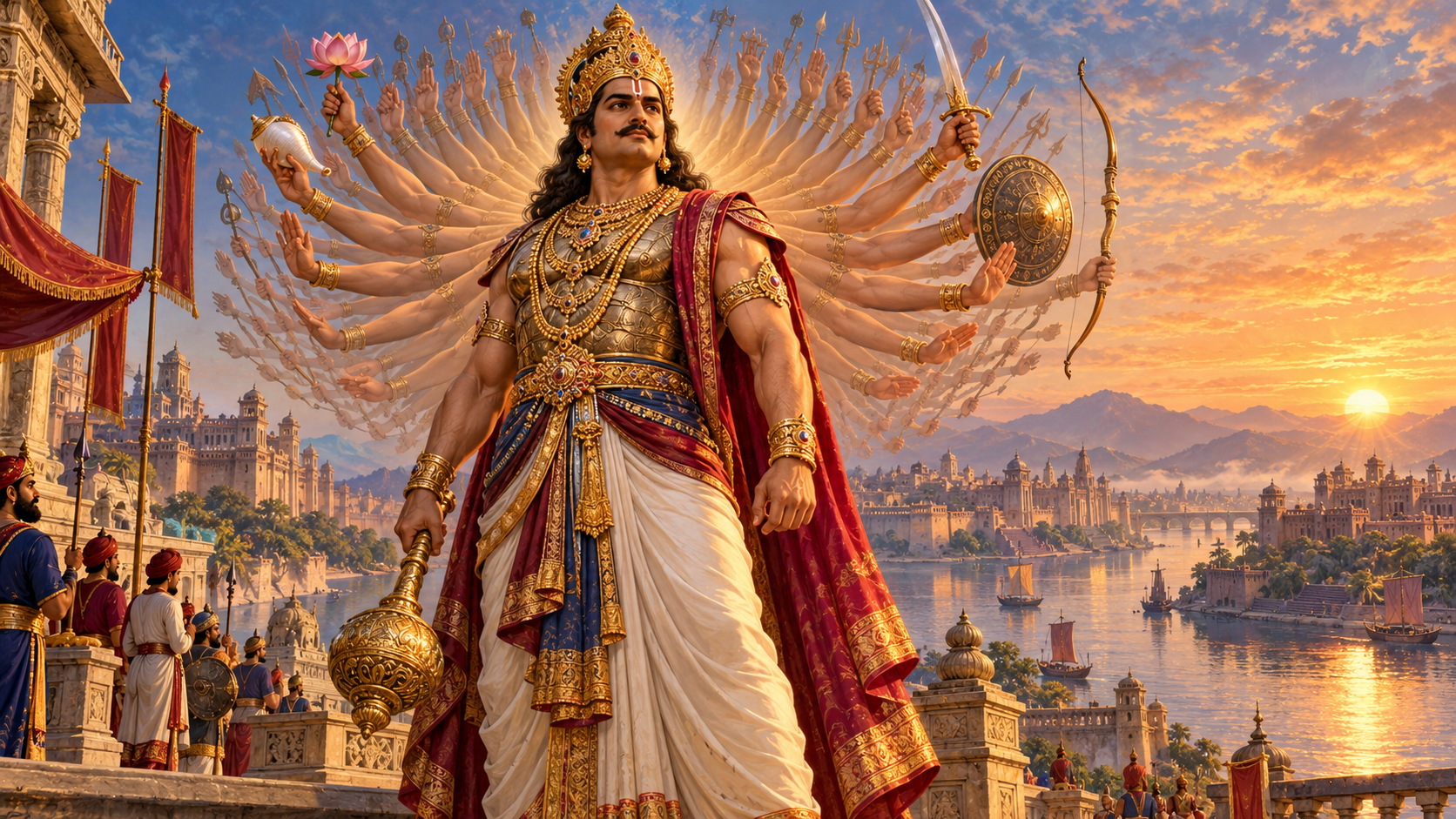
You may have encountered Kartavirya Arjuna, Karthaveerya Arjuna, and Sahasrabahu Arjuna and wondered whether Hindu tradition is describing one king or several. These names belong to the same celebrated ruler. Sorting them out is the first step toward understanding his identity without confusing him with another Arjuna.
His many arms are memorable, but they are not the whole portrait. His Haihaya lineage, divine boons, extraordinary strength, royal authority, and reputation as a warrior belong together. Read in that order, Kartavirya Arjuna becomes more than an exotic figure: he becomes a serious meditation on the reach of power and the Dharmic responsibility that must govern it.
First, settle the names and identity
Kartavirya Arjuna and Karthaveerya Arjuna are spelling variants of the same name. English spellings of Sanskrit names often differ because sounds can be represented through scholarly transliteration, regional pronunciation, or simplified Roman letters. The extra letters in Karthaveerya do not create a second person.
Sahasrabahu Arjuna is a descriptive name for the same Haihaya king. Sahasra means “thousand,” while bahu means “arm,” making Sahasrabahu the “thousand-armed” one. The epithet brings his extraordinary physical form to the foreground; Kartavirya identifies him through his proper and dynastic name.
- Kartavirya Arjuna: the concise spelling commonly used for the king.
- Karthaveerya Arjuna: an alternate Roman spelling of the same name.
- Sahasrabahu Arjuna: the epithet that identifies him through his extraordinary arms.
- Haihaya king: the dynastic identity that places him within a royal lineage rather than presenting him as an unattached wonder-worker.
The name Arjuna is not unique to one personality in Hindu tradition. Do not merge Kartavirya Arjuna with the Pandava Arjuna merely because they share it. When you are uncertain, look for three identifying markers: the Haihaya dynasty, the Sahasrabahu epithet, and the combination of divine boons with extraordinary bodily power. If those markers appear together, the figure is Kartavirya Arjuna.
The many arms belong to a complete portrait of power
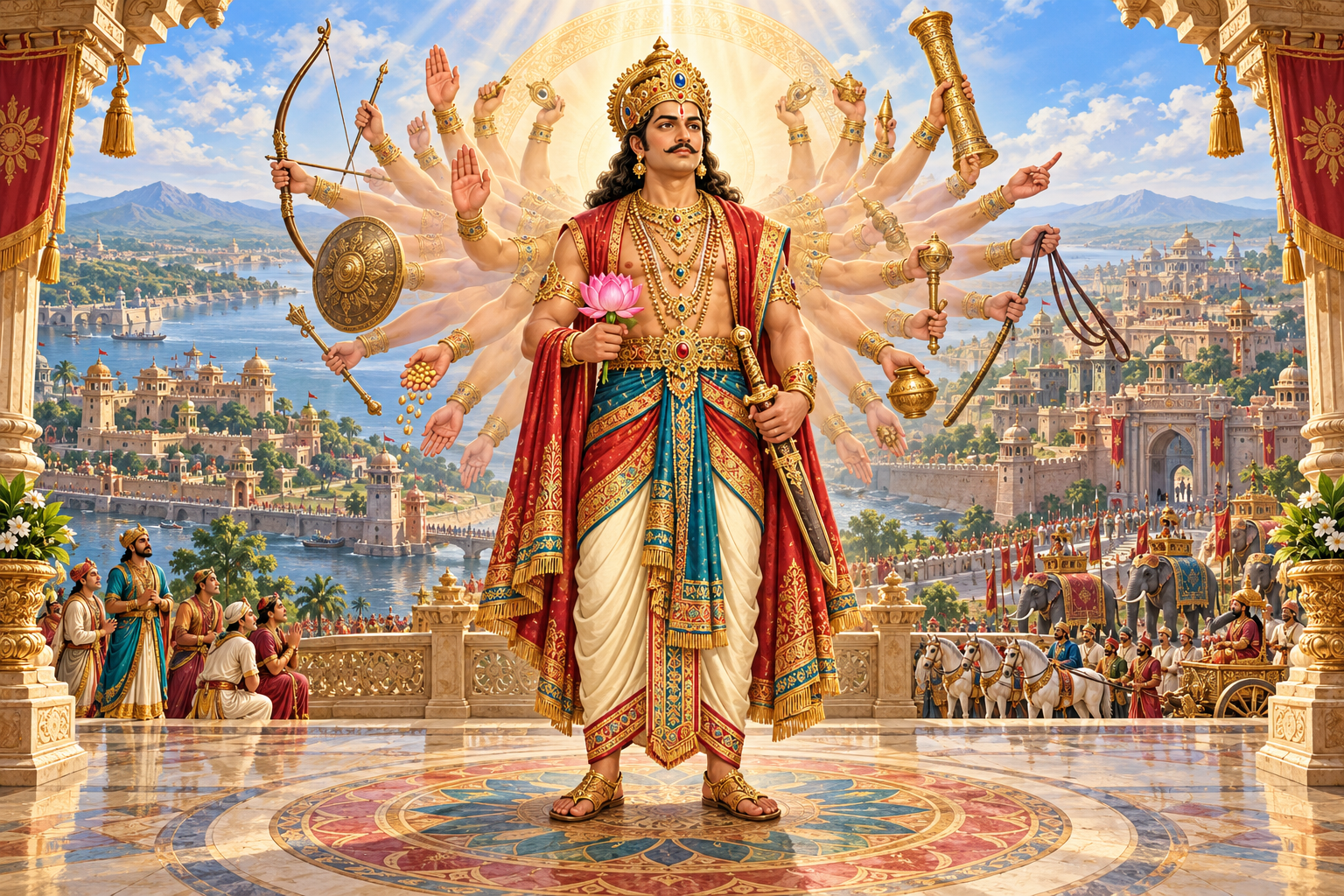
Kartavirya Arjuna is remembered for extraordinary strength, divine boons, and numerous arms. These are not three unrelated curiosities. Together they establish a ruler whose capacities exceed ordinary human limits and whose presence must be understood on a correspondingly large scale.
The divine boons explain that his exceptional condition is not ordinary physical development. The arms make his abundance of power visible. His strength shows that the extraordinary form has practical force rather than being ornamental. His kingship then turns that force into a public question: how should someone with exceptional reach exercise authority?
You do not have to force an immediate choice between “literal anatomy” and “mere symbolism.” That modern either-or can obscure what the traditional image accomplishes. Within the narrative world, the arms are part of the king’s extraordinary identity. At the level of reflection, they can also help you contemplate power multiplied beyond familiar limits. One mode of reading does not automatically cancel the other.
Your purpose should guide the emphasis. In devotional or traditional storytelling, receive the form as the tradition presents it. In literary analysis, ask what the multiplied arms communicate about reach, force, sovereignty, and human limits. In historical inquiry, record the traditional claim accurately without quietly converting it into archaeological proof or dismissing it because it is extraordinary.
Above all, do not reduce Sahasrabahu to a spectacle. The arms matter because they make power impossible to overlook. The useful question is not simply, “How many arms did he have?” It is, “What happens when capacity becomes vastly greater than that of everyone around the ruler?” That question carries the image from visual wonder into Dharmic thought.
Read the ruler before judging the warrior
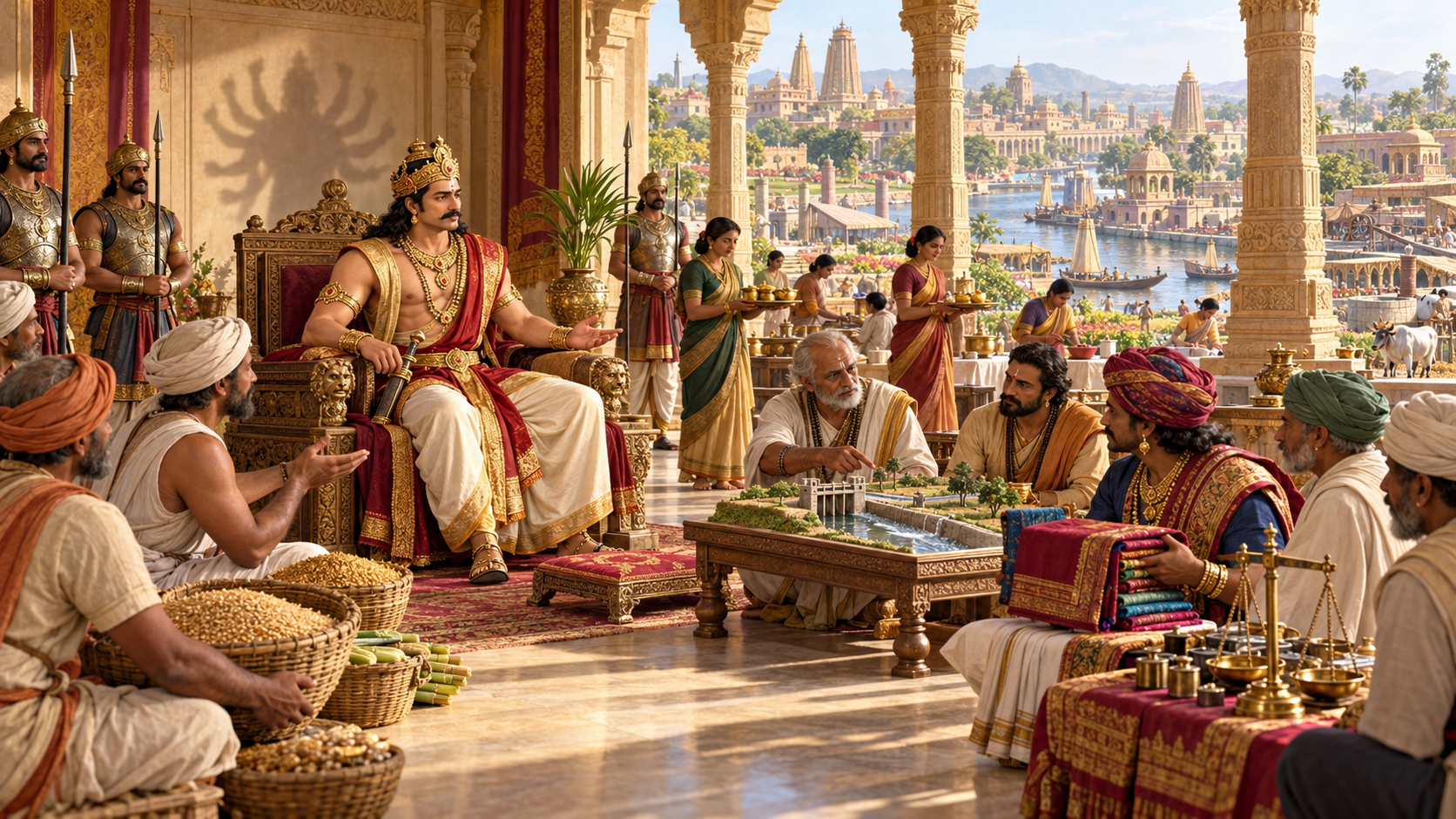
Kartavirya Arjuna is presented as both a formidable warrior and ruler. Remembering only the warrior leaves out the office that gives his strength social consequence. A warrior can prevail in a contest; a king must also carry responsibility for order, protection, judgement, and the use of authority.
This distinction matters because divine favour, unusual capacity, and Dharma are not interchangeable. A boon grants or confirms power. It does not, by itself, prove that every use of that power is righteous. Likewise, victory proves that someone prevailed; it does not settle the moral quality of the conduct that produced it.
A careful Dharmic reading therefore keeps gift, office, action, and judgement separate:
- Identify the gift. Note the boon, strength, or extraordinary form granted to the figure.
- Identify the office. Ask what obligations come with being a king rather than a private individual.
- Examine the use. Follow what the ruler actually does with exceptional capacity in the particular telling before you.
- Apply the standard of Dharma. Do not substitute admiration, victory, lineage, or supernatural status for moral evaluation.
- Attend to the outcome. Let the complete narrative disclose how the tradition evaluates power, rather than judging from an isolated description.
This sequence also prevents a common interpretive mistake: turning a complex royal figure into either a flawless hero or a simple villain before reading the relevant narrative. Hindu traditions frequently preserve powerful personalities precisely because their lives invite sustained reflection. Admiration for strength need not become moral surrender, and criticism of conduct need not require denying the grandeur of the figure.
The Haihaya affiliation deserves similar care. A dynasty is not decorative genealogy. It places a ruler within inheritance, continuity, political authority, and collective memory. When the dynastic name accompanies Kartavirya Arjuna, keep it in your notes. It helps distinguish him from namesakes and reminds you that his power operates through kingship, not only through personal prowess.
Keep sacred memory and historical proof in their proper lanes
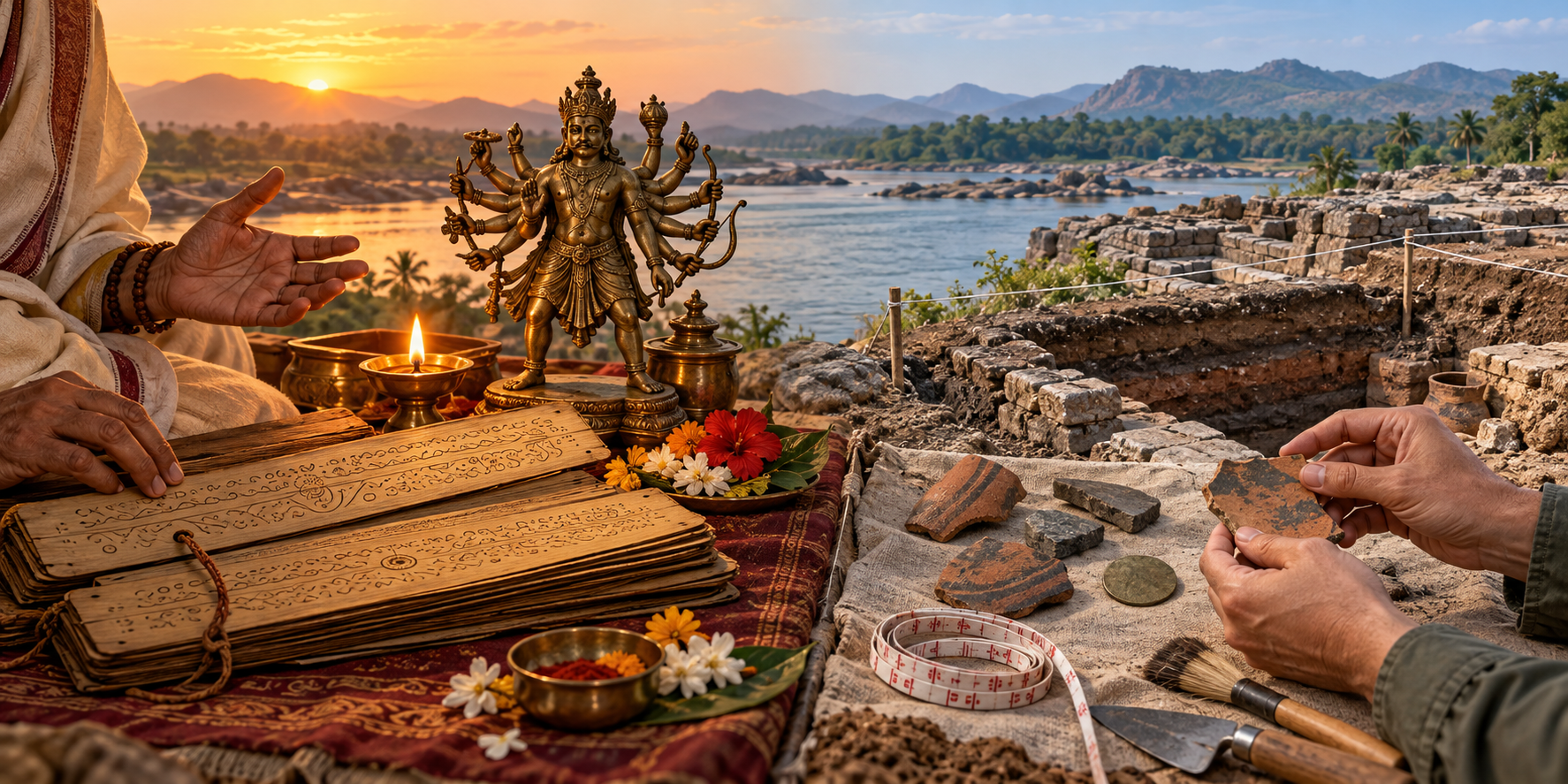
You may see Kartavirya Arjuna described as a legendary king from ancient Hindu texts and history. Read that wording carefully. “History” can refer broadly to an inherited account of the past, while modern historical argument normally requires evidence that can support specific claims about chronology, place, authorship, or material events.
A traditional identity and a modern historical reconstruction are therefore different kinds of claim. The first asks how Hindu memory presents the king. The second asks what can be established through dated texts, manuscript analysis, inscriptions, archaeology, geography, or other independently examined evidence. Respect for tradition does not require collapsing those categories, and historical discipline does not require contempt for sacred memory.
Use precise language when you discuss him:
- Say “Hindu tradition remembers” when describing an inherited identity or narrative.
- Say “a named text narrates” when you have the title and can identify the relevant passage.
- Say “an inscription attests” only when an actual inscription supports the particular claim.
- Say “a later interpretation understands” when presenting symbolism that is not explicitly stated in the narrative.
- Avoid assigning a firm date, location, quotation, relationship, or deed unless your reference supplies it.
This vocabulary protects the tradition from two opposite errors. One is careless literalism, which treats every inherited statement as if it were already a modern historical conclusion. The other is careless dismissal, which assumes that anything extraordinary has no religious, literary, philosophical, or cultural truth worth understanding.
It also helps when different tellings supply different emphases. Instead of rushing to harmonise every version, identify which text or community is speaking, what name it uses, and what aspect of the king it places at the centre. Variation need not mean that the tradition is broken. It may reveal how a durable figure carries more than one layer of meaning.
Key takeaways
- Kartavirya Arjuna, Karthaveerya Arjuna, and Sahasrabahu Arjuna identify the same celebrated ruler.
- The Haihaya dynasty, the Sahasrabahu epithet, divine boons, and extraordinary strength are the quickest markers for distinguishing him from another Arjuna.
- His many arms should be read together with his kingship and warrior identity, not as an isolated curiosity.
- A divine boon establishes unusual capacity; it does not automatically certify every exercise of that capacity as Dharmic.
- Traditional memory, literary interpretation, and modern historical proof can all be valuable, but they answer different questions and should be labelled accurately.
When you next encounter Kartavirya Arjuna, begin by writing down the name, epithet, dynasty, boon, and role used in that particular telling. Then follow how the narrative moves from extraordinary capacity to the exercise of authority. That small discipline will let you see the thousand-armed king as Hindu tradition intends him to be seen: not merely as an astonishing body, but as a ruler whose scale of power demands a correspondingly serious moral inquiry.
References

Leave a Reply
You must be logged in to post a comment.