
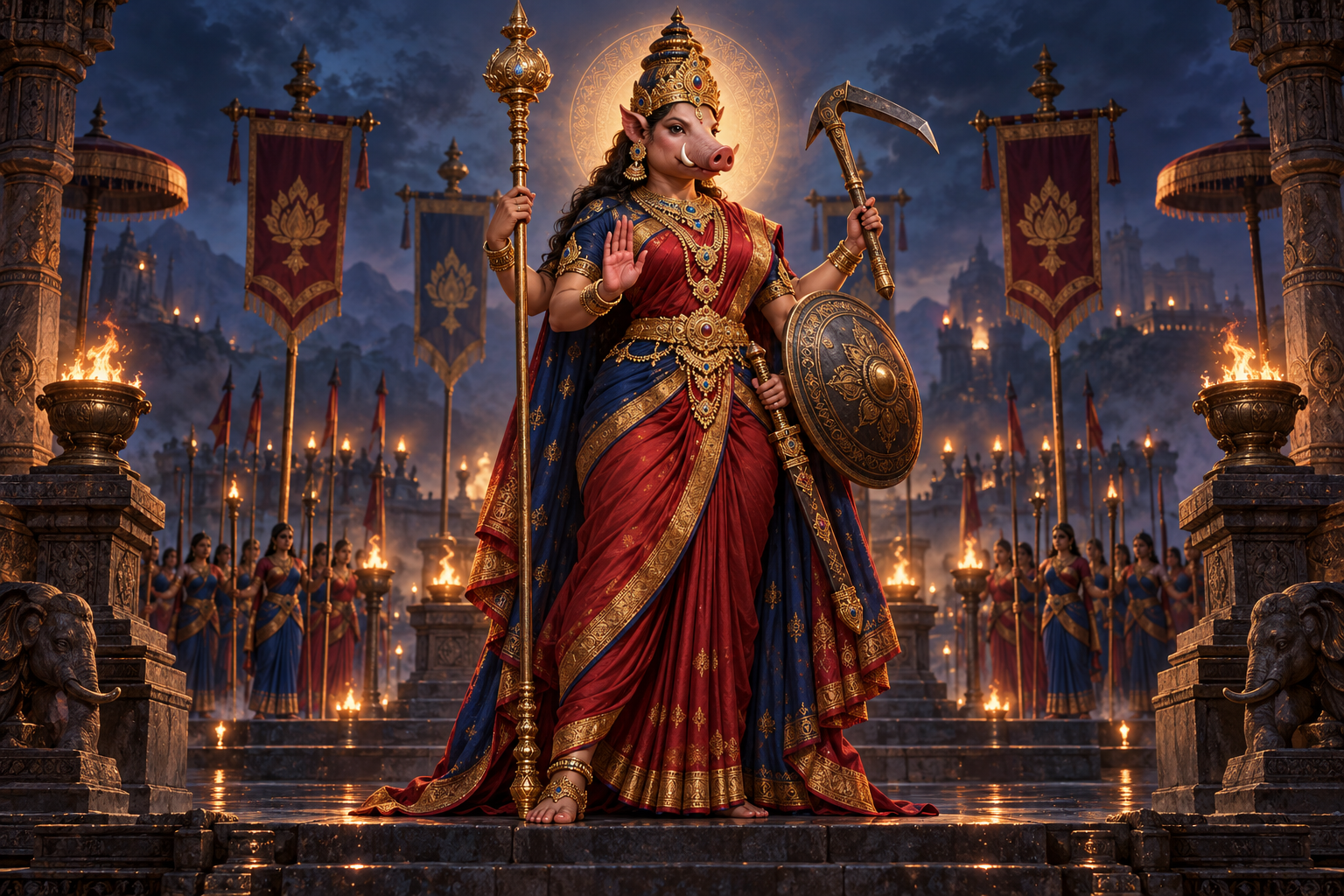
You have found an image labelled Dandini Varahi, but the label alone does not tell you what to notice. Is she simply Varahi carrying martial emblems, or does the commanding form express something more precise?
The useful answer begins with a distinction: Varahi identifies the boar-faced Devi, while Dandini emphasizes her authority as a commander. Once you hold those two ideas together, the image becomes easier to read. Its fierceness is not random aggression. It is power placed under discipline, direction and dharmic purpose.
The name gives you the first iconographic test
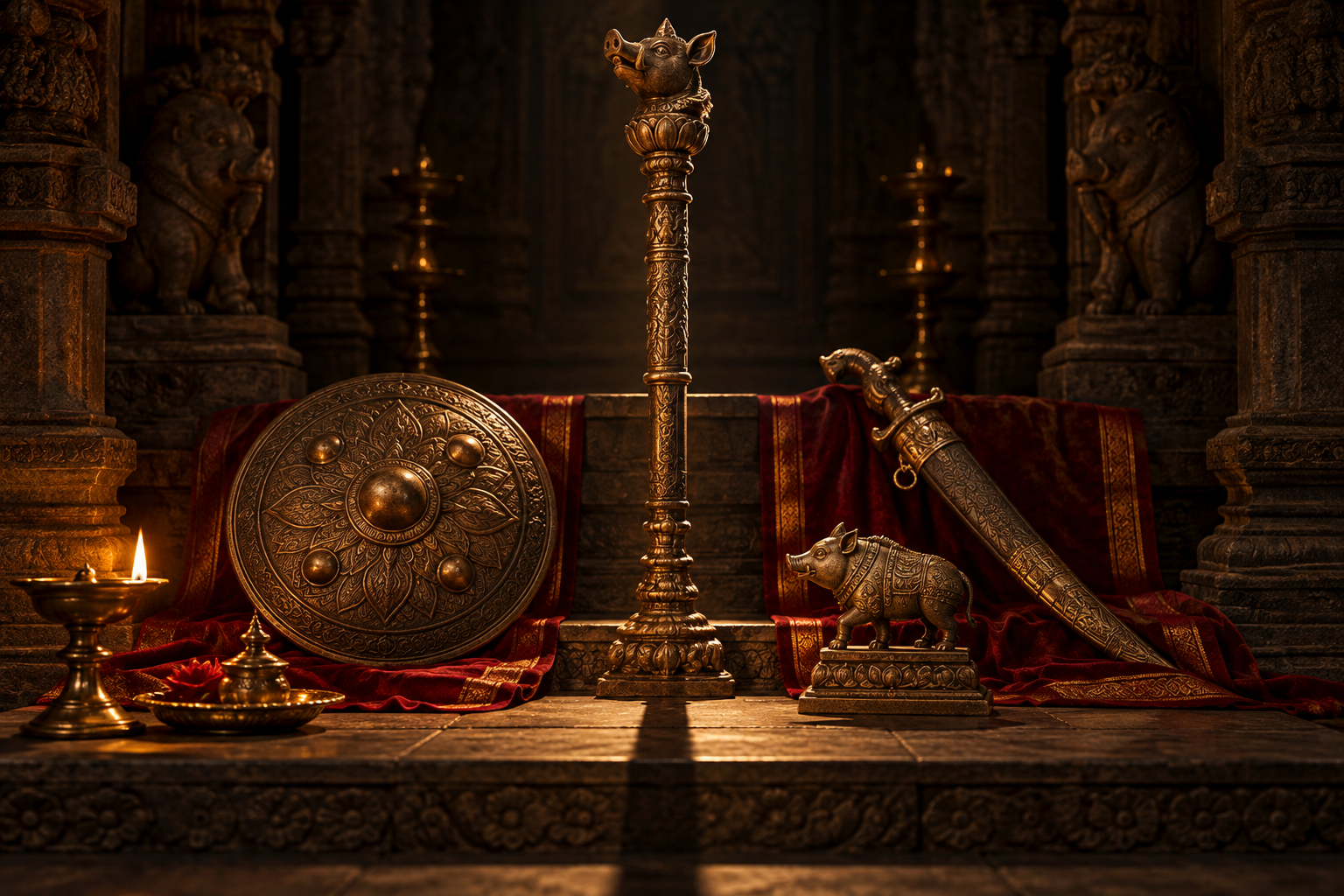
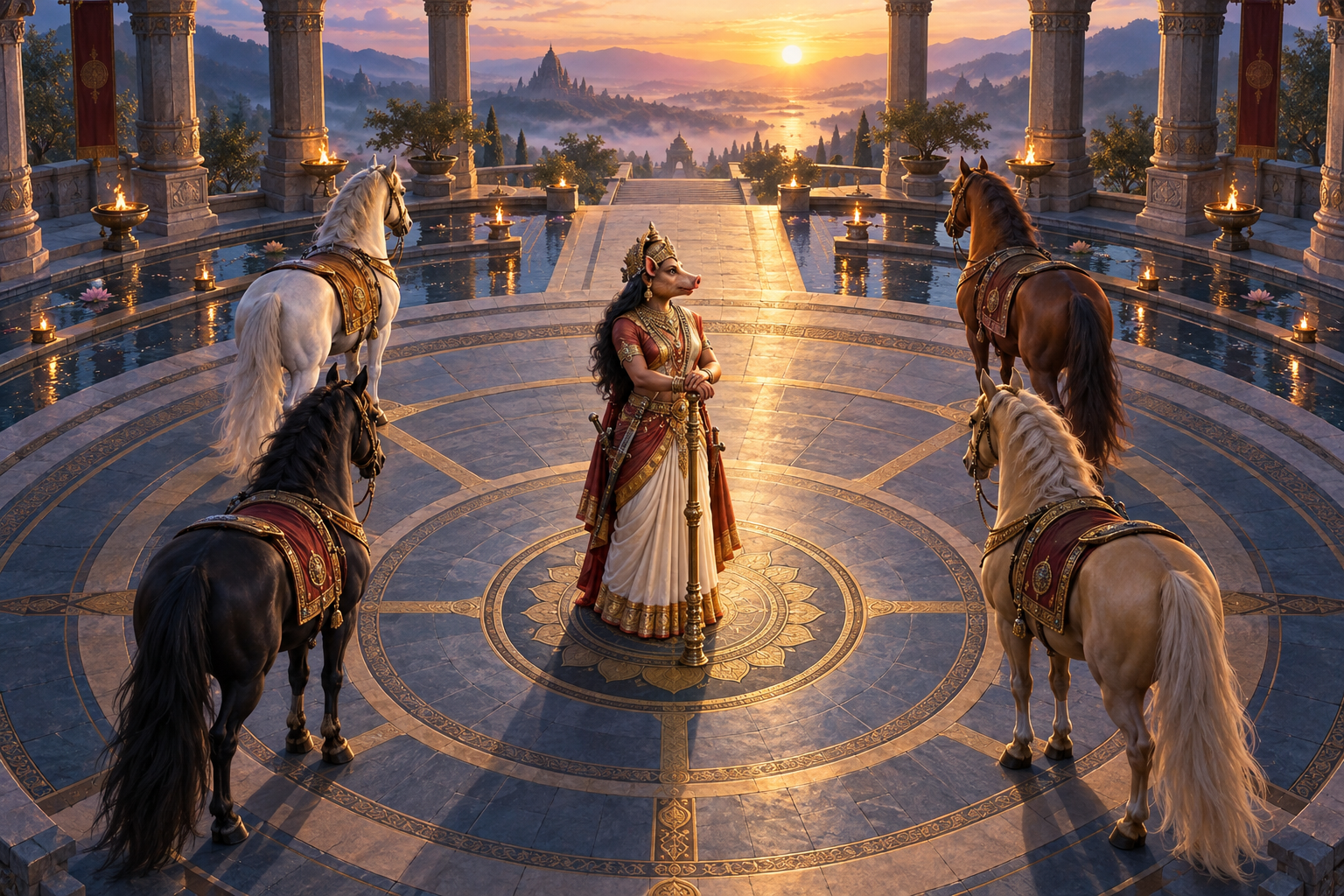
Dandini Varahi is the boar-faced commander of the divine army and a warrior aspect of Varahi Devi. Both parts of that identity matter. If you attend only to the boar face, you identify Varahi but miss the form’s commanding function. If you attend only to weapons or a fierce bearing, you see martial energy without establishing whose energy it is.
This gives you a practical rule: do not assume that every image of Varahi is specifically Dandini. The additional name marks an emphasis on command, readiness and the ordering of force. A Varahi image may share features with that commanding mode without being identified by its community as Dandini Varahi.
The distinction matters because Hindu iconography is not assembled from isolated symbols like a rebus. Identity arises from a coherent combination of face, bearing, attributes and ritual context. One martial object cannot settle the identification by itself. Nor can an intense facial expression, an ornate crown or a modern caption detached from the image’s original setting.
Dandini Varahi is also better known in initiated traditions than in popular worship and is not extensively treated in mainstream iconographic manuals. That relative scarcity of standardized public descriptions should make you more careful, not more imaginative. When details differ, record the difference instead of forcing every depiction into one supposedly universal template.
The boar face and the commander’s role must be read together
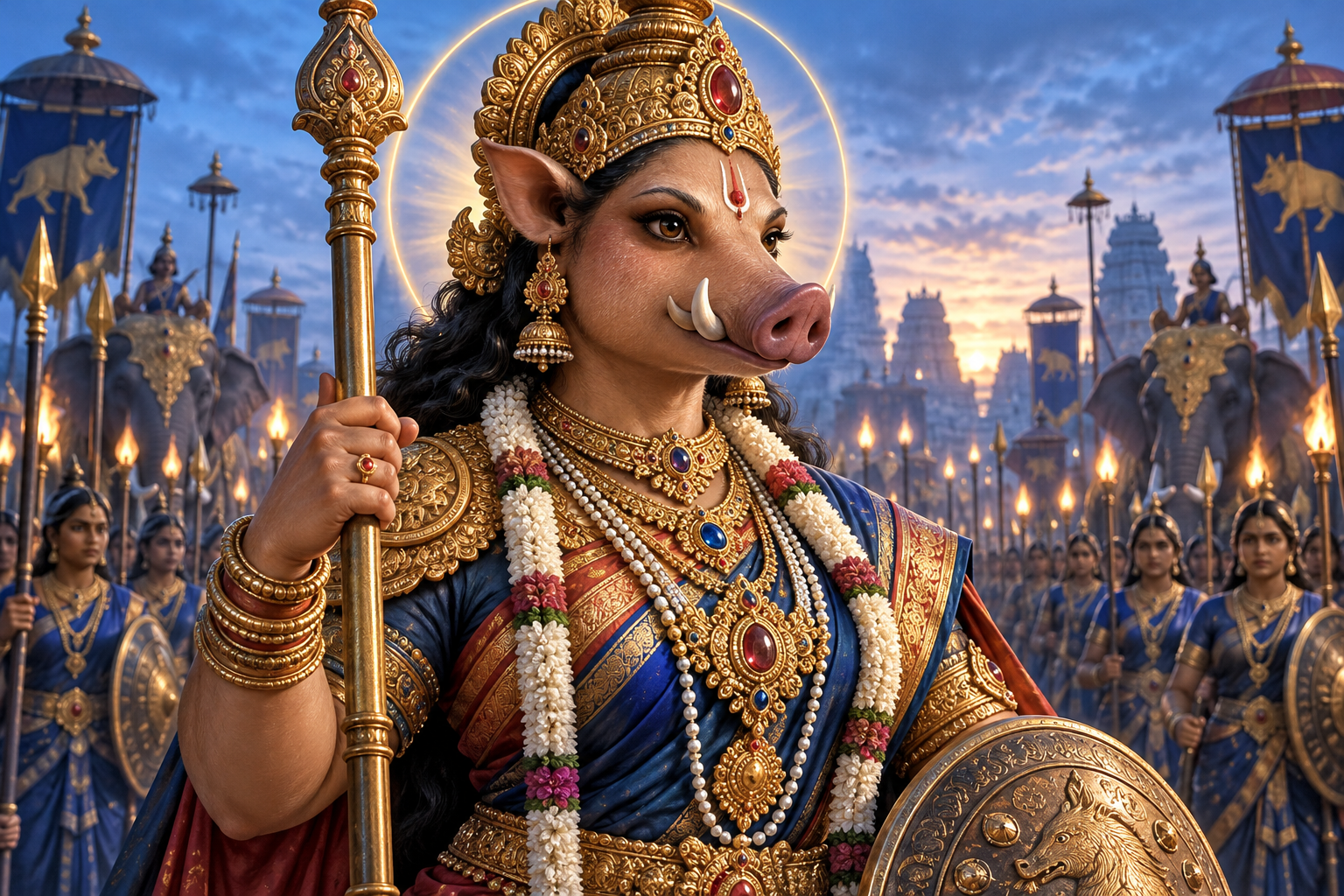
The boar face is not a decorative oddity and should not be reduced to ugliness, anger or animal instinct. It establishes the figure as Varahi and places her power beyond ordinary human measure. Sacred animal-headed imagery asks you to abandon the assumption that divinity must resemble an idealized human being before it can embody intelligence or authority.
The commander’s role then tells you how that extraordinary power is operating. A commander does not merely possess force. A commander directs it, assigns it and holds it to an objective. Dandini Varahi’s martial character is therefore better read as governed power than as an invitation to glorify violence.
This distinction changes the spiritual meaning of the image. Anger scatters attention and reacts to whatever provokes it. Command gathers attention and places it in service of a chosen duty. Rage wants release; disciplined force accepts direction. When you encounter Dandini Varahi’s fierceness, ask what governs that force rather than merely asking how frightening it appears.
The divine army can likewise be approached on more than one level. Iconographically, it establishes rank and a field of sacred action. Contemplatively, it can help you examine the many powers that require direction in your own life: attention, speech, desire, courage and physical action. That inward reading is an application of the command symbolism, not a claim that every lineage assigns those exact meanings to particular figures or objects.
Keep the hierarchy clear. The boar face tells you who is present. The martial bearing tells you the mode in which she is present. The idea of command tells you how to interpret the energy. None of these elements should be read in isolation.
How to examine an unfamiliar Dandini Varahi image
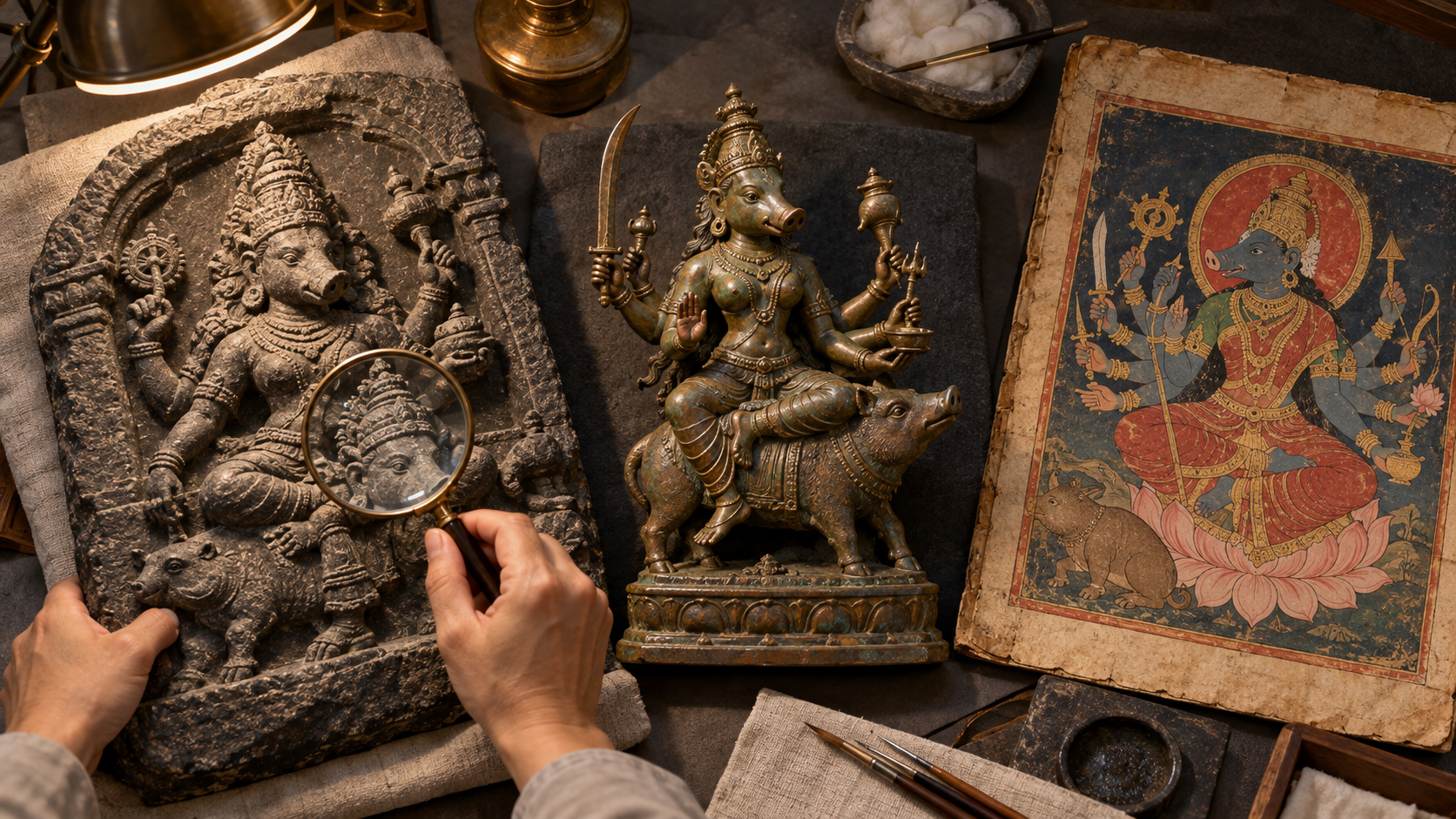
If you are standing before a murti, studying a photograph or trying to catalogue an image, begin with observation rather than a ready-made symbolic glossary. Use the following sequence.
- Record the supplied identity. Note the name used by the temple, custodian, inscription, catalogue or lineage. Preserve that wording even if an online image search offers a different label.
- Confirm the Varahi marker. Look first for the recognizably boar-like face. Damage, stylization or an oblique photograph may make this less obvious, so do not pretend certainty when the defining feature is unclear.
- Inventory what is actually visible. List the posture, number of arms, objects held, gestures, ornaments, attendants, vehicle and surrounding figures only when you can see them. Write “unclear” where the image does not support a confident identification.
- Look for a command relationship. Ask whether the full composition communicates authority, organization, readiness or leadership. A single weapon establishes a martial note; it does not by itself establish the specific identity of a commander.
- Separate observation from interpretation. “The right hand holds an object” is an observation. Naming the object is an identification. Claiming that it represents a particular spiritual faculty is an interpretation. Keeping those levels separate prevents guesses from turning into facts.
- Check the living context. Where a temple, sampradaya or regional tradition supplies a specific identification, let that situated knowledge outrank a generic caption. Variations do not automatically mean that one community has made a mistake.
This method also protects you from a common iconographic error: identifying a deity through one conspicuous attribute while ignoring the rest of the composition. Objects may be worn, damaged, replaced or difficult to distinguish. A coherent cluster of evidence is stronger than one dramatic detail.
Use precise language when certainty is limited. “This appears to be a martial form of Varahi” is more responsible than declaring “This is Dandini Varahi” when neither the original label nor the commanding context is known. Careful uncertainty is not a failure of devotion. It is respect for the specificity of the form.
Turn the command symbolism toward self-command
Dandini Varahi becomes spiritually useful when you stop treating her martial form as spectacle. The immediate question is not which enemy you want divine force to defeat. It is whether your own powers are ordered well enough to serve dharma.
Begin with one area in which energy exists but command is missing. You may have knowledge without steady practice, indignation without truthful speech, courage without restraint or devotion without regularity. Name the disorder plainly. Then identify the duty that should govern it and the next concrete action that brings the two into alignment.
Three questions can guide that contemplation:
- Which part of my conduct is energetic but undisciplined?
- What dharmic responsibility should direct that energy?
- What action would demonstrate command rather than impulse?
This is a demanding reading of the warrior form because it does not allow fierceness to excuse loss of control. If your speech becomes cruel, your attention remains scattered or your conduct serves pride, intensity alone has not become disciplined power. The commander’s image asks whether purpose is governing strength.
Iconographic study must also be kept distinct from initiated practice. Learning to recognize a form does not confer authority to improvise its mantras, ritual sequences or esoteric disciplines. Do not construct a practice from disconnected captions or fragments found online. Where a lineage treats Dandini Varahi through initiation, follow its competent guidance. You can still approach the image respectfully, contemplate its visible meaning and allow its symbolism to sharpen your understanding of self-command.
Key takeaways
- Dandini Varahi joins two defining ideas: the boar-faced identity of Varahi and the authority of a divine commander.
- Her martial appearance is best read as disciplined, directed power rather than uncontrolled anger or violence.
- Do not identify the form from one weapon, gesture, colour or online caption. Read the complete iconographic cluster and its local context.
- Keep visible facts, object identifications and symbolic interpretations separate when studying an unfamiliar image.
- The command symbolism becomes practical when you use it to bring attention, speech, courage and action under dharmic purpose.
- Iconographic understanding is not a substitute for initiation into lineage-specific ritual practice.
The next time you stand before Dandini Varahi, resist the urge to decode every detail immediately. First see the boar-faced Devi. Then notice the bearing of command. Finally ask which power in your own life needs direction. That sequence turns an unfamiliar warrior image into a disciplined encounter with dharma.
References

Leave a Reply
You must be logged in to post a comment.