
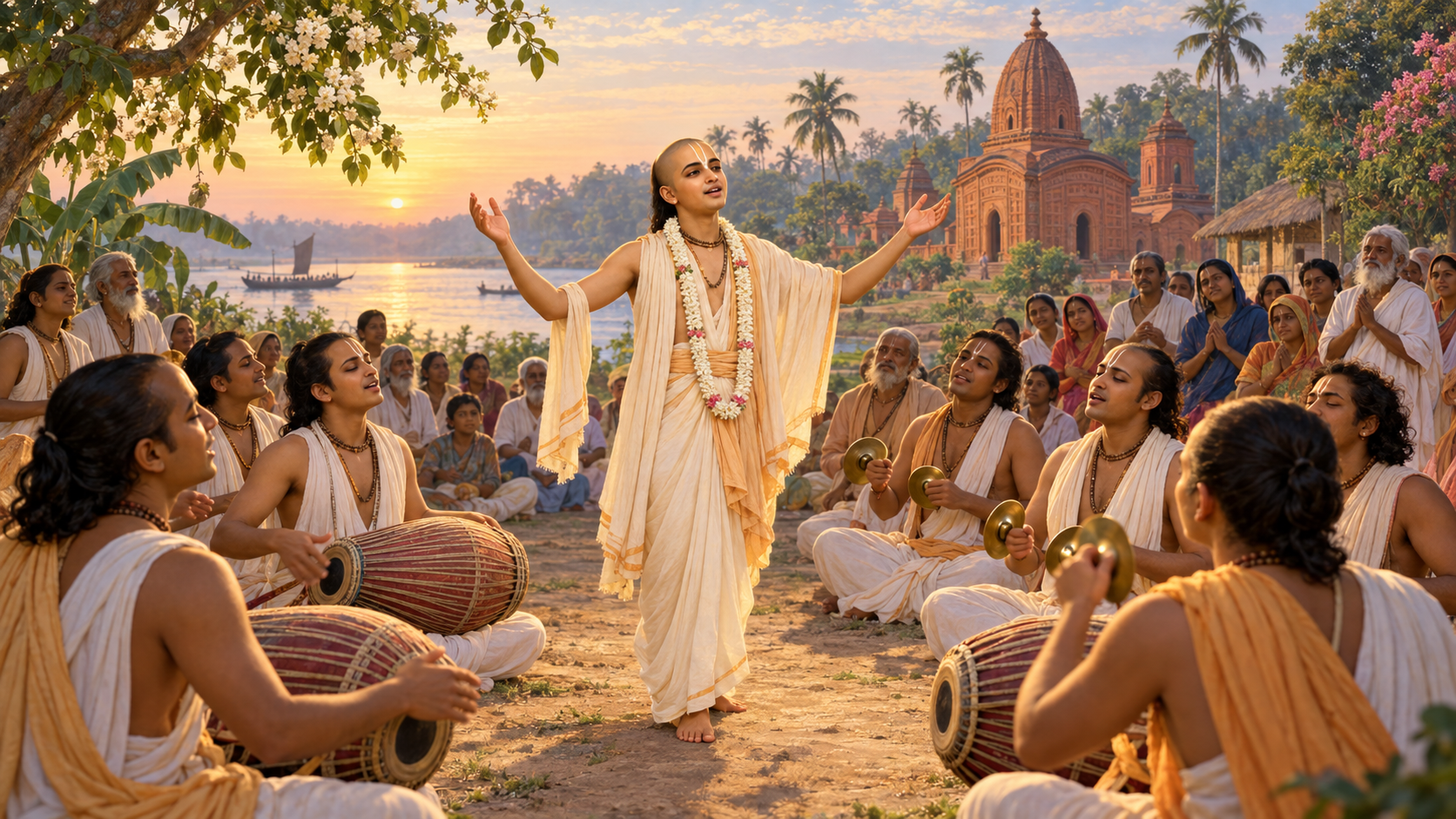
You may know Narottama Dasa Thakura through a bhajana sung in a temple, yet still wonder who he was and why his voice remains so central to Gaudiya Vaishnava life. The answer is not simply that he wrote beautiful songs. He joined disciplined learning, complete discipleship, sacred geography, community leadership and kirtana into one coherent life.
Follow that life in its proper order: he heard before he taught, served before he led, and learned the siddhanta before he carried it through song. That sequence will help you read his pastimes as practical instruction rather than as a collection of distant wonders.
Begin at Kheturi: privilege did not become possession
Narottama was born in the month of Magha to Raja Krishnananda Datta and Narayani Devi, in a prosperous royal household associated with Kheturi. His birth is surrounded by the auspicious signs customary in the sacred lives of great devotees: charity to brahmanas, unusual joy among the villagers and predictions that the child would become an exalted personality capable of benefiting many people. His name itself expressed that expectation: Narottama, the finest among human beings.
Gaudiya memory places him within Sri Caitanya Mahaprabhu’s mission even before his birth. During sankirtana, Caitanya is remembered turning toward Kheturi and repeatedly calling the name Narottama. Nityananda and the assembled devotees responded with inexplicable joy. The episode makes a theological claim about his life: his future service belonged to the unfolding work of Gaura, not merely to the ambitions of his family.
Even the child’s first grain ceremony carries that orientation. Narottama repeatedly turned away from the rice until it had been offered to Lord Vishnu and returned as prasada. The household thereafter became more attentive to offering his food to Krishna. Whether you approach the scene primarily as sacred history or as devotional symbolism, its instruction is precise: bhakti does not reserve a separate religious corner of life. It changes how the ordinary act of eating is understood.
Narottama’s ability soon became evident in school. He could retain a lesson after hearing it once and rapidly mastered Sanskrit grammar, poetry, rhetoric and scripture. Yet he did not reject learning because it was difficult; he questioned knowledge after becoming good at it. Whatever did not serve Hari-bhajana gradually lost its attraction for him. That distinction matters. His later songs could express profound siddhanta in accessible Bengali precisely because disciplined study had preceded their simplicity.
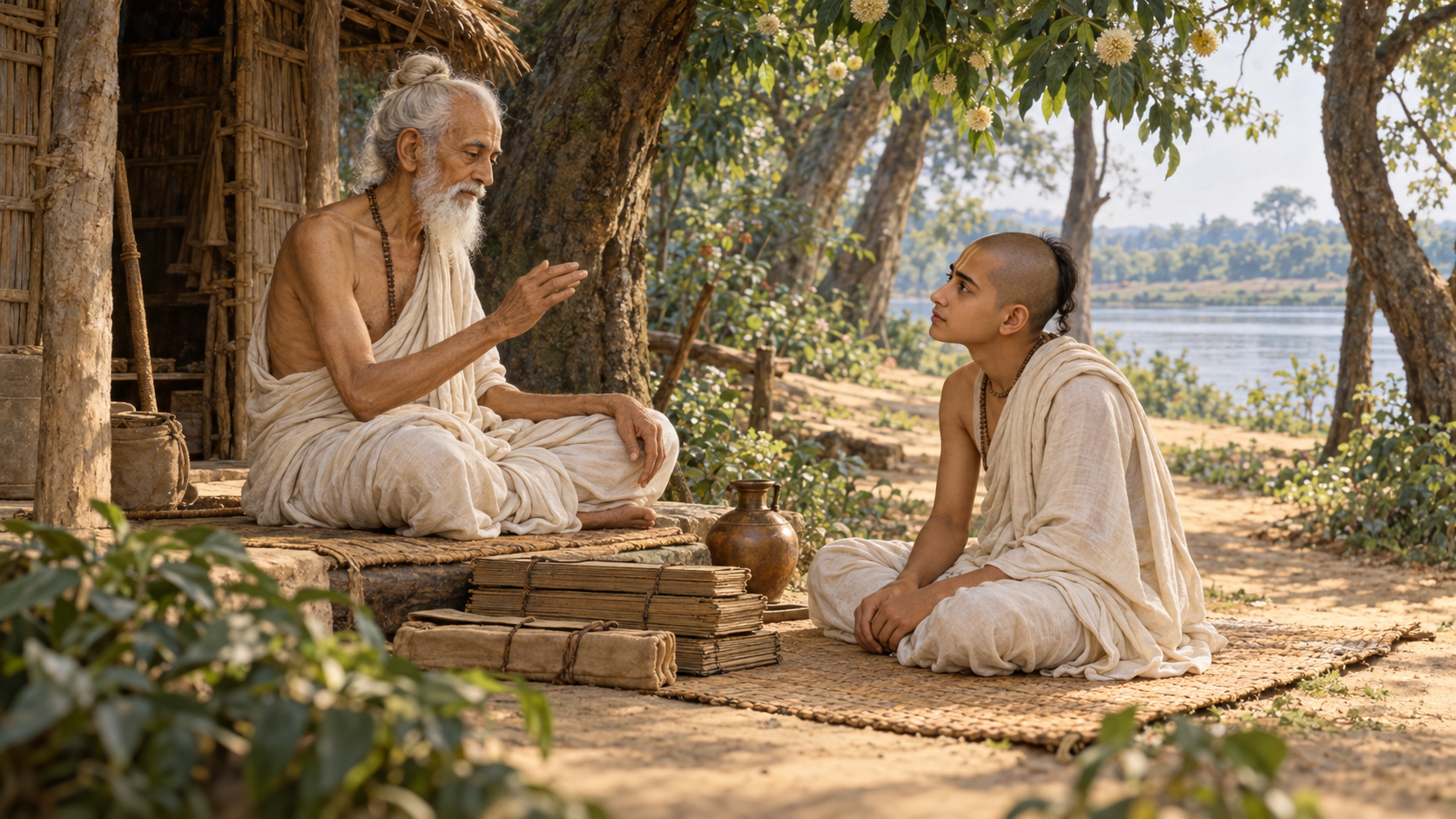
The decisive education also came through hearing from a devotee. An elderly brahmana named Krishnadasa visited him regularly and narrated the lives of Caitanya, Nityananda, Advaita and their associates. Narottama received him respectfully, asked questions and listened. Those recurring conversations gave personal shape to a spiritual world that had previously been distant. His longing was therefore not generated by novelty or impatience; it was cultivated through sustained Vaishnava-katha.
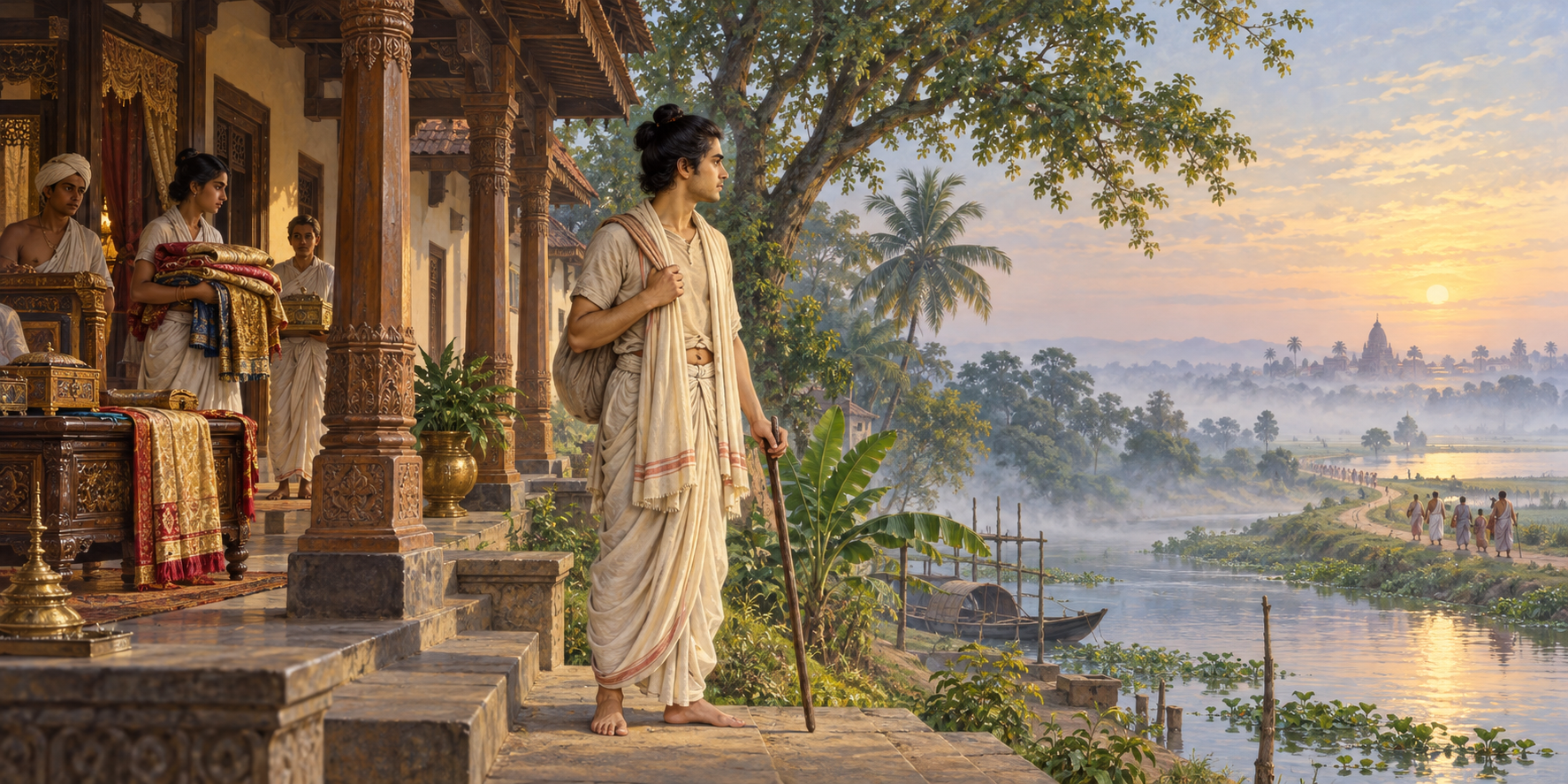
He began chanting the names of Gaura and Nityananda day and night, received a dream darshana of Gaurasundara and lost interest in royal pleasure. His parents saw the direction of his life and feared that he would leave. Guards were assigned to watch him. Their anxiety should not be caricatured: they saw a gifted son and royal heir withdrawing from the future they had prepared for him. Narottama, meanwhile, experienced the guarded household as confinement and prayed for a way to reach Vrindavana.
A devotee may receive the dreams, prophecies and divine signs in these pastimes literally. A historically minded reader can still recognize what they disclose within Gaudiya tradition: Narottama’s renunciation was understood as a response to grace, not as adolescent rebellion. In either reading, notice the preparation. Study, hearing, chanting and prayer came before departure.
Vrindavana: the royal heir accepts the discipline of a disciple
The opening came when Krishnananda and his brother Purushottama travelled to meet the ruler of Bengal. On the full-moon day of Kartika, Narottama quietly left his family and protectors and set out for Vrindavana. He sometimes lived on milk and sometimes on roots and fruit, while the hope of reaching Vraja carried him through hunger and fatigue. On the road he continued hearing the glories of Gaura and Nityananda, so the journey remained an act of remembrance rather than an escape into anonymity.
At Mathura he saw the Yamuna and wept while remembering Rupa, Sanatana and the other Goswamis. After entering Vrindavana, he approached Sri Jiva Goswami, who directed him to Lokanatha Goswami. This was a significant pairing. Lokanatha’s own life had been formed by Caitanya’s order to remain in Vraja despite the pain of separation, and his worship was centered on Sri Sri Radha-Vinoda. Narottama was therefore seeking shelter from a deeply renounced servant whose obedience had already been tested.
Narottama received diksha, or initiating shelter, from Lokanatha Goswami and siksha, sustained philosophical instruction, from Jiva Goswami. Keeping those relationships distinct helps you understand his formation. Initiation established his direct bond with his spiritual master; instruction under Jiva gave him rigorous grounding in Gaudiya philosophy. He did not treat personal devotion and careful theology as competing paths.
That combination corrects a common misreading of charismatic saints. Narottama did not emerge as an influential singer simply because he possessed emotion and a sweet voice. Before becoming a teacher, he accepted direction, service and study. Before gathering communities, he allowed a lineage to shape him. His later authority rested on submission rather than self-appointment.
He remained a lifelong brahmacari. That fact describes his particular vocation; it does not make celibacy a universal prescription for everyone who admires him. The lesson applicable across ashramas is more fundamental: decide what your life serves, then arrange learning, relationships and daily conduct around that center. Renunciation is meaningful when it frees service, not when it merely displays deprivation.
His return carried Vrindavana’s inheritance into living communities
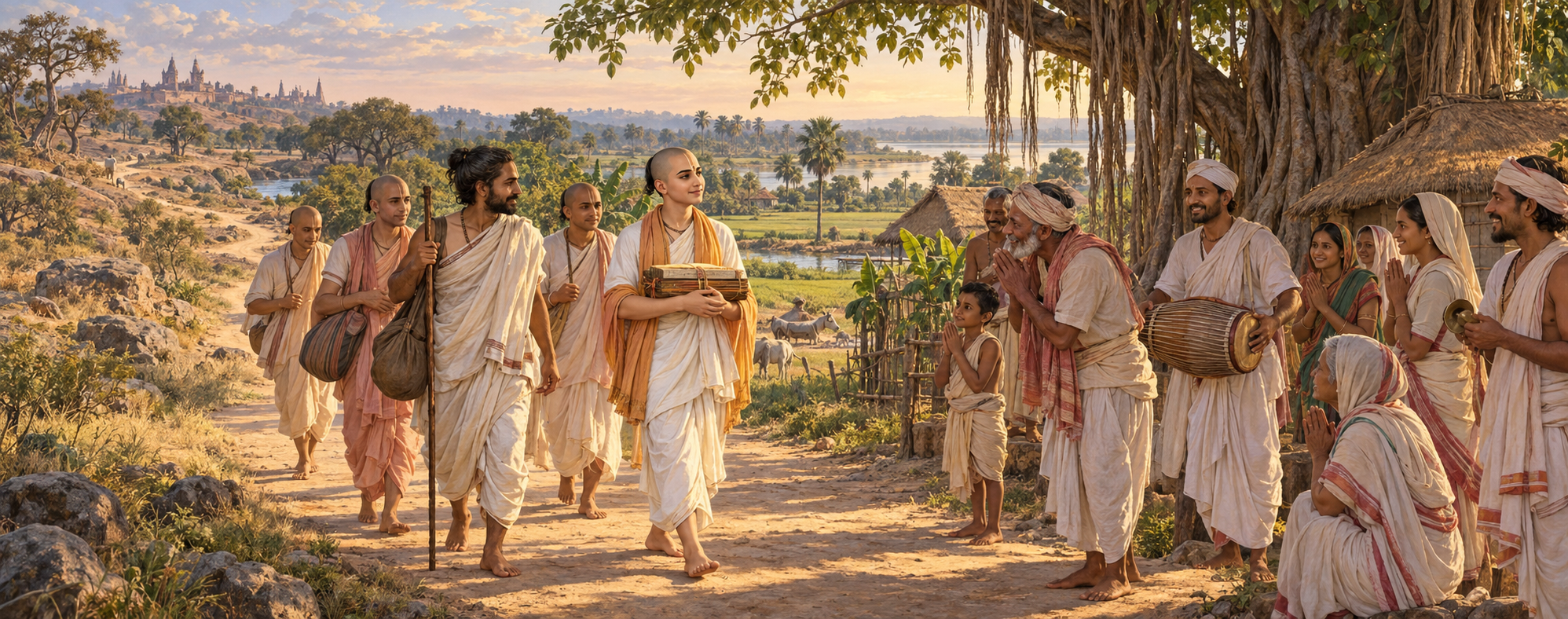
Narottama did not remain in Vrindavana as an isolated contemplative. When he reached Navadvipa, devotees immediately asked about the welfare and activities of the Goswamis. Their questions reveal a living network: Vraja and Bengal were separated by distance, but not by spiritual concern. Narottama could carry training, news and relationships between them.
He visited the places connected with Caitanya throughout Gaura-mandala, then travelled to Jagannatha Puri. His route also included Shantipura, Srikhanda, Kanthaka-nagara, Ekachakra and finally Kheturi. These were not stamps in a pilgrim’s collection. At each place he met devotees and encountered the remembered pastimes of Caitanya and his associates. The itinerary joined sacred place, inherited memory and present association.
You can use that geography as a reading key for Narottama’s songs. When a composition turns toward Radha and Krishna, listen for the devotional culture of Vraja. When it calls upon Gaura and Nitai, listen for the mercy and sankirtana of Navadvipa. When it bows to guru and the Vaishnavas, remember that these were not abstract categories for him; he had crossed regions to seek, serve and reunite their communities.
This movement between holy places also explains why his legacy cannot be reduced to private mysticism. His interior longing repeatedly became outward responsibility. The person who had once begged for the freedom to reach Vrindavana returned prepared to help others receive what he had learned there.
Kheturi Mahotsava turned devotion into a shared culture
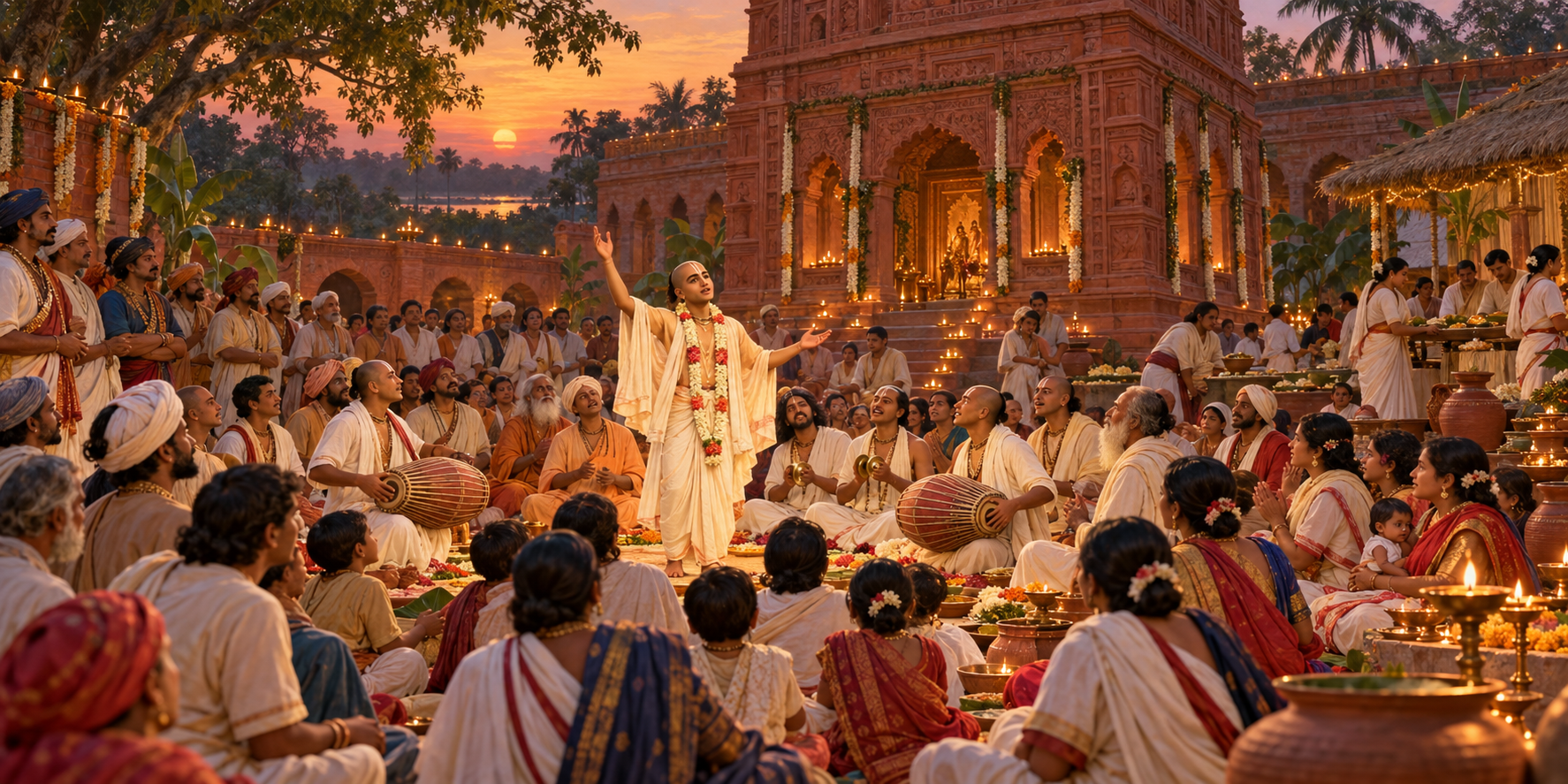
Narottama’s great public achievement was the Kheturi Mahotsava, remembered as the first Gaura-Purnima festival dedicated to Sri Caitanya Mahaprabhu’s appearance. Six Deities were installed during the celebration:
- Sri Gauranga Deva
- Sri Vallabhi Kanta
- Sri Vraja Mohana
- Sri Krishna
- Sri Radha Kanta
- Sri Radha Ramana
The installation names disclose the festival’s theological breadth. Gauranga was worshipped alongside forms of Krishna and Radha-Krishna. The celebration did not force devotees to choose between the mercy of Caitanya and the Vraja devotion he came to distribute.
Hundreds of Vaishnavas attended, including direct disciples of Caitanya, Nityananda and Advaita. Different interpretations had developed among Gaudiya communities, so gathering them was not merely a matter of arranging a large kirtana. Jahnava Devi came from Kardaha, presided over the assembled Vaishnavas and helped reconcile their diverse conclusions within a coherent Gaudiya framework. Narottama’s leadership made room for an authoritative senior Vaishnavi rather than treating unity as his personal possession.
The festival also brought together kirtana styles that praised Caitanya as well as Krishna and Krishna’s pastimes. Narottama’s singing moved the devotees to tears. In the sacred remembrance of the event, Caitanya and his associates became manifest within the sankirtana, and devotees perceived him according to their own relationships: some as the youthful Nimai of Navadvipa, some as the renounced sannyasi, and others in majestic reverence.
The practical lesson for a community is not to imitate the extraordinary vision or manufacture emotional spectacle. It is to notice how Kheturi built unity:
- Establish a shared center. Deity worship and remembrance of Caitanya gave the gathering a purpose larger than any faction.
- Let siddhanta guide fellowship. Differences were not ignored; respected leadership helped bring them into a consistent philosophical understanding.
- Make participation embodied. Installation, pilgrimage, darshana and congregational kirtana allowed philosophy to become a lived culture.
- Use music to carry meaning. The kirtana joined Gaura and Krishna devotion so that theological unity could be heard and practiced, not merely declared.
If you are organizing a temple festival, study circle or local satsanga, that pattern is still usable. Begin with the shared object of service, clarify the teaching with trusted elders, and choose practices that let everyone participate. Unity created only by avoiding difficult questions is fragile; unity expressed through siddhanta and shared seva can endure.
Let Narottama’s songs turn biography into practice
Narottama wrote about the spiritual master, the Vaishnavas, devotional service, the Six Goswamis, Gaura-Nityananda and Radha-Krishna. His best-known works are Prarthana and Prema-bhakti-chandrika. Their Bengali is direct and singable, but the simplicity is deliberate rather than shallow. The songs carry shastric conclusions in a form that enters memory through melody.
Radha and Krishna are my goal in life and death.
Narottama Dasa Thakura, Prema-bhakti-chandrika
That sentence is not decorative poetry. It names an organizing center for breath, worship, aspiration and identity. The surrounding prayer asks for Radha-Govinda’s service and for the divine couple to dance within the devotee’s mind. Narottama’s songs repeatedly turn theology into petition: he does not merely describe devotion from a distance; he teaches the singer what to desire.
A.C. Bhaktivedanta Swami Prabhupada regularly sang these bhajanas and quoted them while teaching the Bhagavatam, treating their siddhanta with scriptural seriousness. That later use helps explain why Narottama’s voice remains audible far beyond Bengal: the songs function as compact lessons in Gaudiya practice, not just as historical compositions.
Within Gaudiya understanding, Narottama eternally serves Srimati Radhika as Chamaka-manjari. His samadhi stands in the courtyard of the Radha-Gokulananda temple. The inner identity is a claim belonging to the tradition’s theology of eternal service, while the samadhi gives pilgrims a physical place of remembrance. Together they show how Gaudiya devotees locate him both in sacred history and in Krishna’s continuing lila.
To engage his songs without reducing them to either performance or sentiment, use a simple discipline:
- Choose one complete song. Begin with a composition from Prarthana or Prema-bhakti-chandrika rather than collecting isolated lines.
- Read the meaning before concentrating on the tune. Identify whom Narottama addresses and what relationship the song assumes.
- Mark the request. Look for the change he asks for: mercy, attachment to guru, service to the Vaishnavas, freedom from worldly absorption or devotion to Radha-Krishna.
- Notice the siddhanta inside the emotion. Ask what the song teaches about grace, qualification, dependence and the goal of bhakti.
- Carry one instruction into conduct. If the song bows to the Vaishnavas, practice respect. If it laments distraction, remove a real distraction from your next period of japa or kirtana. If it longs for service, accept a definite act of seva.
Key takeaways
- Narottama’s renunciation grew from learning, Vaishnava-katha, chanting and prayer; it was not a rejection of responsibility without preparation.
- His diksha from Lokanatha Goswami and siksha from Jiva Goswami joined personal surrender to philosophical discipline.
- His travels connected Vrindavana’s theology with the devotees and sacred places of Navadvipa, Puri and Bengal.
- Kheturi achieved unity through shared worship, respected leadership, clear siddhanta and participatory kirtana.
- His songs are best approached as instructions for desire and conduct, not merely as melodies to admire.
Start with one Narottama composition at your next period of bhajana. Read its meaning, sing or recite it attentively, and identify the single request you are prepared to act upon. That is where his life stops being a revered memory and begins shaping yours.
References
- Dandavats – Pastimes of Narottama Dasa Thakura
- Dandavats – Narottama Dasa Thakura
- Dandavats – Narottama Vilasa by Narahari Dasa
- Dandavats – Disappearance Day of Srila Narottam Das Thakura

Leave a Reply
You must be logged in to post a comment.