
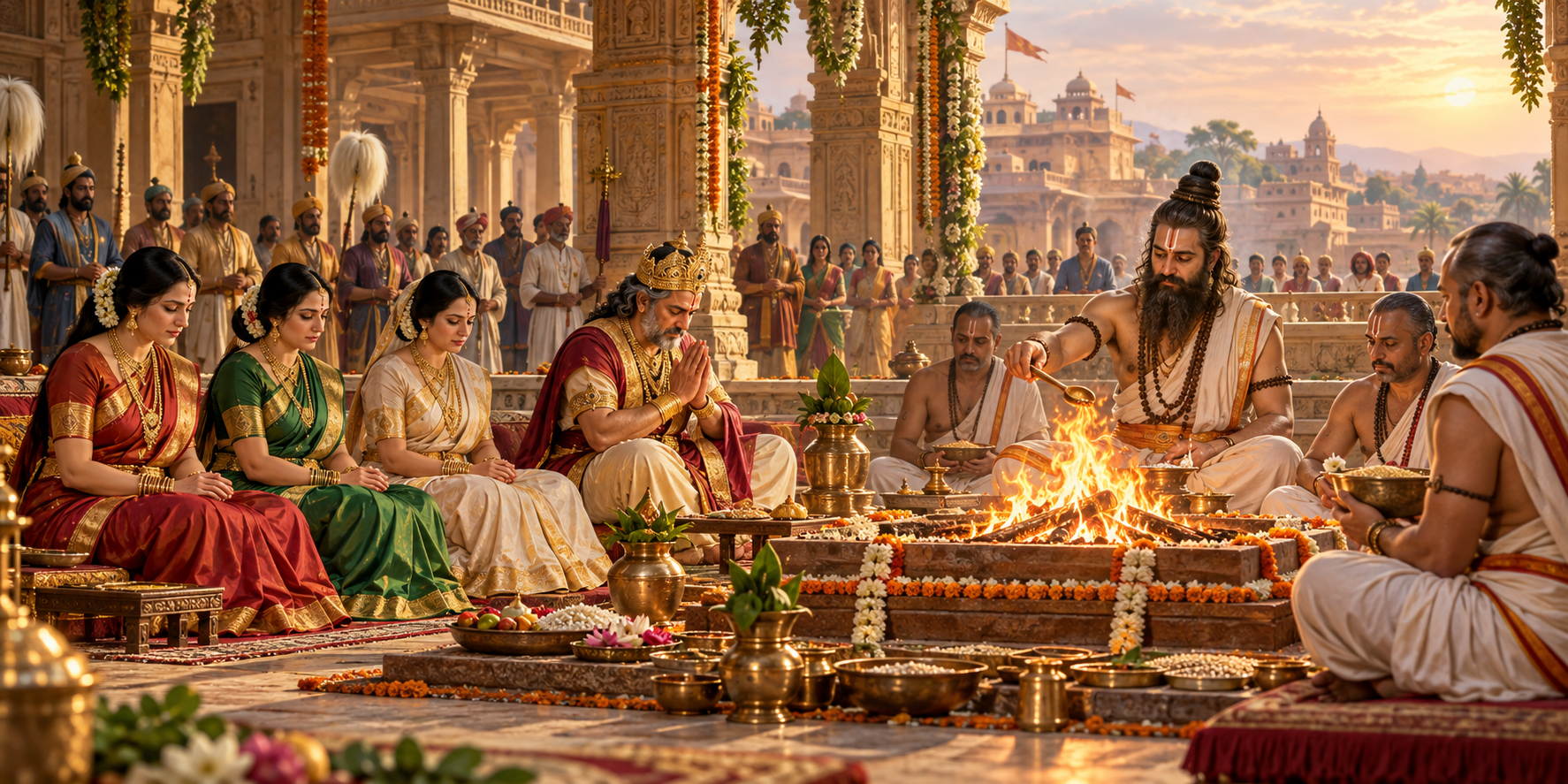
If you came to the Putrakameshti episode wondering whether it describes a ritual formula for obtaining a son, pay attention to the order of events. The Ramayana first presents a crisis of dharma: King Dasharatha possesses authority and virtue, yet he has no successor through whom the Ikshvaku line can continue.
That context changes the meaning of the yajna. It is neither an advertisement for instant wish fulfilment nor a declaration that human desire is unspiritual. It shows how a powerful desire can be acknowledged, examined, placed under wise guidance and offered within a sacred order that remains greater than the person asking.
What happens before the Putrakameshti Yajna
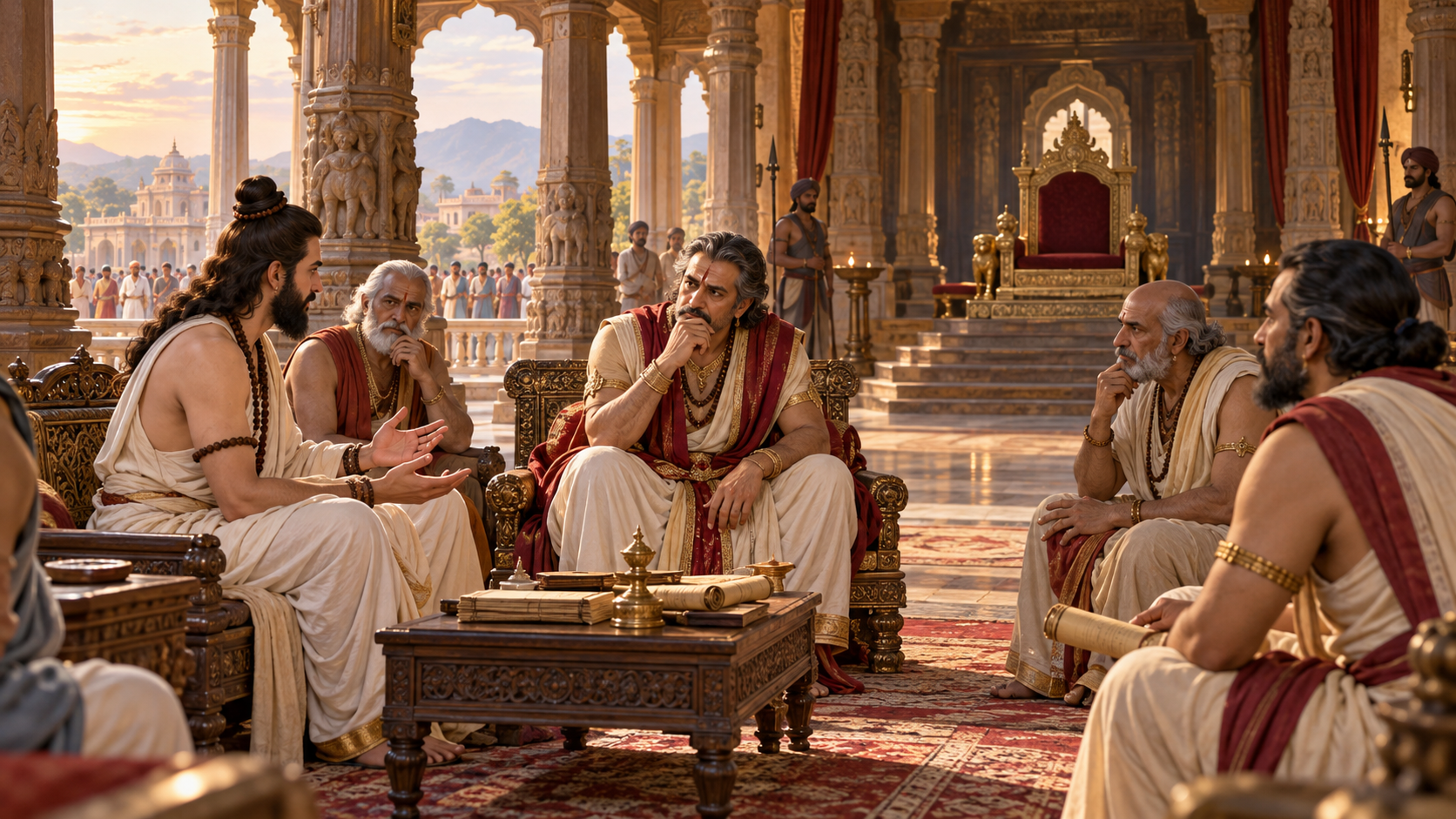
Dasharatha’s sorrow is not presented as evidence that he is wicked or spiritually deficient. He is a great and righteous ruler who nevertheless has no son. This matters because it prevents a crude reading in which every painful circumstance is treated as proof of personal failure.
His concern also has two dimensions. There is the intimate pain of a man who longs for a child, but there is also the public responsibility of a king whose dynasty needs continuity. If you reduce the episode to private longing, you miss its political and dharmic stakes. If you reduce it to royal succession, you erase the human sorrow that moves Dasharatha to act.
The response to that sorrow unfolds in a disciplined sequence:
- Dasharatha recognises that the absence of a son threatens the continuation of the Ikshvaku line.
- He does not invent a remedy on the strength of his royal authority.
- He receives counsel from the sage Vasishta and others.
- He undertakes the Putrakameshti, a yajna directed toward the desire for children.
- A great being appears from the sacrificial fire, showing that the result comes as a sacred response rather than as the king’s self-produced achievement.
The practical point is easy to overlook: Dasharatha acts, but he does not act alone. Kingship does not make him his own spiritual authority. His desire passes through counsel, discipline and yajna before the answer appears.
Why the yajna is not a mechanical transaction
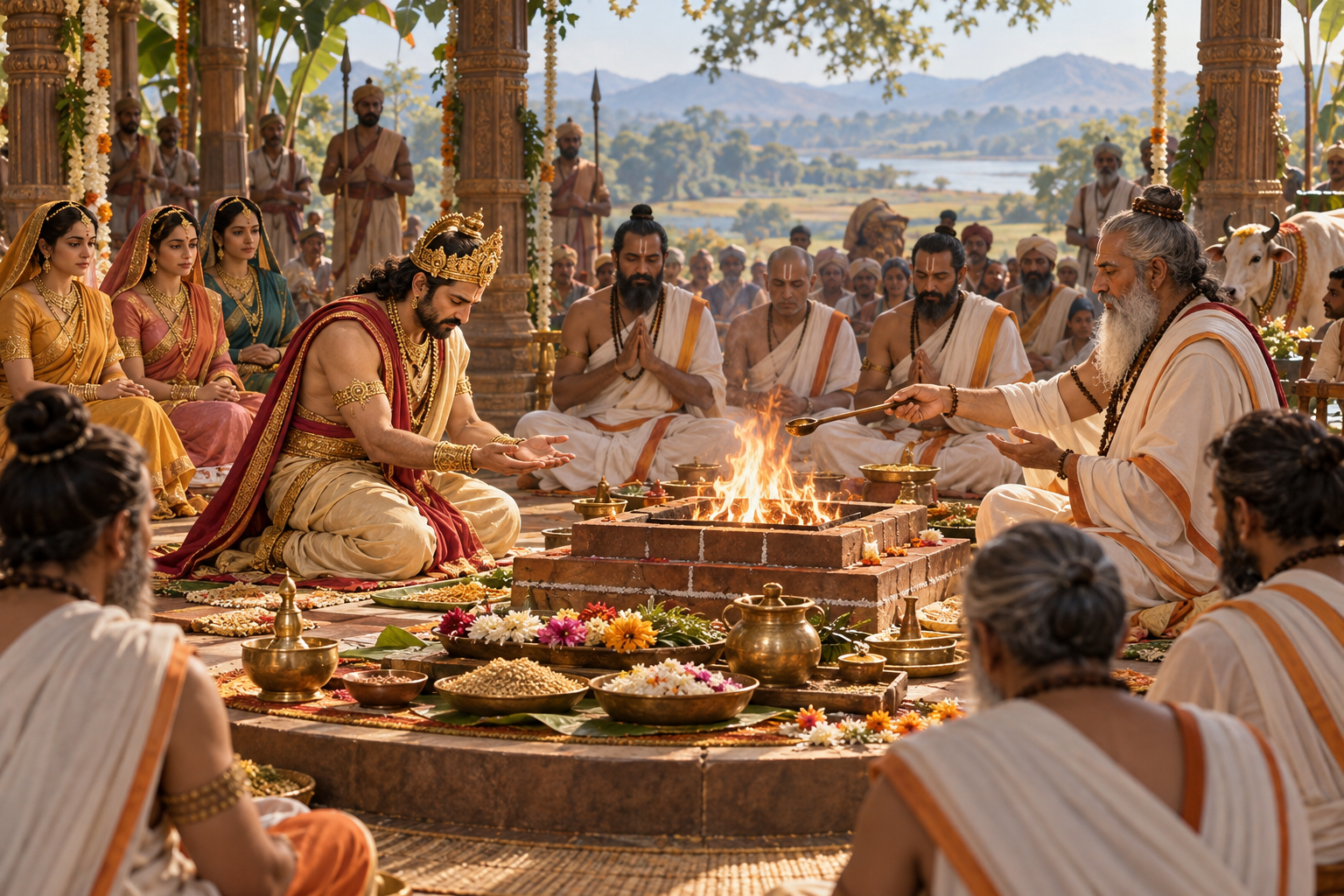
The name Putrakameshti identifies a rite connected with the desire for offspring. That specificity does not turn yajna into a machine in which an offering is inserted and a guaranteed result comes out. The Ramayana’s sequence contains several kinds of agency: Dasharatha longs and decides, sages guide, the rite orders his action, and the divine response arrives from beyond his command.
This is a useful distinction whenever you encounter a purpose-specific Hindu vrata, puja or yajna. A stated purpose tells you what the worshipper is seeking. It does not prove that the ritual compels Ishvara, overrides karma or creates an enforceable claim upon the sacred.
Yajna also changes the posture of desire. Dasharatha cannot simply cling to an outcome in private. He must bring his longing into a consecrated act, accept guidance and make an offering. Desire remains present, but it is placed within dharma. The episode therefore avoids two equal errors: pretending that a serious human longing does not exist, and treating that longing as sovereign.
You do not have to strip the event of its sacred reality in order to find meaning in it. Within the world of the Ramayana, the yajna is a real religious act and the fire-born being is a real response. The spiritual meaning arises through the event; it does not need to replace the event.
What the being from the sacrificial fire signifies
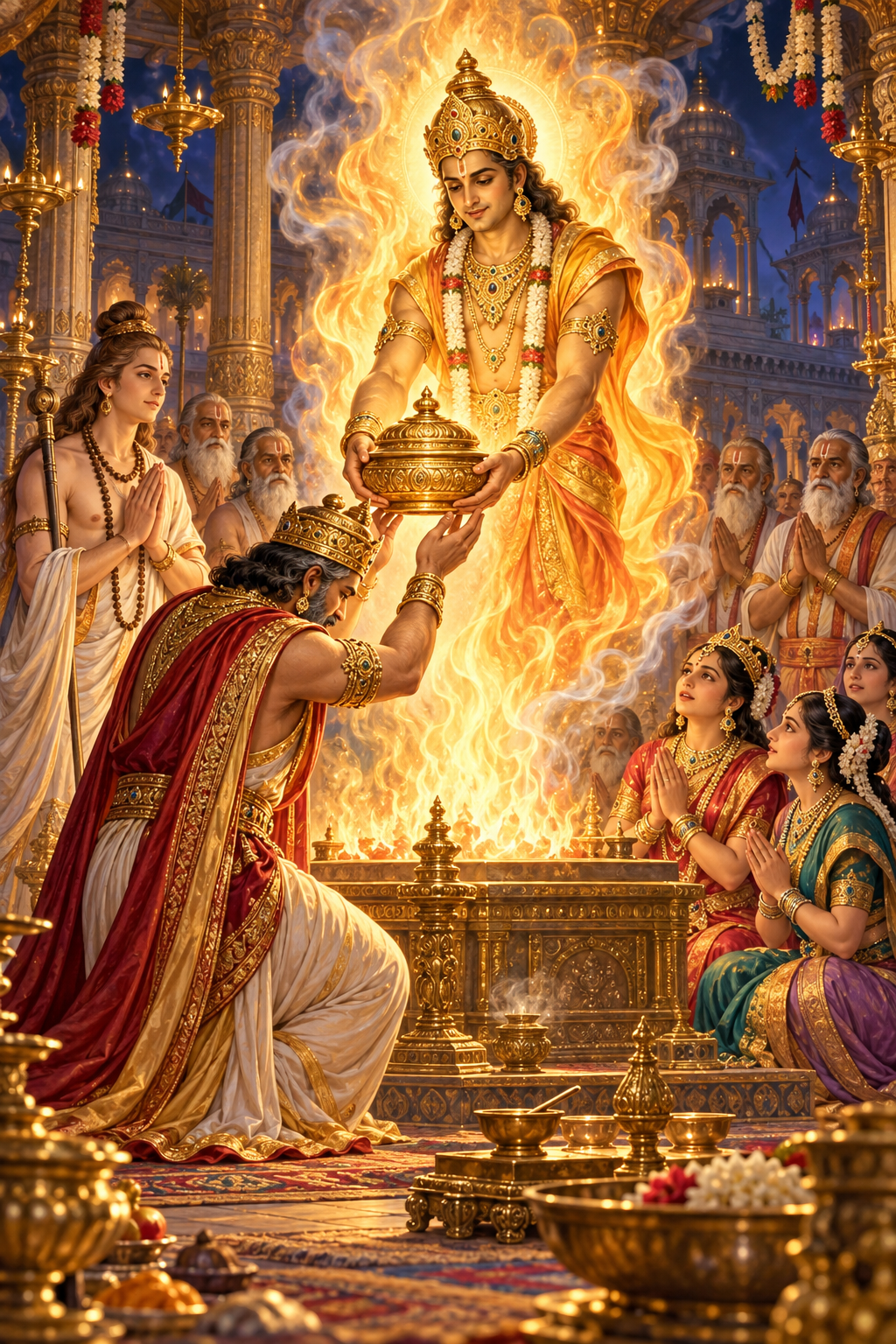
The appearance of a great being from the sacrificial fire is the turning point. Until then, the movement is human: sorrow, deliberation, counsel and ritual action. At the fire, the direction reverses. A response comes toward Dasharatha.
At least three meanings become visible in that moment.
- The king is not the ultimate cause. Dasharatha has done what is appropriate, but the answer is not portrayed as something manufactured by royal wealth or will.
- Grace becomes concrete. The response is not merely a reassuring thought in Dasharatha’s mind. The narrative gives it presence and form.
- Fire marks a meeting point. In yajna, offerings are carried into the sacred fire. Here, the answer itself emerges from that same centre, making reciprocity between the human and divine realms visible.
This is why the scene loses its force when treated only as fantasy or only as psychology. Its religious claim is that disciplined human action matters, but fulfilment is still received. The king participates in the answer without becoming its master.
Four common misreadings to avoid
Misreading 1: The episode guarantees a child after a ritual
A sacred narrative showing one divinely ordered event is not a universal guarantee of an identical result. The Ramayana does not present Dasharatha as someone casually copying a procedure. He acts in a particular dynastic crisis, under the counsel of sages, within the sacred world of the epic.
If you are considering a Putrakameshti today, ask a qualified acharya or purohita what the rite means in the tradition you follow, who is authorised to conduct it and what commitments it places upon the participants. An online checklist cannot supply lineage, competence or spiritual accountability.
Misreading 2: Ritual can replace fertility care
The episode belongs to sacred narrative, not clinical medicine. If your question arises from present-day infertility, recurrent pregnancy loss or another health concern, devotional practice may accompany your response, but it should not replace evaluation by an appropriate medical professional. Treating a yajna as a diagnostic test or medical intervention assigns it a role the episode does not establish.
Misreading 3: Any intense desire becomes dharmic when ritualised
Dasharatha’s longing is joined to responsibility for the Ikshvaku line, and his action is subjected to wise counsel. The lesson is not that religious form automatically sanctifies whatever someone wants. The lesson is that desire must be examined and ordered. Before turning a wish into a sankalpa, ask what duty it serves, whom its fulfilment would affect and whether you are willing to accept obligations along with the hoped-for blessing.
Misreading 4: A dynastic need for a son is a verdict on every family
The narrative’s immediate problem is explicitly the absence of a son who can continue a royal line. You should neither hide that feature nor turn it into a universal judgement against daughters, childless adults or families formed under very different social conditions. The setting explains Dasharatha’s particular concern; it does not authorise contempt toward people whose lives do not reproduce that setting.
Key takeaways for reading the episode responsibly
- Begin with Dasharatha’s actual predicament: personal sorrow is joined to the public duty of dynastic continuity.
- Notice that righteousness does not make a person immune to pain, uncertainty or an unfulfilled longing.
- Read Putrakameshti as desire brought under dharma, counsel and sacred discipline, not as a technique for controlling the divine.
- Treat the fire-born being as the sign that the decisive answer is received rather than manufactured by human power.
- For a contemporary ritual decision, seek qualified religious guidance; for a fertility concern, seek appropriate medical care as well.
- Do not convert a royal succession crisis into a universal measure of the worth of daughters, childless people or modern families.
When you return to the episode, follow the movement from longing to counsel, from counsel to offering, and from offering to grace. Then apply its discipline before its desired outcome: name what you seek, test it against dharma, accept trustworthy guidance and refuse to confuse sincere action with control over the result.
References

Leave a Reply
You must be logged in to post a comment.